Just Wrought

Recovering playwright, once won a STRANGER Genius Award for theater. Now writing a bloated novel about… G-d help me! Theatre.

Author: jefferyr

  • Maybe not in Seattle, but “Over There” They Care

    Maybe not in Seattle, but “Over There” They Care

    Ah, the ironies of being playwrights in Seattle: the local Big Houses and mainstream press largely ignore us, and yet the national theatre blogosphere monitors our commentary on unfolding events, especially the Intiman implosion, with the rapt glee of NASCAR fans watching a slow-motion 13 car pile up.

    And now, we’ve gone international, as the United Kingdom’s Guardian runs a blog post on our response to the Intiman Board’s somewhat bemusing announcement that they intend to ask the advice of artists on how to proceed.

  • Making “Nows” from Now Matters Too

    Making “Nows” from Now Matters Too

    Here’s another dirty secret for you: I am as essentially indifferent to theatre as the next 21st century adult.  I like it fine, but if you were to tell me I could never see another production of American Buffalo or Titus Andronicus, I’d find a way to somehow suck it up.  And even though I spent a good part of my youth as an actor, and managed to pay for what little college I got with a performance scholarship; and even though I still really enjoy doing it, if you were to tell me that I had some strange incurable disease, basically benign but which would strike me dead if I ever again strutted and fretted, I’d still somehow find a way to live the rest of my natural days in non-thespian peace.  But I experienced something Sunday that reminded me yet again that there is one aspect of theatre I cannot and will not give up.  So if you tried to tell me I couldn’t write another play for live performance, and I thought you meant it– well, you and I would have a bit of a war on our hands.

    My wife and my boys, ages nine and six, decided late Sunday afternoon to attend the opening performance of Balagan’s Theatre’s 2011 summer outdoor offering, King Arthur and the Knights of the Playground.  It was a perfect Seattle summer day, a rare enough jewel of deep greens and blues.  About a hundred and fifty of us, maybe more, gathered on the rich lawn behind the Asian Art Museum in Volunteer Park beneath some of the most glorious old trees you could ever hope to see.  There were friends, and friends of friends, and friends and family of cast members and crew, and just plain lovers of theatre, young and old; and we all watched some truly sublime goofiness with a wide open heart at its core. I wrote the section—one of five— called “The Ballad of Balin and Balan”, and based my interpretation of these two tragically fated brother-knights on the relationship of my own two sons.  Sitting there on a blanket with my mostly oblivious models, my heart was in my throat from the beginning of the piece, and I was embarrassed to have to wipe my eyes at the corny final scene:

    [They both fall to the ground, gasping.]

    BALAN:  You know what this means?

    BALIN:  We’re gonna die.

    BALAN:  Well, yeah, but something else.

    BALIN:  Yeah?  What?

    BALAN:  The curse said you would kill your best friend.

    BALIN:  Yeah.  So what?

    BALAN:  So that means I’m your best friend.  Curses can’t lie.

    BALIN:   Hey, yeah, that’s right.  And I’m your best friend.

    BALAN:  That’s right.

    BALIN:  Forever.

    It didn’t bother me one bit that my sons were more interested in the toy light sabers wielded by the actors than the fact that I had used their sweet, easy devotion to each other as my inspiration.  I’m pretty sure that if the real Richard III had a chance to see a modern Seattle production of Shakespeare’s play about him, he would be way more fascinated in the costumes, props and actual women on stage than in any resemblance to the biographical facts of his life.  (This is, by the way, another glorious feature of theatre.  We all see something deeply different.)  What blew me away was my own awareness of a profound and magical moment, wherein the very beauty of the earth seemed to host this collection of stories, as sweet and true and fresh as life itself; that my boys were watching grown men attempting to match the matchless nobility of love that children can hold for one another.  And I was part of it.  A very small, perfectly happy part of it.  And because my job was done, all I had to do was breathe and gratefully accept the moment knowing that I can have no idea what experiencing the moment might mean down the road for either of my boys, but suspecting there’s a good chance that it might mean something.

    Making plays matters.  Alas, I still have immense difficulty convincing many of my colleagues of this truth.  There’s a director in Seattle whose work I consistently admire who has maintained publicly more than once that he doesn’t believe we need any more new works for the stage because we will never have enough time or resources to produce all of the great plays that have already been written.  Many powerful decision makers in American Theatre agree, most implicitly, but some even explicitly, that the canon of theatrical literature is full: like the Bible, we cannot, should not, and even must not, add volumes to it.  I shake my head and smile at this notion, so apparently provable in the abstract, and yet so falsifiable by one deep blue green gorgeous Sunday afternoon in 
    Seattle’s Volunteer Park.

    Balan-Declan and Balin-Keelan

    Please forgive the geek metaphor, but if plays are algorithms—timeless software to be run on a particular time’s theatrical hardware (i.e. actors, sets, costumes, props, lighting and sound designs and, yes, even directorial concepts), then I want some of those future algorithms to be from my time.  Put more simply, if plays are “nows” thrown forward into “then”, then I need to believe that some of those “then-nows” will be from this now, if only so my sons’ daughters might know something of how wonderful their fathers were to each other when they were boys.

  • Intiman Asks Artists for Ideas: Sure Sign of the Apocalypse

    Even if I do say so myself, I have been very good about shutting up and keeping shut since promising to do so a few weeks ago.  However, when I ran across Misha Berson’s Seattle Times article “Intiman Interviewing Artists about Company Revival” I simply could not stifle my eagerness to hear what my colleagues in the Seattle theatre scene had to say.  So I posted a link on Face Book and sat back waiting for friends’ responses.  I didn’t have to wait long:

    Stephen McCandless Spend less than you take in. Lather. Repeat.

    Rik Deskin I want this to work out for them, but I’m a little miffed that they have disregarded my offer to honor Intiman subscriptions at Eclectic Theater Company. The offer was made before they posted the companies currently listed. Oversight? Probably.

    Keri Healey It makes me furious that the timeline for this research into the future artistic direction of the theater is framed by the board (at least in this article) as important “if we want to start approaching funders.” Right back to the old dependent-on-funders model that got them where they are. Why not rethink that construct, too, as they look at alternatives for operating models? What I wonder about is how the implosions at Intiman and Giant Magnet might change the way local funders look at all arts organizations in the coming years. I suspect the level of trust funders have with arts organizations dropped quite a bit recently.Jim Jewell Keri, you are without doubt right on. We need to develop a different stance, more proactive and self-sufficient and more engaged with the audience, if we are going to win back that trust.

    Kasia Patora To be honest, my initial response was the same as to when Hulu asks me to “choose my ad experience”: free market research.

    Rik Deskin I really believe that Intiman needs to throw out the old book of running a theater and start from scratch, taking insight from ACT, … Jim Jewell and like Stephen McCandless says: don’t spend more than you make. Also, like ACT’s current model, embrace the wealth of local smaller companies, local theatre artists, and most importanly, embrace your goal of making Seattle a World Class Theatre City, cultivating, investing and developing Seattle’s voice. Not New York. Not Chicago. Not Moscow. Seattle!

    At this point, Culturebot editor Jeremy M. Barker asks if I’d seen what Isaac Butler had written on his blog Parabasis.  The post was so brief I don’t mind quoting it in its entirety here:  “Intiman is inviting local theatre artists to submit blueprints for reviving the company. My guess is Paul Mullin wasn’t invited.

    Isaac’s right.  Intiman hasn’t invited me, nor are they likely to.  One can hardly blame an institution for not extending a solicitation of ideas for its survival from someone who publically called for its swift and merciful death; but a larger question remains:  just who are the artists who Intiman plans on polling?  And why wouldn’t a discussion of this nature take place publically?  (Intiman board chair Bruce Bradburn told Misha that “…throughout July there will be individual discussions with artists about their visions for the company’s future.”)

    Comments kept rolling in:

    Scot Augustson I find myself more interest in elves than in Intiman’s Future. (And easier to believe in.)

    Michael Baker The only way this works is if the artists kidnap the Board à la 9 to 5 and hold them for ransom, while livestreaming it on the web. Also, there should be Dolly covers by Rudinoff.

    Mike Rainey I had the impression that the board was more or less the underlying cause for the problems in the first place. It’s like a fart asking how we can make this place smell better.

    Jeremy M. Barker HA!

    Stephen McCandless I maintain that the Intiman doesn’t need “new ideas”. The management was totally incompetent. To shut down in the fashion they did sternly suggests that their operating principle was “How can we be broke, we still have checks.”

    Jim Jewell BTW, plans are quickly coming together for convening a community discussion (not so much about Intiman) about what we are doing well, poorly and what we need to do next. A strictly no-bullshit affair that is going to launch new projects, not float suggestions. Keep an eye and ear out.

    Stephen McCandless (continuing) They went over budget, spent their reserves, spent their endowment – all over the course of several years. And when their MD leaves suddenly and suspiciously, only then do they cop to a problem – and even then have no idea how large it is until an outside consultant set them straight.  There [was] no one at the wheel. Nobody paying attention. No administration. You can’t just let go of the steering wheel and they claim you need “new ideas” about vehicle suspensions. YOU DON’T. YOU NEED A DRIVER.  Who authorized the spend-down of a one-million-dollar endowment and didn’t simultaneously raise concerns about the theatre’s finances? Who? It took years for this to go wrong. Years. And they act like it’s an emergency that reflects on the state of American Theatre. Talk about a sense of entitlement. I might as well try doing a cartwheel and then talk about how the resulting trauma reflects on the state of American Gymnastics and our chances for gold at the next Olympics.

    Michael Baker I’ve been an Intiman booster for years, but I can’t fathom this. It actually strikes me as insane–if this “Intiman” (who is that, exactly) were a person, you’d assume heroin addiction. Talking to artists? What about the Intiman subscribers and donors who rallied to support them, only to be told that a) Intiman needs to shut down anyway, and b) they’d spent subscription for next season on debts? How about explaining, in minute detail, exactly how this happened, first. I can only guess that hasn’t happened because of how clubby the board is. The subscribers should form a class action and take the Intiman back themselves.

    Paul Budraitis The article doesn’t say that they’re only going to consult with artists and no one else. i understand that financial mismanagement was the root of the problem and that it must be a primary component of their restructuring, but why shouldn’t they talk with local artists – ones who the article states have worked previously with the theatre – while in the process of getting back up off the mat? if they hadn’t done this, someone would be complaining about the fact that they haven’t even bothered to talk to local artists about the future. i say good for them for remembering art while all everyone else wants to do is talk about money.

    These are smart people, many of them deeply familiar with the challenges of making theatre both from an artistic and an administrative side.  Most of them take great pains to disagree with me as often and as vociferously as possible.  I don’t know who the Intiman plans on reaching out to for advice, but if their list doesn’t include at least one of the names chiming in above, then I gotta wonder whether the sounding board they say they seek isn’t really just another echo chamber.  I will also be interested to see if Misha Berson and The Seattle Times do any critical follow up on Intiman’s stated plans to include artists’ advice.  Given their track record, very little of what the Intiman’s board says should be taken at face value. 

    P.S.  Everyone quoted above has indicated to me that they are okay with being quoted.  If by some chance I am mistaken about that, please just let me know and I will remove your quote.  Conversely, if you want to add to discussion, please feel free to comment below.

  • This is Why I am Shutting Up

    This is Why I am Shutting Up

    I kicked off 2011 here at Just Wrought with an essay called “Demons’ Year Off” in which I promised to reduce my ranting and “listen more than talk going forward”.  In a more recent piece, “Joining Averroës’ Search” I renewed my commitment to keeping quiet so that others, ideally smarter, more informed and better positioned to effect change might join the discussion.  (Admittedly, this is a bit of a quixotic gambit, given how mum most of Seattle’s artistic administrators have kept during this crisis.) Today, with his post over at the Seattlest “Open Letter to the Intiman Board”, Jim Jewell has reaffirmed my faith in the ability of smart arts professionals in this town to lead the way out of this crisis, and maybe even show the nation how it is done.

    “… For all of the difficulties facing Intiman, you have also been presented a unique opportunity. While every other theatre in town, and really in the country, tries to figure out how to make difficult transitions, shifting the earned/contributed income balance and trying to break from the failing subscription model, you have a blank slate…. This is not the time to try to fix a broken model, but to take the pieces you have and build something new. It isn’t enough to be stewards; a steward could easily work in hospice. We need you to be shepherds, to lead, and to be willing to follow, the rich flock of artistic talent in Seattle.”

    Jewell goes on to offer suggestions both bold and innovative, but neither impossible nor even all that risky, compared to the very real risk that Intiman’s board will do nothing significant at all.

    He rightly points out that the subscription/season model is a tumor that sucks the vitality out of arts institutions across the country, and he offers a sober workable alternative tempered by his experience as the former Marketing and PR Manager at Seattle Children’s Theatre, the founder and de facto leader of the marketing discussion group Holes Not Drills, and as Managing Director of NewsWrights United.

    For better or worse, whether in self-congratulation or deprecation, I can’t help but think of myself as Sam Adams in Seattle’s struggle to become a world class theatre town.  As folks are happy to point out, I have a knack for starting loud and unruly conversations; but Sam Adams, drunken loud-mouthed Tea Party-thrower that he was, was never well positioned to lead the colonies anywhere except into ever rowdier arguments.  In the end, he had to turn the struggle over to his betters and let them lead the cause. If I’m Sam Adams, then Jim Jewell is my cousin John: smarter, better informed, and better positioned to effect the change we need.

    Jim, the floor is yours.  Let facts be submitted to a candid world.

    John Adams

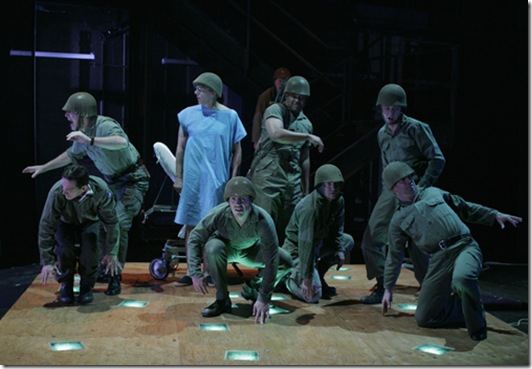
  • The Dream of the Black Soldier

    The Dream of the Black Soldier

    It is hard for me to imagine some future day when that day 67 years past will cease to captivate  human imagination.

    To all of the human beings whose fates were altered that day; in other words, to all of us: wherever we go, whatever we do, let us go and do it seeking peace, with the understanding that sometimes the world must be wrested back from those who would hold it in ignorance and malice.

      (…Louis opens his eyes and smiles at the audience, raising his arms out of the ice troughs like a prophet.)

    SLOTIN:  The time is come.

    DREAMER A:  It’s June the 6th, 1944.

    DREAMER B:  I’m in an amphibious landing craft headed straight for Omaha Beach.

    DREAMER A:  Normandy.

    SLOTIN:  Time is come. 

    DREAMER A:  As I look around at the other soldiers puking up their last rations–

    DREAMER B:  As the LC bounces across the channel’s heavy chop.

    SLOTIN: I realize a strange thing.

    BLACK SOLDIER:  I am a black man.

    SLOTIN:  I have always been black.

    DREAMER A:  From Arkansas maybe, or the Carolinas.

    DREAMER B:  I am the only Negro on this boat.

    BLACK SOLDIER:  Hell, I’m the only Negro in this entire invasion.

    DREAMER A:  And even with the shells lofting columns of sea and spray all around us. 

    DREAMER B:  And even with the shore looming closer and closer, and the thrill and terror pumping so thick I can taste it.

    DREAMER A:  I have to laugh.

    SLOTIN:  Because I realize there’s been some mistake:

    BLACK SOLDIER: This ain’t my war.

    DREAMER A:  The boat hits the beach. 

    DREAMER B: We can hear the bullets clanging on the other side of the steel landing ramp.

    DREAMER A:  And then down it drops.

    DREAMER B:  And we can see machine gun fire churning the water in front of us to a wall of froth.

    BLACK SOLDIER:  Ain’t nobody stepping into that.  But when I turn round, the Navy skipper’s pointing his sidearm Colt at us.  So what do we do but go?  White boys falling all around me.  Some cut to pieces by the guns, some just drowning under their gear.  But I move forward.  Kraut bullets just won’t hit me.  Ain’t my war.
          I got me a Browning automatic rifle and I start pumping her good into anything that moves up on them cliffs.  And then I’m up the cliffs.  I leave all them white boys behind dying and such down on the beach.  Ain’t got time for that.  Ain’t my war.  Every lousy Kraut blue-eyed bastard I find, I just jerk back on my B.A.R. and pump some lead in his face.
          “Damn, Fritz.  Sorry now, ain’t ya?  Should a thought a that sooner, hunh?  Now get down in hell where you belong.

    DREAMER A: And then I’m running.

    DREAMER B:  Running ahead.

    BLACK SOLDIER:  I ain’t got time for this.  This ain’t my war.

    SLOTIN:  I run past Paris.

    BLACK SOLDIER:  Sorry, Ladies.  Much as I’d like, ain’t no time for that now.

    DREAMER A:  I run forward.

    SLOTIN:  Past the Maginot line.

    DREAMER B:  Into Germany.

    BLACK SOLDIER: And I kill Krauts when I see ’em, but ain’t wasting no time neither.

    DREAMER A:  I’m running.

    DREAMER B:  Past Berlin.

    SLOTIN:  Past Hitler.

    BLACK SOLDIER:  Ain’t got time for that lousy little shit-ass now.  Let ’em eat his own lead.

    DREAMER A:  I’m running.

    DREAMER B:  I’m into Poland now.

    DREAMER A:  And then I’m there.

    SLOTIN:  Auschwitz.

    BLACK SOLDIER:  And damned if it don’t look just like “Gone With The Wind”.  Big ol’ plantation with big ol’ pearly white columns.  And who you think’s sitting up on that porch, just a-sipping on a julep but the Doctor himself.

    SLOTIN:  Mengele.

    DREAMER A:  Kill him.

    DREAMER B:  Kill him now.

    BLACK SOLDIER:  Yeah.  Now we got somebody worth killing.  I stroll on up them front steps drop my BAR from my shoulder and get set to shoot, only the gun ain’t a gun.  Just a damned stick.

    DREAMER A:  A yardstick.

    DREAMER B:  A slide rule the size of a yardstick.

    DREAMER A:  It’s hard to say.

    DREAMER B:  It’s all pretty hard to say.

    SLOTIN:  At any rate, Mengele smiles.  He gets up, and from his vest pocket draws a very small knife.

    DREAMER A:  A scalpel–

    BLACK SOLDIER: And cuts me open.

    SLOTIN:  To find the foolish Canadian Jew inside.

    BLACK SOLDIER & SLOTIN (together):  Louis.

    BLACK SOLDIER:  And right then and there it dawns on me–

    DREAMER A & DREAMER B (together):  We got trouble.

    (Blackout.)

    BLACK SOLDIER & SLOTIN (in darkness):  Louis… we need to talk, Louis.

    From Louis Slotin Sonata

  • The SunBreak Suggests Some New Strokes

    Just because I have excused myself from the debate about the future of Seattle Theatre along with the broader crisis in American Arts doesn’t mean I can’t celebrate an insightful perspective, especially when it comes from someone who sees the problem from sides I can only barely glimpse.  Michael van Baker, Editor and Publisher of The SunBreak once worked for the Seattle Opera and other non-profit arts organizations around town; and in his recent post, “Arts Marketing for Dummies”.  He sneaks us a peak of some of the lessons he learned, with promises of perhaps more and deeper observations to follow:

    Because self-preservation is the defining aspect of arts institutional life–ironically, the non-profit model virtually guarantees it–the business model warps in that direction. People begin to have trouble distinguishing between best business practices and those that have worked in the past to pay everyone’s salaries. Over time, the institution’s existence–its habits and proclivities–mediates the art presented. It’s not just a question of the popularity of one work versus another–it’s a question of box office receipts. That’s what’s being discussed when the directors meet: saleability.

    It should be discussed! Don’t get me wrong. But, as before, is anything important being left out?

    Van Baker sketches some bold fresh solutions, but with the sober understanding that they are not likely to be quickly adopted by a cadre of arts administrators who would rather sink with the ship than swim a new stroke.

    Rule: We create art and outsource/outshare the rest….

    …  As it happens, arts administrators are not the soulless quasi-corporate drones they are at times portrayed to be. So it’s already the case that most arts organizations collaborate and share a great deal, more than you might expect if you considered how competitive the marketplace is. The problem is, they collaborate inefficiently. … Every single organization reinvents the database, usually in their own way, and the results are sometimes anarchic.

    The situation is unlikely to change because, at an institutional level, there’s no apparent incentive and the loss of control disturbs leadership. Thus, database management and mining remains a core function of organizations theoretically devoted to art production.

    Van Baker also recognizes a fact which took over a year of me blogging here to sink into my thick skull:  a lot of folks, in this city particularly, would rather quibble and bitch behind backs than make any actual moves.  Says Van Baker, “Of course, the arts being what they are, there are many over-educated people willing to argue about minutiae rather than broader principle.”

    Towards the end of the piece Van Baker hints that there might be a larger, more detailed opus forthcoming.  I encourage that effort and look forward to its fruition, especially since I’m shutting up.

  • Joining Averroës’ Search

    Joining Averroës’ Search

    One of my favorite stories by Jorge Luis Borges is “Averroës’ Search”.  It’s not a very good story— Borges himself admits as much in a rather tortured apology that he tacks on at the end—but it’s a story about theatre—at least in part—and since it’s one of the only times Borges, a favorite of mine, touches on the art form that I have sunk so much of myself into, the short piece has become special to me.  I can approximate how many times I have read it by counting the different colors of pencils I have used to mark it up: dark blue, light blue, purple, green.

    The story opens with the great Islamic annotator of Aristotle lamenting the frequent appearance in the Poetics of two words  that, to a devout Muslim of the 12th Century, seem to have no meaning at all: “tragedy” and “comedy”. 

    He had come across them years earlier in the third book of the Rhetoric; no one in all of Islam could guess as to their meaning….  Yet the two arcane words were everywhere in the text of the Poetics—it was impossible to avoid them.

    In the very next paragraph Averroës takes a break from his work and looks down from his balcony. 

    …  There below, in the narrow earthen courtyard, half-naked children were at play.  One of them standing on the shoulders of another, was clearly playing at being a muezzin: his eyes tightly closed, he was chanting the muezzin’s monotonous cry,  There is no God but Allah.  The boy standing motionless and holding him on his shoulders was the turret from which he sang; another kneeling, bowing low in the dirt, was the congregation of the faithful.  The game did not last long— they all wanted to be the muezzin, no one wanted to be the worshippers or the minaret.

    For me, this is Borges at his best and most loveable: a great thinker imagining a great thinker struggling to imagine a concept that, in fact, palpably surrounds him.  As many of my friends who like to argue with me point out, theatre will always survive.  You literally cannot not have theatre.  But as Borges might counter, you can certainly have it without knowing you have it.  Perhaps that’s where we are heading.  The great Argentine did foretell the internet after all.

    Recently, in a fit of frustration that so many people seemed to miss the point of my recent post about playwrights not making a living from their plays while plenty of folks make one making theatre, I recently wrote the following self-pitying status on Face Book. 

    I somehow need to find a way to harness the average Seattle theatre artist’s endless enthusiasm for arguing into an actual force for change.

    Yes, we’re all smart. We’re all well read. We all know how to attack a straw man and cleverly defend the indefensible, but at what point do we decide we can do better and then take steps to do it?

    It’s a cliché, but it always applies: if not us, who? If not now, when?

    Maybe self pitying isn’t the right description.  Maudlin?  Mawkish?  In any case, a good friend and theatre colleague blithely chimed in: “Shut up and do a show.”  It’s good advice.  Well, again, advice isn’t really the right word.  No one telling you to shut up is giving you advice so much as dictating a directive, and a rather ironic one at that, since it’s impossible to tell someone to shut up without opening your mouth.  Still though, the person who said this has a largely gentle heart, and I know he would not want me to do anything I did not really want to do. 

    With the understanding that I did not have a lot of room to talk about Seattle theatre unless I was actually making Seattle theatre, I have been pushing pretty hard on producing over the last few years.  This spring I wrote and served as executive producer for The New New News: A Living Newspaper; a little over a year before that I served in the same capacities for It’s Not the the P-I: A Living Newspaper About a Dying Newspaper.  And before that there was The Ten Thousand Things at Washington Ensemble Theatre, The Don Juan Cult Concerto at NSCC, Tuesday and An American Book of the Dead- The Game Show at Annex Theatre.  Just listing those shows makes me smile and feel tired at the same time.  Boy, have I done some shows since coming back to Seattle in 2002!

    Now it’s 2011 and I have foundered on a fact that frightens me a bit and that I need to share with you.  I don’t want to put on another show.  Even if I did, I don’t have one.  It’s just not in me at the moment.  And I don’t know if it ever will be again.  (It feels like a long moment, frankly.)  I believe this is something that every theatre artist has to face at some point.  A future with no shows.  But just like Averroës, I will be surrounded by theatre whether I know it or not, whether I want it or not.  After all, isn’t the Intiman’s colossal failure a tragedy in the truest sense?

    So, with the understanding that one earns one’s right to speak about Seattle theatre by making Seattle theatre, I need to cash in for a while and keep my mouth shut.  I will still keep Just Wrought active, and still post here, but my advocacy for Seattle becoming a World Class theatre town, and all the kvetching and posturing that goes with it, is hereby retired indefinitely.

    It is time for me to shut up, sit back, and watch the show… as produced by others.

  • St. Peckinpah

    St. Peckinpah

     
    “Come” she told me, “with your shame and your gringo.” I looked up & stepped toward
    the old woman, black habit
    standing under the sun-white arch of the church.
    She was called Agatha, mistress of God.
    And I would be called graverobber, trapped in a movie
    trapped in Mexico, some hundred & eight miles from the border,
    with a man’s head in a Scotch plaid hatbox. Fucking flies. And not a whorehouse in sight.
    This is a dirty old town without clear pavement markings
    & I drove right into the doorway of the little apostolic house of Jesus
    before I noticed the labored eyes of Our Lord looking down on me.
    I parked the sedan. It purred raggedly, panting exhaust
    like a hole in a lung. Then the engine stopped altogether & I took my cue to get out
    & get religion. Head, I’m taking you with me.
    There’s nothing sacred about a hole in the ground. The Church
    cuts off lips, fingers, the petrified genitals of saints made merchandise …
    but me I’m seventy miles an hour
    out of midnight, the village cemetery in Jalisco,
    men shouting in Spanish on brown horses, women on horses
    shouting & everybody’s got a gun.
    Hypocrites, double-crossers … Head, you’re the only one in this country who’s not trying to kill me
    & I appreciate that. Bygones are bygones, the past is the past & the past
    wants us all to be happy. I’m going to stagger into the confessional
    & stagger back out. Then we’ll go see Mr. Big
    & his boyfriends. So don’t touch anything on the tables. So stop looking at me
    with your goddamn fucking eyes.

    David Penn
    1995

    “peckinpah”
    by Omar Willey

    (more…)

  • Tony Kushner Cannot Support Himself as a Playwright

    Is this true?  Is it significant?  What does it mean to Seattle in its struggle to become a world class theatre town?

    I have to admit, for all my complaining about lack of institutional support for new work, especially outside New York City, I was still shocked when I read this in Scott Waters blog, Theatre Ideas  (crucial reading as far as I’m concerned): 

    “I make my living now as a screenwriter! Which I’m surprised and horrified to find myself saying, but I don’t think I can support myself as a playwright at this point. I don’t think anybody does.” — Tony Kushner, in Time Out.

    My question to you: if Tony Kushner, who I would argue is the best playwright in America today, can’t support himself as a playwright, can anybody? And if not, should Kushner’s statement be seen as an earthquake that might lead to the examination of the overall theatre business model?

    Over a year ago, at Seattle’s Outrageous Fortune discussion, one of our Big House Artistic Administrators stood up in defense of his theatre’s relative neglect of new work development by saying, “We are looking for excellence and we’re just not finding it.”  At the time, outraged as I was, I thought he was just talking about local playwrights.  But now I understand he really meant everywhere and everyone.  When Seattle’s Big Houses claim to want to address vital current issues, they go one of two ways: they mount one-person shows like I am Rachel Corrie and The Agony and Ecstasy of Steve Jobs, or they yank a “classic” off the shelf and say, “Here, Glengary Glen Ross shows us something relevant about the recent mortgage meltdown that had its epicenter a mile and a half south of here at the WaMu Tower.”  When, of course, it does nothing of the sort.

    Somehow this nation can support hundreds upon hundreds of regional theatre artistic directors, managing directors, development directors and adjunct staff—a whole class of workers that can only be described as “artistic administrators”; but even our very best writer for the stage must go to film and television for his bread and butter.

    We all nod sagely and agree the system’s broken.  But if you want to fix it—do more than watch sadly as it dies the death of ragdoll—then I continue to suggest you follow the money and ask impolite questions.

  • Lost and Found

    Lost and Found

    Circle X Theatre’s world premiere of An American Book of the Dead – The Game Show, designed by Gary Smoot, was the most visually evocative production of any show I have ever written.   The tableaus and scenic effects were so unique and so profoundly stunning that it’s damned near impossible to describe them in words.  So imagine how depressing it has been these nine years to think that the only two surviving images of the show were this…

    And this…

    Kevin Fabian as Blink and the spokesmodels (Jamie Bullock & Daniele O'Loughlin) from the Circle X Theatre World Premiere of An American Book of the Dead- The Game Show.

    Now don’t get me wrong: the incomparable Kellie Waymire ravishes us posing above as the troubled proto-supermodel Jacqui Potts*; and Blink Bodie (Kevin Fabian) flanked by his spokesmodels (Jamie Bullock & Daniele O’Laughlin) wrapped in Old Glory certainly hits the “American” part of the title on the nose.  On the other hand, not only do both shots fail to tell us anything novel about the show, they also, more importantly, don’t tell us what we don’t know about it, thus piquing our curiousity enough to maybe come see.  Compare them with this newly unearthed shot, again of Kellie as Jacqui…

    Kellie Waymire as Jacqui Potts in the all together.

    This not only screams “sex”, but “mystery”, “exposure”, and somehow, oddly, “death” itself.  If we had captioned this “Jacqui Potts about to enter the bardo realm by dropping acid and posing nude for the first time”, we might just have been able to get your butt in one of Circle X’s seats, mightn’t we?   Why we did not try to sell the show with the countless more evocative images than those first two, I will probably never know.  The fact is, however, that because those two shots were used for publicity, they alone survived.  Or so I thought for nearly a decade.

    A lot of life got lived between 2002 and now, and the rolls of film that all of us knew were captured in that meticulous marathon photo call somehow disappeared  somewhere along the way.  I confirmed the loss when I started blogging here at Just Wrought and wanted to write about how I love to work with designers as early as possible in the development process.  Even though I was living in New York City when I wrote ABOD and Gary Smoot lived in Los Angeles, we somehow managed to meet in Seattle over a long post-9/11 Thanksgiving weekend, and in the living room of Gary’s boss’s house we brainstormed ways to stage the bizarre effects I was imagining.

    I described the process in my essay on designers:

    We needed three isolation booths for the afterlife contestants.  I wanted something straightforward and on the nose, similar to the glass boxes they used in Twenty-One.  Naturally, Gary zagged off my zig.  We went through a lot of ideas, including bubble packs for life-sized action heroes, file cabinets and morgue drawers.  Finally he landed on simple genius, and of course had the skill and the luck to bring it together:  three identical, perfectly white refrigerators, with plastic magnet letters to spell out each enclosed contestant’s name. When the intense gelled Fresnels were focused on them, the white surface utterly transformed into whatever deeply saturated color the lighting designer chose to call up.  The “contestents” blithely climbed in and out of them, emerging unexpectedly from one after entering another, like so many peas in a karmic shell game.  For the audience the layers of meaning dawned almost imperceptibly but no less forcefully for that: the three fridges were uniquely American icons of consumption, comfort, death and banality all at once, and as they were signifying these things, it was also obvious that they were nothing more or less than refrigerators, or isolation booths, or maybe some vast gentle joke played on everyone from patron to playwright.  When Gary’s designing the sense of play never leaves the play, even if the play involves death at its very core.

    When I wrote that I had no reason to believe anyone would ever again be able to see what I was trying to describe.  When I called Gary to ask if he had captured any photos for his own records, he said he might have, but that he would have to dig for them when he had some free time.  That’s Smoot code for, “It ain’t gonna happen.”  Gary never has free time.  Even so, a few months later he told me he had looked and hadn’t find anything.  Now we were both bummed.

    Then, a few months later, I was on the phone with Tim Wright, the current Artistic Director of Circle X, pitching him a new script when a mini-miracle occurred.  Tim casually mentioned that he had the ABOD production shot negatives and if I wanted, he would send them to me!  The rest was logistics.  This past week I got the negs developed to digital at a respectable mom and pop photo shop, and spent most of Saturday uploading the images to Flickr and Face Book and tagging them with the names of old friends.*    I smiled all day as folks involved with the production chimed in to say hello, share memories,tag more photos and grab shots for the profile pics.

    So you wanna see those fridges, and how well they worked?  Well, in lieu of a few thousand words, here’s a few pictures…

     Barry goes into the isolation booth Tommy Hennessy mourns  Surge gets a Karma inversion Tanya squares off with Surge

     The Rat Pack in the Bardo of Louie Prima 4

    *Deep inside information:  It is a testament to Kellie’s wide-spectrum of talent and tireless dedication that she also helped to sew and hang the sumptuous red curtain behind her in this shot.

    Not to mention death: Kellie Waymire died in 2003.

    *You can enjoy the full set on Flickr, here… 

    Available Now
    image
    imageBuy Now