Just Wrought

Recovering playwright, once won a STRANGER Genius Award for theater. Now writing a bloated novel about… G-d help me! Theatre.

Category: Art

  • How Theatre Really Could Save the World

    How Theatre Really Could Save the World

    I am reading Jaron Lanier’s simultaneously depressing and invigorating manifesto, You are Not a Gadget and I plan to write a full review of it soon, since it touches on so much of what we are doing over at NewsWrights United, but when I ran across this section I felt compelled to rush to share an excerpt (while noting the irony that rushing and excerpting are two of then things Lanier warns we do far too much of in the digital age).

    It is easy to forget that the very idea of a digital expression involves a trade-off of metaphysical overtones…. 

    A digital image of an oil painting is forever a representation, not a real thing.  A real painting is a bottomless mystery, like any other real thing.  An oil painting changes with time; cracks appear on its face.  It has texture, odor, and a sense of presence and history. 

    … You could define a … standard for representing oil paintings that includes odors, cracks, and so on, but it will always turn out that you forgot something, like the weight or the tautness of the canvas. 

    The definition of a digital object is based on assumptions of what aspects of it will turn out to be important.…  If you didn’t specify the weight of a digital painting in the original definition, it isn’t just weightless, it is less than weightless.

    A physical object, on the other hand, will be fully rich and fully real whatever you do to it.  It will respond to any experiment a scientist can conceive.  What makes something fully real is that it is impossible to represent to completion.

    A digital image, or any other kind of digital fragment, is a useful compromise.  It captures a certain limited measurement of reality within a standardized system that removes any of the original source’s unique qualities.  No digital image is really distinct from any other; they can be morphed and mashed up.”

    Theatre by definition takes place in the real world.  As I wrote in an early draft of my play The Ten Thousand Things: “Theatre has limits.  Limits of distance, scale.  If I can’t reach you with my own live voice, it’s not really theatre anymore.” This drawback, which we have bemoaned since the advent of microphones, turns out to actually be an asset.  Theatre cannot be represented.  It can only be presented.

    So why are we still so stuck in representational theatre: literal living room “dramas” that represent so-called “real-life”  in so called “real-time?”  Would our standards as theatre artists be higher if we accepted the truth that our art form may stand squarely on the front line of the battle to keep culture human?  Would we hold our feet closer to the fire of true creation and not just continue to spew out fodder for, by and about an ever dwindling Upper Upper Middle Class?

    We theatre artists have to stop thinking we have been left behind in some technology backwater of the struggle for expression, and instead wade into the fray confident that our magic is more powerful than anything Silicon Valley can produce.  Our magic is real.  It is bottomless.  The present of theatre can only be presented.  It can never be re-gifted.

    Hey.

    Welcome to the fray.
  • Why is Theatre Puget Sound Diluting its Mission?

    Why is Theatre Puget Sound Diluting its Mission?

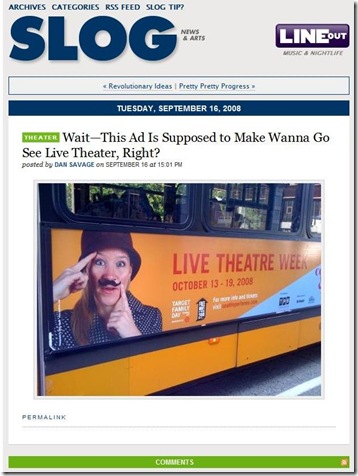
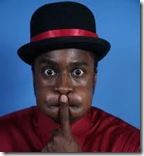
    Yes, we all cringed when we saw the Theatre Puget Sound (TPS) ads for Theatre Week in years past.   Apparently some PR firm had been hired in Sioux Falls, South Dakota and given the very specific instructions to create a campaign that would confirm every uninitiated civilian’s suspicion about just how lame and goofy live theatre can be.  Bowler hats, canes and dorky “del arte” facial expressions were de rigueur.  Some one who did not know better could easily have gotten the impression that every show in Seattle was some variation of a Godspell Hell.

    The comments to Dan Savage’s Slog post here about this flip phone pic  below sum up the general response hilariously.  Comment number 5 buttons them all together, thusly: “Perhaps it is a typo… perhaps it is supposed to read “Live Theatre Weak”

    Screen shot from Slog

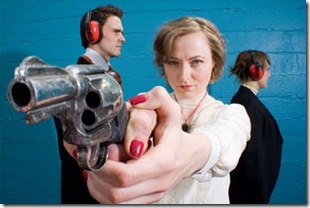
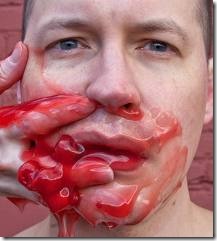
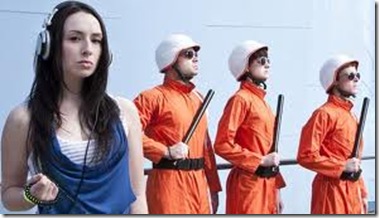
    If you are tempted to riposte in the comments with that hoary Seattle arts chestnut of an excuse: “They were doing the best they could”, please spare us, because anyone looking to encapsulate the thrill of theatre photographically need look no further for examples than any of the images pushed out over the last few years by WET. (Sorry, I just can’t bring myself to cave and call them “Washington Ensemble Theatre” just because some litigious trust-funded ensemble in NYC got jealous of WET’s success.  See here .)

    Promotional photo from WET's Hedda Gabbler redux: blahblahblahBANG Promotional photo for WET's Titus Androncius

    Promotional photo for WET's RoboPop

    (Just how and why is it that WET can make headphones so sexy?)

    As much as Seattle’s theatre professionals longed for a fresh and empowering marketing campaign from TPS to hook people into big and small local theaters around town, the last kind of change most of us would have wished for is what rolled out this Spring.

    Announcing Arts Crush,
    The Month-Long Arts Festival

    on April 19, 2010, at 5:30 pm | Category: Arts Crush

    As you may already know, Theatre Puget Sound is planning an expansion of our highly successful Live Theatre Week festival.  In an effort to build upon the momentum of that program and address the expressed needs of the larger arts community, we decided to expand our scope and build a more diverse and inclusive month-long festival modeled after Live Theatre Week.

    This October, Theatre Puget Sound will present Arts Crush, a month-long festival that connects artists and audiences with invigorating new experiences at hundreds of events across the region.  More than 200 arts organizations and innumerable artists from all over the Puget Sound will come together as a united arts community to share arts experiences with people of all kinds….

    So Theatre Week becomes Arts Crush, and somehow, the theatre artists (mostly actors, actually) that make up TPS’s membership, all of the sudden become, without being asked, patrons of all the arts, because, you know, we make so much money on the stage.  Where are the other major discipline-specific arts organizations that are joining TPS in this move towards expansiveness?  There are none.  TPS basically owns Arts Crush, in conjunction with broad based arts funders like Seattle Office of Arts & Cultural Affairs.  None of the non-theatre-but-still-discipline-specific organizations like Velocity Dance or Seattle Chamber Music come even close to matching TPS’s size or influence.

    Before I go on, let’s take a quick look at TPS’s mission, shall we?

    TPS is a member-driven organization whose main goals are the nurturing of a healthy and vibrant theatre community, developing strong ties among the region’s theatre professionals, raising the visibility of the region’s theatre scene on national and international levels, and finding ways to develop new and diverse audiences.

    Nowhere in the paragraph above is there any mention of cross-discipline arts promotion.

    So why is TPS diluting its mission?  My best guess is fear, with a touch of pointless power grab thrown in for flavor.  The move is part of a larger strategy to beat a tasteful and bloodless retreat from world class status.  The thinking goes like this, “Theatre is suffering.  And so are all the arts.  The core audience for theatre in the Northwest overlaps the core audiences for all of the other arts.  Let’s expand our scope, control that shrinking core and hope to hold the ground we have.  We can give up the castle to control the wider, albeit weakened, kingdom.”

    Of course this runs counter to what I and many of my colleagues believe is the best strategy to not only save theatre in Seattle but also elevate it to world class status at the same time.  We believe now is the time go on the offensive: to advance, not retreat; to push forward bold new and innovative plans for making a completely different and fresh sort of theatre.  We certainly do not think we should be spending our limited resources promoting “arts” in general.  That sort of “yay arts!”, “up with people!” advocacy ultimately helps no one.

    TPS’s desperation is showing.  Just this week an email went out from extending the deadline for applications to the Arts Crush festival.  A cynic has to wonder why.  Could the dilution of the TPS’s core mission have anything to do with it? <
    /p>

    Turning Theatre Week into Arts Crush is a mistake.  Theatre artists are rightfully reluctant to underwrite an effort that has expunged the word “theatre” from its name.  (If you played professional shortstop in Seattle, and the Mariners began a promotional campaign promoting all sports, but omitting the word “baseball” from its title, would you be worried, irritated or both?)  TPS should rethink this move.  Seattle needs a theatre advocacy organization that can keep its focus.  If TPS wants to be something other than it is, they should be honest about it and change their moniker to “APS” for Arts Puget Sound.  Of course, if they did that you would have to wonder what it would do to their membership rolls.