Just Wrought

Recovering playwright, once won a STRANGER Genius Award for theater. Now writing a bloated novel about… G-d help me! Theatre.

Category: Louis Slotin Sonata

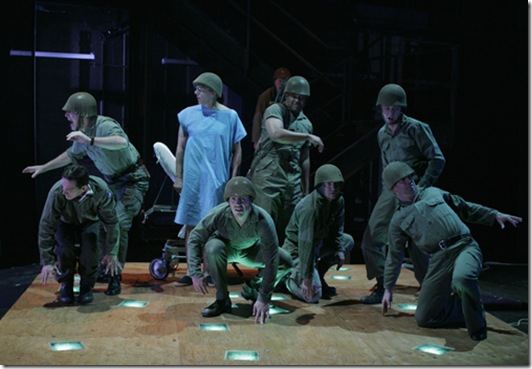
  • The Dream of the Black Soldier

    The Dream of the Black Soldier

    It is hard for me to imagine some future day when that day 67 years past will cease to captivate  human imagination.

    To all of the human beings whose fates were altered that day; in other words, to all of us: wherever we go, whatever we do, let us go and do it seeking peace, with the understanding that sometimes the world must be wrested back from those who would hold it in ignorance and malice.

      (…Louis opens his eyes and smiles at the audience, raising his arms out of the ice troughs like a prophet.)

    SLOTIN:  The time is come.

    DREAMER A:  It’s June the 6th, 1944.

    DREAMER B:  I’m in an amphibious landing craft headed straight for Omaha Beach.

    DREAMER A:  Normandy.

    SLOTIN:  Time is come. 

    DREAMER A:  As I look around at the other soldiers puking up their last rations–

    DREAMER B:  As the LC bounces across the channel’s heavy chop.

    SLOTIN: I realize a strange thing.

    BLACK SOLDIER:  I am a black man.

    SLOTIN:  I have always been black.

    DREAMER A:  From Arkansas maybe, or the Carolinas.

    DREAMER B:  I am the only Negro on this boat.

    BLACK SOLDIER:  Hell, I’m the only Negro in this entire invasion.

    DREAMER A:  And even with the shells lofting columns of sea and spray all around us. 

    DREAMER B:  And even with the shore looming closer and closer, and the thrill and terror pumping so thick I can taste it.

    DREAMER A:  I have to laugh.

    SLOTIN:  Because I realize there’s been some mistake:

    BLACK SOLDIER: This ain’t my war.

    DREAMER A:  The boat hits the beach. 

    DREAMER B: We can hear the bullets clanging on the other side of the steel landing ramp.

    DREAMER A:  And then down it drops.

    DREAMER B:  And we can see machine gun fire churning the water in front of us to a wall of froth.

    BLACK SOLDIER:  Ain’t nobody stepping into that.  But when I turn round, the Navy skipper’s pointing his sidearm Colt at us.  So what do we do but go?  White boys falling all around me.  Some cut to pieces by the guns, some just drowning under their gear.  But I move forward.  Kraut bullets just won’t hit me.  Ain’t my war.
          I got me a Browning automatic rifle and I start pumping her good into anything that moves up on them cliffs.  And then I’m up the cliffs.  I leave all them white boys behind dying and such down on the beach.  Ain’t got time for that.  Ain’t my war.  Every lousy Kraut blue-eyed bastard I find, I just jerk back on my B.A.R. and pump some lead in his face.
          “Damn, Fritz.  Sorry now, ain’t ya?  Should a thought a that sooner, hunh?  Now get down in hell where you belong.

    DREAMER A: And then I’m running.

    DREAMER B:  Running ahead.

    BLACK SOLDIER:  I ain’t got time for this.  This ain’t my war.

    SLOTIN:  I run past Paris.

    BLACK SOLDIER:  Sorry, Ladies.  Much as I’d like, ain’t no time for that now.

    DREAMER A:  I run forward.

    SLOTIN:  Past the Maginot line.

    DREAMER B:  Into Germany.

    BLACK SOLDIER: And I kill Krauts when I see ’em, but ain’t wasting no time neither.

    DREAMER A:  I’m running.

    DREAMER B:  Past Berlin.

    SLOTIN:  Past Hitler.

    BLACK SOLDIER:  Ain’t got time for that lousy little shit-ass now.  Let ’em eat his own lead.

    DREAMER A:  I’m running.

    DREAMER B:  I’m into Poland now.

    DREAMER A:  And then I’m there.

    SLOTIN:  Auschwitz.

    BLACK SOLDIER:  And damned if it don’t look just like “Gone With The Wind”.  Big ol’ plantation with big ol’ pearly white columns.  And who you think’s sitting up on that porch, just a-sipping on a julep but the Doctor himself.

    SLOTIN:  Mengele.

    DREAMER A:  Kill him.

    DREAMER B:  Kill him now.

    BLACK SOLDIER:  Yeah.  Now we got somebody worth killing.  I stroll on up them front steps drop my BAR from my shoulder and get set to shoot, only the gun ain’t a gun.  Just a damned stick.

    DREAMER A:  A yardstick.

    DREAMER B:  A slide rule the size of a yardstick.

    DREAMER A:  It’s hard to say.

    DREAMER B:  It’s all pretty hard to say.

    SLOTIN:  At any rate, Mengele smiles.  He gets up, and from his vest pocket draws a very small knife.

    DREAMER A:  A scalpel–

    BLACK SOLDIER: And cuts me open.

    SLOTIN:  To find the foolish Canadian Jew inside.

    BLACK SOLDIER & SLOTIN (together):  Louis.

    BLACK SOLDIER:  And right then and there it dawns on me–

    DREAMER A & DREAMER B (together):  We got trouble.

    (Blackout.)

    BLACK SOLDIER & SLOTIN (in darkness):  Louis… we need to talk, Louis.

    From Louis Slotin Sonata

  • Chicago Posts: Dead and Alive

    Three nights ago my old friend Louis Slotin and I each got one of those chances that only theatre can offer.  He got to be alive while I got to be dead.

    Everybody loves a dead playwright.  The deader the better.  Living ones are prickly and unpredictable.  Actors and directors assume, sometimes rightly, that living playwrights have special insight into their plays because, well, they wrote them.  Such insight can be resented as often as welcomed.  Rehearsing a play is a process of discovery.  No one wants to do an Easter egg hunt with someone they suspect knows where all the eggs are hidden.  Smart playwrights understand when it’s time to walk out of the rehearsal hall so everyone else can breathe a little.  They do this even though they know that they do not in fact have all the answers and really might like to stay and hunt for a little treasure too.  In other words, a smart playwright knows when to roll over and play dead.

    As I confessed in an earlier essay installment of these Chicago Posts, I have seen every full production of every play I have ever written.  Often I have been part of the development process, even if the play has already had its world premiere.  For Louis Slotin Sonata’s second production which was staged off–Broadway at Ensemble Studio Theatre I rewrote substantially, adding at least one scene, which I would later cut.  I was living in New York at the time, so I could attend as many rehearsals as I wanted (and thought wise.)  The same was true for the third production at the now dead Empty Space Theatre.  By then I had moved to Seattle with my wife and kids and was able to work with the director, John Langs, to touch up the script, and most importantly, completely swap out the second act song, replacing it with the utterly original “Sodom Saki Shuffle” for which I wrote all new lyrics which the incomparable Mark Nichols then brilliantly scored.  (Click this to hear the Seattle version of the Sodom Saki Shuffle.)

    For this fourth production of the play at A Red Orchid Theatre in Chicago , I had nearly zero input.  I answered a few small script questions via email from the director Karen Kessler, but otherwise I really might as well have been blissfully departed.  So I had no idea what I was in for when showed up at the storefront theatre in Old Town two nights ago.  I have sat through productions I had nothing to do with that blew me away with their unforeseen brilliant interpretation of my script, and I have sat through shows so awful, so utterly antithetical to the play I imagined that I was struck quite literally catatonic with horror, rage and shame.

    Louis Slotin was just about to leave Los Alamos when he had his accident.  His bags were packed.  He was showing the “crit test” to Alvin Graves, his replacement at Pajarito Canyon labs.  The next day he planned to fly out to the South Pacific to see the Navy explode the very plutonium core he held in his hands.  From there he would head to the University of Chicago to continue his studies in his original field of biology.  Of course, Slotin never made it to Chicago.  He never made it out of Los Alamos alive.  They put his radiation-ravaged body in a lead-lined casket and shipped it to Winnipeg, Manitoba, his hometown.

    Two nights ago I saw Louis Slotin alive in Chicago.  He was occupying the body of an actor named Steven Schine, who through happy happenstance looks a hell of a lot like him.  I watched as that long-ago dead man was forced to, via long distance phone call, break the news in Yiddish to his father Israel Slotin that he was dying.  Israel was inhabiting the body of an eminently accomplished veteran Chicago actor named William J. Norris.

    I watched those men relive a pain that no one should even have to live through once.  I watched and I wept.  But I also felt a great strange satisfaction.  After 64 years Louie had arrived where he was going.

    Maybe I should play dead more often.

  • Chicago Posts: Awesome Theatre Town? Or the Awesomest?

    Chicago Posts:  Awesome Theatre Town?  Or the Awesomest?

    Chicago is an awesome town.  I know this because I have been there once and I had a blast.  Chicago buys you whiskeys and beers-back in friendly, binged-in pubs, and Chicago puts its arm around you and tells you about its job as an assistant district attorney and how it married its high school sweetheart and has a nice family though one of its kids is disabled with something you cannot remember because of all the drinks Chicago has stood you.  And then later when you go to take a piss you find Chicago making out with this kind of skanky chick in the men’s room stall, and you’re pretty sure she’s not Chicago’s wife who Chicago was just telling you about–what was it?  Five minutes?– or half an hour ago?  Doesn’t matter.  Who are you to judge?  Doesn’t change the fact that Chicago is an awesome town.

    *

    But how awesome is Chicago as a theatre town?  My personal experience on this subject is much more limited.  This production of Louis Slotin Sonata that I am going to see this weekend is my first full production in what is, by nearly everyone’s estimation, one of the United States great stage cities.

    Certainly everyone in the business likes to point to the Chicago’s Steppenwolf Theatre Company as the model for how to be both commercially successful and artistically relevant.  How many nascent ensemble-based theatre companies have promised you, with their collective hand out for a donation, that they intend to be Seattle or L.A.’s next Steppenwolf?  Me, honestly have no idea if Steppenwolf is all that great.  I have only seen one production by that team, nearly two decades ago, in New York City.  It was their adaptation of Steinbeck’s Grapes of Wrath and it was… oh right, it was frickin’ awesome.

    Chicago is certainly less shy about promoting its theatre scene than Seattle.  The Tribune’s critic, Chris Jones calls his blog “Theater Loop: News from America’s Hottest Theater City.”  What critic in Seattle would ever be so boldly boosterish?  By my admittedly loose estimation, Louis Slotin Sonata received more reviews per capita in Chicago than in Seattle, Los Angeles or New York.  The fact that they were not all unqualified raves does not really matter.  Coverage is coverage and wide coverage is a sign of health for a theatre town.

    To be fair, Chicago does seem to have more than its fair share of block-headed, Broadway-bedazzled reviewers.  Back in January, the above-mentioned Mr. Jones offered his thoughts on Outrageous Fortune, TCG’s ground-breaking analysis of the plight of American playwrights.  He dismissed us as “whining” and “absurdly self-indulgent.”  More recently he began the meat of his review of my Louis Slotin Sonata by saying, “By reacting fast, blocking and ending the reaction, Slotin saved the lives of the men who were with him in the lab that day,” thus moronically parroting the blatant falsehood that the U.S. government began spinning within hours of an embarrassingly avoidable accident.  One might forgive Jones for perpetuating this historical and scientific deceit if the precise counterpoint were not demonstrated over and over throughout the play, providing (I hope) the essential underpinning of Slotin’s unique path to redemption.

    So critics can be patronizing blowhard nitwits in the Midwest, too.  Doesn’t matter.  Who is Seattle to judge?  (We can’t even get our best reviewer to commit to staying past intermission.)  Doesn’t change the fact that Chicago is almost certainly an awesome theatre town.  On this trip I want to learn more about how and why this is so.  I think the Emerald City could learn some things from the Windy One.

    ***

    *A note on Gary’s illustration:  I’m so excited by this one because it gives an inside view to a process usually only seen by myself, Gary and the director of whatever show we might be working on.  Gary likes to diagram.  I think he calls these things bubble charts and they represent one of the ways he gets his arms around a play. 

    I stared at this one for like fifteen minutes last night after it came across the inter-tubes.  I could make sense of pieces of it, but the whole eluded me.  I chalked this up to Gary being smarter than me.  The next morning I looked at it fresh and realized my error.  The main path represents not “Paul’s” progress, but “Chicago’s”.  Of course!  I’m not the main character of this piece, Chi-town is (especially in the first paragraph, which this picture maps to perfection.)

    Gary’s diagrams cut straight to the heart of a story and expose the essential mechanics that even the writer didn’t fully understand when he constructed it. 

    Plus they’re funny.

  • Chicago Posts: My Shameful Little Secret

    Chicago Posts: My Shameful Little Secret

    In the days of development ramping up to the world premiere of Louis Slotin Sonata in Los Angeles, I once spent a week in a Hollywood apartment in which the same three inches of scummy water never drained from the bottom of the bathtub. As for the New York premiere of my play Tuesday, even though I had attended early rehearsals and had high hopes, I wound up falling asleep during an actual performance, thereby poisoning forever my relationship with that theatre company and its artistic director. I once sent my most obscure and arcane play The Septarchy to an even more obscure little company in Louisville, Kentucky on the recommendation of a gorgeous stage manager running a Twilight Zone I was acting in at Theater Schmeater. Unaccountably, they produced the play and staged one of the best versions of “The New You Boat”the quantum particle-crewed, Schrödinger’s Box-based mini-submarine play-within-the-play— that I have ever seen.  And I’ve seen them all.  That is my shameful little secret.  I have seen every full production of every full-length play I have ever written.

    If you don’t know already, I am obliged to inform you that, among my fellow American dramatists, this fact identifies me as an abject amateur. Playwrights of a certain caliber simply do not attend every production of their plays.  Worse than being impossible it would be unthinkable.  It would be tacky, pedestrian.  One’s ideal play distribution process goes like this: workshop in Manhattan, and ideally premiere there.  Less preferably, emulate that sequence at one of the regional big houses scattered throughout the nation. After a respectable world premiere production (thought don’t even get me started on the esoterica of what constitutes a “world premiere” and how many times an unprincipled playwright can apply that term to the very same play). Finally, trickle the play down through the theatrical food chain, to smaller and smaller houses, not unlike a wholesale supply network.

    Needless to say, I don’t do it that way.

    While I make more money in a year from theatre than most union card-carrying actors, I will not shrink from being called an amateur, if that is the appellation that seeing every one of my plays earns me. For one, it’s just way too much fun. Even if the production is less than inspiring, going to some new town and partying with perfect strangers who treat me like a cast-mate merely because I wrote the show is arguably the best thing about being a living playwright. (The very best perks, of course, are reserved for the dead.)  How else would I know that Louisville has one of the most beautiful graveyards in the nation? Or that Los Angeles, surprisingly, has some of the best breakfast spots. (I wouldn’t have guessed they even ate breakfast in LA.)

    (Let’s take a break for a moment and enjoy Gary’ Smoot’s 15 minute mash-up illustration for this installation.) (As Gary happily pointed out when he sent this to me, the above crowd would actually represent a pretty good selling night for a lot of my plays.)

    I part ways with my colleagues who seek to distribute their plays like wholesale book-sellers. It’s boring. It’s corporate. And, heck, let’s face it: our dying art form, absurdly or not, is starting to look like a lot better bet than the book business. Besides, our nation’s best work has come from amateurs. Our Founding Fathers, for instance, found the notion of professional politicians anathematic. Our best soldiers have always been citizen-soldiers. And give me any day the amateurs Thoreau and Whitman over the professional philosopher Rand and pro poet Pound. Plus, despite all I’ve said, who says a professional playwright can’t see every production of his plays? I suspect Shakespeare saw every one of his before finally leaving London for good.

    The day may come when I will not be able to attend a particular production of one of my plays. The coming of that day may mean I have finally become a fully professional playwright.

    You know what?

    I can wait.

    "the end" by Gary Smoot

  • Chicago Posts: Kick-Off

    Chicago Posts: Kick-Off

    Even when I try to keep my Just Wrought posts short, they still end up longer-winded than I’d like.  So I’m going to try something a little different with this series about my upcoming trip to Chicago.

    Heather and I will be flying to the Windy City next Friday, ostensibly to see the Mid-West premiere of my play Louis Slotin Sonata at A Red Orchid Theatre, but if you think the fact that the Seahawks are playing the Bears at Soldier Field on Sunday has nothing to do with it, well, you obviously don’t know me and my wife very well.

     *

    I feel like I can defend the choice to blog this trip by promising to share with you my singular experiences as a playwright traveling to see his plays.  When you think about it, this is a particularly odd occurrence in the broad realm of artistic endeavor.  We playwrights create these action/dialogue designs, send them out into the world for other people to work on– often, as in this case, with almost no input into the particulars of the production– and then, should we choose to and be lucky enough to have the means, we travel to the other cities to see the results.

    Who else does this?  Fiction writers can carry their finished product around in a bag or Kindle.  Painters and sculptors have their hands on their handicraft until it goes up on some wall or pedestal.  Performers– actors and dancers and musicians are their work themselves in a sense.  But what other kind of artist does this weird dance of intimacy and distance– sending their kid off to boarding school and then showing up for the graduation ceremony?  Composers maybe?  I don’t know much about composers.  More’s the pity.

    I will try to keep these posts short, 500 words or less, unless I feel like I got something crucial to say about theatre.   “Something crucial to say about theatre.”  As soon as I typed those words I snorted a little.

    *(A fun note: Gary Smoot has agreed to provide illustrations for these short posts, with the caveat that he will spend no more than 15 minutes on any given image.  The above “f ing drama”,  is the first.  Going forward with this experiment, please understand that I have very little control over what Gary chooses to produce.  I can make a initial few suggestions, but the ultimate product is purely his commentary on my commentary.  Come to think of it, that’s not unlike what happens when he designs for one of my plays.)

  • Chicago Public Radio Glows for Slotin

    Chicago Public Radio Glows for Slotin

    I was determined not to bore you with reviews from the Chicago premiere of Louis Slotin Sonata, but this one from Chicago Public Radio, WBEZ, has several things going for it:

    1. It’s extremely short.
    2. It’s completely, unequivocally positive. 🙂
    3. And you don’t have to read it.  You can just listen to it here.

    Money pull-quote: 

    “… Intellectualy thrilling and rigorous.  It really is a must see.”

    *Inside Baseball: Vocally, this critic Kelly Kleiman sounds remarkably like The Seattle Times’ Misha Berson; only difference being she doesn’t hate my guts…yet. 

    Just one more reason to love the Windy City!

  • Steve Schine Joins a Very Exclusive Club

    Steve Schine Joins a Very Exclusive Club

    Gotta say, my Chicago home boy, Steve Schine, is practically a dead ringer.  Don’t ya think?

    Compare with . . . Louis Slotin in his Los Alamos mug shot

    No dis,  mind you, on my former Slotin homeboys, the inestimable Paul Morgan Stetler (The Empty Space Theatre, Seattle) and the seminal William Salyers (Circle X Theatre, Los Angeles and Ensemble Studio Theatre, New York).

    Paul Morgan Stetler as Hollywood SlotinWilliam Salyers as Louis Slotin as Joey Mengele

  • Sun-Times Previews A Red Orchid’s Slotin Nicely

    Sun-Times Previews A Red Orchid’s Slotin Nicely

    Ask anyone who’s been doing theatre long enough and they’ll tell you, “I don’t care if they review me so long as they preview me.” 

    Well, The Chicago Sun-Times just gave a very nice one here to A Red Orchid’s Chicago premiere of Louis Slotin Sonata, which will be starting preview’s tonight, on my birthday! 

  • A Red Orchid’s Poster for Louis Slotin Sonata

    A Red Orchid’s Poster for Louis Slotin Sonata

    The poster for the new production of Louis Slotin Sonata in Chicago. . .

    I have to say…

    I like it.

    I like it very much. 

    Eye-witness accounts of atomic blasts invariably share some sentiment to the effect that the explosion’s aftermath easily rates as the most beautiful and simultaneously horrible sight the witness has ever seen.  Richard Rhodes collects page after amazing page of first-hand reports from the test shot at Trinity in his seminal history, The Making of the Atomic Bomb.  Here’s just one from J. Robert Oppenheimer’s brother Frank: 

    And so there was this sense of this ominous cloud hanging over us.  It was so brilliant purple with all the radioactive glowing.  And it just seemed to hang there forever.  Of course it didn’t.  It must have been  just a very short time until it went up.  It was very terrifying.

    And the thunder from the blast.  It bounced on the rocks, and then it went—I don’t know where else it bounced.  But it never seemed to stop.  Not like an ordinary echo with thunder.  It just kept echoing back and forth in that Jornada del Meurto.

    By cropping the mushroom cloud neatly by half, the designer has de-iconized the image, forcing us to look again more closely at the amazing, disturbing forms and colors, not to mention the cloud’s sheer enormity.

    Posters are for putting butts in seats.  I have no idea if this will do that.  But I could stare at it all day.

    May human eyes never witness such beauty again.