Just Wrought

Recovering playwright, once won a STRANGER Genius Award for theater. Now writing a bloated novel about… G-d help me! Theatre.

Category: Scripts

  • Louis Slotin will Finally Reach Chicago

    Louis Slotin will Finally Reach Chicago

    While I have kept this news close to my vest for a while, it is now official, folks!  My play Louis Slotin Sonata will be produced in Chicago this Fall at A Red Orchid Theatre.

    The Chicago Sun-Times covers the announcement here.

    BroadwayWorld.com – Chicago’s story is here.

    What makes this upcoming production particularly gratifying for me is that Slotin had immediate plans for his life beyond Los Alamos and the Manhattan Project.  He intended to switch gears from physics and engineering to pursue his original area of study, life sciences, at the University of Chicago.  His bags were already packed when the accident happened.   After all these decades, if only in my admittedly strange and somewhat sentimental imagination, Louie will finally arrive where he was heading.

    ChicagoSkyline1

    Sodom Saki Full Length by Paul Mullin

  • He said He was Going to Do It, and Apparently He Did

    He said He was Going to Do It, and Apparently He Did


    CRAIG:  The human sequence is only the beginning.  Next we gotta do the chimp. it’ll be easy since it’s 90% the same as the human anyhow. 
          Then I want to shotgun everything in the human digestive tract; a cubic meter of Sargasso sea water, the Amazon rainforest, the entire globe.  I’ll take Sorcerer II and circumnavigate, shotgunning samples as I go.  There’s an infinity of questions to be asked, but we don’t even know the basics, like what friggin’ lives out there.
        I want to build an artificial genome from parts.  A whole new life form and see if we can make it work.  Doctor Frankenstein eat your heart out.

    KELLIE:  Sounds like you might get that invite to Stockholm after all.

    CRAIG:  Screw it.  They only give you a million dollars anyway.

    KELLIE:  What would make you happy then?

    CRAIG:  Happy?  If I could be the first to synthesize life, I’d be happy. . . for a while.

    When I wrote those words five years ago,  I never doubted even then that Venter would accomplish his seemingly impossible goals.

    J. Craig Venter is a playwright’s dream.  A real-life Faust, a gigantic brain attached to an even bigger mouth, a brilliant bio-tech Muhammad Ali.  It was a pleasure to build The Sequence around his race with Francis Collins to decode the human genome.  Now he’s apparently booted up a whole new life form from parts, just like he said he would, both in my play and in real life.

    New York Times: “Researchers Say They Created a ‘Synthetic Cell’

    Paper Bits
  • Put Grudges on your Calendar

    Put Grudges on your Calendar

    Just wanted to give Seattleites advanced warning that there will be a reading of my very latest play, Gossamer Grudges at  the Seattle Repertory Theatre* on Tuesday, June 8 at 7 pm in the PONCHO Forum.

    For over a hundred years Gossamer Holdings has delivered faithfully on its simple pledge: “We hold grudges, so you don’t have to.”  Times, however, have changed, and Horatio Gossamer knows that in this “go big or go home” world, the family firm must grow or die.

    Gossamer Grudges is a fast, funny, furious six-actor comedy with its feet firmly planted in classic farce and its head swimming in the intoxicating clouds of instantaneous celebrity, money, and sex.

    We will have an amazing cast amazingly directed, and maybe, just maybe the play will be worth hearing.  I have been working on the idea for over three years.  Farce is easily the most difficult form I have ever attempted. So please come because I’m going to have lots of questions on how to make this bird sing.

    This reading series is co-sponsored by the Rep’s New Play Program and Northwest Playwrights Alliance.  Special thanks to Jerry Manning, Braden Abraham and Bryan Willis for making this program possible, and letting a pain-in-the-ass like me participate.

    *Yes, they’re letting me in the building.

  • The Colbert Nation Meets The 10,000 Things

    The Colbert Nation Meets The 10,000 Things

          Stewart Brand was on The Colbert Report last night, mostly talking about his conversion to the notion that nuclear energy is a viable option for getting human beings out of the current environmental/energy crisis; but at ~4:30 in the time code Colbert asks him about the Clock of the Long Now.

    The Colbert Report Mon – Thurs 11:30pm / 10:30c
    Stewart Brand
    www.colbertnation.com
    Colbert Report Full Episodes Political Humor Fox News

          I first met Stewart Brand at the Exploratorium in San Francisco, after a staged reading of my play The Sequence produced by the Magic Theatre.  To my later shame I had no idea that this was the founding publisher of The Whole Earth Catalogue and the originator of one of the first and most famous electronic bulletin boards, the WELL.  My friend and mentor Richard Rhodes introduced us, we chatted briefly about my play , then Stewart handed me his card and informed me he was building a clock in the desert that will keep time for ten thousand years. 

    People say a lot of strange things to me after readings, but this rated easily in the top ten.  I went home to Seattle, ordered his book The Clock Of The Long Now: Time And Responsibility from the library and proceeded to learn more about this project.  By the time I had finished reading I was hooked.
          The brainchild of Brand, composer Brian Eno, and supercomputer inventor, Daniel Hillis, The Clock of the Long Now is intended to provide a counterpoint to today’s “faster/cheaper” mind set, promoting instead “slower/better” thinking by keeping accurate time for 10,000 years: ticking once a year, booming once a century and “cuckooing” every thousand years.  The very act of contemplating how to design, build and maintain such a device forces everyone involved to re-think their relationships to time, technology, community, culture and the planet.  How should the clock operate given its unprecedented life-span for a machine?  What should its power source be?  Should it be located far enough from the mainstream of civilization to avoid any possible concomitant destruction, or close enough to allow its significance to be absorbed by normal people?  Should the clock require “winding”, or should it be able to hum along through the millennia with no need for human interaction at all?  These questions and many others are only just beginning to be wrestled with, as the full-sized clock’s construction has not yet begun.
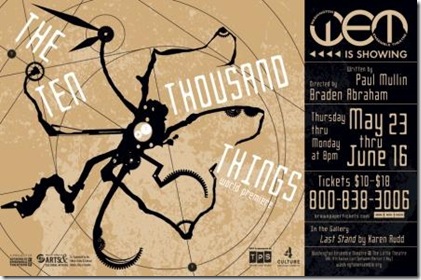
          Soon after reading his book I contacted Brand and offered my services as a playwright, explaining that theatre, while ostensibly foundering in today’s high-tech culture, is nevertheless one of humanity’s most robust and enduring art forms: perfect for accompanying a clock through the millennia– introducing and illuminating “deep time” ideas to audiences, while also evolving itself through the epochal duration.  Brand and his fellow Long Now board members decided my proposal had merit, and charged me with assembling the wherewithal and funds to conceive, draft and produce such a play.  In other words, they loved the idea, but were not about to draw precious resources away from the Clock’s construction.  Eventually I landed a grant from the City of Seattle and Washington Ensemble Theatre offered to produce the play based on some early pages.  In May of 02008 the first 19 ticks of The Ten Thousand Things were performed. (You can learn more about The Ten Thousand Things, and even purchase a digital copy of Tick 19 here.)
    TTKpost WEB size80KB
          To follow is a short excerpt.  I will buy a drink for the first person to spot one of the “ticks”.  There’s at least one in there.  Maybe more.  (WET production members are ineligible, though heck, I’d happily buy any of youz guys a drink, too.)

    * * *
    PLAYWRIGHT:  People have been predicting the imminent end of the world since the beginning of the world.

    PRODUCER:  I’m not just people.  I’ve made a few fortunes predicting stuff.   Trust me: we’re toast. a few decades tops.

    PLAYWRIGHT:  I can imagine even you being wrong now and then.

    PRODUCER:  You’re right.   Assume I’m wrong.  Tell me about your play.

    PLAYWRIGHT:  Forget it.

    PRODUCER:  No, really.

    PLAYWRIGHT:  No, really, forget it.

    PRODUCER:  Stop.  I wanna know.  I really am asking nicely.

    PLAYWRIGHT:  Are you?
          It’ll be a clock.

    PRODUCER:  What?  The play?

    PLAYWRIGHT:  Yes.

    PRODUCER:  The play will be a clock.

    PLAYWRIGHT:  Yes.  From the beginning I’ve known that the play has to change though the ages like the clock.  It can’t just stay still, frozen in time while the clock ticks on; but how does the play change?  At first I thought it changed with time.

    PRODUCER:  Isn’t that how all things change?

    PLAYWRIGHT:  Well, yes, but hear me out.  At first I thought it changed in ordinary time, time like a clock keeps, ticking like a clock ticks..

    PRODUCER:  Okay.

    PLAYWRIGHT:  But after a lot of false starts and blind alleys I’ve come to realize that the play has to keep time like only a play would or could.

    PRODUCER:  And how is that?

    PLAYWRIGHT:  It has to keep theatric time.

    PRODUCER:  And what is that?

    PLAYWRIGHT:  Well, in the theatre, time only passes in front of the audience.  No audience, no time.  So I decided a very simple solution.  The play ticks once a performance.

    PRODUCER:  It ticks.

    PLAYWRIGHT:  Yes.

    PRODUCER:  Explain that please.

    PLAYWRIGHT:  It ticks a word.

    PRODUCER:  It ticks… a word. 

    PLAYWRIGHT:  Right, and if, say, the play were exactly ten thousand words–

    PRODUCER:  Sounds long.

    PLAYWRIGHT:  Actually it’s only like a third of Hamlet.

    PRODUCER:  Okay–

    PLAYWRIGHT:  And a single word changes every time it’s done, then the theatric clock ticks ten thousand times, just like the actual clock chimes once a year.

    PRODUCER:  Okay.  And who changes the word?

    PLAYWRIGHT:  Anyone.

    PRODUCER:  Anyone?

    PLAYWRIGHT:  Except me.

    PRODUCER:  Anyone except you?

    PLAYWRIGHT:  That’s right.  An actor, the middle, an audience member, the light board operator– I don’t care– anyone.

    PRODUCER:  Except you.

    PLAYWRIGHT:  Except me.

    PRODUCER:  Why except you?  You wrote it.

    PLAYWRIGHT:  That’s the beauty.

    PRODUCER:  I’ve seen prettier.

    PLAYWRIGHT:  What?  It’s perfect.  Something will happen.  Then something different.  For a little while I’ll even get to watch, maybe.  Who could ask for more?

    PRODUCER:  You’re willing to just hand over a huge amount of your work to someone, everyone, else to change. 

    PLAYWRIGHT:  That’s basically what playwrights do anyway.

    PRODUCER:  More’s the pity.  They’ll obliterate you.

    PLAYWRIGHT:  It’s only one word at time.

    PRODUCER:  Yeah, like Chinese water torture, they’ll take you apart.

    PLAYWRIGHT:  I’m hoping they won’t.

    PRODUCER:  But they will.  That’s what actors, bananas, audience members, board ops, other people do.  Trust me. 

    PLAYWRIGHT:  Stop saying “trust me.”  It’s a bully’s trope. 

    PRODUCER:  Okay, let me ask you this: what happens if some one comes along and purposefully tries to ruin your play?

    PLAYWRIGHT:  You know? I think I might want them to purposefully try and ruin my play.

    PRODUCER:  All right.  What if– worse– they make mundane, meaningless changes, simply for the sake of honoring your demand that they change it?

    PLAYWRIGHT:  I think I want them to do that too.

    PRODUCER:  What if they wind up not caring at all?

    PLAYWRIGHT:  And that would be so different from now how?
  • The Sequence in Print

    The Sequence in Print

    I am delighted to announce that my play The Sequence, which dramatizes the real-life race to decode the human genome, is now available in print from Original Works Publishing.

    It has been a long road since that phone call eight years ago when Curt Dempster, then artistic director of Ensemble Studio Theatre in New York, offered me a commission to write something about the genome race.  He had seen Craig Venter on The Charlie Rose Show and I imagine he recognized a kindred spirit: an arrogant, monomaniacal genius who had the raw guts to want to change the world.  I knew nothing about the story.  I wanted instead to write a play about scientific investigations into human consciousness (still do, for that matter), but after doing some initial research I was quickly convinced that there really was a play here.  The detail that sold me for good was learning that Venter had secretly used his own “genetic material” as Celera’s sample for sequencing.  The lofty fog of scientific endeavor suddenly cleared as this act of sheer human outrageousness snapped everything into crisp dramatic focus.  There was a story here.  Boy oh boy, was there a story!

    Curt has since passed on, by his own hand, determined as ever to navigate this life on his own terms or none at all.  He never got to see the world premiere of The Sequence at The Theatre @ Boston Court in Pasadena.  He never got to see this final script, which he conceived by commission nearly a decade ago.  But in my overwrought imagination, I see him thumbing through it, slouched in his hovel of an office at the corner of 52nd Street and New Jersey, dog curled beneath his chair, surrounded as he always was with stacks and stacks of new play manuscripts, hundreds of them, maybe thousands, some of which he had asked for, most which he hadn’t, nearly all of which he would never read (he preferred to watch readings), but every single one of which he believed in; because for Curt, theatre was about making plays, not merely staging those already made.

    You can pre-order the script by clicking here.

    I hope you like it.  I also hope that when you read it, you remember that The Sequence, like all plays, was wrought more than written, and ultimately meant to be watched more than read.

    The cover for the Original Works publication of The Sequence, by Paul Mullin

  • Celebrate Valentine’s Day with The Don Juan Cult

    Celebrate Valentine’s Day with The Don Juan Cult

    1995.

    Seattle hadn’t changed yet. The wave was cresting, but no one was really sure if it would break, or how to surf it when it did. Cobain had already blown himself away, but that seemed more like part of the times than an end to them. Hell, Pearl Jam was still putting out good albums. The Kingdome still stood and Sweet Lou Piniella still threw the best tantrums since Earl Weaver in it. The Stranger was only mildly annoying, and everyone only read the “I Saw You’s” and “Hey Faggot” anyway. The Honey Bear in Wallingford still baked the best blueberry scones anywhere. Fremont didn’t suck. And the greatest interior space that ever existed, the 211 Pool Hall in Belltown, had not yet been utterly burned out by some idiot’s electrical fire.

    I was still single, still drinking, childless– as far as I knew– and pretty damned convinced I was happy…. But what the fuck did I know?

    1995 was when I first met Jonathan. I can’t say whether I immediately despised him… but… it was close.

    Just in time for St. Valentine’s Day, Kindle has slashed in half the price of  The Don Juan Cult Concerto.  So now you can have my love letter to Rainsville’s fervent 90’s for the incredible price of just $3.99.

    Dueling monologues by Les (Mathew Suhr) and Jonathan (Colin Campbell).

    About The Play

    Les Newman’s half-brother Jonathan is in Seattle to compose a concerto inspired by the legendary Don Juan, but it seems he’d rather study the arts of seduction than actually write the score. Meanwhile, Les is too busy getting his own heart broken to pay much attention as the eager composer zeroes in on his ultimate challenge: a reticent receptionist with a savagely sad secret of her own.

    THE DON JUAN CULT CONCERTO explores the often brutal— often brutally hilarious— territory of unbridled romantic rapacity, as two men and three women each come separately to a single inevitable conclusion: no matter how you see yourself— predator or prey— you are, like it or not, always and forever, a member of the cult.

  • THE SEQUENCE now Half-Price

    THE SEQUENCE now Half-Price

    Just slashed the price of the Kindle version of my play The Sequence. To order the digi-script, hit my page for the play here and then click through the Amazon badge pictured just to the right of the synopsis.

    The Sequence dramatizes the real-life race to decode the genetic instructions for building a human being.  The play world-premiered in 2008 produced by The Theatre @ Boston Court in Pasadena, California. 

    Here’s a little teaser:

    Renegade researcher Craig Venter develops a controversial “shotgun” technique for sequencing DNA, then quits the NIH over an institutional lack of imagination. He quickly makes a fortune in the private sector, and becomes simultaneously the most loved and hated scientist in the world.

    A folksy doctor named Francis Collins inherits the U.S. government’s Human Genome Project. When his victory in the sequencing race is threatened by Venter, he quickly makes the transition from apparent bumpkin to fierce competitor.

    Journalist Kellie Silverstein cuts her teeth on the biggest science story of all time, while simultaneously running a race with her own mortality.

    In the competition to sequence the human genome, will the grand prize be the public good or private profit? And how will three people, amid the frenzied race to determine what makes a human being, discover their humanity?

     Kerri Krause, Hugo Armstrong and William Salyers as Kellie, Venter and Collins

    So if you dig electronic versions of play scripts (and really, who doesn’t?) then order a copy of The Sequence now, because supplies of these electron configurations are going fast!  (186,000 miles per second, to be exact.)

    ****

    Note: other scripts of mine currently available on Kindle include:  Louis Slotin Sonata, Tuesday, The Ten Thousand Things and The Don Juan Cult Concerto.

  • TUESDAY now for sale

    After dickering with Amazon to prove that I actually owned the rights to my play Tuesday, it’s now for sale for Kindle.

    http://tinyurl.com/yf36fgz