A lot has already been said about the revelation that Mike Daisey fabricated many portions of his one-man show, The Agony and The Ecstasy of Steve Jobs: a piece he previously passed off as entirely truthful reportage, most egregiously on This American Life, a nationally broadcast public radio program. I leave it to wiser minds to sort through all but one of the many questions Mike’s transgressions raise, reserving for scrutiny only that which I feel I am particularly qualified to examine: what impact will Mike’s dishonesty have on the intersection of theatre and journalism?
A huge number of people are familiar with Daisey’s work creating and performing topical monologues at some of the most prestigious venues in America, from the Seattle Rep to New York’s Public Theatre to the Woolley Mammoth in Washington, D.C. A much smaller number of people know of the work produced by NewsWrights United, a theatre company I co-founded and serve as Executive Director. We dramatize news using a form invented in the early 20th century called the living newspaper, and all of our stories are researched and written by local Seattle playwrights. (Memorable examples include Scot Augustson staging the farcical misadventures of a reporter/photographer duo sent to Detroit a week early to cover the Seahawks only Superbowl appearance; and on the serious side, Pamela Hobart Carter’s lyric poem/play about the psychic damage done by the Green River Killer.) On first appearances, NewsWrights United and Mike Daisey seem to occupy similar territory in the art/news nexus, but in actuality I believe we do something fundamentally different, and if I can tease apart for you these differences, I earnestly hope to convince you that coverage of news in the theatre is something worth saving even if Mike Daisey’s methods are not.
I predict two reactions to this crisis from artistic administrators at U. S. regional theatres. The first is already in evidence. Institutions that have already booked Mike will mostly stick with him, echoing his essential tack: “Yeah, lying to the public radio program TAL was wrong, but lying in the theatre is obviously eminently forgivable. After all—heck!—isn’t all theatre lying?” Artistic administrators are not widely known for the courage of their convictions, however, so I further predict that over the next year or two, while the controversy dies down, they will quietly divest themselves of as much Daisey stock as possible, so long as it doesn’t cost them too much to dump it. What’s worse, I also predict they will take the dreadfully wrong-headed step of underscoring this divestment with an abandonment of all new work that explores the intersection of theatre and journalism. (The exception to this new silent ban will be, perversely, Mike’s inevitable one-man apologia, which regional houses will be falling over each other to stage.)
But forsaking the theatre/journalism intersection does not have to be our future. With hard work, honest self-examination and courage we can take this opportunity not to withdraw but advance the genre. As a once and, with luck, future practitioner of news theatre, I venture to offer some practical advice on how we might achieve this.
Expand the Pool
Beyond his extraordinary talent as a storyteller, Mike’s shows appeal to regional theaters across the country because they are cheap and easy to mount. Most important, they are portable. If you are looking to plug a little topicality into your otherwise staid season, you cannot do it more easily than by giving Mike a call.
Living newspapers are much more difficult. To create effective alternatives to the Daisey Debacle, you have to give up some of the conveniences of the one-man show; most crucially, you have to give up the idea of “one-man.” Actual plays are vast collaborative efforts, featuring dialogue among and between more than one player on stage. The play development process contains a built-in organic vetting process that zeroes in on “truth” even when the story, like Agony/Ecstasy, is more accurately classified as fiction.
For instance, I am working with Rebecca Olson’s project Custom Made Plays to develop a script for her and another actor. Every week I sit in a room with them and the director, carefully combing through the script with questions. The process is gentle but relentless, and when a false note gets rooted up, we pounce to replace it with something more “honest.” Many of the moments in Agony/Ecstasy that Daisey promised us were real were not. In retrospect, they reek of bad fiction now that we know that is exactly what they are.
I reach into my satchel, and I take out my iPad. And when he sees it, his eyes widen, because one of the ultimate ironies of globalism, at this point there are no iPads in China. …. He’s never actually seen one on, this thing that took his hand. I turn it on, unlock the screen, and pass it to him. He takes it. The icons flare into view, and he strokes the screen with his ruined hand, and the icons slide back and forth. And he says something to Cathy, and Cathy says, “He says it’s a kind of magic.”
Daisey’s a fine writer and I have no doubts he could have avoided this tripe, offering instead something genuinely brilliant, if he had only admitted it was fiction in the first place and then collaborated with performers and a director to sharpen it.
Living newspapers expand the pool in more than one dimension. Beyond just other actors in the room, you must also let in other writers. How much would anyone trust a newspaper with only one reporter who also served as the sole editor? NewsWrights United engaged several local playwrights for its living newspaper about the demise of the actual newspaper, The Seattle Post-Intelligencer. By spreading the attack, we were able to cover a number of different beats—sports, politics and arts coverage at the P-I—in a wonderfully varied spectrum of styles, some of which implicitly “watermarked” their stories as fictionalization (but more on “watermarking” later.) Using more artists allows you to cover more kinds of stories, leading to another way to better provide theatrical news…
Up Your Local Content
It certainly was exciting to watch “David” Mike take on “Goliath” Apple from the stage of my local regional theatre; and certainly my local regional theatre enjoys, along with regional theatres across the country, the imprimatur of international relevance when such a story as Agony/Ecstasy gets told. However, we lose a huge opportunity when our big houses keep mounting the very same one-man show, instead of staging local news that actually has as much, if not more, to do with the lives of local audiences as does Applegate. Let’s dare to flip the model and have each theatre produce its own living newspapers, telling stories about their own communities, and sure, plugging in national stories such as those Mike tells when appropriate.
I promise you: locally grown journalistic theatre is not only doable, it’s been done. In NewsWrights United’s last effort, The New New News: A Living Newspaper, we locally sourced nearly all of our stories about the crisis in journalism brought on by the digital age. Our play It’s Not in The P-I: A Living Newspaper about a Dying Newspaper gave voice to locally beloved P-I reporters so that a community eager to hear their tales finally had the opportunity that no other medium would give. We also broke important exclusives into the buy-out process that the Heart Corporation used to cherry-pick and union bust their newsroom as they shuttered the print version of The Seattle P-I and moved to an all on-line edition. It didn’t hurt that one of our founding producers, Tom Paulson, is a professional journalist, formerly the P-I’s science reporter, and currently writing for NPR’s Global Health site, Humanosphere.
Use “Watermarks”
Not everything that takes place in a theater is theatre. If this is news to you, you might not be to blame. The theater = theatre fallacy is happily perpetrated by artistic administrators to fill their seasons with the easiest fare to produce. (Click here to see my essay on this.) True theatre is rife with “watermarks” built into both the text and context of a play to remind you, sometimes explicitly but mostly implicitly, that what you are seeing is to some degree false.
“Watermarks?” You say. “How come I’ve never heard of these watermarks before?” Well, for two reasons: One, I just started using the term in a theatrical context about a week ago when I was trying to explain why Mike should not be allowed to take refuge in our art form. Two, watermarks are so endemic to theatre that we tend to look right through them, like reading glasses. The Greeks used masks as watermarks. Shakespeare and his contemporaries stitched their plays out of the watermarking fabric of Iambic pentameter. Not a single tradition within our grand form lacks them, but an exhaustive list is superfluous to this argument, because the definition of theatre is the ultimate watermark: two or more people staging a live dialogue (before you ask, no, it doesn’t have to be with words) within the physical perception of other people. Think about it. Someone tells you a story on the street. She could be lying. She could be telling the truth. But two or more people obviously acting out a story in front of you? Without question there’s some tomfoolery going on here.
Of course there is an important stipulation implicit to the tradition of tomfoolery and even blatent dishonesty in the theatre: we demand ardent honesty about our dishonesty. We tell you were going to lie, before we do it, while we do it, and after we do it.
If we shadows have offended,
think but this; and all is mended
that you have but slumbered here
while these visions did appear
When you reach the certainty that we paltry players are lying, you can begin to understand that we are actually telling the truth. Daisey could have easily entered this tradition. He could have done all the good works he claims to have hoped to have done within it. Instead he took the risk that selling fiction as non-fiction would get him further. It did. But he got caught. And now he’s run back into our house claiming sanctuary. Brother Daisey has forgotten that theatre’s unwritten canon is as unyielding as the ecclesiastic: the crimes of the church can be punished within the church. If he wants sanctuary here, he will have to work hard and long at his penance.
Here’s a simple rule of thumb about watermarks: a theater (i.e. the venue) cannot serve as a watermark; theatre (i.e. the work of art) must contain the watermarks that prove it false, and thus prove it true theatre. Otherwise you’re just some guy telling me a story and if you tell me explicitly that what you’re saying is true, I am likely to take you at your word.
A living newspaper has an even greater obligation than conventional theatre to watermark early, often and obviously. For example, when we staged the Twitter stream of the Maurice Clemmons manhunt (He killed four Puget Sound cops in cold blood), we did not alter a single word of the tweets, though obviously, since there were over five thousand, we had to whittle them down considerably. We knew we could not give an accurate portrayal of what it was like to witness this stream in real time. No one could. Not only was it a moment passed, but in a way it was a meta-moment. No one person witnessed it in its entirety. So we posited the next best thing. We staged the stream as a symphony of actors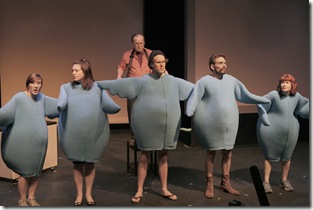 dressed in blue bird suits, evoking the Twitter logo. We weren’t just trying to be funny (though god I hope we were). We were saying, “Obviously we can’t give you the literal truth. Pay no attention to the blue bird suits if you don’t want to, but every (often idiotic) word these actors declaim was actually tweeted over that 3-day ordeal.” (Here‘s a segment on this section by Seattle’s NPR affiliate KUOW did .)
Not only did Mike refuse to use watermarks, he actively defumigated the theatre of all its delicious anti-sanctity.
“… Mike told at least me time and time again [that the story] was true. He insisted that “This is a work of non-fiction” be printed in playbills.”
— Alli Houseworth,
former marketing/communications director
at Woolly Mammoth Theatre Company.
(You can read her excellent essay by clicking here.)
Mike didn’t want a watermark within a mile of any house he played. He wanted us to believe every word he charmed us with. And now he encourages his defenders to ridicule and condescend to the very people who took him at his word. “We are all liars and hypocrites,” says Mike. There is something particularly vicious about the man who would punish others simply for being the victims of his sins.
Act Like it Matters
The worst thing I heard in response to Daisey’s dishonesty was this from a friend of a friend on Facebook:
“I never believe you theater folk – you’re a rascally bunch.”
Yeah, we’re rascally. But sometimes we are able to illuminate stories that journalists themselves are not willing to touch, like when NewsWrights covered the closing of the P-I. And sometimes we are able, like Daisey, to tell a story like Agony/Ecstasy, in such a moving way that we inspire people, perhaps otherwise impossible to inspire, to action. However, in order to poach a bit on journalism’s turf we have to be trusted. Do we really want to give up this wonderfully fertile ground just because Mike Daisey lied and then excused his lies as so much “theatre”? Do we really want to let him claim sanctuary in our church where we have established traditions stretching across millennia of being scrupulously honest about our dishonesty?
In answer to this question, the silence from big house artistic administrators so far has been pristine. Clearly theatre has a leadership vacuum in addition to its identity and relevance crises. No one seriously denies that we are simply not producing enough new, fresh, locally sourced material to keep our audiences engaged like Shakespeare’s were, or even Shaw’s. Projects like Daisey’s and NewsWrights United’s help mitigate the problem, but only if we take the issue of truthfulness seriously. We have to act like it matters. We have to show our audiences that we give the issue of truth consideration and respect, or they will walk away from us forever.