Just Wrought

Recovering playwright, once won a STRANGER Genius Award for theater. Now writing a bloated novel about… G-d help me! Theatre.

Tag: Living Newspaper

  • Please Let the Daisey Debacle Mean More Theatre/Journalism, not Less.

    Please Let the Daisey Debacle Mean More Theatre/Journalism, not Less.

    A lot has already been said about the revelation that Mike Daisey fabricated many portions of his one-man show, The Agony and The Ecstasy of Steve Jobs: a piece he previously passed off as entirely truthful reportage, most egregiously on This American Life, a nationally broadcast public radio program. I leave it to wiser minds to sort through all but one of the many questions Mike’s transgressions raise, reserving for scrutiny only that which I feel I am particularly qualified to examine: what impact will Mike’s dishonesty have on the intersection of theatre and journalism?

    A huge number of people are familiar with Daisey’s work creating and performing topical monologues at some of the most prestigious venues in America, from the Seattle Rep to New York’s Public Theatre to the Woolley Mammoth in Washington, D.C. A much smaller number of people know of the work produced by NewsWrights United, a theatre company I co-founded and serve as Executive Director. We dramatize news using a form invented in the early 20th century called the living newspaper, and all of our stories are researched and written by local Seattle playwrights. (Memorable examples include Scot Augustson staging the farcical misadventures of a reporter/photographer duo sent to Detroit a week early to cover the Seahawks only Superbowl appearance; and on the serious side, Pamela Hobart Carter’s lyric poem/play about the psychic damage done by the Green River Killer.) On first appearances, NewsWrights United and Mike Daisey seem to occupy similar territory in the art/news nexus, but in actuality I believe we do something fundamentally different, and if I can tease apart for you these differences, I earnestly hope to convince you that coverage of news in the theatre is something worth saving even if Mike Daisey’s methods are not.

    I predict two reactions to this crisis from artistic administrators at U. S. regional theatres. The first is already in evidence. Institutions that have already booked Mike will mostly stick with him, echoing his essential tack: “Yeah, lying to the public radio program TAL was wrong, but lying in the theatre is obviously eminently forgivable. After all—heck!—isn’t all theatre lying?” Artistic administrators are not widely known for the courage of their convictions, however, so I further predict that over the next year or two, while the controversy dies down, they will quietly divest themselves of as much Daisey stock as possible, so long as it doesn’t cost them too much to dump it. What’s worse, I also predict they will take the dreadfully wrong-headed step of underscoring this divestment with an abandonment of all new work that explores the intersection of theatre and journalism. (The exception to this new silent ban will be, perversely, Mike’s inevitable one-man apologia, which regional houses will be falling over each other to stage.)

    But forsaking the theatre/journalism intersection does not have to be our future. With hard work, honest self-examination and courage we can take this opportunity not to withdraw but advance the genre. As a once and, with luck, future practitioner of news theatre, I venture to offer some practical advice on how we might achieve this.

    Expand the Pool

    Beyond his extraordinary talent as a storyteller, Mike’s shows appeal to regional theaters across the country because they are cheap and easy to mount. Most important, they are portable. If you are looking to plug a little topicality into your otherwise staid season, you cannot do it more easily than by giving Mike a call.

    Living newspapers are much more difficult. To create effective alternatives to the Daisey Debacle, you have to give up some of the conveniences of the one-man show; most crucially, you have to give up the idea of “one-man.” Actual plays are vast collaborative efforts, featuring dialogue among and between more than one player on stage. The play development process contains a built-in organic vetting process that zeroes in on “truth” even when the story, like Agony/Ecstasy, is more accurately classified as fiction.

    For instance, I am working with Rebecca Olson’s project Custom Made Plays to develop a script for her and another actor. Every week I sit in a room with them and the director, carefully combing through the script with questions. The process is gentle but relentless, and when a false note gets rooted up, we pounce to replace it with something more “honest.” Many of the moments in Agony/Ecstasy that Daisey promised us were real were not. In retrospect, they reek of bad fiction now that we know that is exactly what they are.

    I reach into my satchel, and I take out my iPad. And when he sees it, his eyes widen, because one of the ultimate ironies of globalism, at this point there are no iPads in China. …. He’s never actually seen one on, this thing that took his hand. I turn it on, unlock the screen, and pass it to him. He takes it. The icons flare into view, and he strokes the screen with his ruined hand, and the icons slide back and forth. And he says something to Cathy, and Cathy says, “He says it’s a kind of magic.”

    Daisey’s a fine writer and I have no doubts he could have avoided this tripe, offering instead something genuinely brilliant, if he had only admitted it was fiction in the first place and then collaborated with performers and a director to sharpen it.

    Living newspapers expand the pool in more than one dimension. Beyond just other actors in the room, you must also let in other writers. How much would anyone trust a newspaper with only one reporter who also served as the sole editor? NewsWrights United engaged several local playwrights for its living newspaper about the demise of the actual newspaper, The Seattle Post-Intelligencer. By spreading the attack, we were able to cover a number of different beats—sports, politics and arts coverage at the P-I—in a wonderfully varied spectrum of styles, some of which implicitly “watermarked” their stories as fictionalization (but more on “watermarking” later.) Using more artists allows you to cover more kinds of stories, leading to another way to better provide theatrical news…

    Up Your Local Content

    It certainly was exciting to watch “David” Mike take on “Goliath” Apple from the stage of my local regional theatre; and certainly my local regional theatre enjoys, along with regional theatres across the country, the imprimatur of international relevance when such a story as Agony/Ecstasy gets told.  However, we lose a huge opportunity when our big houses keep mounting the very same one-man show, instead of staging local news that actually has as much, if not more, to do with the lives of local audiences as does Applegate. Let’s dare to flip the model and have each theatre produce its own living newspapers, telling stories about their own communities, and sure, plugging in national stories such as those Mike tells when appropriate.

    I promise you: locally grown journalistic theatre is not only doable, it’s been done. In NewsWrights United’s last effort, The New New News: A Living Newspaper, we locally sourced nearly all of our stories about the crisis in journalism brought on by the digital age. Our play It’s Not in The P-I: A Living Newspaper about a Dying Newspaper gave voice to locally beloved P-I reporters so that a community eager to hear their tales finally had the opportunity that no other medium would give.  We also broke important exclusives into the buy-out process that the Heart Corporation used to cherry-pick and union bust their newsroom as they shuttered the print version of The Seattle P-I and moved to an all on-line edition.  It didn’t hurt that one of our founding producers, Tom Paulson, is a professional journalist, formerly the P-I’s science reporter, and currently writing for NPR’s Global Health site, Humanosphere.

    Use “Watermarks”

    Not everything that takes place in a theater is theatre. If this is news to you, you might not be to blame. The theater = theatre fallacy is happily perpetrated by artistic administrators to fill their seasons with the easiest fare to produce. (Click here to see my essay on this.) True theatre is rife with “watermarks” built into both the text and context of a play to remind you, sometimes explicitly but mostly implicitly, that what you are seeing is to some degree false.

    “Watermarks?” You say. “How come I’ve never heard of these watermarks before?” Well, for two reasons: One, I just started using the term in a theatrical context about a week ago when I was trying to explain why Mike should not be allowed to take refuge in our art form. Two, watermarks are so endemic to theatre that we tend to look right through them, like reading glasses. The Greeks used masks as watermarks. Shakespeare and his contemporaries stitched their plays out of the watermarking fabric of Iambic pentameter. Not a single tradition within our grand form lacks them, but an exhaustive list is superfluous to this argument, because the definition of theatre is the ultimate watermark: two or more people staging a live dialogue (before you ask, no, it doesn’t have to be with words) within the physical perception of other people. Think about it. Someone tells you a story on the street. She could be lying. She could be telling the truth. But two or more people obviously acting out a story in front of you? Without question there’s some tomfoolery going on here.

    Of course there is an important stipulation implicit to the tradition of tomfoolery and even blatent dishonesty in the theatre: we demand ardent honesty about our dishonesty. We tell you were going to lie, before we do it, while we do it, and after we do it.

    If we shadows have offended,
    think but this; and all is mended
    that you have but slumbered here
    while these visions did appear 

    When you reach the certainty that we paltry players are lying, you can begin to understand that we are actually telling the truth. Daisey could have easily entered this tradition. He could have done all the good works he claims to have hoped to have done within it. Instead he took the risk that selling fiction as non-fiction would get him further. It did. But he got caught. And now he’s run back into our house claiming sanctuary. Brother Daisey has forgotten that theatre’s unwritten canon is as unyielding as the ecclesiastic: the crimes of the church can be punished within the church. If he wants sanctuary here, he will have to work hard and long at his penance.

    Here’s a simple rule of thumb about watermarks: a theater (i.e. the venue) cannot serve as a watermark; theatre (i.e. the work of art) must contain the watermarks that prove it false, and thus prove it true theatre. Otherwise you’re just some guy telling me a story and if you tell me explicitly that what you’re saying is true, I am likely to take you at your word.

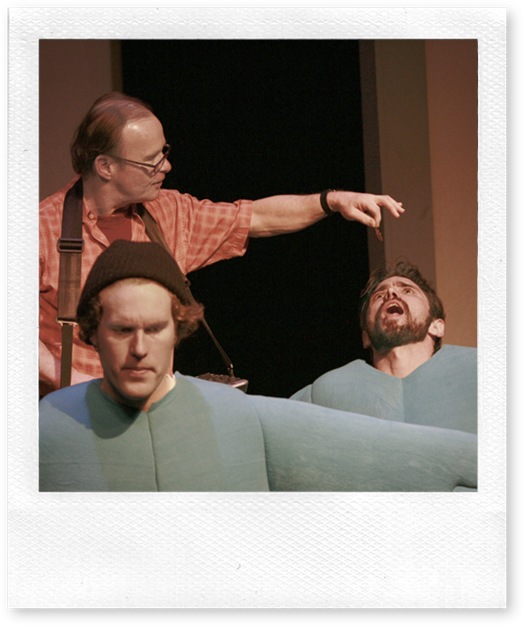
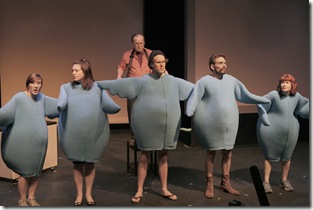
    A living newspaper has an even greater obligation than conventional theatre to watermark early, often and obviously. For example, when we staged the Twitter stream of the Maurice Clemmons manhunt (He killed four Puget Sound cops in cold blood), we did not alter a single word of the tweets, though obviously, since there were over five thousand, we had to whittle them down considerably. We knew we could not give an accurate portrayal of what it was like to witness this stream in real time. No one could. Not only was it a moment passed, but in a way it was a meta-moment. No one person witnessed it in its entirety. So we posited the next best thing. We staged the stream as a symphony of actorsNEW NEW NEWS Twitter Chorus, Photo by Chris Bennion dressed in blue bird suits, evoking the Twitter logo. We weren’t just trying to be funny (though god I hope we were). We were saying, “Obviously we can’t give you the literal truth. Pay no attention to the blue bird suits if you don’t want to, but every (often idiotic) word these actors declaim was actually tweeted over that 3-day ordeal.” (Here‘s a segment on this section by Seattle’s NPR affiliate KUOW did .)
    Not only did Mike refuse to use watermarks, he actively defumigated the theatre of all its delicious anti-sanctity.

    “… Mike told at least me time and time again [that the story] was true. He insisted that “This is a work of non-fiction” be printed in playbills.” 

    Alli Houseworth,
    former marketing/communications director
    at Woolly Mammoth Theatre Company. 
    (You can read her excellent essay by clicking here.)

    Mike didn’t want a watermark within a mile of any house he played. He wanted us to believe every word he charmed us with. And now he encourages his defenders to ridicule and condescend to the very people who took him at his word. “We are all liars and hypocrites,” says Mike. There is something particularly vicious about the man who would punish others simply for being the victims of his sins.

    Act Like it Matters

    The worst thing I heard in response to Daisey’s dishonesty was this from a friend of a friend on Facebook:

    “I never believe you theater folk – you’re a rascally bunch.”

    Yeah, we’re rascally. But sometimes we are able to illuminate stories that journalists themselves are not willing to touch, like when NewsWrights covered the closing of the P-I. And sometimes we are able, like Daisey, to tell a story like Agony/Ecstasy, in such a moving way that we inspire people, perhaps otherwise impossible to inspire, to action. However, in order to poach a bit on journalism’s turf we have to be trusted.  Do we really want to give up this wonderfully fertile ground just because Mike Daisey lied and then excused his lies as so much “theatre”? Do we really want to let him claim sanctuary in our church where we have established traditions stretching across millennia of being scrupulously honest about our dishonesty?

    In answer to this question, the silence from big house artistic administrators so far has been pristine. Clearly theatre has a leadership vacuum in addition to its identity and relevance crises. No one seriously denies that we are simply not producing enough new, fresh, locally sourced material to keep our audiences engaged like Shakespeare’s were, or even Shaw’s. Projects like Daisey’s and NewsWrights United’s help mitigate the problem, but only if we take the issue of truthfulness seriously. We have to act like it matters. We have to show our audiences that we give the issue of truth consideration and respect, or they will walk away from us forever.

  • Long Live Living Newspapers!

    Long Live Living Newspapers!

    When The Stranger asked me at the end of the year what my biggest regret of 2011 was, I said:

    I regret that due to limited resources, we had to mothball NewsWrights United prior to the Occupy movement blowing up, because I would have really liked to cover that in a living newspaper. Adjacent to that is my regret that none of the big houses in Seattle (or small, for that matter) saw fit to include making topical theatre, based on events happening right here right now, as part of their regular programming this year. 

    Well, shade my regret mitigated by the news from across the pond that my former playwriting student German Munoz has organized a living newspaper about the Occupy movement called The Occupied Times.  After spending a month researching and visiting the Occupy sites in London, emerging playwrights will present a night of short plays in the format of a living newspaper. They will act as reporters and cast a critical eye on the Occupy movement, its supporters and detractors, all under the Arcola Tent. 

    And color me even more vividly gratified when I saw that the project gave Seattle a shout-out in their press release:  “This project was inspired by It’s not in the P-I: A living Newspaper about a Dying Newspaper presented in Seattle in 2009 as a response to the closing of The Seattle Post-Intelligencer newspaper by Newswrights United.”

    Not surprisingly, The Occupied Times seems to be garnering the same sort of media excitement that the two living newspapers NewsWrights United produced in 2009 and 2011.  The London Evening Standard ran a preview of the piece   and quoted my friend German thusly:

    We want the show to explore sides of the movement that have not been heard. We’re hoping to reach people of all ages who feel they’ve made up their minds about the Occupy movement. People who either think of the protesters as a bunch of lazy hippies who don’t want to get a job, or see them as martyrs fighting the good fight against a system that is unbearably corrupt. Of course neither of these are completely true, and we want to show audiences our responses as artists and help them make up their own minds.

    I heartily encourage my friends in London to check out this fresh, locally grown theatre inspired in the crucible of the right here and the right now.  Here’s the show info:

    Six Degrees Productions presents  . . .

    The Occupied Times: A living newspaper
    about the Occupy movement

    Venue: Arcola Tent, 2-8 Ashwin Street, London, E8 3DL

    Date: Sunday 19 February, 2012

    Time: 3:00pm and 7:00pm

    Ticket prices: £12 (£10)

    Venue Box Office: 020 7503 1646 or http://www.arcolatheatre.com 

    For all enquiries and ticket requests, please contact:  German Munoz of Six Degrees Productions on 07854 231 085 or g@germanmunoz.com

    And as for my friends in Seattle, do you ever wonder why the Big Houses haven’t picked up such a wildly popular and media magnetizing idea?  Well, in fairness, maybe they will now that it is being done in London, one of the two officially approved cities for sourcing new plays.

  • Hawking Whole Theatre at “What’s Next?”

    Hawking Whole Theatre at “What’s Next?”

    Last night I joined a small but extremely energized group of theatre professionals at the second iteration of “Seattle Theatre: What’s Next?” hosted by Jim Jewell and Peggy Gannon.  I want to talk more about what was discussed and what action items came out of that discussion, but I think I will wait until Jim publishes the official minutes.  Until then, here’s a transcript of the three minute spiel that I was asked to give on what’s currently exciting me about Seattle Theatre:

    Whole Theatre

    Be careful what you wish for, sure.  But when it comes to Seattle Theater, it’s also wise to be specific what you wish for.  For a good while now Seattle’s Big House theatres have been gradually increasing the percentage of local actors they hire.  And rightfully they have then touted this change as a noble step in the direction of locally grown theatre. But let’s be honest.  We all know one of two things happened.  Either the artistic administrators of Seattle’s Big Houses all got together in a room and decided, “Hey, we should do the right thing and hire more local actors.”  Or… they all independently realized that in the current depression it was becoming cost prohibitive to fly in every actor from New York or LA.  I’ll leave it to you to decide which scenario seems more plausible.  But look, when a good thing happens it’s churlish to over-analyze the reasons for it.

    The problem is that using local actors isn’t enough.  And so when we advocate for locally grown theatre, we need to be more specific…  Whole Theatre.  Theatre that is soup to nuts local: written by local talent in collaboration with local talent.  Zero degrees of separation among everyone from the playwright to the director to the designers to the actors to the audiences. 

    Zero degrees of separation. 

    If what I am proposing sounds radical or overly ambitious, consider this: we do it all the time.  In fact, if I can brag a little, as a playwright and an actor, I have done very little in the last five years that hasn’t been Whole Theatre.  Going back to 2006, there was the Empty Space production of Louis Slotin Sonata.  When the floor needed final painting, Allison Narver was there in jeans, helping designer Gary Smoot to finish it.  I’m trying to picture one of Seattle’s Big House artistic directors doing that.  To be fair, I’m sure there are union rules against it.

    Then there was The Ten Thousand Things, which Washington Ensemble Theatre produced.  I sat in a room with the director and the designer Etta Lilienthal talking through her sketches. Later, I sat in the theatre while audience members rewrote my play one word each performance.

    And most recently there was Newswrights United producing two living newspapers, researched, written and produced by Seattleites, about Seattleites, for Seattleites.

    And of course it’s not just stuff I’m working on.  There’s the incomparable 14/48, perhaps the most consistently exciting weekend of theatre in town.  All local actors, directors, designers and crew mixing it up on plays written by local playwrights in the space of maybe ten hours, tops.

    There’s Printer’s Devil, opening yet another Scot Augustson world premiere, Shadow Odyssey in their unique committed relationship with him.

    There’s Sandbox Radio which just staged its second all original slate of short pieces, combining some of Seattle’s best actors with the best playwrights and musicians.

    And right on the horizon is Rebecca Olson’s new project Custom Made Plays, commissioning local playwrights to write for specific local actors.  I’m happy to be the playwright on the pilot play, writing for Rebecca herself and Hana Lass.

    Whole Theatre.  Theatre that hasn’t had the yummy good-for-you stuff processed out of it.  Non-corporate theatre that ain’t stale from being packaged three years ago in a theatre scene 2,700 miles away by MFA’s who have never stepped foot in your town.  Whole Theatre. Seattle’s crawling with it.  And surely it gives us the most solid shot at World Class.

    (I want to do a version of the poster that says Enjoy Whole Theatre!  Or as Shakespeare, Molière and Chekhov called it, “Theatre.”)

  • The SunBreak takes The New New News to Heart

    The SunBreak takes The New New News to Heart

    The New New News show poster 

    sunbreak logo

    Artists want their work to have impact, and certainly theatre artists are no exception.  Unfortunately, a lot of us, a lot of the time, stay caught in the trap of thinking that exquisite craft is the only way we can really move people.  After all, our stories are old, often ancient; surely we can only make them relevant by telling them so well that our audiences will be altered somehow by the excellence of our execution.  Why else would you do Of Mice and Men?  Or Hamlet?  Or All My Sons?  Most of us already know the message of these works, so the value must lie in the medium.  And so it does. 

    Please understand, I am not looking to explode the canon.  I, too, see great value in revisiting the classics over and over again.  But I also believe that there is another path to relevance available to theatre artists.  When we bring current local  issues into our theatres we replenish its vitality for effecting change in the here and now; and we guarantee its rightful place among the arts that lean into the future and not the just the past.  Theatres do not just have to be museums.

    So as gratified as I was by The Sunbreak’s very positive review of The New New News:  A Living Newspaper, imagine my even greater gratification when I saw in a separate piece these words written by the online magazine’s editor, Michael van Baker:

    I have to admit to having been inspired by The New New News to sit down and write this update on the site’s progress. The play’s argument that transparency is lacking as news is reinvented (at least as a business model) online hit home with me. We’re in one of those historical periods of exploration, financing tiny little caravels to travel uncharted paths, and it’s just plain discourteous not to leave a journal behind.

    Let me start with the more reader-relevant details before moving on to a discussion what makes The SunBreak tick, and what our online magazine plans are. 

    The New New News continues its run for two more weeks at the Theatre One Stage at North Seattle Community College.  While we at NewsWrights United understand that the piece will never join the ranks of the classics, we are nonetheless very proud of the immediacy of the stories we are telling, and the overt impact they are having in our community.  Theatre for, by and about the people of Seattle!  Market fresh, and indeed, quite perishable!  (We only have two more weeks.)

    You can check it out by ordering your advance reservations here.

  • The New New News on the Radio . . . Again!

    The New New News on the Radio . . . Again!

    The Puget Sound’s NPR affiliate 88.5 KPLU ran a segment on our show this morning,  A look at “The New, New, News: A Living Newspaper.”  You can read the accompanying text article and listen to the audio here.

    But I won’t leave you without a little teaser:

    The play also explores how long time print journalists are making their way in the world of blogs and virtual newsrooms that don’t have any firewalls separating them from the demands of advertisers.

    They pull back the curtain of online journalism and raise a lot of interesting questions.

    Mullin and Nichols say they don’t want people to take sides, new versus old, paper versus digital. But they do want us to be aware of the changes happening in journalism, and to question these changes so we can make the profession better. They say that if the public does not take these changes seriously, our democracy could eventually suffer.

    We have finished up our West Seattle and Capitol Hill runs, and now only have two weeks left at our home base in North Seattle.  So get your advance reservations now by clicking here

    (You can click here to listen to KUOW’s earlier piece on The New New News.)

  • The Early Scoop on The New New News

    The Early Scoop on The New New News

    The early news on The New New News is in… and it’s good!

    In Mónica Guzmán Preston’s post over at Intersect, “My favorite moment from the @newswrights play ‘The New New News” (a meta- media laced headline if there ever was one), she describes:

    … one of those moments in storytelling where, in ways you couldn’t have predicted, disparate elements of narrative and meaning all come together.

    For this longtime fan of the much misunderstood mass microblogging service, it was fantastic.

    I am one NewsWright who is delighted that Monica enjoyed the show, especially since she helped us so much in the early phases of our research, suggesting leads, pointing us toward whole new stories to run down, inviting us into her “meet-ups”.  We do wonder, though, if she recognized herself in any of the characters.

    * * *

    Jose Amador, at the Seattlest says:

    There’s nothing about News that’s passive, or simple; very little that is formulaic… which is unusual and welcome in an age where everything can and will come to you. At the end of the night… one is rewarded with an excess of interesting thoughts about the world we inhabit….

    * * *

    And then The Stranger’s Brendan Kiley chimed in.  He hasn’t seen it yet, but that doesn’t stop him from recommending it:

    ….[NewsWrights United] put together The New New News—about the rise of local blogs, how the Seattle Times got a Pulitzer Prize for its readers’ Twitter coverage of the Maurice Clemmons manhunt, and what happened to Art Thiel when he started his own blog and had to get tangled with selling his own ads. Judging by their last effort and the seriousness of their material, The New New News should be scarier than the ersatz Mack the Knife.

    * * *

    I particularly enjoyed Rosemary Jone’s interview at Examiner.com because it gives NewsWrights United’s Managing Producer, Jim Jewell a chance to say why he believes in the work we do.

    Right now, theater looks to me like newspapers in the 90’s, watching changes all around them and somehow believing themselves above the change, too venerable to fail. We spend too much time in the theater talking about what theater is instead of actively engaging the form and deciding what it will be, and we aren’t too far from the crisis newspapers have found themselves in: failure to evolve.

    * * *

    So what does all this good news for NewsWrights mean to you?  Well, for one it means that if you had hoped not to leave Capitol Hill to see the show, you better order your advance reservations soon.  We have only one week at the Erickson, and it starts tonight.   The following two weekends will be staged at Theater One on the North Seattle Community College campus (advance reservations for those performances here).

    Of course, you can always risk walking up because we always hold back a quantity of pay-what-you-can seats.  You just  have to ask yourself, are you really cheaper than the majority of your Capitol Hill neighbors?  If so, show up early.  All evening performances start at 7:30 pm.  The matinee is at 2 pm.

  • What is Going on in this Pic?

    What is Going on in this Pic?

    Gee I wish I could tell you, but then you might think you don’t need to come to The New New News: A Living Newspaper, and that would be so so wrong.  Because you do need to come.  We open FRIDAY!  Book your reservation now so you you too can get a taste.

  • On Institutional Arrogance

    On Institutional Arrogance

    Seattle has already lost the print edition of the Seattle PI and the … The Empty Space. We need to fight against the Darwinian trend of saying that only the strongest survive, and take action against the slow erosion of the cultural tapestry of Seattle. We are a city that prides itself on its intellectual acuity.

    Kate Whoriskey
    Artistic Director of the Intiman Theatre

    I am often accused of arrogance.  The aspersion does not bother me much.  I try to remind everyone who will listen that the last thing they should be looking for in a playwright is reticence.  Dramatists can be wrong—often are— but after all boldly framed public dialogue is what we wright when we write.  Institutional arrogance, however, is an all together different, more heinous sin.  My recent work blurring the line between journalism and theatre with NewsWrights United has opened my eyes to the prevalence of this poisonous phenomenon in both fields.

    Back in June 2010, at a panel on monetizing on-line news David Boardman, the Managing Editor of The Seattle Times, made a stunning statement about the recent death of his former competition, The Seattle Post-Intelligencer, “The reality is: it’s not like something was lost.”  This is not the first time someone at The Times has gone out of their way to kick the corpse of The P-I.  If you choose to watch the video (Boardman makes his remarks at timestamp 52:50 in the video provided below) you will notice that the journalism insider panelists barely blink at Boardman’s chilling dismissal of Seattle’s longest running daily newspaper.  In fairness, they might have been reluctant to register the churlishness of one in the rare position to offer them a paying job in their chosen field.  (As a playwright I have long since been liberated from this kind of fear, since no artistic director is willing to pay me, or any local playwright, at a rate comparable to even what an Equity actor makes, let alone a living wage.)

    The Seattle Times survives through the idiotic exigencies of fate.  It could have easily been the other way around, and in their hearts they know it.  The jury remains out on newspapers.   So “Fairview Fanny”, as The Times is traditionally nicknamed, would do well to watch her step in the cemetery lest she dance into her own grave.

    The chasm gapes even wider and closer for The Intiman Theatre, one of Seattle’s three Big Houses.  In a recent email to everyone in their database the Intiman made it clear that unless a half a million dollars is raised by the end of March, and then another half million by September, the theatre will cease operations.  In the business, we call this a “shoot-the-puppy” campaign: a deeply desperate move, fraught with risk, but also deeply arrogant.  At its core the implicit message is:

    Our survival matters so much that you should overlook our ineffectuality, our malfeasance, our self-dealing, our cowardice and even the very arrogance of this plea.  We matter more than the artists we underpay.  We matter more than the audiences we fail to reach.  We matter more than the smaller organizations you will not be supporting so that you can help us survive, because we must survive and you must pay now for nothing more than the chance to watch us live another day.

    Allow me to honor the clarity of Intiman’s ultimatum with some clarity of my own: I hope they die.   I hope they do it soon and with a minimum of suffering.  And most of all I hope they do it without siphoning precious funds from the rest of us who make theatre in the Pacific Northwest.

    In her note on the Intiman’s blog which I quoted at the top of this post, Artistic Director Kate Whoriskey invokes the ghosts of The Empty Space and The P-I as if she actually suffered their loss instead of showing up on the scene quite recently and long after those beloved institutions succumbed.  She merrily previews the upcoming season: “I will be directing my husband in The Playboy of the Western World,” assuming we would be delighted by this nepotism.  She must imagine we were similarly delighted when we learned that she had been hand-picked for her position by her predecessor Bart Sher without any input from the community, the patrons, and very little, it seems, even from board  “Without the Intiman, will we be as strong?” she implores in closing.  And all I can think of is the Lone Ranger joke.  He and Tonto are surrounded by a band of Apaches.  He says, “Looks like we might die here, old friend.”  And Tonto replies, “What’s this “we” shit, Kemosabe?”

    Seattle theatre is alive and thriving.  Buy me a beer and I will name you at least 100 theatre organizations in Western Washington more deserving of your donation than the Intiman.  For now I will give you three for free and attempt to tier them to your tastes:

    • If you like raw gusty innovative new stories which actually take place here now in Seattle, then support the project for which I currently serve as Executive Producer, NewsWrights United.  We are world premiering our second edition The New New News: A Living Newspaper this Friday.  Our ticket prices are considerably more affordable than the Intiman’s.  If you can’t make the show, you can still support us here.  (I don’t hate our odds of surviving past September.)
    • If your tastes are more conservative, but you still want to support a smaller endeavor; if you love the classics and want to see them done with verve, talent and bold new insights, support Seattle Shakespeare Company.  They have a production of Three Penny Opera coming up that I am itching to see, since it’s by my favorite German playwright and it stars one of my favorite undersung Seattle actors, John Bogar.   You can donate to Seattle Shakes here.
    • If your tastes are still more conservative, and/or you are rich enough to consider such smaller theatres beneath the consideration of your largesse, give some money to A Contemporary Theatre.  The day before Intiman sent out its desperate plea, its fellow Big House downtown  announced that for the second year running it had booked a budget surplus.   You can donate to an already healthy ACT here.

    All three of these organizations prove that at every level of operations we can do better than what the Intiman has been doing.  We know this in our hearts.  What we do not know is if the Intiman can do better than what the Intiman has been doing.  I tend to doubt it, and that is why I believe it is time to let it die.

    Please do not misunderstand me.  The shuttering of the Intiman represents a loss nearly as terrible and irrevocable within Seattle’s cultural ecosphere as the loss of the P-I is within Seattle’s journalism world (Mr. Boardman’s fear-born callousness notwithstanding).  I will not dance on the Intiman’s grave.   But I will also not be a party to keeping the institution on life support past the time of its viability, especially when doing so means diverting funds from theatre arts organizations that have been more successful in reaching and expanding their audiences, like, frankly, NewsWrights United, Seattle Shakespeare Festival and ACT.

    The Intiman has been arrogant for a very long time.  If Kate’s note is any indication, they have no intentions of improving their tone-deaf messaging.  They want you to believe this current crisis was the fault of one lone mismanaging scapegoat.  But as Michael Strangeways pointed out on the SLOG comments board: “Brian Colburn… didn’t steal the money, or spend it. Years of overspending and waste and the laziness of the Board has led to the woes of Intiman. It wasn’t one man/woman, but many, including fair haired child Bart Sher.”

    Losing the Intiman will be a tragedy, but we will survive.  We can even hope to be a better community for it in the long run, if we guard against institutional arrogance.  We need to remember that artists matter more than institutions, that audiences matter more than funders, that plays matter more as works of art than career stepping stones.  As Mark Handley, author of Idioglossia, remarked on Face Book:

    I’m too much of an evolutionist to take this seriously. Every one of the theaters that produced me as a young man are gone, squeezed out by creeping provincialism. People seem to think that this is ALL (read: $60 ticket, NY director, LA actors) or NOTHING (as in: nothing, gone, kaput, out of business) is the way to go… *sigh*

    So yes, harsh as it sounds: please let the Intiman die with dignity.  Its time is done.  In its place, let’s build something new, local and accountable.  We actually already have the pieces in place for that.  The Intiman will not live to see the promised land, but if Kate Whoriskey is serious about making Seattle her home– claiming its unique triumphs and defeats as hers too– then perhaps she will still be living here when we finally grow into a “world class” theatre town.

    * * *

    (Above is full video of the panel discussion “Town Square: Revenue Models in the Changing Media Landscape”  from which I referenced David Boardman’s glib remarks about the death of  The Seattle Post-Intelligencer.  If you dare, surf a little past the Boardman quote and you can see me holding Publicola’s Josh Feit’s feet to the fire on his equally glib Pollyannaish assessment of arts coverage in the current environment.  If you decide to watch the entire event, you will witness the nearly monolithic patronizing attitude of the panel (David Brewster excepted) to questions from an audience who is clearly not buying their uniformly optimistic outlook.  Oh, journalists love the concepts of honesty and transparency, as applied to others.)

  • #WAshooting on the Airwaves

    #WAshooting on the Airwaves

    image

    Seattle’s NPR affiliate 94.9 KUOW will be running an interview with me and Jeremy Richards about a story NewsWrights United stages in The New New News: A Living Newspaper about the Twitter coverage of the 2009 Maurice Clemmons manhunt, now infamously known as the “WAshooting Feed”.  The segment will air on the radio on Saturday, February 12 at 12:06 pm PST, but the sneaky tech-savvy listener can access it now and forever at “Tweeting the Manhunt”.  I welcome your thoughts.  (But I already know that I talk to fast.)

    The show itself premieres on Friday, February 18, in West Seattle at Olympic Hall at South Seattle Community College.  Advance reservations can  be made here

    We will also be delivering the “paper” to North Seattle (click here) and Capitol Hill (click here) locations.  Don’t miss it!

  • Maurice Clemmons is in the Air

    Maurice Clemmons is in the Air

    Over the last 48 hours on-line news sources have exploded with fresh stories about Maurice Clemmons, the prematurely released Arkansas felon who, on the Sunday after Thanksgiving, 2009, walked into a coffee shop outside Tacoma, Washington and murdered four Lakewood Police officers as they drank their morning coffee.  Clemmons then led law enforcement on a two-day wild goose chase throughout Western Washington before being shot dead in Seattle by a lone cop.  In those two days it became clear that local journalism would never be the same, not in Seattle, not anywhere.

    It is this very urgent transition which we cover in our latest production The New New News: Living Newspaper, investigating the on-line reportage of the Clemmons Manhunt in a section we call “#WAshooting” after the Twitter hashtag used to track tweets concerning the ongoing chase.  We are fairly certain that our upcoming opening, (Friday, February 18) has exactly nothing to do with the recent rash of articles about Clemmons, but we welcome the renewed interest in the case nonetheless, and not just because it might cause the curious to check out our show.  The story of Maurice Clemmons will not go away, nor should it, because its implications affect the future of Western Washington, U.S. national politics and the nature of journalism across the globe.

    Certainly the once-and-possibly-future presidential candidate Mike Huckabee is hoping we forget about Clemmons.  While Governor of Arkansas, Huckabee granted clemency to the 8-time felon, who otherwise would have been incarcerated until 2015, in part because Clemmons claimed in his application that he came from “a very good Christian family.”  (One need not wonder what Huckabee’s decision would have been if instead “Muslim” had been the adjective modifying the subject of that clause.)

    Likewise, it is not hard to trace a deterioration of relations between Western Washington police and the communities they serve since Clemmons’ murderous rampage.  Had Maurice never left his Arkansas prison would Seattle Police Officer Ian Birk have given Native American wood-carver, John T. Williams, more than four seconds to put down his carving knife before shooting him dead? 

    We will never know the answer to that, but we do know with certainty that active crime investigations will never be covered the same anywhere in the future.  From now on, journalists, law enforcement, regular citizens, and yes, even criminals, will all be privy to instant information, some of it deeply flawed or downright false, as it emerges on Twitter or whatever tool we will be using to share data.  We examine this fundamental shift in The New New News.  I could tell you how, but really, I’d rather show you.  The first copy drops on West Seattle’s doorstep a week from Friday.  Why not order your “subscription” now?

    Cross-posted at NewsWrights United: The Blog.