Just Wrought

Recovering playwright, once won a STRANGER Genius Award for theater. Now writing a bloated novel about… G-d help me! Theatre.

Tag: Locally grown new plays

  • Locally Grown Gains a DC Advocate

    You need to check out D.C. playwright Gwydion Suilebhan’s brilliant new essay, “Theatrical Biodiversity. Seriously. Click here. Take the time to read it all the way through.  It’s hard for me to express how gratifying it is to see a fellow theatre artist so  effectively articulate why he is joining the locally grown theatre movement.  Fresh and fierce, Suilebhan’s voice achieves an eloquence that has eluded me in these discussions.  Witness him bring the rigor of science to his metaphors:

    In the same way that all the corn we eat in America now comes from a small number of genetic strains owned by a small number of huge agribusinesses, we now experience theater made largely by artists from a small number of graduate programs who live in a small number of huge cities…. We have lost, or may be at least losing, our artistic biodiversity.

    … That’s bad for a lot of reasons. … A mono-culture (either agricultural or artistic) is vulnerable. If a new pest or blight emerges to which the one predominant strain of a crop is vulnerable, we all starve. What then might happen to the American theater, then, if it’s threatened by a similar pest or blight? Or has it already? Has the accessibility and quality and ubiquity of television and film, for example, turned theater into a “gourmet” entertainment that only a few well-heeled diners can afford to consume?

    And watch him bring even more rigor to targets that take us beyond the status quo:

    …In a healthy theatrical ecosystem, one that doesn’t suffer from the weaknesses of a mono-culture, at least 33% of the plays on our stages every season will be… completely locally grown. That is to say: drafted, developed, directed, designed, dramaturged, and done by people who live and work within a reasonable distance — let’s say 100 miles, since that’s the locavore standard — of the audience members who are going to engage with it.

    And maybe 33% isn’t enough.… But [it] is a start. Right now in DC — a theatrical community that’s considered fairly healthy, nationwide — we’re at about half that level….  New York, Chicago, and likely LA are almost certainly higher than that, but…is St. Louis — just to pick a city at random — even close? What about Mankato, MN, or Decorah, IA?… My guess is the numbers don’t look good.

    And what about Seattle?  What are our numbers?  And what sort of future benchmarks for locally grown works can we get ACT, The Rep, Intiman, and all the houses in smaller tiers to commit to?  I think Gwydion might agree that hothouse development workshops, from which scripts never see the light of full production, don’t count as a viable or sustainable source of theatrical nourishment.

    However, Suilebhan’s admonishments aren’t reserved solely for feckless, floundering artistic administrators.  We playwrights come in for some rightful tweaking too:

    … We need to write plays that wrestle with the everyday concerns and the specific interests and particular longings of our audiences. We need to understand our neighbors — to be among them, to be members of our communities — in order to give them what they need. (Which is not the same as what they want. We all want doughnuts; we do not need doughnuts.) We need to start writing for the family next door, not for a nameless artistic director in Manhattan.

    To you status quo clingers that clutched faith that I had given up and gone permanently quiet about the necessity of locally grown organic theatre, your prayers may be getting answered ironically.  Others are coming to the struggle: smarter and better spoken.

    .…We’d be establishing what the biologists call semi-permeable membranes between them in order to regulate what gets in and what gets out. In effect, if we embraced a locally grown cultural development approach, the American theatrical ecosystem would become less of a top-down hierarchical structure controlled by centralized authorities and more of a distributed network of peers. Just like, oh, everything else that’s succeeding in the world at the moment.

    With folks like Gwydion joining the fray, the word you are now looking for to describe progress toward a locally grown American Theatre, exploding Manhattan’s hub-and-spokes model, is “inexorable.”
  • Simultaneous Publication: Legit Experiment or Hat on a Hat?

    Simultaneous Publication: Legit Experiment or Hat on a Hat?

    Sometimes when you risk a lot with a piece of art, it pays to find ways to risk even more. Or at least that’s the counter-intuition behind the newest wrinkle in the Custom Made Play Project. A couple days ago a box arrived at my house containing exactly fifty copies of my soon-to-world-premiere play Ballard House Duet. Given the unique circumstances of its development (which I blog about in some detail here), the idea light-bulbed to offer a published version of the play simultaneously with its world premiere production.  After all, we custom made this play for two local actors, Hana Lass and Rebecca Olson: a Seattle story for Seattle audiences in the purest vein of locally and organically grown new theatre.  What better way to underscore how we are trying to change the way plays are made than to offer tangible printed proof of the pudding for sale.

    So I emailed my friend and colleague Jason Aaron Goldberg, president of Original Works Publishing in Los Angeles.  OWP publishes acting edition scripts and licenses productions of plays by “bold, original, and adventurous playwrights from around the globe.” I currently have three plays in their catalogue:  An American Book of the Dead* – The Game Show†, The Sequence, and The Good Ship Manhattan.  Other Seattle playwrights have plays with OWP as well. For example, Elizabeth Heffron’s Mitzi’s Abortion received some strong productions around the country after OWP’s decision to publish it. 

    I think it is fair to say that Jason was less than enthused by my idea. He told me OWP had looked at simultaneous publishing before, but never pulled the trigger. They prefer for a play to have a production history in advance of publishing it. This only makes sense. Productions work the kinks and flaws out of a play, not to mention garner reviews from which you can pull quotes for the script’s back cover. I, however, pressed my proposal. I agreed to absorb the financial risk of printing the scripts if OWP was willing to risk a bit of its institutional reputation on the experiment. Jason graciously agreed.

    So now you get to vote on whether this experiment succeeds or fails. I have 45 scripts to sell, each individually numbered and personally signed by me. I have priced them nearly a buck cheaper than what OWP sells my scripts for on their website.  If we do another publishing run of Ballard House Duet, they won’t be sold by me, won’t be signed by me, and won’t be part of a limited numbered edition: so why not buy one now while it’s cheap and special?

    Here are the ways you can buy, in descending order from best to next next best:

    • Go buy your tix to the show now (click here), then buy a script at the door.  (While supplies last.)
    • Ping me with a way to send you my snail mail address.  Once I do, send me a check for $10, and I’ll send you back a script.  (I’ll eat  the postage on this option.)
    • Buy a script on Ebay by clicking here, for $10 plus postage.  (This option allows PayPal.)

    Vote now: the simultaneous publication experiment: success or failure?

  • Bespoken Word

    Bespoken Word

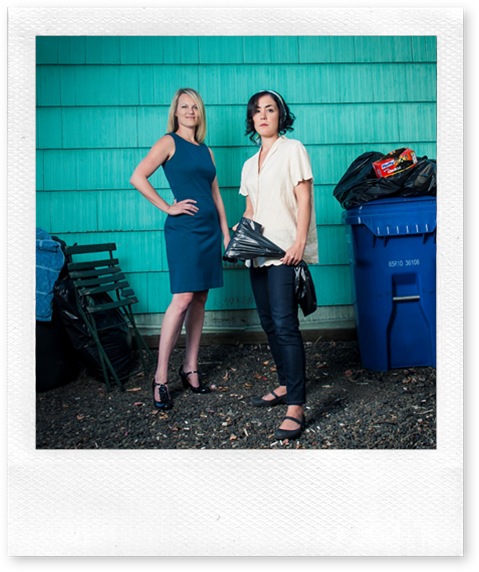
    Have you ever had clothes custom-made for you? I have never been rich enough to afford such a luxury; but theatre, never ceasing to infuse my life with ironies, provided me once with an opportunity to have a pair of 16th Century “pumpkin-pants” plus doublet perfectly cut and stitched to my then much slimmer proportions for a run as Berowne in Love’s Labour’s Lost. Rich or poor, ironic or not, it is always a superbly satisfying feeling to have a something fit you like a second skin. I imagine actors must feel a similar satisfaction when roles are tailor-written for them, which is exactly what I have done for two extraordinary Seattle actors, Hana Lass and Rebecca Olson, in a play called Ballard House Duet, premiering in a little over two weeks at Washington Ensemble Theatre.

    It started with an email from Olson back in June of last year, asking if I would be interested in being the guinea pig playwright for her proposed project to develop new plays written specifically for local actors. For this first outing, she said, the actors would be herself and Hana Lass.

    I responded with interest. It certainly sounded like a strong move toward the sort of locally grown new work I had been advocating here at Just Wrought. I told her my one caveat was I wanted only to write: no producing, no promotion, no administration.  Having served as Newswrights United’s Executive Producer, and having just staged the second of two fully produced Living Newspapers, I was burned out with wearing other hats.

    Rebecca agreed to my proviso, which then left us facing the proto-existential question: how to start?  Okay, so I am writing for Rebecca and Hana, but what am I writing? What kind of characters do I build for them? What kind of story? Would the play require additional actors? Would I write specifically for them as well, or write now and cast later?  I decided to pull a trick out of my NewsWrights bag.  I set up casual interviews with each actress. I wasn’t sure what I was looking for.  Maybe it was just an excuse to indulge my nosiness without seeming too creepy.  I drafted up a list of questions which, digital packrat that I am, I still have.

    Questions for Hana and Rebecca

    What kind of roles do you get type cast in?

    What kind of role have you always wanted to play but never got a chance to?

    Do you have a sister(s)?  {Clearly I was already thinking in that vein.}

    Tell me about your relationship to her.

    If you could change one thing about your sister what would it be?

    What are your weaknesses as a performer?  Strengths?

    What are my weaknesses as a playwright?  Strengths?

    If there’s one thing you could change about Western / American Culture what would it be?

    I had a lot of fun indulging my nosiness under the guise of art.  I found out way more about Hana and Rebecca than I ever could have through casual conversation.  Crucially, I discovered that the three of us all had a close relationship with someone who suffered from the very real disease of hoarding. I seized on this as the foundation for the play, literally the ground on which my characters would play. I also confirmed through these conversations that my instinct to make the characters sisters was dead on; but it also raised a problem:  Rebecca and Hana look nothing alike, not even close.  No one would buy them as biological sisters.  “Fine. They’re adopted,” I decided.

    Next I concluded there was no up-side in expanding the character sheet.  I would focus on the two sisters, tracking them back and forth through time.  If they needed to interact with other characters, the audience would have to play them.  I was already experimenting with this technique in another, weirder play I am devloping, Philosophical Zombie Killers.  This piece for  Custom Made Play Project would give me the opportunity to test it in a more realistic framework. 

    Armed with my interview notes and my burgeoning ideas, I started to build a proto-draft, one plot point and/or dialogue scrap at a time. What I didn’t know, I left blank.  From the outset, I was determined to see these two singing.  My own sisters sang all the time in my house, as did my mother, who sang opera as a young woman, and still sings in two church choirs.  My wife also sings opera and jazz.  So somehow, on stage or off, family for me is inextricably mixed up with music: specifically female voices.

    Point by point, emerging limitations made the play grow.  This is not surprising.  Problems are a playwright’s best friend. Conflict is our soup; obstacles, the chewy nuggets we chop into it.  The unique qualities of my two performers sharpened my focus and maximized my momentum.  For the first time in a long time, there was something— or rather someone or some ones— tugging from the other side.

    Hana claims I had a first draft within two weeks of the second interview, but my rather anal-retentive record keeping shows it was more like five.  Still, that’s a damned fast turn-around for me.  The play has come a long way since this first stab, but the basic shape of the plot and the relationships has survived and expanded.

    The most remarkable aspect of the process, which I feel cannot be emphasized enough, is that Ballard House Duet simply would not exist if we three specific people had not existed and offered it some part of ourselves. Without Hana and Rebecca to build them for, Holly and Heidi simply would have never occurred to me. Not only would the story have gone untold, it would have gone unconceived.  For me that fact is fundamentally astounding and magical.

    I have no idea yet if the play succeeds or fails.  We will need an audience for that final analysis. (That’s where you come in.  Go get your tix!) What I do know is that the experiment itself was completely, utterly worth it. I encourage every playwright to give this sort of personal tailoring a try. 

    Despite how exciting this Custom Made Play Project has been, it only seems like we are doing something new and innovative. The truth is most of the plays we praise in the canon were created bespoke for specific actors. Following this old process is not immediately easy or intuitive, but in the die-press production line, hub-and-spoke distribution network that is 21st Century American Theatre, Seattle is perfectly poised in its Goldilocks perfection— not to big, not to small— to revive a method that can maximize the vitality of locally grown new works for stages across the nation.

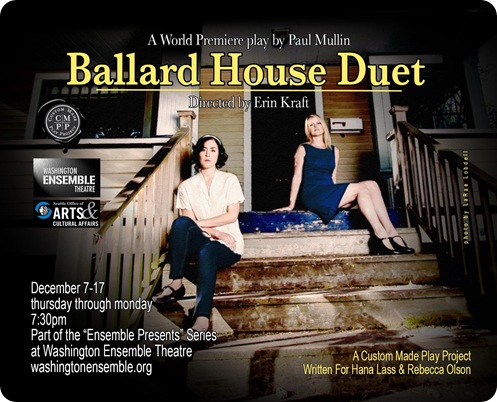
  • Ballard House Duet’s Poster is Here!

    Ballard House Duet’s Poster is Here!

    There’s nothing quite like a show’s  poster going live to underscore the message: “This sh*t is happening!”

    You can get your tix here.  (Do the math. {Small house + short run} * {dynamite cast + crackerjack production team} = early sellout!)

    You can stay up-to-date  on additional Ballard House Duet information as it comes available by “liking” the Custom Made Plays Project Facebook page here.

    And as always, I’ll do my best to keep you up to date here at Just Wrought. More fun news is on the way, I promise!

  • Ballard House Duet: Just the Facts

    Ballard House Duet: Just the Facts

    Blogging is hard. You have to keep posts short to hold people’s attention, but then a project comes along like Ballard House Duet and all I want to do is tell everyone every little thing about it. I want to describe why it’s been so important to me creatively: how it’s been so fun, but also stretched me; why I think every playwright should try custom writing for individual actors; why I think the play tells a locally grown story Seattleites can uniquely identify with; and on and on.

    I am, however, going to show some restraint, by limiting myself in this post to delivering the simple facts.  Ballard House Duet grew out of local actor Rebecca Olson’s idea to commission plays crafted especially for individual actors in Seattle. Says Olson:

    The process begins with a blank page; the actors themselves are the basis for the play, and the actors stay attached to the script from conception through performance. The project includes development, workshops and full production of the finished scripts. This model allows the playwrights to draw on the individual and collective experiences of the artists they are working with. The resulting plays are more satisfying to produce and more resonant with local audiences.

    Olson offered me the honor of being the premiere guinea pig playwright. Hana Lass is Rebecca’s castmate, and Erin Kraft leads the project as director and unofficial dramaturg (though Hana and Rebecca certainly had a hand in that as well. More on that later.)

    We kick this premiere off on December 7 (‘cuz nothing bad has ever happened on that date, right?) and run for two short weeks in a small house, so you’re gonna wanna get your tix quick, by clicking here.

    Here’s a synopsis . . .

    Heidi doesn’t say the word “adopted”.  Holly’s her full sister, even if she is half-Asian and Heidi’s all American.  Somehow Holly inherited Aunt Nana’s religion gene, while Heidi got Mom’s need to be the center of attention.  Now in their 30’s the two sisters have agreed to clear out their hopelessly hoarding great aunt’s house, but when Heidi shows up a week late, hoping to film the process for a reality show, the past and future explode, scattering the shrapnel of strong, deeply hidden betrayals and even stronger, more deeply hidden loyalties.  As they wade through a lifetime of accumulated possessions – and personal grudges – Holly and Heidi must decide: What has value and what are they better off just throwing away?

    And here are the production details . . .

    WHAT:  Ballard House DuetA Custom Made Play Project & World Premiere

    WHO:  Written by Paul Mullin  for actresses Hana Lass and Rebecca Olson; directed by Erin Kraft.

    WHEN:  December 7-17th, 2012, Thursdays through Mondays at 7:30pm; Sneak Peak Thursday Preview, December 6th @ 7:30pm

    WHERE:  608 19th Avenue East, at The Little Theatre in Capitol Hill

    TICKET INFORMATION:  Tickets are $15-$25 and are available at the door or in advance at www.washingtonensemble.org.

  • The SunBreak takes The New New News to Heart

    The SunBreak takes The New New News to Heart

    The New New News show poster 

    sunbreak logo

    Artists want their work to have impact, and certainly theatre artists are no exception.  Unfortunately, a lot of us, a lot of the time, stay caught in the trap of thinking that exquisite craft is the only way we can really move people.  After all, our stories are old, often ancient; surely we can only make them relevant by telling them so well that our audiences will be altered somehow by the excellence of our execution.  Why else would you do Of Mice and Men?  Or Hamlet?  Or All My Sons?  Most of us already know the message of these works, so the value must lie in the medium.  And so it does. 

    Please understand, I am not looking to explode the canon.  I, too, see great value in revisiting the classics over and over again.  But I also believe that there is another path to relevance available to theatre artists.  When we bring current local  issues into our theatres we replenish its vitality for effecting change in the here and now; and we guarantee its rightful place among the arts that lean into the future and not the just the past.  Theatres do not just have to be museums.

    So as gratified as I was by The Sunbreak’s very positive review of The New New News:  A Living Newspaper, imagine my even greater gratification when I saw in a separate piece these words written by the online magazine’s editor, Michael van Baker:

    I have to admit to having been inspired by The New New News to sit down and write this update on the site’s progress. The play’s argument that transparency is lacking as news is reinvented (at least as a business model) online hit home with me. We’re in one of those historical periods of exploration, financing tiny little caravels to travel uncharted paths, and it’s just plain discourteous not to leave a journal behind.

    Let me start with the more reader-relevant details before moving on to a discussion what makes The SunBreak tick, and what our online magazine plans are. 

    The New New News continues its run for two more weeks at the Theatre One Stage at North Seattle Community College.  While we at NewsWrights United understand that the piece will never join the ranks of the classics, we are nonetheless very proud of the immediacy of the stories we are telling, and the overt impact they are having in our community.  Theatre for, by and about the people of Seattle!  Market fresh, and indeed, quite perishable!  (We only have two more weeks.)

    You can check it out by ordering your advance reservations here.

  • It’s Been a Year

    I launched Just Wrought a year ago today with the essay “Towards a World Class Theatre”.  I am glad I did it, but now for reasons completely different from those I had when I started.  Back then I had no idea that through this blog I would gain the good friendship and professional working relationship I have with Jim Jewell, now the Managing Producer of NewsWrights United; or that I would get to know Lyam White, Jose Amador, and Omar Willey so much better.

    Conversely, I honestly did not suspect that I would lose some friends simply by saying publicly what I had always said to them in private bullshit sessions; but alas, this too is true, as some have conflated my arguments here about failures of leadership, courage and imagination in Seattle theater with personal aggression towards them and their livelihoods.  Some, but happily not all, or even most; because even more surprising than the estranged colleagues have been the artistic leaders who have reached out to me to say essentially, “I think a lot of what you say is crap, but I am glad you are saying it.”

    Just like nearly everything we do as artists—or really, humans— I have no idea if this project has succeeded, and I may never know.  I do not suspect for a minute that I have yet made even the slightest dent in the status quo of how theatre gets done in Seattle, but I do sometimes flatter myself with believing I have helped simultaneously broaden and sharpen the conversation.

    Of the thirteen formal essays I set out to write, I have managed to finish only five over the last 365 days.  Looking at the list now, I realize with certainty that I will never write at least three of them.  “Since When Are Directors Indispensable?” was going to point out that directors are a relatively new species in the long history of theatre, and that playwrights like Shakespeare and Moliere managed incomparable dramatic brilliance without them; but honestly, I don’t know of a single working playwright who leans more heavily on the talent of the directors he collaborates with than myself.  I literally cannot imagine producing Tuesday at Annex Theatre, or our current Living Newspapers, without Dawson Nichols, and the thought of the erstwhile Empty Space’s production of  Louis Slotin Sonata without John Langs at the helm, bringing together as he did all the amazing acting and design elements (not to mention his kick-ass choreography in the second act dance number) literally depresses me.  I could not do my work without directors, so what sort of non-hypocritical point was I hoping to make?  Perhaps only that the rising stock of the anti-collaborative idea of singular stage director auteurship, borrowed as it is from filmmaking, is a mistaken and destructive direction in theatre, especially when regional houses make season selections based on which plays will entice particular directors to work with them.  Throughout the 20th century stage directors gained power   mostly at the expense of playwrights.  The art form will regain health when that inequity is honestly addressed and steps are taken to resolve it.

    I also no longer plan to write about the deleterious arrangement Seattle theatre has with Actors Equity (the stage actors union), or how the viral nature of MFA programs for actors, directors and playwrights is weakening and rarifying our art form in this country.  I realize after this year of speaking out that as a college-dropout actor-turned-playwright, these are no longer my battles to fight.  Only the actors in this town can fix things so they have the same right to develop new works for the stage as actors in Los Angeles and New York; and only young people themselves can wake up and realize that chasing the imprimatur of higher education only takes them further away from the audiences that really need them, and that the excuse of needing a degree to make a living by teaching their craft only perpetuates the virus, while ultimately helping no one, including themselves.

    Of the five essays I did manage to write I am proud and stand by them.  Locally grown new plays do matter, and I see signs that Seattle is making more of them.  World Class Theatre does mean something, even when it cannot and should not be defined precisely.  Playwrights and designers can form some amazing alliances, and I earnestly hope for more of them, for myself and for the world of play development at large.  One-person shows are an easy way for a theaters to shirk the hard work of actually making new plays.  (All props and apologies to Mike Daisy, Jose Amador, Marya Sea Kaminski and everyone else who does such amazing solo work.  I don’t want you to stop.  I just want theatres to stop selling live story-telling  as “plays” {And yes, I understand that even that won’t happen.})

    That leaves five essays unwritten and unspiked.  The one most likely to see daylight in 2011 is “Stop trying to be Respectable, You’re in Show Business”; because I still see way too many of my Seattle colleagues cozying up for financial support and social legitimacy to the very same powerful interests that they should instead be looking for ways to indict theatrically.  I wish I had a condo payment for every time an otherwise  brilliant artistic administrator has baldly insisted to me that theatre is an elitist art form and therefore must depend on the good graces of corporations and  the upper class for its existence.  If I believed this, I would not only quit today, I would start doing everything I could to darken every stage currently producing plays in this city.  Thankfully, I know better.  As show people, we are at our best playing the dangerous fool, telling the wealthy and well-placed  who would teach us our art, what Lear’s Fool told Lear, “I am better than thou art now; I am a Fool, thou art nothing.”

    Just Wrought’s first year has been an often hectic, sometimes even bruising struggle.  Lately I have had to remind myself and others that I am an artist first, and an advocate only much further down my list of priorities.  Over the last few weeks I have been feeling a growing need to take time to lie fallow here for the sake of my creativity.  I resolve to listen more than I talk in 2011.  Of course that doesn’t mean I won’t be talking at all.

    Expanded conversations.  Bruising struggles over important ideas.  Greater clarity around the issues about which I should just keep quiet.

    Lost friends.  Gained friends. 

    It’s been a year.

  • Auditions for The New New News

    Auditions for The New New News

    All the sudden it just got very real up in this joint . . .

    Auditions for the The New New News: A Living Newspaper will take place Saturday December 11, 2010.

    If you are interesting in helping us make theatre for, by and most importantly about the people of the Pacific Northwest, then please send your headshot/resume to Managing Producer Jim Jewell at jim@newswrightsunited.org

    Project Description:

    The New New News: A Living Newspaper is the next installment of NewsWrights United’s Living Newspapers, and looks specifically at new media, journalism and the implications of monetization.

    The story follows an organization called The New New News, an online media source that covers the media coverage of Seattle. Their primary funder has given them 24 hours to double their site traffic or go under. How will the The New New News crew respond?

    The New New News will open at South Seattle Community College, move to the Erickson Theatre on Capitol Hill, and then wrap up at North Seattle Community College.   The production run is scheduled for mid-February through early March of 2011.  Rehearsals will start in mid-January.

    We are looking to offer 4 to 5 PAID non-union contracts with a projected $500 stipend at the beginning of the project and a share of box office at the completion..

    NewsWrights United is an associated program of Shunpike.

    Audition Information

    Audition/Interview Dates:   Saturday December 11, 2010 from 10a – 6p

    Audition Requirements: Sides-only audition. Sides will be available when you are scheduled for a audition.

    Character Breakdown / Project Needs:  We are casting for several roles, though which roles will be determined by the results of the auditions. There is a particular need for middle-aged or older men and women, though all ages are encouraged to audition, as well as people of color.

    Audition Location:  Email for appointment: jim@newswrightsunited.org. Drop-ins will not be seen. Auditions to take place at North Seattle Comunity College’s Stage One Theatre.

    Do it!

  • Why NewsWrights United Matters

    Why NewsWrights United Matters

    Wes Andrews,  the New Media Analyst and Dramaturg for NewsWrights United, asked each of our creative team members to write a short essay for our blog on why this project matters to them. This one’s my stab.

    Fresh theatre is living theatre.

    I hold this truth to be self-evident.

    I have held it so for a very long time, but have only argued it publically and formally for about 9 months, since launching my blog Just Wrought, and its first in a series of essays, “Theatre Takes Place: Why Locally Grown Plays Matter”.  By itself, the notion is not terribly controversial. The argument comes when we theatre professionals attempt to determine whether you can make something fresh with 10 year-old, 20-year-old, 50-year old and 500-year old ingredients. I say, “Well… sometimes.” My esteemed adversaries in this ongoing argument defiantly avow “Always!”, and then they sink a staggering amount of effort into convincing their audience, and more importantly, themselves that that so long as one has excellently trained and accomplished actors, insightful and renowned directors and designers, plenty of money from donors and a cultured public, one can always make the already existing great plays of the canon fresh.

    I disagree.

    In reality you need actual fresh content to keep theatre relevant and alive.  And fresh content only comes from creating new plays. Thus, as much as the ascendancy of “The Director” in the 19th Century, and “The Artistic Director” in the 20th, seemed to herald the demise of the playwright, the playwright remains a necessary component— perhaps the necessary component—of ensuring theatre remains a living—and not merely a museum– art form.

    We at NewsWrights United believe that employing the theatrical form of the living newspaper to cover local news is one of the best ways of injecting fresh, locally compelling, material into the theatrical canon. That alone, however, is not enough to answer why this project matters. Happily, when we produced our first edition It’s Not in the P-I: A Living Newspaper about a Dying Newspaper, we noticed an added bonus. The people came—and we sold out nearly every night—not to see excellent theatre adeptly presented by trained professionals but rather stories about a local newspaper that they loved (or hated) that had died recently. In other words, they came to see themselves.

    When theatre offers the new and the relevant, it matters and lives.   When it offers only  the polished and perfect– plays we all already know– it dies a museum death.  We are doing this project because journalism matters. We are also doing it because theatre matters. When blended they achieve an almost explosive synergy.

    Why?

    It’s simple. Audiences matter. Stories matter. The rest is icing. Sometimes icing is delightful, but it will not keep you alive forever.

    I hope you will join us Monday evening, November 15 for  . . .

    Journalism: a.WAKE.ning?  

    Tickets for the event are $20 and are available at Brown Paper Tickets (http://www.brownpapertickets.com/event/133319) or may be purchased at the door.

    Or if you cannot make it, please consider helping us out with a donation.  Below is our support hat.  You can start filling it by clicking on it.  It’ll take you to our Shunpike donation page.  

    Donation hat

    Early support is always deeply appreciated support.  So thanks.

  • Frasier Takes the Stage

    Frasier Takes the Stage

    Those of us who lived in Seattle back when the sitcom Frasier was still on the air used to get a kick out of the shows many geographical gaffes.  We would laugh, shaking our heads when some character arranged a meeting at a diner on 14th street because we knew that not only was there no such restaurant in Seattle, there was no such street.  The film Sleepless in Seattle offers similar hilarities.  Characters casually stroll from Pike Place Market to Gas Works Park, and in one scene a dreamy distracted Tom Hanks paddles his son in a canoe from Portage Bay to Alki Beach: not an impossible feat, but nearly so seeing as the trip would be some twelve and a half miles by water, one-way, and require the canoe to pass through the Ballard Locks and major ferry lanes.  He should have at least worked up a sweat during the four or five hours it would have taken him.

    Frasier’s apartment has a lot in common with the apartment in The God of Carnage, which opened last night at the Seattle Rep.  It’s beautiful, meticulously appointed to indicate tasteful wealth, and it simply does not exist– because it could not exist– in Seattle.  As a private residence window cleaner in Manhattan for three years, I have seen plenty of apartments like the one I saw last night on the Rep’s stage.  A few in SoHo, a couple in the Village, but really nearly almost all of them on the Upper West Side.  As a resident of Seattle, on and off, for seventeen years I have never once seen such an apartment here, and certainly not occupied by an upper middle class couple with two young children.  The very notion is absurd.  (And not the good Ionesco kind.)

    The play proffers “Meydenbauer Park” and “the 405” and “Tukwilla” as obvious and, frankly, clunky substitutions for the actual places meant before the play’s rapid import from Broadway, namely Central Park, the FDR Highway and Long Island.  Why do I care?  Well if it were a Frasier episode on the television I wouldn’t, but this was yet another play for, by and about Upper West Siders forced down the guffawing gullets of Big House theatre goers who in reality live 2,700 miles and tens of thousands of dollars of annual salary away from the action of this play.

    Some aspects of parenthood are universal.  Of course.  But in a play like Carnage the devil is in the details, those aspects which are deeply specific to the city where one lives with one’s family: the tiny hopes and niggling fears for your children, the snobberies and slights, the lines of attack and defense.  My wife and I moved back to Seattle from New York City shortly after our first son was born precisely because we understood these deep existential differences between raising kids there compared to raising them here.  I think every parent in that audience last night shares a similar understanding, and implicitly understood further that the play they were seeing, as funny as it was—funny as Frasier frankly– had very little to do with their actual lives.

    So here’s a crazy thought, if you are going to take the trouble to substitute out words so that you can pretend a play takes place in Seattle, why not go a few steps further and substitute all of the words.   Have it written such that the story clearly lives here, thus giving your audience the genuine and irreplaceable thrill of seeing their actual experiences staged instead of those of some Upper Class Upper West-Siders.  And if you’re going to do that, then here’s an even crazier thought: have someone who lives here wright it.