Just Wrought

Recovering playwright, once won a STRANGER Genius Award for theater. Now writing a bloated novel about… G-d help me! Theatre.

Tag: locally grown theatre

  • Locally Grown Gains a DC Advocate

    You need to check out D.C. playwright Gwydion Suilebhan’s brilliant new essay, “Theatrical Biodiversity. Seriously. Click here. Take the time to read it all the way through.  It’s hard for me to express how gratifying it is to see a fellow theatre artist so  effectively articulate why he is joining the locally grown theatre movement.  Fresh and fierce, Suilebhan’s voice achieves an eloquence that has eluded me in these discussions.  Witness him bring the rigor of science to his metaphors:

    In the same way that all the corn we eat in America now comes from a small number of genetic strains owned by a small number of huge agribusinesses, we now experience theater made largely by artists from a small number of graduate programs who live in a small number of huge cities…. We have lost, or may be at least losing, our artistic biodiversity.

    … That’s bad for a lot of reasons. … A mono-culture (either agricultural or artistic) is vulnerable. If a new pest or blight emerges to which the one predominant strain of a crop is vulnerable, we all starve. What then might happen to the American theater, then, if it’s threatened by a similar pest or blight? Or has it already? Has the accessibility and quality and ubiquity of television and film, for example, turned theater into a “gourmet” entertainment that only a few well-heeled diners can afford to consume?

    And watch him bring even more rigor to targets that take us beyond the status quo:

    …In a healthy theatrical ecosystem, one that doesn’t suffer from the weaknesses of a mono-culture, at least 33% of the plays on our stages every season will be… completely locally grown. That is to say: drafted, developed, directed, designed, dramaturged, and done by people who live and work within a reasonable distance — let’s say 100 miles, since that’s the locavore standard — of the audience members who are going to engage with it.

    And maybe 33% isn’t enough.… But [it] is a start. Right now in DC — a theatrical community that’s considered fairly healthy, nationwide — we’re at about half that level….  New York, Chicago, and likely LA are almost certainly higher than that, but…is St. Louis — just to pick a city at random — even close? What about Mankato, MN, or Decorah, IA?… My guess is the numbers don’t look good.

    And what about Seattle?  What are our numbers?  And what sort of future benchmarks for locally grown works can we get ACT, The Rep, Intiman, and all the houses in smaller tiers to commit to?  I think Gwydion might agree that hothouse development workshops, from which scripts never see the light of full production, don’t count as a viable or sustainable source of theatrical nourishment.

    However, Suilebhan’s admonishments aren’t reserved solely for feckless, floundering artistic administrators.  We playwrights come in for some rightful tweaking too:

    … We need to write plays that wrestle with the everyday concerns and the specific interests and particular longings of our audiences. We need to understand our neighbors — to be among them, to be members of our communities — in order to give them what they need. (Which is not the same as what they want. We all want doughnuts; we do not need doughnuts.) We need to start writing for the family next door, not for a nameless artistic director in Manhattan.

    To you status quo clingers that clutched faith that I had given up and gone permanently quiet about the necessity of locally grown organic theatre, your prayers may be getting answered ironically.  Others are coming to the struggle: smarter and better spoken.

    .…We’d be establishing what the biologists call semi-permeable membranes between them in order to regulate what gets in and what gets out. In effect, if we embraced a locally grown cultural development approach, the American theatrical ecosystem would become less of a top-down hierarchical structure controlled by centralized authorities and more of a distributed network of peers. Just like, oh, everything else that’s succeeding in the world at the moment.

    With folks like Gwydion joining the fray, the word you are now looking for to describe progress toward a locally grown American Theatre, exploding Manhattan’s hub-and-spokes model, is “inexorable.”
  • Ballard House Duet: Just the Facts

    Ballard House Duet: Just the Facts

    Blogging is hard. You have to keep posts short to hold people’s attention, but then a project comes along like Ballard House Duet and all I want to do is tell everyone every little thing about it. I want to describe why it’s been so important to me creatively: how it’s been so fun, but also stretched me; why I think every playwright should try custom writing for individual actors; why I think the play tells a locally grown story Seattleites can uniquely identify with; and on and on.

    I am, however, going to show some restraint, by limiting myself in this post to delivering the simple facts.  Ballard House Duet grew out of local actor Rebecca Olson’s idea to commission plays crafted especially for individual actors in Seattle. Says Olson:

    The process begins with a blank page; the actors themselves are the basis for the play, and the actors stay attached to the script from conception through performance. The project includes development, workshops and full production of the finished scripts. This model allows the playwrights to draw on the individual and collective experiences of the artists they are working with. The resulting plays are more satisfying to produce and more resonant with local audiences.

    Olson offered me the honor of being the premiere guinea pig playwright. Hana Lass is Rebecca’s castmate, and Erin Kraft leads the project as director and unofficial dramaturg (though Hana and Rebecca certainly had a hand in that as well. More on that later.)

    We kick this premiere off on December 7 (‘cuz nothing bad has ever happened on that date, right?) and run for two short weeks in a small house, so you’re gonna wanna get your tix quick, by clicking here.

    Here’s a synopsis . . .

    Heidi doesn’t say the word “adopted”.  Holly’s her full sister, even if she is half-Asian and Heidi’s all American.  Somehow Holly inherited Aunt Nana’s religion gene, while Heidi got Mom’s need to be the center of attention.  Now in their 30’s the two sisters have agreed to clear out their hopelessly hoarding great aunt’s house, but when Heidi shows up a week late, hoping to film the process for a reality show, the past and future explode, scattering the shrapnel of strong, deeply hidden betrayals and even stronger, more deeply hidden loyalties.  As they wade through a lifetime of accumulated possessions – and personal grudges – Holly and Heidi must decide: What has value and what are they better off just throwing away?

    And here are the production details . . .

    WHAT:  Ballard House DuetA Custom Made Play Project & World Premiere

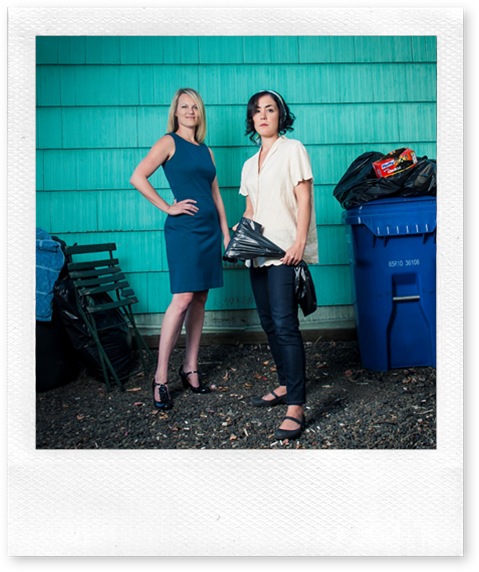
    WHO:  Written by Paul Mullin  for actresses Hana Lass and Rebecca Olson; directed by Erin Kraft.

    WHEN:  December 7-17th, 2012, Thursdays through Mondays at 7:30pm; Sneak Peak Thursday Preview, December 6th @ 7:30pm

    WHERE:  608 19th Avenue East, at The Little Theatre in Capitol Hill

    TICKET INFORMATION:  Tickets are $15-$25 and are available at the door or in advance at www.washingtonensemble.org.

  • Custom Made Love for the Loveliest Lady

    Custom Made Love for the Loveliest Lady

    I make a lot of outrageous claims about Seattle as a theatre town, and a lot of outrageous demands, too. I stand by all of them. But the claim I am most eager to defend at the moment is that Seattle is the best city in the world for locally grown plays: that is, new work written for Seattleites, by Seattleites, with Seattle audiences  in mind.  We do it quarter after quarter over at Sandbox Radio, Annex Theatre has been doing it for decades, and Printer’s Devil for only slightly less than that. Recently, local actor Rebecca Olson founded the Custom Made Plays Project dedicated solely to matching Pacific Northwest playwrights with local actors to develop and produce new plays of regional significance. (More on that exciting new wrinkle in a later blog.) Even the big lumbering mastodons are starting to get into the act, with A Contemporary Theatre recently world premiering Yussef El Guindi’s  Pilgrims Musa and Sheri in the New World to great success, and the Seattle Rep fostering a ongoing workshop of local playwrights, though, in fairness to companies fully fighting the good fight, the Rep has yet to really put its producing money where its workshopping mouth is.

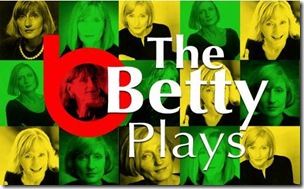
    In this spirit of making theatre which is a custom fit to performers and audiences alike, allow me to introduce to you The Betty Plays, world premiering this Sunday at Theater Schmeater. These are four new short plays written for actor Betty Campbell by Scot Augustson, Pamela Hobart Carter, Paul Klein, Jim Lapan and myself, plus a short film, “Lethal Cotillion”, which was featured at the Cannes Film Festival. Says the Schmee in their press release:

    The playwrights embarked on this project because of their love for the acting talents of the brilliant Betty Campbell and their desire to see her on the stage again.  Stylistically distinct, the four plays demonstrate the prowess of Seattle’s reigning thespian septuagenarian.

    And here’s what contributing playwright, Scot Augustson said recently on Facebook:

    I’ve got a show coming up that won’t get a review, is playing just 3 Sunday afternoons. I’m guessing less than 150 people will see it. It will never be nominated for anything. The taste makers won’t declare it The Hot Ticket In Town! And yet, it gets to the core of why I stay in Seattle and make theater. . . . Betty Campbell is an incredibly talented woman who has given immeasurably to this town and this community. But, she’s been facing some physical limitations lately that make doing a whole show difficult. Pamela Hobart Carter realized that to not have Betty up in front of an audience was ridiculous. So she got a hold of a few of Betty’s fans who were also writers to create an evening of shows . . . .  It’s gonna be great, check it out. (Hmm, if we can’t get Hot Ticket, maybe we can be Best Kept Secret. )

    As for me, I first saw Betty Campbell  six years ago when were both making our “virgin” appearances in the 14/48 instant theatre festival: her as an actor, me as a writer. I watched wide-eyed as Betty stalked around the arena stage, opposite another actress, as they both shouted competing boasts to the audience about the depraved pornographic acts they were about to perform. Now, you don’t need to know Betty well to know she’s a consummate lady with a deeply sweet and genteel heart. She was playing fiercely against type.  But more importantly, she was playing fiercely. She was not cowed by material. She rose to it. And then she rose above it. She is the kind of performer that makes a playwright’s fingers itch for his keyboard.

    Here are the details for the Theater Schmeater run of The Betty Plays, should you choose to avail yourself of Scot’s delightful “secret”:

    (more…)

  • A Bountiful Fall Harvest for Seattle’s Locally Grown

    A Bountiful Fall Harvest for Seattle’s Locally Grown

    Seattle’s scene for locally grown plays has always been stronger than your average mid-sized city’s, but anything good is worth fighting to make better. That’s why I mouthed off over two and a half years ago with an essay titled “Theatre takes Place: Why Locally Grown Plays Matter”.  I listed some bullet points explaining why the development of new plays is so crucial to the health of any great theatre scene:

    • “Local actors evolve a better understanding of how their contribution … can be generative as well as interpretive.
    • “Local audiences evolve a better understanding of how plays get made and how they can participate in the process….
    • “Local funders evolve a better understanding of their roles as patrons of the arts…
    • “Local funders, artists, and administrators …[can see] the development of plays as actual investments, with the potential to pump profits back to Seattle in several ways.”
    • I even complained that the then recently introduced TPS  Gregory Awards had a category for “outstanding director” but none for playwright, a blunder since rectified.

    Mouthing off is fun, but theatre is a collaborative art form.  Unless others join the fray it isn’t much more than meaningless monologue.  Happily, the last few years have shown just how much a modest city can grow as a theatre town when a group of motivated professionals put their collective mind to it.  For instance, last year A Contemporary Theatre finally took another chance on a local playwright by producing Yussef El Guindi’s  Pilgrims Musa and Sheri in the New World.  The gamble paid off big-time: El Guindi won The Harold and Mimi Steinberg/ATCA New Play Award (plus the $25,000 that comes with it), and American Theatre Magazine just published the script in its current September 2012 issue.

    Keri Healey’s new play Torso, produced by Printer’s Devil Theater, mesmerized everyone I know who saw it.  I suspect it is no coincidence that Keri has been short-listed for a Stranger Genius Award this year.  Torso recently doubled down on local impact with its currently running second production on Orcas Island.

    These are just two stand-out success stories from many.  And this fall promises another bountiful harvest of locally grown new theatre.  Again, just to name and explain a few (with a promise to blog separately on some as they come closer):

    14/48 outdoors for the first time ever

    A few weeks ago I raved about the glorious gamble the 14/48 steering committee was then making by staging their first “Kamikaze” festival, but this weekend they are amping up their Summer of Risk by staging the instant theatre festival outdoors for the first time in their 15 year history.  Tickets are free (also a new twist) so it’s hard to see how you could afford to miss it. (More info here.)

    The Betty Plays

    Beloved local actor Betty Campbell doesn’t get around as easily as she used to, so five local playwrights, myself included, wrote four short plays tailored to her unique and extraordinary talents.  This special Theater Schmeater offering is the sort of one-of-a-kind live experience that only happens in Seattle.  (Click here for more information  and here for reservations.)

    NCTC’s Foreclosure by Vince Delaney

    One of Seattle’s hottest acting ensembles workshops one of Seattle’s hottest playwrights, as he tackles an issue facing Americans nationwide  There aren’t many performances scheduled for this pre-world premiere, so you better reserve early.

    Sandbox Radio Live!

    1. The podcast from Episode 5: “An Unexpected Twist” recently dropped.  (A blog on that to come.)
    2. A “Best Of” show kicked ass at Bumbershoot!  (Check out this review.)
    3. And Episode 6: “Something Wicked This Way” is coming very soon: October 1 at West of Lenin.

    Why is Sandbox Radio Live! so important to Seattle’s locally grown theatre movement?  Because it happens every quarter and every quarter it gets better.  Because nearly every play, poem or commercial is written by top local playwrights and performed by top local actors.  Because it is fresh local “produce” at its best and most consistent.

    Custom Made Plays

    In my opinion this may just be the most exciting new wrinkle in Seattle’s locally grown scene, and not just because I have the good fortune of being the inaugural playwright.  Brainchild of local actress Rebecca Olson, the Custom Made Play Project  is dedicated to matching Pacific Northwest playwrights with local actors to develop and produce new plays of regional significance.  In my case, after interviewing my collaborating actors, Ms. Olson and Hana Lass, I tailor-made the soon-to-world- premiere Ballard House Duet to their unique talents and qualities.  Because of that, I am painting with colors I have never used before, and I’m loving it.  The resulting script simply would not exist were it not for these unique one-on-one collaborations. That fact excites me.

    Here’s another fact: Seattle is the best city in the country—maybe even the world— for locally grown theatre.  And we are only getting better and better at growing it.  As you can see from the small sampling above, it’s going to be an awesome autumn harvest.  It makes you wonder what next winter, spring and summer will bring.

  • One Great Year One–Sandbox Radio Live!

    One Great Year One–Sandbox Radio Live!

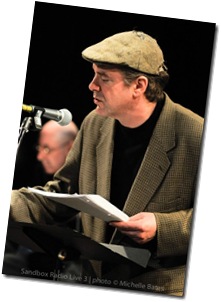
    Back in April we staged the fourth episode of Sandbox Radio Live, “The Chase” rounding out a year of producing this unique offering of all local theatre talent.  The podcast of this last show is now available here.


    Episode 4, “The Chase”
    recorded at West of Lenin on April 16, 2012

    @1:42    “Stewart and Miriam” by Elizabeth Heffron
    @10:52   “Markheim: Episode 4” by Paul Mullin
    @25:40   “Why We Run” by Scot Augustson
    @29:35   “Ain’t Gonna Chase After You” Charles Leggett
    @33:25   “The Back of the 358 #4” by Paul Mullin
    @34:50   “Straight With Chaser” by Ki Gottberg
    @42:54   “Always Disappearing” by Juliet Pruzan
    @56:20   “The Back of the 358 #5” by Paul Mullin
    @57:40   “Child of the Second Tier” by Elizabeth Heffron
    @1:04:32 “I’m Always Chasing Rainbows”
    @1:07:53 “The Back of the 358 #6” by Paul Mullin
    @1:09:45 “Squeeze Play” by Vincent Delaney
    @1:22:00 “Finale/Credits

    It was a great evening, as the Sandboxers have really hit their stride generating and performing work intended especially for the pleasures of listening.  For me the standouts of the evening were poems by Scot Augustson and Elizabeth Heffron, “Why we Run” and “Child of the Second Tier”; plus Charles Leggett’s hard blowing “Ain’t Gonna Chase After You” blues, getting its sassy behind kicked by Leslie Law’s second mic vocals.

    In July we’ll kick off a whole new year, with Episode 5 “An Unexpected Twist”, be there to share the making of the magic.

    And per tradition, below the fold you’ll find the script for Episode Four of Markheim, should you care to follow along as you listen.

    (And thanks again to John Ulman for taking such great photos!)

    (more…)

  • The Chase

    The Chase

    Markheim’s just a half-fallen angel trying to keep his head down and walk neutral in The Show, but a street kid stole his dog and now some Cherub has dropped down from the Fix for heaven only knows what reason.

    Seattle ain’t big enough for two expatriate angels. Sam ain’t gonna like it.  And when Sam’s unhappy, nobody’s happy.  

    Does tax season have you on the emotional lam?  Then join “The Chase”: The Sandbox Artists Collective’s fourth episode of its wildly successful SANDBOX RADIO LIVE! to be recorded before a live audience on Monday, April 16 at 8:00pm at Fremont’s newest theatre, West of Lenin.

    Entirely new, fresh and locally grown, Sandbox Radio is written, produced and performed by some of Seattle’s hottest stage talent. This latest episode, “The Chase” will include new original poems by playwrights Elizabeth Heffron and Scot Augustson, new short plays by Vincent Delaney, Ki Gottberg, Elizabeth Heffron and Juliet Waller Pruzan, plus Episode 4 of Paul Mullin’s noir-angel serial “Markheim”, original blues from Charles Leggett, and special guest chanteuse Joanne Klein.  Before the show and during intermission enjoy a beverage from our newly added bonus feature, The Sandbox Bar!   Halloween Sandbox Fun

    Members of the Sandbox Artist Collective currently scheduled to appear include: Megan Ahiers, Eric Ray Anderson, Shawn Belyea, Ki Gottberg, Mik Kuhlman, Amy Love, Charles Leggett, Todd Jefferson Moore, Peter Dylan O’Connor, Rebecca Olson, Kathryn Van Meter and Richard Ziman. Original music will be provided by Jose Gonzales and The Sandbox Radio Orchestra: including Dave Pascal, Dan Tierney and Rob Witmer.  You won’t want to miss this, and you won’t want to wait until the podcast of this episode is available online.

    Come see it LIVE! on Monday, April 16th…
     

     Sandbox Radio 4 postcard

    Who:     The Sandbox Artists Collective

    What:    SANDBOX RADIO LIVE! Episode 4 “THE CHASE”

    Where:  West of Lenin (203 N. 36th Street, Seattle WA) www.westoflenin.com

    When:  Monday, April 16th, house opens at 7:30 with live music, show at 8:00pm

    How Much:   $10 suggested donation at the door, Reservations recommended! Available at Brown Paper Tickets after April 2nd by clicking here

    Sandbox Radio is conceived, produced and directed by Leslie Law.  Contact:  sandboxradio@thesandboxac.org

    Podcast available in iTunes and by clicking  here

  • Hawking Whole Theatre at “What’s Next?”

    Hawking Whole Theatre at “What’s Next?”

    Last night I joined a small but extremely energized group of theatre professionals at the second iteration of “Seattle Theatre: What’s Next?” hosted by Jim Jewell and Peggy Gannon.  I want to talk more about what was discussed and what action items came out of that discussion, but I think I will wait until Jim publishes the official minutes.  Until then, here’s a transcript of the three minute spiel that I was asked to give on what’s currently exciting me about Seattle Theatre:

    Whole Theatre

    Be careful what you wish for, sure.  But when it comes to Seattle Theater, it’s also wise to be specific what you wish for.  For a good while now Seattle’s Big House theatres have been gradually increasing the percentage of local actors they hire.  And rightfully they have then touted this change as a noble step in the direction of locally grown theatre. But let’s be honest.  We all know one of two things happened.  Either the artistic administrators of Seattle’s Big Houses all got together in a room and decided, “Hey, we should do the right thing and hire more local actors.”  Or… they all independently realized that in the current depression it was becoming cost prohibitive to fly in every actor from New York or LA.  I’ll leave it to you to decide which scenario seems more plausible.  But look, when a good thing happens it’s churlish to over-analyze the reasons for it.

    The problem is that using local actors isn’t enough.  And so when we advocate for locally grown theatre, we need to be more specific…  Whole Theatre.  Theatre that is soup to nuts local: written by local talent in collaboration with local talent.  Zero degrees of separation among everyone from the playwright to the director to the designers to the actors to the audiences. 

    Zero degrees of separation. 

    If what I am proposing sounds radical or overly ambitious, consider this: we do it all the time.  In fact, if I can brag a little, as a playwright and an actor, I have done very little in the last five years that hasn’t been Whole Theatre.  Going back to 2006, there was the Empty Space production of Louis Slotin Sonata.  When the floor needed final painting, Allison Narver was there in jeans, helping designer Gary Smoot to finish it.  I’m trying to picture one of Seattle’s Big House artistic directors doing that.  To be fair, I’m sure there are union rules against it.

    Then there was The Ten Thousand Things, which Washington Ensemble Theatre produced.  I sat in a room with the director and the designer Etta Lilienthal talking through her sketches. Later, I sat in the theatre while audience members rewrote my play one word each performance.

    And most recently there was Newswrights United producing two living newspapers, researched, written and produced by Seattleites, about Seattleites, for Seattleites.

    And of course it’s not just stuff I’m working on.  There’s the incomparable 14/48, perhaps the most consistently exciting weekend of theatre in town.  All local actors, directors, designers and crew mixing it up on plays written by local playwrights in the space of maybe ten hours, tops.

    There’s Printer’s Devil, opening yet another Scot Augustson world premiere, Shadow Odyssey in their unique committed relationship with him.

    There’s Sandbox Radio which just staged its second all original slate of short pieces, combining some of Seattle’s best actors with the best playwrights and musicians.

    And right on the horizon is Rebecca Olson’s new project Custom Made Plays, commissioning local playwrights to write for specific local actors.  I’m happy to be the playwright on the pilot play, writing for Rebecca herself and Hana Lass.

    Whole Theatre.  Theatre that hasn’t had the yummy good-for-you stuff processed out of it.  Non-corporate theatre that ain’t stale from being packaged three years ago in a theatre scene 2,700 miles away by MFA’s who have never stepped foot in your town.  Whole Theatre. Seattle’s crawling with it.  And surely it gives us the most solid shot at World Class.

    (I want to do a version of the poster that says Enjoy Whole Theatre!  Or as Shakespeare, Molière and Chekhov called it, “Theatre.”)

  • Towards a World Class Theatre

    Playwright’s rule of thumb #3: if you don’t know what you’re doing, raise the stakes.  This is also a favorite for anyone losing an argument.  Arbitrarily up the ante and things become more interesting.  More interesting equals intrinsically good in a play.  In an argument, it’s… well… whatever it is, it’s more interesting.

    Over a year ago I was given a “Genius Award” in theatre by Seattle’s weekly newspaper The Stranger.  It’s one of those honors that cannot, and probably should not, ever quite sit right: the kind of recognition any artist craves not just for the added publicity and legitimacy it brings your work, but also because, let’s face it: it’s a delicious ego stroke and the $5,000 cash that comes with it helps ease any pointless pangs of guilt over being singled out.  Beyond that guilt, however, looms another misgiving which grows out of the fact that the honor is bestowed not in recognition of any particular piece but one’s entire body of work.  You’re forced to wonder, “What the hell am I going to do next?  And how the hell will that be good enough to garner such praise in the future?”  I had no idea.  Still don’t. 

    Nor did I have any idea back then about what I was going to say when I accepted the award at the Moore Theater on that Saturday, September 13, 2008.  I did know that the folks at The Stranger enjoyed presenting the awards in flamboyant and entertaining ways.  (For instance, Paul Constant channeled an old time booming-voiced boxing announcer when he handed the prize for literature to Sherman Alexie.)  So this much I determined: as show people, I’d be damned if I let some tabloid scribbler upstage me.  I had to say something engaging other than just “thanks a lot”, but what?  That’s when I remembered rule #3.  Raise the stakes.

    I began my acceptance by magnanimously allowing that Seattle was a pretty good theatre town.  The crowd approved.  Then I lofted my caveat: we were good, but we weren’t great.  The crowd grew quiet, restless.  I said I believed we had everything it takes to be great, but we weren’t great; and worse, we didn’t even seem to be moving in the right direction.  More awkward noises.  Then I said I believed we could be a world class theatre city within 5 years, but only if we wanted to.  We had to want it.  The crowd liked this.  They clapped, they hollered.  It felt great.  Lots of toasts and backslaps afterwards.  I made a self-congratulatory moment into a community-wide challenge.  And every one seemed to slurp it with a spoon.  Success, by any definition.

    Since then, however, not many people have mentioned my acceptance speech, though there is one particularly notable exception.  A month after that night I got an email from my sister Margaret.  It said simply:  “Just in case you were wondering.  9/13/13.  Make it so!”  Since odds are about even that you do not know my sister, allow me to unpack her cryptic note and translate it plainly into the words I know she intended.  “Dear Brother, in case you were thinking that you could make that challenge publicly solely in order to arbitrarily raise stakes and thus add empty entertainment calories to your speech, hoping no one will remember, please think again.  I will remember.  I will hold you to it.  I will publicly mock you if you fail.  So deliver me a world class theatre town by the Fall of 2013, or prepare to face my undying scorn.”  You see, I come from a very loving and supportive family.

    Upping the ante is painless and risk-free if no one is paying attention.  Thanks to my sister, such is not my fate.  But I am, after all, a collaborative artist.  If she intends to hold me accountable over the next four years, then I intend to share her attentions with all of my beloved fellow theatre artists in this amazing city.  My discomfiture will become their discomfiture, or at least as much of it as I can artfully manage to share.  Which brings me to these essays.  This is the introductory first of ten or twelve I intend to write on the subject of theatre in Seattle.  During my last 22 years as a theatre professional here and in New York City I have come to some strongly held conclusions about how I think theatre can be made better.  I have shared these opinions with friends and colleagues in one-on-one conversations or in small groups in social situations.  Now I think it is time for me to share more formally and more widely—to raise the stakes.

    A few weeks back, I began keeping a little folder on my computer with text files in it.  Some contain embryonic notes and outlines, the beginnings of these future essays.  Others consist only of tentative titles, like the following:

    The essays will be written with primarily my theatre colleagues in mind; but I fervently believe we need to also invite non-show people into these conversations because, as a self-identified neo-Vaudevillian, and in sharp contrast to the rising class of theatre academic elite, I believe that what the audience wants and needs actually matters.

    Potshots of prose alone cannot go any significant distance toward making theater better here in Seattle or anywhere.  Only making great theatre will make theatre great here.  This series will be about sharpening my arguments and placing them in a public place, where they may serve to convince or be dismissed, or maybe even dismantled and built into something more useful.  I am done bitching in bars.  I am pushing my stakes on the table and I encourage my colleagues, especially those who disagree with me, to do the same.  Our stock-in-trade is dialogue.  Maybe we can employ its power to discover the way forward towards a world class theatre in our own home town.