Just Wrought

Recovering playwright, once won a STRANGER Genius Award for theater. Now writing a bloated novel about… G-d help me! Theatre.

Tag: Paul Giamatti

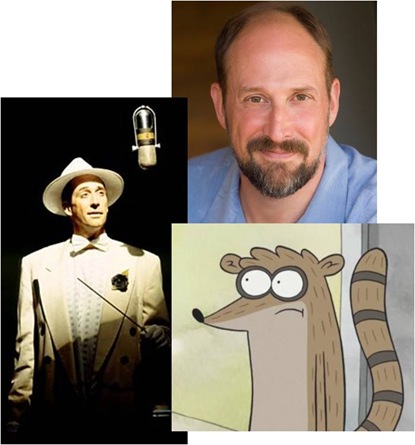
  • My Friend Goes to LA, Becomes Famous Raccoon, Returns to Seattle to Kill Philosophical Zombies

    My Friend Goes to LA, Becomes Famous Raccoon, Returns to Seattle to Kill Philosophical Zombies

    William Salyers and I met during Seattle’s fervent 90’s: a now hazy golden age when you could beg an actor like Paul Giamatti to be in your play workshop, or witness a writer like Karl Gajdusek premiere his deeply surreal, nearly inaccessible Dr.s F.s in the Terminal Ward twenty years before he would premiere his eminently accessible action series, The Last Resort, on national network television. So Bill Salyers and I already sort of knew each other from the scene when were forced by the exigencies of corporate temping into the close proximity of the licensing department of Northern Life Insurance. The two of us would blunt the boredom when we could by improvising various scenarios. I would open with something like:

    PAUL (best British Colonial Officer voice): Do you remember that time in the Congo when the battalion lost its way and we were forced to eat grubs?

    BILL (way better British Colonial Officer voice): Oh, yes. Sergeant Major Grubbs. Terribly good man. Such a pity.

    No one can match Bill for voices and improv.

    When I began writing my play Tuesday— a piece which I now, in retrospect, recognize as my first post-journeyman work— I could only manage to finish it by assuring myself that Bill would play the main character, Audie McCall. That development process, and culminating first production at AHA! Theatre, began a collaboration that lasted over the following 17 years, with Bill premiering the title role of my Louis Slotin Sonata at Circle X Theatre in LA and then playing it off-Broadway, then playing Walt Whitman among several other rolls in An American Book of the Dead – The Game Show, and then inhabiting the skin of the now real-life head of NIH, Francis Collins, in my play about the race to decode the human genome, The Sequence. And it’s not just my plays that Bill has helped to mid-wife. Having run the math, I am now convinced that William Salyers has participated in the world premieres of more plays than any other person currently on the planet. I am still waiting for someone to prove me wrong.

    While the size of the houses my plays premiere in has stayed, well, let’s say “cozy”, Bill has happily gone on to much wider success as a stage actor. For instance, he’s currently premiering Dan O’Brien’s The Body of An American at Portland Center Stage. Beyond the boards, Bill has achieved exponentially greater fame —the kind only Hollywood can offer— for work he’s done as a voice actor. I finally managed to impress my nephews with my show business connections when I told them that the guy who voiced Rigby the Raccoon on The Regular Show was my good friend. (Congratulations to Bill and everyone on TRS for their freshly won Emmy!)

    All this history is just my a long winded wind-up to telling you that Bill will once again be helping me bring a new play to life by playing the role of Simon in a very raw reading of my latest stab, Philosophical Zombie Killers, along with Susanna Burney, John Q. Smith and Amy Love.

    Here’s a sort of synopsis of the play:

    The graduate level seminar is about human consciousness. Or at least that’s what you thought when you signed up for it. Now someone’s telling you that you’re 45 years old and you’re dying. You certainly didn’t sign up for that. Now this alcoholic professor is asking you to explain consciousness to him. And this depressed ex-cop from Missouri is telling you about the epidemic of decapitations in Seattle. And this weird lady from Omnisoft just wants you to admit that there’s no such thing as consciousness and no such thing as you for that matter. Could she possibly be right? Might make dying easier. Who said you were dying?

    And here are the details:

    Who:       Susanna Burney, Amy Love, William Salyers and John Q. Smith

    What:     Philosophical Zombie Killers by Paul Mullin

    Where:   The Bathhouse Theater in Green Lake

    When:    October 15, 2012, 7pm

    How:      Pay what-you-will, including nothing at all. You’re doing us a favor by giving it a listen.

    Reserve seats at Brown Paper Tickets: http://www.brownpapertickets.com/event/278468

    Zombie Bill

  • Boiled Frogs

    Boiled Frogs

    Josh Parks is a fellow veteran from Annex Theatre’s golden years in the early to mid 90’s.  Josh starred in my favorite Annex show of all time, Bessemer’s Spectacles by Glen Berger.  Nowadays it is wisest not to mention the show to anyone involved with it if you don’t want to hear an earful.  Apparently it was a clusterfuck to produce, but produced it was, and beautifully, devastatingly so.  When the house lights came up after the curtain call everyone but me filed out of the theatre. I had to stay where I sat.  Couldn’t get myself zipped back together.  My was heart pulled open and sore and I couldn’t stop the tears from streaming down my face.  Josh also did a few other turns across the Annex stage, including Faith Healer.  A production still is provided below.  Josh stands to the far right alongside the incomparable Susanna Burney, left, and some guy named Paul Giamatti, center.  (Wonder what ever happened to him.)

    I can claim zero credit for what Josh says below, beyond cutting and pasting it with permission from his Facebook page, and maybe suggesting the title.  While many of us have sat stuck in these ever warming waters of theatrical ineffectuality, Josh has been living his life, raising his family, working his jobs.  The essay describes his experiences jumping briefly back into our pond. 

    Clybourne Park is the first equity house (non Christmas) production I can remember seeing in at least 10 years. Maybe 15. That was a big part of what pushed me from “That play sounds interesting,” to actually being willing to shell out $116 for two tickets (more on that later). I was not only interested in what the play had to say, I was very interested in what the experience of an evening of theater had to say. The world has changed so much on so many fronts over the past 10 to 15 years, I felt like I had a unique opportunity to see how theater had evolved over the same period of time, having very few intervening reference points to color my thinking.

    You may have an idea where this going.

    But before we get there, one of the striking things about the experience was that the most memorable line did not come from the play, it came from the preshow ask, delivered by a board member. I believe he said something like, “As you probably don’t know, the price of your ticket only covers about half of the cost of production.”

    Really? In the 10+ years since I’ve been to a show has the Rep really done such a poor job of educating its patrons on this issue? Are there any regular Seattle arts patrons who don’t know this? I am the opposite of a regular, and I knew it. “For those who may not know…” or something that didn’t insult the intelligence of what I imagine to be a big chunk of the audience would have made a surprisingly big difference. To me anyway.

    Even more memorable was the impression, having shelled out over $100 for my tickets, that the Rep was trying to make me feel — even before having seen the show — like I had received what I should regard as a temporary discount. I found that off-putting. There seemed to be very little appreciation for the fact that we had already given them our money, and a lot of appreciation for the fact that, “little did I know,” I had actually come up a little short in their eyes.

    OK, so now that I’ve been made to feel like I’m not doing enough to support the arts (even though every dollar is “meaningful”), on with the show!

    The production was serviceable. The playwriting was really not as good as I had hoped, nor was the direction, which seemed to be trying (but failed) to make a lot of the dialogue come across as Aaron Sorkin-esque line-chopping rapid-fire banter. The acting was good enough.

    But what’s the word to encapsulate the experience, the energy in the room, the aftertaste? “Quaint” seems to be the most persistent answer. As the play unfolded I found myself amazed at how little things had changed since I last saw an Equity house production, and I have been pondering that ever since. When I think about what the world was like in 1998 and where we are now, how so many industries, and governments, and lives have been transformed in that time, the experience of going to the theater seemed to have stood still. The production I saw was certainly no worse than any quality production I could have seen years ago. But much more important (and surprising), it was absolutely not a single bit better. And suddenly it occurred to me, could this be at the heart of theater’s “decline” (LORT theaters anyway)?

    I was expecting some progress, some innovation, some sign that what the Rep and similar establishments offer does in fact track the change/progress going on in the real world. Certainly the subject matter of the play was “relevant” and “topical” to a degree, and it was connected to a famous play and film in an ostensibly interesting way. But the actual production itself, including the means by which it was staged, struck me as really no different from anything I have ever seen on any stage anywhere. And that surprised me. I was not expecting virtual reality goggles, but I realized as it was happening (or not happening) that I was expecting something. I understand there are limitations on what can change about a play and still have it be a play, but I was stunned to feel like I had stepped out of a time machine.

    Thus, my Colonial Williamsburg comment. Was this really creativity? Or was it about recreating a notional idea of theater. Playing the experience out into the future, I can imagine some day that the experience of going to a play at an Equity house could become more and more like attending a concert of Baroque music on the original instruments. Quaint. A bit odd. And — no offense to anyone who has mastered the sackbut — just as relevant to the human condition.

    I imagine in the days of O’Neill and Williams and Miller and Shaw and Coward and even Neil Simon for God’s sake, that theater thrived because it was one of the places people went to see something cool, something current. It wasn’t a place where ideas were rehashed — be they about politics, society, design, lighting, or acting — it was a place where they were born.

    Unfortunately, I find I don’t have many answers, just questions. Where is the surprise, the creativity, the unexpected, the brilliance? If there isn’t some in every element of the show, why should anyone bother? I see you and like-minded folks trying that with This Not Just In. I can think of exceptions to a lot of my ranting, but dare I say most of them are from the fringe element in Seattle, where the quality index is a lot more volatile, but it also doesn’t cost as much to get in the game. There are people who are trying to create theater they wouldn’t have seen 15 years ago, certainly, but the impression I have is that isn’t what gets a lot of established theater people out of bed in the morning, and that baffles me. Maybe it shouldn’t, but I’m glad it does.