Just Wrought

Recovering playwright, once won a STRANGER Genius Award for theater. Now writing a bloated novel about… G-d help me! Theatre.

Tag: Paul Mullin

  • The Solo Show: A Risk Averse Artistic Administrator’s Best Friend

    The Solo Show: A Risk Averse Artistic Administrator’s Best Friend

    The fourth in a series of essays entitled: 
    Towards a World Class Theatre

    Some fifteen years ago Dawson Nichols and I were having lunch at a long gone Japanese noodle house on Broadway when he asked me an awkward question that I will now try to do a better job of answering.  Back then we were not the close friends and collaborators we are now—more like respectful but wary competitors for the title of AHA! Theatre’s Golden Boy.  Dawson had a much better line of attack on the prize, because while we both wrote strong multi-actor plays, Dawson also amazed us all with his impressively diverse catalogue of one-man shows, including Stop/Start, Virtual Solitaire, I Might be Edgar Allen Poe and Three Descents of Darwin.  I have always been captivated by Dawson’s one-person work. 

    I have also always had my theoretical reservations about the genre, as Dawson must have suspected that day over yakisoba when he challenged me squarely, “You don’t think my solo work is theatre, do you?”  I must have made a weak apologetic smile. I must have hemmed and hawed. I think I finally answered, “Strictly speaking, no, but—“ and then went on to make some half-lame explication, but the look on Dawson’s face showed it all: hurt and disbelief at my dismissive arrogance, even as I tried to explain how much I respected him as a generative and performing artist.

    So perhaps now, with my friendship with Dawson a little more secure (I hope), it is time to make that earlier explication sharper, and then explore that explication’s implications within our regional theatre administrator’s collective half-conscious effort to re-forge by fudging a new definition of the art form and thus raise the number of one-person shows they can get away with and still claim that they are practicing theatre.

    Before writing this I decided to do a little research by reaching out to my compadres over at 14/48 via Facebook:

    Paul Mullin

    April 9 at 3:32pm

    Hello lovers!

    Any and/or all of you can answer. And yes, I’m going to quote you in my blog. I’m working on an essay about one-person shows. And my question is this: “Why don’t you ever have the option of drawing just one actor in the actor draw? Are there any other reasons beyond the fact that that poor schlump would have to memorize too much?”

    Let me know.

    Love,

    Paulie

    clip_image001[4]

    Shawn Belyea

    April 10, 2010 at 3:56pm

    Re: Question for the 14/48 Crew

    Cuz one-person shows are dumb. Mostly it’s memorization and it’s supposed to be a collaborative effort so we want actors to have some company.

    clip_image001[6]

    Jodi-Paul Sanford Brown-Wooster

    April 11 at 1:06am

    I hate one person shows. And yes, I’m looking at you Lauren. There is no intrinsic dramatic tension with one person, it’s fakey.

    clip_image001[8]

    Peter Dylan O’Connor

    April 11 at 3:52p

    One person shows are fucking glorified camp fire stories…

    clip_image001[10]

    Matthew Richter

    April 11 at 8:33pm

    i love one-person shows. and i think they’re an interesting challenge for 14.48.

    but i’m retired.

    xom

    If you seek consensus, you would be wise not to consult the prophets of 14/48.  Once again, I am left to my own opinions and devices.  I proceed with that caution for you, my gentle reader.

    Basically, solo shows boil down into two kinds: the actor’s tour de force and the enlarged lecture.  Dawson Nichols shares the first tradition with Anna Deavere Smith, Chazz Palminteri and countless other talented writer/actors, who generate shows that then require them to become all of the characters on stage, even at times performing both sides of multi-sided dialogue.  Over the last few decades, it has become an increasingly effective way of growing an actor’s career.  Palminteri literally leveraged himself into playing the principal role, Sonny, in Robert DeNiro’s directorial debut film A Bronx Tale, which began as Palminteri’s one-man show of the same name.  As Rik Deskin, Aristic Director of The Eclectic Theatre points out, “When you’re self-producing/self-promoting, a solo show is one way to get yourself out there.”

    My friend and comrade-at-arms, Mike Daisey, presents from the lecturer tradition, most recently reinvigorated by Spalding Gray, but one which runs the gamut, in just this country alone, from Jonathan Edwards to Mark Twain and right on up to David Sedaris and Sarah Vowell.  This kind of show employs more direct address, less actorly technique.  Instead of primarily inhabiting other characters, the lecturer’s own personality ties the evening together.  In the hands of a Daisy or Sedaris it can be hugely fun, funny and compelling, but no one plying the trade 130 years ago would have thought of calling themselves a theatre artist, even if a particular night’s performance happened to take place in a theater—unlikely in that age, since theaters were rarely dark and there was a plentitude of active churches, as well as all sorts of lecture halls specifically built for this purpose.  As different as these two kinds of solo show are, and as much as it seems the Nichols / Deveare Smith variety is much closer to theatre as we know it, they both represent variations of the much older, and completely honorable tradition of story telling.

    Theatre, however, is something really quite different.  It happens in the preternaturally galvanized space between two or more people on stage and the other people in the audience.  It sprang forth from its older sibling, storytelling, in that radical moment when the teller pointed at someone in the campfire circle and said:  “You be me.  I’ll be the wolf.  We’ll show them how it happens.”  Thus a whole new art form was born.

    As a solo lecturer, Mike Daisey has a point of view.  And a damned good one too.  He makes no bones about telling you what to think.  And if you want my opinion, you should listen to him.  I have a different role as a playwright and a different box of tools.  I can show you things happening, but it is up to you what to make of them.  Theatre is dialogue.  Not as part of the narrative, like in a novel, but as all of the show.  Even if no words are spoken, dramatic action takes place in a framework of implicit dialogue: people doing things to other people. This is why our collective audience hackles go up whenever a narrator starts telling us the story instead of enacting it.  Good playwrights understand this and know how to leverage the discordance of direct address narration (see Shakespeare’s Chorus in Henry V or Wilder’s Stage Manager in Our Town).  Lesser playwrights never seem to learn: you can’t tell an audience anything.  They can only be shown.  They can only ever come to their own conclusion about what is happening.

    Dialogue breeds risk like flowers bloom scent, and risk is the fabric of theatre.  Because two or more people on stage can never know with certainty what an other is about to do, no matter how many times they have done it before, the audience attends the action with a sense of the innate exposure.  “Anything could happen, and we are in the same damned room with these agitated people.”   Risk is not a by-product of drama.  It is the main ingredient.  

    Nothing wrong with masturbation, but everyone knows you cannot tickle yourself.   Likewise, I cannot, as a performer, ever surprise myself to the degree another performer can—arguments about unexpected inspiration notwithstanding.  When there is another actor on stage with me, I have to watch, I have to listen, I have to be wary.  Other actors can push you around, and you can push back.  No one can manufacture this kind of risk in a solo performance, no matter how earnestly the performer tries to convince his corpus callosum  not to tell his left brain what his right plans on doing.   Sure, an actor can mimic dialogue, playing both sides of a conversation, but even at its very best this trick still contains an unconscious but unavoidable note of condescension, like Donald Rumsfeld asking himself ostensibly difficult questions about the Iraq War in a press conference and then answering them with ostensibly matter-of-fact brilliance.  True dialogue adds a crucial dimension which defines theatre, just as surely as the third dimension of physical depth defines sculpture. 

    Theatre also trades on what we show folk loftily refer to as “the willing suspension of disbelief.”  Wikipedia defines this notion as “the willingness of the audience to overlook the limitations of a medium, so that these do not interfere with the acceptance of those premises. According to the theory, suspension of disbelief is a quid pro quo: the audience tacitly agrees to provisionally suspend their judgment in exchange for the promise of entertainment.”  (I should fully disclose here how I hate this term, mostly for its gratuitous gracelessness.  I mean, is the double negative really necessary to nail the point?  What would be wrong with, say, “fabrication of belief?”)  In a solo show disbelief can never be truly suspended.  At best, it can be sent to detention, where it still manages to sulk and grimace and call attention to itself.

    Let me be clear.  By pointing out that one-person shows are not, strictly speaking, theatre, I am in no way trying to denigrate them or argue for their banishment.  It has been a long standing tradition for regional theatres to opt for filling one slot in their season with an easily produced, low-overhead solo show, but indications are rising that Big Houses in this town intend to lean on this option more heavily in the future.  The Seattle Rep recently announced its 2010-2011 season in which they will be offering not one, but two solo shows,  The K of D in the smaller Leo K venue and Mike Daisey’s new piece on their Bagley Wright mainstage (a relatively unheard-of placement of a solo show for them.)  If Daisey does well (and as his friend and colleague, I cannot help but hope he does) you can bet you will be seeing more mainstage solo offerings from the Rep.  It is just too cheap for them not to.  And as long as no one’s complaining that they are not actually doing theatre in their theater, well…

    Meanwhile, next door at the Intiman, they have answered with unblushing cynicism the call for more locally grown new plays by staging The Thin Place which they laud on their website as “the second world premiere by a local writer in Intiman’s history.”  Note the pride with which they admit a fact of which they should rightly be ashamed.  Using a solo show to rectify their abysmal record reveals how little they wish to risk on the attempt.   How quickly will Intiman abandon and distance itself from The Thin Place if it does not do well with critics or audiences?  How likely are they to offer up the now tired Big House refrain when a locally grown piece does not catch fire right away?  “See?  We tried ‘locally grown’.  It just doesn’t work.  Can we please go back to retreading Pinter, Mamet and off-Broadway’s last season?”  Always behind such excuses are obfuscated variables of production and promotion that contribute to a given show’s putative failure but that go unnoticed and unconsidered in public.   In this case,  the crucial factor that will not be mentioned is that The Thin Place is a one-man show, and not, strictly speaking, theatre at all.

    Regional Big Houses defend their solo performance offerings like a richly-endowed sculpture gallery might defend an exhibition of paintings.  “We love sculpture.  And of course we are a sculpture gallery, but sculpture itself is expensive and difficult to maintain.  Instead, why not enjoy some lovely paintings of sculptures?”  Paintings of sculptures can indeed be lovely, but not even an idiot would call them sculptures, any more than Mark Twain would have referred to himself as a theatre artist 130 years ago.  Solo performance billed as theatre is a pig in a poke.  The unpredictability of human beings interacting lies at the heart of what we are selling in the theatre.  We trade it out and bank our future on its diminishment at the very risk of our art form’s soul.

    Next up: “Good Friend for Jesus’ Sake Forbear and Never Build another Proscenium Stage”
  • Playwright as Toolmaker: David Ball’s Incomparable BACKWARDS & FORWARDS

    Playwright as Toolmaker: David Ball’s Incomparable BACKWARDS & FORWARDS

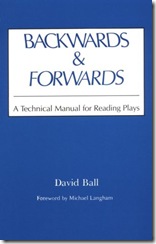
    A bunch of us local playwrights (the same ones you won’t be seeing any time soon at a Seattle Big House near you) are busy working on the next edition of A Living Newspaper.  Last fall we produced the very first edition, It’s Not in the P-I: A Living Newspaper about a Dying Newspaper.  All through this process we have been working with an actual journalist, Tom Paulson, who in addition to being one of the founders and executive producers of NewsWrights United, also works as a freelance reporter specializing in science and world health issue.  Tom was on staff at The Seattle Post-Intelligencer for over twenty years prior to the demise of that paper’s paper edition.  Dawson Nichols and I have been bugging Tom to actually write something for the stage, an “article” for this next edition.  He says he wants to, seems eager even, but then turns shy, complaining that play-wrighting is an entirely different sort of scribbling and that he does not know the method.  (How I wish that a particular subset of the playwrights’ community shared this reticence to perpetrate dramatic mediocrity.)  So Tom asked us if there was a book he could read to find out how to write a play.  I said I didn’t know of any, smug in my belief that no such book could possibly exist.  Dawson said “Backwards & Forwards by David Ball.”  So I ordered Ball’s book from the library, and quickly discovered by the first few pages that once again Dawson had smashed my smugness:

    A play is a series of actions.  A play is not about action, nor does it describe action.  Is a fire about flames?  Does it describe flames?  … Why do you think actors are called actors?

    Where had this book been all my playwright’s life?!

    Ball presents Backwards & Forwards as “a technical manual for reading plays”, but since its publication in 1983, it as been fully recognized and celebrated for what it really is: a stealthily but thinly disguised treatise on how to write them.  And why not?  No self-respecting playwright would want to write anything unworthy of the kind of careful reading Ball demands his students give a play.  With plain-spoken, clearly articulated admonishment, Ball calls us back to bare bones, reminding his putative readership: actors, directors, designers, anyone involved in actually staging theatre that scripts are nothing but architecture

    Play characters are not real.  You cannot discover everything about them from the script.  The playwright cannot give much, because the more that is given, the harder it is to cast the part.  The playwright must leave most of the character blank to accommodate the actor.  Scripts contain bones, not people. 

    Some other gems to tempt you into ordering this book, just as I intend to, after returning this copy to the library:

    A character’s self description, or how others in a play describe a character, is not reliable for the simple real-life reason that what people say is not reliable….  Description must be validated by examination of action.  Action either verifies description, rending description redundant, or it reveals that the description is wrong.  Redundant or wrong: that is all description can be.

    And. . .

    A particularly insidious trap is the old assertion that character changes during a play.  But people in plays don’t change any more than people in real life do.

    He goes on to point out that Edmund’s seeming point-of-death conversion to goodness at the end of King Lear

    Edmund:  I pant for life.  Some good I mean to do. / Despite of mine own nature

    –isn’t a conversion at all, but rather yet another attempt to best his brother Edgar.

    … By Act 5 Edgar is revered for his virtue, not his land.  Now Edmund must appear virtuous to get what he wanted all along: equality to Edgar.  It is the same trait, same desire.  Edmund’s character has not changed, but a changed situation calls for different tactics.  Edmund remains Edmund.

    And then there is this, which hints at presaging a theory I am working on, that theatre has a unique line of attack on the collective unconscious:

    The good [theatre] artist does not seek a group response, but rather a group of individual responses.

    And a particular favorite in light of the struggle for a return to locally grown new work:

    Playwrights—even great ones— do not write for the ages.  They write for their specific audiences….  Special problems arise when a play is done for an audience other than the one it was written for.

    Just this morning I had to scold my 8-year old son.  He loves my tape measure, has always loved measuring things, but he also likes to pay the tape out and then let it reel back all at once in a ever-accelerating rush so that it slams back into the housing.  This drives me nuts because the edge of the tape is sharp and I’m worried he’s going to cut himself.  I said, “This is a real tape measure: a tool not a toy.  And some tools can hurt you if you don’t use them properly.”  I was instantly reminded of the penultimate paragraph in Ball’s book.

    Think of the script as a tool.  Before you pick it up to use, know which is the handle and which is the blade—or you might cut your throat.

    How many theatre artists are keeping their tools that sharp?  How many really respect or even care about the potential danger in what we do?  Is there any danger any more?  Are museums inherently dangerous or safe places to visit?  I think audiences come to theaters  not for craft, nor excellence, nor even for great directing nor great acting,  not even for important  ideas illustrated through words strung  beautifully together.  Audiences come to be thrilled.  Are will selling them that?  Are our tools sharp enough to cut us?

  • The indy film I wrote and acted in a lifetime ago. (Okay, okay, only 17 years ago.)

    http://hittingtheground.com/

    I’ll buy a beer for anyone who can tell me who owns this website.

  • Lost Alamos

    we knew it was going to be a long winter
              snow swallowed      a mud sucked boot
         and yeah we knew that we’d get through      but still 

         lose something somehow      like a bad bet won 
         on a dumb dare      wiser      but wondering
              why survive what you don’t have to?      what’s it prove?

    and what now?      what would jesus do?      hell he’d
              go to the desert      las vegas      los
         alamos      some place bets are happily lost

          to the flat pan      the mesa      the hugeness      the
         bone-bleached and blueness      a place to bake
              back into something fresh flaky and      true

          a body of christ
                  why not?     
              amen      again

    2002

  • Misha Versus Joe

    It is a long-standing fantasy among show people to perpetrate a “turn-about” and review the reviewers, but really, if want to do what you do best, stay at your own level and not sink to mere criticism, the proper “turn-about” for stage folk is to stage the critics.  That is exactly what we did here.

    Misha vs Joe from NewsWrights United on Vimeo.

    Misha Berson, Theatre Critic for The Seattle Times was not happy with this portrayal and made her displeasure clearly known to all of the producers including myself.  Others, especially ex-staffers for The Seattle Post-Intelligencer complained about how we savaged their former colleague, Joe Adcock; but I completely disagree with this appraisal and I suspect Joe might too.  For me the piece lands clearly on a final note of love.  The genuine pain I felt upon Joe’s departure was not shared by many in my community, but I have to hope this is because they did not know him very well, or care to. One Big House artistic director reportedly remarked on learning of Joe’s retirement: “Ding dong, the witch is dead!” I suspect that same AD will feel the same when/if I finally leave town, dead or alive.  I say, be careful when casting anyone as the witch: for all you know, many may picture you surrounded by ugly flying monkeys. For my part, I want to dance with the Big House witches, not wish them dead. I wish my dear witches would wake up. And I am determined to do everything it takes to make that happen. 

    I have seen how theatre gets covered in other towns Seattle’s size. I am glad we have Misha and Brendan Kiley and all the others. In the current crisis of journalism, every critic we lose is an irrevocable loss. Alas, I suspect Misha does not feel the same about me. After all, playwrights are a dime a dozen, and happily we do not depend on the survival of any one institution. Formidable is the power of nothing to lose. At this ripe moment in the history of our art form, I wouldn’t trade it for anything.

  • To Not Die the Death of a Rag Doll

    To Not Die the Death of a Rag Doll

    It’s been a little quiet lately, hasn’t it? 

    Three weeks ago today TPS hosted the Seattle whistle stop of the authors of Outrageous Fortune.  At the end of that day’s session our community received high praise from the panelists as being the first place where they heard such frank and open discussion among playwrights, artistic directors, and other theatre professionals in the room.  We all know, however, that talk is cheap, action expensive, and real progress almost prohibitively so. 

    There have been, however, some positive steps, like Jim Jewell’s astoundingly succinct, yet imminently workable proposal for pipelining work from smaller local theatres to the big houses.  With his permission I posted it here.  I am also being told about subtle maneuvers being made behind the scenes to bring the right people in to a room together for a more private session.  (This, of course, presupposes that someone knows who the right people are.)  Also, rumors of another Stranger-hosted Shit-Storm toss about on the chill spring sound wind, though some doubt another such gathering’s potential to effect any real change.  Says former Seattle Weekly theatre critic,  John Longenbaugh:  “What exactly did all of those Sh*tstorms ever accomplish? Did any local theatre change its policies in any way? Did any playwright get produced as a result?”

    Even a stopped clock is right twice a day.  The Shit-Storms have been little more than opportunities for blowing off steam.  Representatives from the Big Houses attend them about as frequently and enthusiastically as vegans visit underground cockfights.  I suspect that several of our entrenched artistic administrators viewed the Outrageous Fortune discussion as little more than a similar but mandatory appointment to act interested in the concerns of playwrights while intending to change exactly nothing.

    There was an expression used in my family when I was growing up: “to die the death of a rag doll”.  Oddly, I have never heard it used anywhere else.  So a few years ago I wrote short essay illuminating the expression’s meaning and usage.  I share it here, in the hopes that our efforts to advance locally grown new plays and bring Seattle to its rightful standing as a world class theatre town does not suffer this uniquely miserable fate.

    To Die the Death of A Rag Doll

    I think I first heard the expression “[blank] died the death of a rag doll” from my oldest sister, and I have always suspected it was passed down to her along the well-worn matrilineal pathways of old Irish sayings, like “whistling makes the Virgin Mary cry” and “this place is filthier than Hogan’s Alley” (don’t ask, I don’t know). Of course, I’m not really sure where my sister got it, although I am  certain that if I asked her, she would blithely swear that she has never heard of, let alone used, the expression in her entire life. (My sister’s like that. Happy to encourage your suspicions of your own insanity.)

    It is perfect really: the best idioms have sort of poetic shorthand about them. They not only say something in less words than it would take to do so straightforwardly, they add a touch of the ineffable to the description, so that strangely, beautifully, they say something that is effectively impossible to say else wise.

    Of course, if I had to come right out and prosaically define it, I would say that a rag doll death is the slow passage into nonexistence of that which was once, however briefly, ardently embraced. You held her patchwork body to your chest every night as you feel asleep, and then one night, either because you got a nicer stuffed toy, or because it dawned on you that sleeping with dolls is stupid, you put her at the bottom of your bed instead of hugging her to you. From there to underneath the bed, dusty and forgotten, is just a few sad, small steps. One day, she just disappears. Maybe Mom throws her out or gives her to Good Will, but it is of no concern to you. You have not even noticed she is gone.

    Once something ceases to be remembered, did it ever even exist at all?

    Examples of things that can die the death of a rag doll:

    • Plans to put in a vegetable garden this year
    • Relationships
    • The ability to fox trot
    • New Year’s resolutions
    • Epic poems
    • Flowers
    • The commitment to learn another language or play a musical instrument
    • Tropical fish
    • Theatre
    • The conviction that, on the balance, the United States of America is a good and just nation
    • Crushes
    • The ability to water ski
    • Ego
    • The four freedoms
    • Inhibitions
    • The certitude that you will one day be pleasantly famous for doing what you do best
    • Black light posters
    • Health
    • Christ-like Christianity
    • A taste for fruit-flavored wine coolers
    • Sexual dynamism
    • A superpower’s promise to bring democracy to nation after invading it
    • Bottles of Crème de Cacao
    • Liberal good intentions
    • A memorized list of the entire crew of the Argo
    • Hopes and dreams
    • Everything
  • The Sequence in Print

    The Sequence in Print

    I am delighted to announce that my play The Sequence, which dramatizes the real-life race to decode the human genome, is now available in print from Original Works Publishing.

    It has been a long road since that phone call eight years ago when Curt Dempster, then artistic director of Ensemble Studio Theatre in New York, offered me a commission to write something about the genome race.  He had seen Craig Venter on The Charlie Rose Show and I imagine he recognized a kindred spirit: an arrogant, monomaniacal genius who had the raw guts to want to change the world.  I knew nothing about the story.  I wanted instead to write a play about scientific investigations into human consciousness (still do, for that matter), but after doing some initial research I was quickly convinced that there really was a play here.  The detail that sold me for good was learning that Venter had secretly used his own “genetic material” as Celera’s sample for sequencing.  The lofty fog of scientific endeavor suddenly cleared as this act of sheer human outrageousness snapped everything into crisp dramatic focus.  There was a story here.  Boy oh boy, was there a story!

    Curt has since passed on, by his own hand, determined as ever to navigate this life on his own terms or none at all.  He never got to see the world premiere of The Sequence at The Theatre @ Boston Court in Pasadena.  He never got to see this final script, which he conceived by commission nearly a decade ago.  But in my overwrought imagination, I see him thumbing through it, slouched in his hovel of an office at the corner of 52nd Street and New Jersey, dog curled beneath his chair, surrounded as he always was with stacks and stacks of new play manuscripts, hundreds of them, maybe thousands, some of which he had asked for, most which he hadn’t, nearly all of which he would never read (he preferred to watch readings), but every single one of which he believed in; because for Curt, theatre was about making plays, not merely staging those already made.

    You can pre-order the script by clicking here.

    I hope you like it.  I also hope that when you read it, you remember that The Sequence, like all plays, was wrought more than written, and ultimately meant to be watched more than read.

    The cover for the Original Works publication of The Sequence, by Paul Mullin

  • A Strong First Stab at a Pipeline Design

    To follow is a first draft proposal of terms for a plan to create a viable pipeline of locally grown new plays here in Seattle, incorporating the deep resources of the large Regional Theatre houses as well as the risk tolerance and experimental acumen of the smaller “fringe” producers.  It was drafted by Jim Jewell, Public Relations Manager at the Seattle Children’s Theatre and all-around Northwest theatre thinker/activist.

    Seattle Local Playwright Initiative

    A partnership between one of the LORT theatres and a fringe theatre with a dedicated space to encourage the ongoing development and production of plays by local playwrights, with a starting timeline of three years.

    The partner organizations will choose two plays each year to be produced in the fringe theatre with marketing and artistic support from the LORT house. The fringe house commits to producing six such plays over three years, and the LORT house commits to producing one play of the six as part of their mainstage programming no later than the season that follows the third year.

    The initial playwright pool will be drawn from Seattle-based applicants to the program and any local playwrights with whom either of the partner organizations has an existing relationship. One play per playwright will be submitted to a reading pool, to be read and commented on by artistic staff at each partner organization (one page response to each play by each organization). The partner organizations will then meet and come to a consensus on two plays to produce each year; in the absence of consensus, each partner organization will select one play.

    Expectations:

    The fringe house will act as primary producer of all six initial productions, acting as lead for design, production, promotion and execution, and will staff all admin, front of house and crew. As primary producer, the fringe house accepts the majority of financial risk and reward.

    The LORT house will provide artistic support, including dramaturgy and design, promotion support, including production and distribution of print and electronic marketing materials, and technical support. The LORT house will also be asked to advocate to AEA and/or IATSE for any union artists or technicians interested in working on the productions.

    The expectation is that the minimal one production at the LORT house that comes from the partnership will be given institutional and budgetary support on par with other productions in the season in which it is performed.

    Benefits:

    Both partner organizations benefit from positive PR generated; six local playwrights get the opportunity to draw on the best the fringe and LORT theatres have to offer to develop their work, with one receiving a full production; the LORT theatre is able to locally outsource some measure of workshopping; fosters more direct relationship between local playwrights and largest institutions; offers and opportunity to develop a local voice in theatre that may help speak to untapped audiences for both LORT and fringe theatres.

    I do not want to make any substantive comments here because I really do want to hear what you have to say, but it must be pretty obvious how I feel about it given that I am posting it here under the title above.

    Let the feedback frenzy begin!

  • Fooled Again? The Seattle Outrageous Fortune Discussion

    Estragon: I can’t go on like this.

    Vladimir: That’s what you think.

    Allow me to share with you the opening paragraph of an amazing essay that Carl Sander brought to my attention a few weeks ago:

    The American non-profit theatre movement is nearing disaster.  Without an adequate sense of tradition or sense of social responsibility, it is in danger of becoming a movement whose only purpose is self-perpetuation.  This idealistic movement begun some generations ago has been unable to achieve a living wage for its actors, a livelihood for its playwrights; it demands that its designers accept twelve to fifteen productions a year just to make ends meet, and forgoes its responsibility to train directors while permitting, under the heading of financial survival, the average income of its audience members to climb higher and higher until this once bastion of social ideas and aesthetic concerns as become the plaything of the upper middle class and the very wealthy.

    Isn’t that amazing?  Doesn’t that paragraph just go straight to the heart of our current situation, and by doing so make you a little bit more hopeful that smart people are talking about theatre’s endemic crisis in such an insightful way, since surely, if we talk about this cogently and passionately, we will inevitably move toward making things better?

    There is only one problem.  This paragraph was written by Richard Nelson for an essay in PAJ: A Journal of Performance and Art in 1983.  So whether you like it or not, whether you knew it or not, these problems are way over a quarter of a century old.  And since Nelson’s incendiary bit of insight was published, absolutely nothing has changed.

    Last Monday, a bunch of Seattle theatre folk sat in a room and listened to Todd London, Ben Pesner,  and Tory Bailey present their findings on the state of the American playwright– findings which culminate in a book called Outrage Fortune: The Life and Times of the New American Play.  I cannot heap enough praise on these professionals for their efforts not only in researching and authoring this book but in their willingness to tour the country to discuss it.  Thank you, London, Voss and Pessner, as well as Tory Bailey, Executive Director of the Theatre Development Fund. Thank you from the bottom of my heart.  I hope we happy few in Seattle can make progress worth your effort.  I hope this, while understanding that hope is not a plan.

    I fretted over how best to how best to shape my thoughts about the day, and then I realized I already had a loose outline in the form of the bite-sized tweets I was firing off live from the room.

    Roll Call” and “Good Mix and Size

    The first two blog posts were longer than what I could manage later, and were dedicated to making note of the very impressive cross-section of artists and administrators who came to share in the discussion.  I am proud of my city for the turnout.  My only caveat: I did not see a large number of actors– certainly nowhere near the proportion they hold in the larger theatre community.  If playwrights really want to get traction in making locally grown new plays a priority then we are going to have to do a better job of convincing local actors why this is important.  I have myself been petulant on this point  in the past and pledge to do better.

    Within “Good Size and Mix” I posted the first of many quotes that I enjoyed: “We are finished with talking with playwrights in one room and artistic directors in another.  This tour is the first salvo of setting playwrights and artistic directors in a room talking to each other.” Soon after I began tweeting quotes with little or no context.  I will try to make up for that here.

    Commissions are what a theatre gives a playwright they like when they don’t want to produce your play.

    Boy howdy, ain’t that the truth!  Understand if you can that in the upside-down, through-the-looking-glass world that is regional theatre everything you learned about money and investment flies out the window.  The larger the commission the less likely the theatre is to actually produce what they have paid you to wright.  Why?  Because it is easier to score a grant funding a commission than it is to get one large enough to underwrite an entire production of a new play.  In the regional theatre world, commissions are an easy win.  The playwright gets paid.  The theatre looks generous.  So long as everyone calls it good, it’s good, right?  (Note: actual play seen by actual audience not included.)

    “‘Everyone wants the same ten playwrights.’– Anonymous Artistic Director

    I ripped this from one of London’s slides.  It is a key point from the book.  There was no argument on Monday from anyone representing the Big Houses, nor have their season selections provided any compelling contradictory evidence.  Plus, when it comes to locally grown, that list of ten can be reduced to one: Steven Dietz, who, while beloved of all, has actually lived in Austin for the past half decade. 

    “Right now Q&A has bogged in a rather tedious, though I suppose necessary analysis of the survey methodologies.”

    Typical Seattle talkback static. “I need to show you how smart I am by questioning your research process while agreeing with its conclusions.  Really, I just want everyone to know I’m smart.  Does everyone know that now?  Great.  I’ll sit down.  What were we talking about?”

    “Things are looking up. A touch of crazy has blossomed in the room.”

    I would live to rue these words, after someone stood up and complained at length about how no one in New York wanted to produce her one-woman show about the day JFK was shot.   Crack-pottery suits the status quo defenders because it helps them lump the legitimate playwrights in with lunatic amateurs.  They can then turn to their boards, shake their heads sadly, and say, “You see what I have to deal with?  You don’t pay me enough to screen out these maniacs.”

    “Okay, now it’s become a pattern– unique to Seattle?– that crazy flowers are dominating Q&A because the smart folks are too smart to pipe up.”

    See above.  But note that the smart people are complicit as well.  And I admit, I too was biting my tongue and sitting on my hands.  But in my defense, I get to mouth off a lot, and was genuinely interested in what other folks had to say.  Come on good folks, speak up!

    “Good question leading to discussion of potential of collaboration across theaters of differing sizes. In other words, a pipeline. Duh.”

    This is what we we need to be talking about, friends: a pipeline: some way of delivering plays across the tiers of theatres in this town.  Todd London talked about how incredibly hard this is to do, and I do not doubt it.  So was going to the moon.  So was writing Hamlet.  So is raising a family.  Can we try something hard?  Can we as Seattleites lead a cultural change instead of hoping Austin figures it out?  (Which by the way, according to London, Austin may already be doing.)

    “Good question from a good friend involved in development asking to identify a “sweet spot” for breaking down silos so that all the people in this room can better collaborate towards developing new work (ideally locally grown).”

    Some sort of pipeline is the sweet spot, I am convinced.  There are other options worthy of research and development: playwright residencies, season slots dedicated to new work, etc.,  but I figure those will be a lot harder for the Big Houses to swallow than a pipeline, which they will wager they can quickly abandon when the pressure’s off (i.e. ACT’s abandonment of its highly successful FirstACT program.)  So I say, let’s convince them to build the pipeline and then let’s defend it vigorously.  Keep the pressure on, forever, forcing them to pull the plug only at their p.r. peril.

    “A little bit of fireworks there. ‘Not enough good plays for the Big Houses.’ ‘Aesthetic absolutes.’ ‘You either get what you want or you don’t.”

    Finally voices from the Big Houses start piping up.  At times to call me out by name to both praise and dismiss me in the same breath.  I am used to this tactic.  It has never cut much ice with me.  Praise is a director’s easy currency.  Many actors crave it.  It soothes them.  There is nothing wrong with this.  At the moment, however, I happen to have my playwright hat on, and I have been to Hollywood.  I know exactly how much such praise is worth.  Instead, I prefer to focus on fighting words, such as “We are looking for excellence and not finding it.”  Bullshit.  You are not looking.  And when pressed, you praise the shit out of anything handed to you in the hopes that the playwright will just go away like a happy little puppy that just got its head patted.  Save the praise.  Let’s do a production.

    “I actually don’t think the system is broken. Just limited resources.”

    Wishful thinking from a Big House voice.  Why is the Center House Theatre packed with people for this discussion if the system ain’t broken?  Are we all crackpots?  Did this all somehow get fixed since Richard Nelson wrote his essay in 1983?  In fairness, you have to expect that this argument will be trotted out, and even perhaps welcome it.  There are people who believe all is essentially well.  Best to know who they are so you can properly provide them  the evidence otherwise.

    “What are you willing to sacrifice?”

    I find this question fascinating.  Primarily aimed at playwrights, the essence is: are you willing to give up a living wage to practice your art?  Are you willing to give up your career to make these changes you are asking for? 

    Answers:  Done and done. 

    I started wrighting plays over twenty years ago understanding I would likely never gain a livelihood from it.  How many actors my age can say the same?  I also hope it is clear by now what I have personally anted up by speaking out here.  Any hopes I had for a nice Dietzian career in this town are herewith spent as payment to sit down  at the bargaining table.  I will not, however, sit without asking absolutely everyone else at that table what they are willing to stake to make this conversation happen.  Are you willing to give up your livelihoods in the theatre to fix this?  Are you willing to sacrifice everything you were hoping for individually, all your preconceptions, to make theatre better in Seattle and across the nation?  Or are you going to defend the status quo because it has gotten you this far?

    Louis Broome wants your figurative head on a platter if you currently make your living at one of Seattle’s not-for-profit theaters.  I just want your actual heart, in your chest, pumping warm blood to your brain so you can have a conversation about producing local plays that matter to the audiences you have never yet managed to reach.  I do not intend to let anyone off the hook because they are having a bad year, or a good year (yes, again, congratulations ACT) or because they absolutely know what quality is and they cannot find it here, the home to some of the finest playwrights living.  Given that I have nothing left to lose, and that I have very little power to comfort the afflicted, I will settle for afflicting the comfortable.

    But let’s not get too excited here.  Heck, it isn’t as if this cause is urgent.  We have at least another 27 years till someone, maybe only 15 years old now, digs up these essays and says, “Damn.  Nothing’s changed.  But we can’t go on like this.”

    That’s what you think, kid.

  • Who should go to the OUTRAGEOUS FORTUNE Discussion? Actors

    I thought I might be able lay low and abandon my series of short screeds about who should come to the March 1 Outrageous Fortune discussion (details below), but my colleague, the actor and incomparably astute analyst of the Seattle theatre scene, Rebecca Olson was not having it.  This from a recent Face Book round robin:

    Rebecca Olson
    I’m still waiting to hear why actors should go to the Outrageous Fortune discussion. Especially since it starts at 9 am, and you know how us actors are about getting up early.
    Fri at 11:56am ·

    Paul Mullin
    Rebecca, I’m feeling very lazy about banging the drum for OF lately. I’ve got a little of SP’s skepticism, so I’ve kind of petered out. But if you give me one good reason why actors should go, I’ll write the essay.
    Fri at 12:29pm

    Rebecca Olson
    I thought you were supposed to tell me why to go? (Yawn. Stretch.) Maybe I’ll go take a nap, then drink some whiskey and bitch to someone about how local actors are not appreciated by the Big Houses. That’s probably more helpful.
    Fri at 12:44pm

    Paul Mullin
    Wow! And I thought Chris Comte was unaccountably nasty. You’ve raised the bar, Olson. What was that you were saying about warm fuzzies, SP?
    Fri at 12:53pm

    S.P. Miskowski
    @Rebecca, if it helps to inspire you, I can tell you what the city’s most glamorous AD says to friends about the acting pool in Seattle.
    Fri at 1:07pm

    Scot Augustson
    SP: Seattle has a glamorous AD?
    Fri at 1:29pm

    Rebecca Olson
    …. Okay – here’s why actors should go: because we’re all in the same Seattle boat, together – and if we stick together and support each other (as the wise Mr. Dietz gently reminded us) it will only help – that includes reaching across the disciplines. And if that’s too warm and fuzzy just appeal to our vanity: what actor doesn’t want a playwright to write a role just for them? This is another incentive to make friends with local playwrights and get their plays produced.
    Fri at 1:35pm

    Paul Mullin
    Perfect. I’ll write the essay.
    Fri at 1:38pm
     

    Of all the artists that play at this game of theatre, playwrights and actors are the most closely related.  If you go back far enough on the timeline of artistic evolution you can see that we were once the same species, called “storyteller.”  Then at some point, between 3,000 -10,000 years ago, when civilizations as we understand them came to fruition, a split occurred, allowing for what biologists call “speciation”.  Actors continued to tell stories, in a live and interactive, i.e. theatrical way, but someone else actually provided the script.  This speciation was never completely delineated, however.  There are still plenty of fertile hybrids. Shakespeare, Moliere, Shepard, and myself (see how I worked that?) all started as actors and then mutated.  Many, like me and all those I just put myself in the company of, continued acting long after they took up the pen.

    A false opposition has taken root here in Seattle, one that often pits actors against playwrights and vice versa.  Playwrights will sometimes mock actors for their short-sightedness: their willingness to sacrifice all artistic vision for their hopes of the next gig and the eternally elusive “living wage.”  Actors will sometimes join the entrenched artistic administrators in their dismissal of local playwrights as essentially backwoods whiners with nothing genuine on the line.  But the fact is, we are close cousins.  We share nearly all of our creative DNA.  And we are artistic equals.

    We do not, however, need each other equally.  You read that correctly.  Actors do not need playwrights as much as playwrights need them.  What Greg Carter once argued at the 2008 Stranger Shit Storm is true.  There are enough excellent plays already extant in the canon that even if another good one were never written, there would still be plenty of strong material for actors and directors and designers to work with simply by pulling classics off the shelf, be they Hamlet, The Adding Machine, or Glenngary Glen Ross.

    You really don’t need us, my player cousins.  And if you have never had the experience of originating an utterly new character for the stage, then I am not likely, nor inclined, to sell you on its merits.

    So come if you feel like it.  Or not.  We need you.  Desperately.  But we are also your family, and it is a shabby family indeed that makes a cousin beg.

    Theatre Puget Sound hosts
    Outrageous Fortune
    March 1, 2010
    9AM – 1PM

    Detail: 9am – 10:30 Presentation by author Todd London

    Break – snacks
    10:40 – 12:00pm Q & A in large group
    Break – lunch type snacks
    12:10 – 1pm small group breakouts and report back

    Center House Theatre

    rsvp: TDFRSVP@tpsonline.org

    Theatre Development Fund, the national service organization, is convening a meeting of playwrights, artistic directors, funders, theatre managers an
    d others in conjunction with Theatre Puget Sound at the Center House Theater in Seattle on March 1, 2010 from 9:00am-1:00pm to stimulate conversation and action to support new American play production. Tory Bailey, executive director of Theatre Development Fund, Todd London, artistic director of New Dramatists, and co-author Ben Pesner will lead the gathering, which will begin with a presentation of the results of an intensive study of new play production in America and then open out to an inclusive conversation.

    TDF has just released the book OUTRAGEOUS FORTUNE: THE LIFE AND TIMES OF THE NEW AMERICAN PLAY written by Todd London and Ben Pesner, with research consultant Zannie Giraud Voss. The book, drawing on six years of research, examines the lives and livelihoods of American playwrights today and the realities of new play production from the perspective of both playwrights and not-for-profit theatres. The study represents the most comprehensive field study in the history of the not-for-profit theatre to analyze new play production practices and the economics and culture of playwriting in America. Set against a backdrop of dwindling audiences for dramatic work, OUTRAGEOUS FORTUNE: THE LIFE AND TIMES OF THE NEW AMERICAN PLAY makes clear the urgent need for new conversations and practices if the American play is to flourish.

    The March 1 meeting will share the study findings and facilitate the beginning of a conversation in which participants can identify possible ways to improve conditions for the production of new American plays, community by community. We hope that a wide group of individuals from the theatre community in the Seattle area will join this conversation.