Just Wrought

Recovering playwright, once won a STRANGER Genius Award for theater. Now writing a bloated novel about… G-d help me! Theatre.

Tag: Peggy Gannon

  • The Inalienable Happy Pursuit of the Living Wage

    The Inalienable Happy Pursuit of the Living Wage

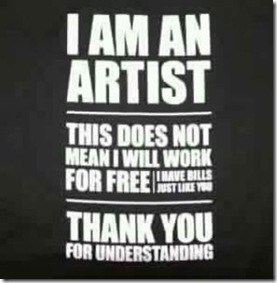
    This image has been floating around Face Book lately, accumulating plenty of “likes” on its way. 

    Well, I don’t like it.  I actually kind of hate it.  I believe that once an artist ties his or her work in a one-to-one, all-or-nothing relationship with making a buck off it, the game is done, and the moneyed powers-that-be have won it all over again.  Nothing new or good or game-changing can come out of saying you’re only going to do your art if someone pays you a living wage for it. Instead, what you are really saying is that your creativity is simply one more commodity to be bought and sold in a market-driven society owned by folks who know a lot more about money, and a lot less about creativity, than you do.

    One the other hand, I also hate the idea artists should shun the marketplace altogether. We should get paid,  as much as we possibly can in any given market. (So long as we are aware and comfortable with knowing that some markets will only offer us compensation that is utterly untranslatable into coin.)

    Up until now I have not written about the “living wage” crisis in Seattle Theatre because I did not have a good new idea on how to frame it. Then I attended the October Seattle Theatre: What’s Next? Forum, and listened with growing excitement as actor/producer Peggy Gannon kicked off a heated round-robin discussion of the issue that was finally and brilliantly summed up by Annex Theatre’s Meaghan DarlingJim Jewell’s notes from the night describe it best:

    Making a living and making art should not be mutually exclusive.

    This last point came out of our earlier discussion, but was most eloquently encapsulated by Meaghan Darling, fairly paraphrased as, “Nobody owes me a living, but I want them to not prevent me from making a living.” Big House rehearsal schedules were particularly discussed here, as the now-standard 10-6 rehearsal day precludes keeping a day job, while the economics of theatre (and of course there is much debate here) can’t offer a sustainable salary for that work (and we lamented how many amazing actors have had to leave town or the profession). We all rallied around this idea, because it is very much in the spirit of Seattle Theatre: What’s Next as a whole – it is a statement that holds within it hope and offers compromise, which seem to me essential components of productive dialogue.

    “Life, Liberty and the pursuit of Happiness.”  Despite the Tea-Bagging idiots who have co-opted their ideas and headgear, our Founding Fathers were no fools. No one can or should guarantee anyone happiness or a living wage. But when your systems—and this goes for unions and Big House administrations alike—stand in the way of the pursuit of making a decent buck from doing theatre, well, then the truth becomes self-evident, and independence must be declared.  If this be treason, let’s make the most of it!

  • Hawking Whole Theatre at “What’s Next?”

    Hawking Whole Theatre at “What’s Next?”

    Last night I joined a small but extremely energized group of theatre professionals at the second iteration of “Seattle Theatre: What’s Next?” hosted by Jim Jewell and Peggy Gannon.  I want to talk more about what was discussed and what action items came out of that discussion, but I think I will wait until Jim publishes the official minutes.  Until then, here’s a transcript of the three minute spiel that I was asked to give on what’s currently exciting me about Seattle Theatre:

    Whole Theatre

    Be careful what you wish for, sure.  But when it comes to Seattle Theater, it’s also wise to be specific what you wish for.  For a good while now Seattle’s Big House theatres have been gradually increasing the percentage of local actors they hire.  And rightfully they have then touted this change as a noble step in the direction of locally grown theatre. But let’s be honest.  We all know one of two things happened.  Either the artistic administrators of Seattle’s Big Houses all got together in a room and decided, “Hey, we should do the right thing and hire more local actors.”  Or… they all independently realized that in the current depression it was becoming cost prohibitive to fly in every actor from New York or LA.  I’ll leave it to you to decide which scenario seems more plausible.  But look, when a good thing happens it’s churlish to over-analyze the reasons for it.

    The problem is that using local actors isn’t enough.  And so when we advocate for locally grown theatre, we need to be more specific…  Whole Theatre.  Theatre that is soup to nuts local: written by local talent in collaboration with local talent.  Zero degrees of separation among everyone from the playwright to the director to the designers to the actors to the audiences. 

    Zero degrees of separation. 

    If what I am proposing sounds radical or overly ambitious, consider this: we do it all the time.  In fact, if I can brag a little, as a playwright and an actor, I have done very little in the last five years that hasn’t been Whole Theatre.  Going back to 2006, there was the Empty Space production of Louis Slotin Sonata.  When the floor needed final painting, Allison Narver was there in jeans, helping designer Gary Smoot to finish it.  I’m trying to picture one of Seattle’s Big House artistic directors doing that.  To be fair, I’m sure there are union rules against it.

    Then there was The Ten Thousand Things, which Washington Ensemble Theatre produced.  I sat in a room with the director and the designer Etta Lilienthal talking through her sketches. Later, I sat in the theatre while audience members rewrote my play one word each performance.

    And most recently there was Newswrights United producing two living newspapers, researched, written and produced by Seattleites, about Seattleites, for Seattleites.

    And of course it’s not just stuff I’m working on.  There’s the incomparable 14/48, perhaps the most consistently exciting weekend of theatre in town.  All local actors, directors, designers and crew mixing it up on plays written by local playwrights in the space of maybe ten hours, tops.

    There’s Printer’s Devil, opening yet another Scot Augustson world premiere, Shadow Odyssey in their unique committed relationship with him.

    There’s Sandbox Radio which just staged its second all original slate of short pieces, combining some of Seattle’s best actors with the best playwrights and musicians.

    And right on the horizon is Rebecca Olson’s new project Custom Made Plays, commissioning local playwrights to write for specific local actors.  I’m happy to be the playwright on the pilot play, writing for Rebecca herself and Hana Lass.

    Whole Theatre.  Theatre that hasn’t had the yummy good-for-you stuff processed out of it.  Non-corporate theatre that ain’t stale from being packaged three years ago in a theatre scene 2,700 miles away by MFA’s who have never stepped foot in your town.  Whole Theatre. Seattle’s crawling with it.  And surely it gives us the most solid shot at World Class.

    (I want to do a version of the poster that says Enjoy Whole Theatre!  Or as Shakespeare, Molière and Chekhov called it, “Theatre.”)