Just Wrought

Recovering playwright, once won a STRANGER Genius Award for theater. Now writing a bloated novel about… G-d help me! Theatre.

Tag: Shawn Belyea

  • Saturday Morning Cartoons LIVE!

    Saturday Morning Cartoons LIVE!

    Death of an Institution

    You may not have noticed, but just a few weeks ago a beloved American institution died the death of a ragdoll; and no less of an American institution itself than The Washington Post announced the passing in its recent article “Saturday Morning Cartoons are No More.” The Post lamented the last holdout:

    This past Saturday, the CW became the last broadcast television network to cut Saturday morning cartoons. The CW is replacing its Saturday cartoon programming, called “The Vortexx,” with “One Magnificent Morning,” a five-hour bloc of non-animated TV geared towards teens and their families.

    Those of us who remember the age of three and only three networks, also recall fondly that, once upon a time the only way you could watch animated cartoons was to wake up on Saturday morning and catch what ABC, NBC or CBS had on offer. Here is what a typical Saturday line up looked like when I was my son Keelans’ age. It includes classics like Bugs Bunny and Woody Woodpecker mixed in with more circa 70’s fair, like The Scooby Doo/Dynamutt Hour, and a personal favorite, Fat Albert and the Cosby Kids, which came on so late, 12 noon, that my mom was usually hectoring me by that time to get outside because I had already wasted too much of “perfectly nice day” watching that “idiot box.”

    “But Mom! It’s Fat Albert!”

    Birth of an Institution

    Happily, theatre—as specifically embodied by director/producer Jim Jewell— did not let the tradition of Saturday morning cartoons go gently into the good night.  Instead, Jewell saw the demise coming, and made a plan to fill the gap with short plays written by teams of local Northwest playwrights and their kids. “Saturday mornings used to belong to kids,” says Jewell. “I remember waiting all week for that one day I could binge on cartoons for hours. So, we wanted to try and create that same feeling with some fun live theater, and what better way to understand what kind of art kids want to see than engaging them in the creation of it?”

    The results of Jewell’s brainstorm will be making their world premiere over three Saturdays this November, at the Pocket Theatre [http://thepocket.org/] on Phinney Ridge in Seattle.

    Saturday Morning cartoons logo

    My sons, Declan and Keelan, and I teamed up to write “Magical Man and the Space Needle of Hideousness”, just one episode in the continuing adventures of Magical Man and his million-plus year sojourn in our paltry four palpable dimensions.

    MAGICAL MAN: I call myself Magical Man. Yeah, I know it sounds stupid, but I can’t say my actual name in your universe. There aren’t enough dimensions.

    I’ve been in your world for one million very, VERY boring years.

    Today I will do what I have waited all those years to accomplish. Confront Roger Wickersham, bring him to justice for his transgressions. . . .

    It certainly doesn’t hurt that Cody Smith and Samuel Hagen will be staring as Magical Man and Roger Wickersham, Evil PhD, respectively.

    Other playwright/kid combinations include:

    • “Don’t Touch That Dial!” by Penelope Venturini and Marcy Rodenborn
    • “Roderick Saves the World (or at least the Day)” by Finn Judd and Maria Glanz
    • “Feline Fitness” by Olivia and Jim Jewell
    • “The Family Jynx” by Jack and Joe Zavadil

    The plays will be brought to life by a talented ensemble, including Val Brunetto, Sam Hagen, D’Arcy Harrison, Cole Hornaday, Kacey Shiflet, and Cody Smith, with a special guest appearance by Paul Shipp. Co-directed by Shawn Belyea and Jim Jewell.

    Here are the details broken out real simple like:

    What?     Saturday Morning Cartoons – Live!

    Who?     B-Sides & Rarities, a Partner Project of The 14/48 Projects, in association with Pocket Theater

    Where?    The Pocket Theater, 8312 Greenwood Ave N

    When?     November 8, 15, 22 @ 10:30am 

    How?     Tickets for Saturday Morning Cartoons are available at The Pocket Theater website (http://thepocket.org/see/) and are $10 adults/$5 kids online (or $14/$7 at the door). Seating is general admission and all children MUST be accompanied by an adult

    Parents, I promise you a good time will be had by all!

  • Mythical Reasons for Not Listening to Sandbox Radio

    Mythical Reasons for Not Listening to Sandbox Radio

     I Hate Theatre

    “I heard I had to see Sandbox Radio in the theatre to get the full experience.”

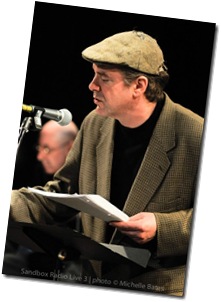
    Hey, listen, as a playwright, let me  assure you that I hate theatre more than you do, and in ways you have never even thought to think of; but just because Sandbox Radio Live! is recorded at West of Lenin’s intimate but fabulous black box in front of a live audience, that doesn’t make it theatre anymore than Mike Daisey reading from his notes in the Bagely Wright makes what he does a play.  (You can delve more deeply into this distinction here.)  The podcast of Sandbox Radio is the full experience. The bonus of going to see it live is like getting to watch Chef Tom Douglas cook your dinner at Dahlia Lounge. Witnessing the prep’s a super-cool extra that only a few people are ever going to get to experience.

    The Inimitable Leslie Law, SBR's Mistress of Ceremonies

    Prairie Home Companion sucks

    “Another “old-timey” radio show?  Been there, listened to that. Next.”

    Uh… you’re high.  Give just one of these podcasts a listen and you’ll see how far from Garrison Keillor our Mistress of Ceremonies Leslie Law takes these recordings. The band ain’t folksy, it’s thumpin’!  And the dialogue is distinctly R-Rated. You can listen to Sandbox Radio Live! on headphones at work, safe in the knowledge that what you’re doing is secretly and securely NSFW.

    It’s Too Late Now

    “If I try to plug into Markheim at this point I’ll be totally lost.”

    Admittedly, listening to a randomly selected episode of my noir-angel-detective serial is sort of like picking up a comic book mid-volume and trying to figure out what’s going on.  In other words… it’s awesome!

    Paul Mullin and Charles Leggett in Markheim

    Isn’t this a Seattle thing? 

    “I don’t live in Seattle.”

    Congratulations. I wouldn’t wish living here on a roving band of  Uruk-hai. Lucky for you, each podcast gives you ~90 minutes of rich Seattle experience while you can still bask in the sun and/or snow and/or hurricane conditions common where you currently live.Rebecca Olson in SBR 7

    Isn’t this a Seattle thing? 

    “I already live in Seattle.”

    Congratulations! Don’t tell anybody else how awesome it is here, please! If you need put-off material, I have a great little geeky LOtR-insider joke about a roving band of Uruk-hai you can use. But here’s the thing, fellow Seattleite: even if you’ve lived here all your life, you don’t know this city like the writers of Sandbox Radio do. We’ve found the places, stories and people that make Seattle—hmm, what’s a kind way of putting this?—“unique”, yeah, that’s it. Witness this delicious morsel of real-life dialogue captured and then re-staged from Seattle’s moveable epicenter of danger-tainment, the 358 metro route to Aurora. (All dialogue guaranteed overheard on the back of the bus.)

    GUY ONE: You wanna talk about John Lennon? Shit, that shit
    wasn’t even meant for him.

    GUY TWO: What?

    GUY ONE: That bullet. S’posed to be Paul McCartney, yo.
    That’s who dude wanted to shoot.

    GUY TWO: Really. McCartney?

    Shawn Belyea and Todd Jefferson Moore in Sandbox Radio Live!GUY ONE: That’s a fact. And dude will never get out of prison.

    GUY TWO: Well, you know, they were all Irish.

    GUY ONE: Sure.

    GUY TWO: And I always thought that must’ve been weird, growing up Irish in London. Must’ve been hard for them. Where the music came from, you know?

     None of these writers are Davids Mamet or Sedaris.

    “Sure, I’ve seen some of Sandbox Radio’s actors on Seattle’s Big House stages.  But if this ‘Scot Augustson’ is so great, why haven’t I seen anything of  his produced  at the Rep.”

    Uh… you realize that question answers itself, right? A regular and relentlessly versatile contributor to Sandbox Radio, as well as other great companies throughout Seattle and beyond, Scot Augustson is without question one of the best artists currently living and writing for the stage. (At least I think he’s still alive.  Homey lives hard up in Rat City.) Scot’s always doing something new for Sandbox, ranging from an original poem, to a hardboiled detective story for forest animals to the new sure-to-be-a-hit Seattle serial, Cousin Katie from Ketchikan. The only reason I don’t consume myself with jealousy for Scot’s talent and accomplishments is that his stuff is far too much fun to watch, or, in the case of Sandbox Radio, listen to.  Every time I want to hate him he makes me giggle. Giggling is death to hate. You’d think someone would have put that fact to good use by now.

    It’s too hip.

    “My tux is at the cleaners.”

    This bon mot comes from friend and colleague, Mark Handley, best known for his play Idioglossia, which was later produced as the Jodie Foster film, Nell.

    It’s okay, Mark. I just pulled your thong out of my dryer.  You can wear that while you listen.  We’re  casual.

    The Amazing SBR Sound fx crew 1

    • Listen to the most recent episode of Sandbox Radio Live! here.
    • Select from all the earlier recordings here.
    • And if you really feel strongly about seeing it live, well our next show’s at West of Lenin in Fremont on April 29.
  • One Great Year One–Sandbox Radio Live!

    One Great Year One–Sandbox Radio Live!

    Back in April we staged the fourth episode of Sandbox Radio Live, “The Chase” rounding out a year of producing this unique offering of all local theatre talent.  The podcast of this last show is now available here.


    Episode 4, “The Chase”
    recorded at West of Lenin on April 16, 2012

    @1:42    “Stewart and Miriam” by Elizabeth Heffron
    @10:52   “Markheim: Episode 4” by Paul Mullin
    @25:40   “Why We Run” by Scot Augustson
    @29:35   “Ain’t Gonna Chase After You” Charles Leggett
    @33:25   “The Back of the 358 #4” by Paul Mullin
    @34:50   “Straight With Chaser” by Ki Gottberg
    @42:54   “Always Disappearing” by Juliet Pruzan
    @56:20   “The Back of the 358 #5” by Paul Mullin
    @57:40   “Child of the Second Tier” by Elizabeth Heffron
    @1:04:32 “I’m Always Chasing Rainbows”
    @1:07:53 “The Back of the 358 #6” by Paul Mullin
    @1:09:45 “Squeeze Play” by Vincent Delaney
    @1:22:00 “Finale/Credits

    It was a great evening, as the Sandboxers have really hit their stride generating and performing work intended especially for the pleasures of listening.  For me the standouts of the evening were poems by Scot Augustson and Elizabeth Heffron, “Why we Run” and “Child of the Second Tier”; plus Charles Leggett’s hard blowing “Ain’t Gonna Chase After You” blues, getting its sassy behind kicked by Leslie Law’s second mic vocals.

    In July we’ll kick off a whole new year, with Episode 5 “An Unexpected Twist”, be there to share the making of the magic.

    And per tradition, below the fold you’ll find the script for Episode Four of Markheim, should you care to follow along as you listen.

    (And thanks again to John Ulman for taking such great photos!)

    (more…)

  • The Chase

    The Chase

    Markheim’s just a half-fallen angel trying to keep his head down and walk neutral in The Show, but a street kid stole his dog and now some Cherub has dropped down from the Fix for heaven only knows what reason.

    Seattle ain’t big enough for two expatriate angels. Sam ain’t gonna like it.  And when Sam’s unhappy, nobody’s happy.  

    Does tax season have you on the emotional lam?  Then join “The Chase”: The Sandbox Artists Collective’s fourth episode of its wildly successful SANDBOX RADIO LIVE! to be recorded before a live audience on Monday, April 16 at 8:00pm at Fremont’s newest theatre, West of Lenin.

    Entirely new, fresh and locally grown, Sandbox Radio is written, produced and performed by some of Seattle’s hottest stage talent. This latest episode, “The Chase” will include new original poems by playwrights Elizabeth Heffron and Scot Augustson, new short plays by Vincent Delaney, Ki Gottberg, Elizabeth Heffron and Juliet Waller Pruzan, plus Episode 4 of Paul Mullin’s noir-angel serial “Markheim”, original blues from Charles Leggett, and special guest chanteuse Joanne Klein.  Before the show and during intermission enjoy a beverage from our newly added bonus feature, The Sandbox Bar!   Halloween Sandbox Fun

    Members of the Sandbox Artist Collective currently scheduled to appear include: Megan Ahiers, Eric Ray Anderson, Shawn Belyea, Ki Gottberg, Mik Kuhlman, Amy Love, Charles Leggett, Todd Jefferson Moore, Peter Dylan O’Connor, Rebecca Olson, Kathryn Van Meter and Richard Ziman. Original music will be provided by Jose Gonzales and The Sandbox Radio Orchestra: including Dave Pascal, Dan Tierney and Rob Witmer.  You won’t want to miss this, and you won’t want to wait until the podcast of this episode is available online.

    Come see it LIVE! on Monday, April 16th…
     

     Sandbox Radio 4 postcard

    Who:     The Sandbox Artists Collective

    What:    SANDBOX RADIO LIVE! Episode 4 “THE CHASE”

    Where:  West of Lenin (203 N. 36th Street, Seattle WA) www.westoflenin.com

    When:  Monday, April 16th, house opens at 7:30 with live music, show at 8:00pm

    How Much:   $10 suggested donation at the door, Reservations recommended! Available at Brown Paper Tickets after April 2nd by clicking here

    Sandbox Radio is conceived, produced and directed by Leslie Law.  Contact:  sandboxradio@thesandboxac.org

    Podcast available in iTunes and by clicking  here

  • Holy Fear

    Holy Fear

    More than once someone has come up to me before an opening of some play I wrote saying something like, “Oh, you’ve been doing this so long you probably don’t even get nervous anymore, right?”  My reply is always: “It’s precisely because I’ve been doing this so long that I’m terrified.  I know all the things that can go wrong.”

    In two days I will be joining the 14/48 team as an actor for the first time.  In the parlance of the Seattle’s venerable “instant theatre” festival, I’ll be a virgin, and thus forced to fetch beer from the keg for whichever veteran demands it.  The fact that I have served as a writer four times makes no difference.  Nor should it.  As an actor, I am a virgin.  I feel like a virgin.  And I have a virgin’s fears.  Or to be more accurate I should say, I expect to feel a virgin’s fears.  I just don’t feel them yet.  It’s one of the blessings of being an actor.  You really don’t need to plan that far ahead.  Actors are soldiers in the trenches. Sure, it’s their ass in the line of fire, but at least they have something to do when the lights rise and it’s time to go up and over.  A playwright, like a general, has to watch in horror– sometimes abject, sometimes surreal– from beyond the action.  Of course there is joy too, but a playwright’s joy comes only in flashes until the final curtain drops.  Until then, anything can, and often does, go wrong.

    So my 14/48 virgin actor fear hasn’t hit me yet, but I have no doubts that by the time of the first morning’s “actors’ draw”, when I find out which play I will be performing and who my director and cast-mates will be, my insides will be doing a nasty free-style crawl towards either end of my G-I tract.  And when it comes time to go onstage for the first performance, I fully expect my swollen heart to be thumping in my chest.  This is only right and proper.  It’s how human bodies process performing publically.  And it’s as it should be. 

    A healthy fear is essential to making theatre.  It is what keys us into the audience’s experience of the immediacy of the moment. If you’re not feeling it, then chances are the audience won’t be feeling much of anything.  And, alas, they’re used to that. If they want “perfection”, they stay home and watch the boob. Our fear as theatre artists fuels the whole machina ex deus that is theatre.  The audience gets off on knowing that the train can leave the tracks at any moment.  Ours is the crucible where the experiment of art is performed—not re-enacted—but embodied in flesh and sweat and spit.  If we already know we’re right— if we know from the outset that the experiment is going to succeed— then we are also already dead.  Fear is life.  Fear is holy.  And in these darkest Northwest days just after New Year’s, fear is also a much needed bolus of bright adrenaline.  I plan on nursing it until the lengthening days can take over.

  • A Show You Don’t Have to Come See

    A Show You Don’t Have to Come See

    How often do you get a plug for a show in which the plugger says he doesn’t really care if you come see it?  Well, that’s exactly what I’m telling about this second edition of Sandbox Radio Live: The Halloween Episode.

    Well, all right, hold on a second.  Fact is, I really would like to see you there in the audience, but our seating at West of Lenin is extremely limited and we will sell out.  So no matter what happens, some of you who show up without reservations will be frozen out, S.O.L, on the sidewalk outside, while the happy few who booked at Brown Paper Tickets early enough watch it live.  (Book ahead here.)  But do NOT despair.  It’s Sandbox Radio remember?  And the whole point of us doing it is to make a permanent recording.  Our first episode is available for you to listen to right now, for free! at iTunes.  (Listen here.)

    The podcast of Episode One, at 90 minutes, is admittedly quite sizable.  In future, perhaps The Sandbox might look at ways to create a table of contents with time-stamps so you can go to the sections of the show that most interest you.  In the mean time, download it so that you have something to play the next time you’re stuck in traffic.  You won’t regret it.  (And after you have a listen, please consider posting a review of the show.  It’s the best way for you to let us know what you do and don’t like, and it also raises Sandbox Radio’s profile on iTunes.)

    And look for the podcast of Sandbox Radio Live: The Halloween Episode coming out shortly after the live performance on October 10!

  • NewsWrights’ Awareness & Fundraising Event – How’d we do?

    NewsWrights’ Awareness & Fundraising Event – How’d we do?

    NewsWrights United held its first ever awareness/fundraising event, Journalism: a.WAKE.ning? this past Monday night.  After taking a few days to recover, I thought it was high time to take a look at how we did.

    Goal 1: Raising Awareness

    The Excerpt Reading

    The evening’s kick off entertainment came with Dawson Nichols’ staging of the first scene of our working script for upcoming second edition of our Living Newspaper: The New New News, featuring the inestimable talents of Robert Agostinelli, Shawn Belyea, Khanh Doan, Amy LoveJoseph P. McCarthy, and our own Wes Andrews.  It is rollercoaster fun for a playwright to watch talented professional actors read, after very little rehearsal, words one collaborated to wright.  One moment you stand horrified helpless witness as they mangle laugh lines you crafted and treasured so dearly; the next moment thrill blossoms again as they find whole new laughs you never expected or designed.  Shawn Belyea embodied the definition of a professional actor– versus, say, a very talented and eager amateur– when he managed to wring the biggest laugh of the night out of losing his place in the script.

    Excerpt Reading from The New New News: A Living Newspaper featuring Robert Agostinelli, Khahn Doan, Amy Love and Shawn Belyea (left to right)

    The Panel Discussion

    Our Consulting Producer, Tom Paulson, ran this discussion of the current state of journalism, with such local luminaries as legendary sports columnist Art Thiel, new media maven, Monica Guzman, Mark Higgins, Metro Editor for The Seattle Times, Brendan Kiley, Theater Critic and Features Reporter for The Stranger, and Chris Grygiel, coordinator of political coverage for the Seattle P-I.com.  Personally, I found this panel discussion the most exciting portion of the evening.  Tom pointed hard-hitting questions at everyone in the room, and not one of the panelists shied away from answering frankly, a rare occurrence, as you would know if you have attended similar discussions in the last couple years.  Journalists have been very leery about hashing through the woes of their industry.  For a quick rundown of the various points-of-view represent, I cannot do better than the rundown provided by Jake Ellison over at Seattlepostglobe.org, which you can check out by clicking here.

     The Journalism: a.WAKE.ning? Panel.  Tom Paulson (in cap) moderates Paul Mullin, Mark Higgens, Monica Guzman, Chris Grygiel, Art Thiel, and Brendan Kiley.  (Left to right.)_

    One moment seemed to leap out for nearly everyone in the room.  Several good friends gave me their feedback in the days after and nearly all of them specifically mentioned the earnest and well-argued exchange between Art Thiel and Brendan Kiley regarding the definition of a journalist.  Is it, as Art argued, an expert in a certain field or, per Brendan, an aggressive novice?  One friend clearly felt Brendan played the wrong-headed asshole in the debate; the other friend, however, remarked on how freaked out he was by what he viewed as Art’s vehement defensiveness.  To a playwright this sounds like magic.  When you can produce something on stage from which different audience members can draw diametrically opposed notions of who the villain was, then you are most definitely cooking with gas.

    GRADE FOR AWARNESS RAISING – 95% – “A”

    Goal 2: Raising Funds

    Of course, the second and co-equal goal for Journalism: a.WAKE.ning? was to raise additional funds for our upcoming second edition: The New New News: A Living Newspaper.  We did that, posting a considerable surplus for the evening, but we could have done it better.  We are a new organization and still learning out how to do the all things we need to do to survive and thrive.  We will get better at this.

    GRADE FOR FUND RAISING – 82.7%  – “B-minus”

    And now to you . . .

    Because we continue reaching for our support goals, I would like to ask you right now to consider joining the NewsWrights team as a supporting member.  We have a wide spectrum of levels at which you can join.  I ask you to consider coming on as at least a Cub Reporter for a donation of $25.  Dawson Nichols smartly modeling the vintage, limited edition Seattle P-I cap available at the $50

    At the $50 level you will be listed in our program as a Columnist and in recognition of your generosity, you will receive, while supplies last, a limited edition Seattle P-I ball cap just like the one you see Artistic Producer Dawson Nichols smartly modeling in the photo  to the right.

    At the Desk Editor level, representing a $100 gift, you will receive two hats,  plus two reserved seats to any performance including one of our three opening nights, as we deliver the paper to Seattle’s doorstep in three neighborhoods: West Seattle, Capitol Hill and Northgate.

    At the $1,000 “Media Mogul”  level you will receive all of those perks, plus coverage of any local story you want by NewsWrights United, because we, like certain cable TV news operations, can clearly be bought.

    Finally, if all you can spare is $10, we would be deeply grateful to have you join our team as a Newsie

    The bottom line is we want your support– any support– because your support represents your “buy-in” to our mission, and that keeps us strong both fiscally and spiritually. So please consider joining us at whatever level you can.  It’s as easy as clicking on our trusty upside-down  NewsWrights Support Fedora, below.  It will take you to our Shunpike donation page. 

    Donation hatThank you so much for filling our hat with your support!

    (Also, if you have not already done so, please consider “liking” our Face Book page here.  For now, it is the very best way to keep track of our doings and some very evocative discussions around current journalism issues. )

  • Notes from a Pure Success

    This past Monday night the Sandbox Artists Collective held its Spring Salon, An Ensemble Playground, with member actors reading short plays that member playwrights had written specifically for them, with an added twist that each playwright had to use seven of ten words assigned by another participating playwright.  I know that the trope “honor and pleasure” gets thrown around a lot, but in this case, my experience of being the member sponsor for this salon was unequivocally both, and you can add “thrill” and a “joy” to the mix, since the whole process reminded me a bit of childhood Christmases, when making presents ran a close second to the fun of opening them.

    I jotted some notes which I share with you here, mostly roughhewn:

    Preshow

    • People are wandering in, enjoying the food, wine and cookies.  Some Sandboxers, but other folks too, including– god help us all!– young people interested in fresh and locally grown plays.
    • 7:10, everyone is still eating, drinking, chatting, playing pinball machines and getting to know one another, which was the primary intent of this salon so I’m reluctant to get things started.

    Play One

    • Anita Montgomery’s  “The Ties that Bind”
    • Early it dawns that Leslie Law and Peter Dylan O’Connor are playing sister and brother, and it’s perfect.  Not only do they convincingly look the parts but their interaction is laced with that particular pain that only a brother and sister grown apart suffer.
    • Is this great acting, great writing, great casting?  Well, the writing essentially is the casting, so . . .
    • Fold in Dave Natale as the palpably estranged  step-brother, again pitch perfect, and the brilliance builds, blissfully untraceable to any single artist in the process, the way great theatre should be?

    Play Two

    • Ki Gottberg’s “Felt”
    • Leaps straightaway from the precipice of “qualia” one of Ki’s ten assigned words (by me: full disclosure).
    • Richard Ziman, gamely filling in for Shawn Belyea, plays a lovable pompous philandering pendant, bookended by his wife (Tracy Hyland) and his young lover (Renata Friedman).
    • Again the voices are pitch perfect.  Even the silences with which both Tracey and Renata charge the beginning of the piece seem written particularly for them. 
    • Ki writes four roles actually, gamely making full thematic use of the yet-to-be born Hyland baby Tracy so gracefully carries.
    • The arc of the piece, launching in absurdist comic verbosity gently lofts into a bitter-sweeter, clearer atmosphere and touches down so gently in shared humanity.  Maybe we can share our experiences, our “qualia”.
    • So exciting to see another playwright attack a subject I have longed to approach and do it so differently and successfully. 

    Play Three

    • “The Eulogy” by Elizabeth Heffron
    • Immediately we know that Mik Kuhlman, Lori Larsen and Seanjohn Walsh are siblings.  Siblings again! and also death, as they’re at a funeral: Anita’s characters were at a viewing.
    • Elizabeth clearly knows each of her actors so well that she can trust them with just enough dialogue to nail the moment without overdrawing it.   
    • The local references to a Ballard and a sex besotted Scandinavian parking lot king has the audience eating out of the palm of Elizabeth hands.  They can taste freshness, like eating a salmon they just watched being pulled out of the locks.

    Play Four

    • “Satsuma” by me, featuring Rik Deskin and Gin Hammond. 
    • Again the performers find their characters’ voices like virtuoso’s picking up their favorite fiddle
    • And  again, it’s siblings.  What’s with the synchronicity?  Is it that many of us in the Sandbox have known each other for so long that we see each other as brothers and sisters?  Or is it, like Lori Larsen suggests in the talkback, just some Jungian archetype that happens to  be floating for the moment in the collective ether.  Either way, it seems like a phenomenon uniquely connected to the immediacy of the work.

    Afterwards, we all agree we have to do something like this again.  The theatrical potentialities unleashed in the fusion of local playwrights with local actors with local audiences are just too powerful to ignore or leave untapped.   I know the Big Houses are busy staying alive, but they need to ask themselves why they are not more actively engaged in this uniquely fertile process.  There’s surviving and then there’s thriving, and Monday night felt like the latter to me. 

    And not just me.  Every person in that room felt it. That’s the singular beauty of theatre.  At its best, there’s nothing singular about it.

  • The Sandbox Artists Collective’s First Ever Ensemble Playground Salon!

    THE PROBLEM

    Of all the excellent points and counterpoints made in recent discussions about how new work is suffering in the American theatre, perhaps the one that hits hardest home for me is that playwrights have generally drifted away from writing for a specific ensemble.  I know I have been guilty of this sin; knowing even as I committed it that the scripts which I have written for specific actors have been some of my most artistically satisfying as well as popular among audiences.  Local work means local actors, and playwrights need to form better connections with the talent that surrounds them in the city they call home.

    ONE SOLUTION

    The Sandbox Artists Collective has dedicated its Spring Salon to an experiment wherein member playwrights write material with specific member actors in mind.

    WHAT?  HOW?

    On April 10 at the Elysian brew pub, five Sandbox playwrights (or their proxies) drew names from an envelope containing 15 Sandbox actors.  Over the course of a month, the playwrights personally and individually met with each of actors we drew.  We then wrote 10 – 25 pages of brand new material specifically for our selected actors. These pages will be read publicly at the Sandbox’s Spring Salon.

    THE TWIST

    Each of the playwrights gave another writer a list of ten words, seven of which they were obliged to include in their script.  (For instance, Anita Montgomery gave me “magic”, “earthquake”, “bat-shit”, “circumcision”, “pilates”, “semi-sweet”, “funk”, “solipsistic”, “satsuma”, and “largesse”.  Hell, those constitute a play in themselves!)

    WHO

    The Sandbox playwrights involved are Ki Gottberg, Elizabeth Heffron, Anita Montgomery, Paul Mullin and John Paulsen.  The Sandbox actors involved are Shawn Belyea, Rik Deskin, Renata Friedman, Gin Hammond, Tracy Hyland, Mik Kuhlman, Leslie Law, Lori Larsen, Todd Jefferson Moore, Paul Mullin Dave Natale, Peter Dylan O’Conner and Seanjohn Walsh.

    WHERE

    The Sandbox Salon 2010 Spring Salon will take place at the THE STUDIO @ 15 MCGRAW, 15 McGraw Street, Seattle WA 98109, on the top of Queen Anne Hill.

    WHEN

    Monday, May 10 at 7PM. 

    HOW MUCH

    Admission is free, though we may beg you for a $5 suggested donation to help bring you innovative Sandbox Projects like this in the future.

  • The Solo Show: A Risk Averse Artistic Administrator’s Best Friend

    The Solo Show: A Risk Averse Artistic Administrator’s Best Friend

    The fourth in a series of essays entitled: 
    Towards a World Class Theatre

    Some fifteen years ago Dawson Nichols and I were having lunch at a long gone Japanese noodle house on Broadway when he asked me an awkward question that I will now try to do a better job of answering.  Back then we were not the close friends and collaborators we are now—more like respectful but wary competitors for the title of AHA! Theatre’s Golden Boy.  Dawson had a much better line of attack on the prize, because while we both wrote strong multi-actor plays, Dawson also amazed us all with his impressively diverse catalogue of one-man shows, including Stop/Start, Virtual Solitaire, I Might be Edgar Allen Poe and Three Descents of Darwin.  I have always been captivated by Dawson’s one-person work. 

    I have also always had my theoretical reservations about the genre, as Dawson must have suspected that day over yakisoba when he challenged me squarely, “You don’t think my solo work is theatre, do you?”  I must have made a weak apologetic smile. I must have hemmed and hawed. I think I finally answered, “Strictly speaking, no, but—“ and then went on to make some half-lame explication, but the look on Dawson’s face showed it all: hurt and disbelief at my dismissive arrogance, even as I tried to explain how much I respected him as a generative and performing artist.

    So perhaps now, with my friendship with Dawson a little more secure (I hope), it is time to make that earlier explication sharper, and then explore that explication’s implications within our regional theatre administrator’s collective half-conscious effort to re-forge by fudging a new definition of the art form and thus raise the number of one-person shows they can get away with and still claim that they are practicing theatre.

    Before writing this I decided to do a little research by reaching out to my compadres over at 14/48 via Facebook:

    Paul Mullin

    April 9 at 3:32pm

    Hello lovers!

    Any and/or all of you can answer. And yes, I’m going to quote you in my blog. I’m working on an essay about one-person shows. And my question is this: “Why don’t you ever have the option of drawing just one actor in the actor draw? Are there any other reasons beyond the fact that that poor schlump would have to memorize too much?”

    Let me know.

    Love,

    Paulie

    clip_image001[4]

    Shawn Belyea

    April 10, 2010 at 3:56pm

    Re: Question for the 14/48 Crew

    Cuz one-person shows are dumb. Mostly it’s memorization and it’s supposed to be a collaborative effort so we want actors to have some company.

    clip_image001[6]

    Jodi-Paul Sanford Brown-Wooster

    April 11 at 1:06am

    I hate one person shows. And yes, I’m looking at you Lauren. There is no intrinsic dramatic tension with one person, it’s fakey.

    clip_image001[8]

    Peter Dylan O’Connor

    April 11 at 3:52p

    One person shows are fucking glorified camp fire stories…

    clip_image001[10]

    Matthew Richter

    April 11 at 8:33pm

    i love one-person shows. and i think they’re an interesting challenge for 14.48.

    but i’m retired.

    xom

    If you seek consensus, you would be wise not to consult the prophets of 14/48.  Once again, I am left to my own opinions and devices.  I proceed with that caution for you, my gentle reader.

    Basically, solo shows boil down into two kinds: the actor’s tour de force and the enlarged lecture.  Dawson Nichols shares the first tradition with Anna Deavere Smith, Chazz Palminteri and countless other talented writer/actors, who generate shows that then require them to become all of the characters on stage, even at times performing both sides of multi-sided dialogue.  Over the last few decades, it has become an increasingly effective way of growing an actor’s career.  Palminteri literally leveraged himself into playing the principal role, Sonny, in Robert DeNiro’s directorial debut film A Bronx Tale, which began as Palminteri’s one-man show of the same name.  As Rik Deskin, Aristic Director of The Eclectic Theatre points out, “When you’re self-producing/self-promoting, a solo show is one way to get yourself out there.”

    My friend and comrade-at-arms, Mike Daisey, presents from the lecturer tradition, most recently reinvigorated by Spalding Gray, but one which runs the gamut, in just this country alone, from Jonathan Edwards to Mark Twain and right on up to David Sedaris and Sarah Vowell.  This kind of show employs more direct address, less actorly technique.  Instead of primarily inhabiting other characters, the lecturer’s own personality ties the evening together.  In the hands of a Daisy or Sedaris it can be hugely fun, funny and compelling, but no one plying the trade 130 years ago would have thought of calling themselves a theatre artist, even if a particular night’s performance happened to take place in a theater—unlikely in that age, since theaters were rarely dark and there was a plentitude of active churches, as well as all sorts of lecture halls specifically built for this purpose.  As different as these two kinds of solo show are, and as much as it seems the Nichols / Deveare Smith variety is much closer to theatre as we know it, they both represent variations of the much older, and completely honorable tradition of story telling.

    Theatre, however, is something really quite different.  It happens in the preternaturally galvanized space between two or more people on stage and the other people in the audience.  It sprang forth from its older sibling, storytelling, in that radical moment when the teller pointed at someone in the campfire circle and said:  “You be me.  I’ll be the wolf.  We’ll show them how it happens.”  Thus a whole new art form was born.

    As a solo lecturer, Mike Daisey has a point of view.  And a damned good one too.  He makes no bones about telling you what to think.  And if you want my opinion, you should listen to him.  I have a different role as a playwright and a different box of tools.  I can show you things happening, but it is up to you what to make of them.  Theatre is dialogue.  Not as part of the narrative, like in a novel, but as all of the show.  Even if no words are spoken, dramatic action takes place in a framework of implicit dialogue: people doing things to other people. This is why our collective audience hackles go up whenever a narrator starts telling us the story instead of enacting it.  Good playwrights understand this and know how to leverage the discordance of direct address narration (see Shakespeare’s Chorus in Henry V or Wilder’s Stage Manager in Our Town).  Lesser playwrights never seem to learn: you can’t tell an audience anything.  They can only be shown.  They can only ever come to their own conclusion about what is happening.

    Dialogue breeds risk like flowers bloom scent, and risk is the fabric of theatre.  Because two or more people on stage can never know with certainty what an other is about to do, no matter how many times they have done it before, the audience attends the action with a sense of the innate exposure.  “Anything could happen, and we are in the same damned room with these agitated people.”   Risk is not a by-product of drama.  It is the main ingredient.  

    Nothing wrong with masturbation, but everyone knows you cannot tickle yourself.   Likewise, I cannot, as a performer, ever surprise myself to the degree another performer can—arguments about unexpected inspiration notwithstanding.  When there is another actor on stage with me, I have to watch, I have to listen, I have to be wary.  Other actors can push you around, and you can push back.  No one can manufacture this kind of risk in a solo performance, no matter how earnestly the performer tries to convince his corpus callosum  not to tell his left brain what his right plans on doing.   Sure, an actor can mimic dialogue, playing both sides of a conversation, but even at its very best this trick still contains an unconscious but unavoidable note of condescension, like Donald Rumsfeld asking himself ostensibly difficult questions about the Iraq War in a press conference and then answering them with ostensibly matter-of-fact brilliance.  True dialogue adds a crucial dimension which defines theatre, just as surely as the third dimension of physical depth defines sculpture. 

    Theatre also trades on what we show folk loftily refer to as “the willing suspension of disbelief.”  Wikipedia defines this notion as “the willingness of the audience to overlook the limitations of a medium, so that these do not interfere with the acceptance of those premises. According to the theory, suspension of disbelief is a quid pro quo: the audience tacitly agrees to provisionally suspend their judgment in exchange for the promise of entertainment.”  (I should fully disclose here how I hate this term, mostly for its gratuitous gracelessness.  I mean, is the double negative really necessary to nail the point?  What would be wrong with, say, “fabrication of belief?”)  In a solo show disbelief can never be truly suspended.  At best, it can be sent to detention, where it still manages to sulk and grimace and call attention to itself.

    Let me be clear.  By pointing out that one-person shows are not, strictly speaking, theatre, I am in no way trying to denigrate them or argue for their banishment.  It has been a long standing tradition for regional theatres to opt for filling one slot in their season with an easily produced, low-overhead solo show, but indications are rising that Big Houses in this town intend to lean on this option more heavily in the future.  The Seattle Rep recently announced its 2010-2011 season in which they will be offering not one, but two solo shows,  The K of D in the smaller Leo K venue and Mike Daisey’s new piece on their Bagley Wright mainstage (a relatively unheard-of placement of a solo show for them.)  If Daisey does well (and as his friend and colleague, I cannot help but hope he does) you can bet you will be seeing more mainstage solo offerings from the Rep.  It is just too cheap for them not to.  And as long as no one’s complaining that they are not actually doing theatre in their theater, well…

    Meanwhile, next door at the Intiman, they have answered with unblushing cynicism the call for more locally grown new plays by staging The Thin Place which they laud on their website as “the second world premiere by a local writer in Intiman’s history.”  Note the pride with which they admit a fact of which they should rightly be ashamed.  Using a solo show to rectify their abysmal record reveals how little they wish to risk on the attempt.   How quickly will Intiman abandon and distance itself from The Thin Place if it does not do well with critics or audiences?  How likely are they to offer up the now tired Big House refrain when a locally grown piece does not catch fire right away?  “See?  We tried ‘locally grown’.  It just doesn’t work.  Can we please go back to retreading Pinter, Mamet and off-Broadway’s last season?”  Always behind such excuses are obfuscated variables of production and promotion that contribute to a given show’s putative failure but that go unnoticed and unconsidered in public.   In this case,  the crucial factor that will not be mentioned is that The Thin Place is a one-man show, and not, strictly speaking, theatre at all.

    Regional Big Houses defend their solo performance offerings like a richly-endowed sculpture gallery might defend an exhibition of paintings.  “We love sculpture.  And of course we are a sculpture gallery, but sculpture itself is expensive and difficult to maintain.  Instead, why not enjoy some lovely paintings of sculptures?”  Paintings of sculptures can indeed be lovely, but not even an idiot would call them sculptures, any more than Mark Twain would have referred to himself as a theatre artist 130 years ago.  Solo performance billed as theatre is a pig in a poke.  The unpredictability of human beings interacting lies at the heart of what we are selling in the theatre.  We trade it out and bank our future on its diminishment at the very risk of our art form’s soul.

    Next up: “Good Friend for Jesus’ Sake Forbear and Never Build another Proscenium Stage”