Just Wrought

Recovering playwright, once won a STRANGER Genius Award for theater. Now writing a bloated novel about… G-d help me! Theatre.

Tag: The Seattle Repertory Theatre

  • Please Let the Daisey Debacle Mean More Theatre/Journalism, not Less.

    Please Let the Daisey Debacle Mean More Theatre/Journalism, not Less.

    A lot has already been said about the revelation that Mike Daisey fabricated many portions of his one-man show, The Agony and The Ecstasy of Steve Jobs: a piece he previously passed off as entirely truthful reportage, most egregiously on This American Life, a nationally broadcast public radio program. I leave it to wiser minds to sort through all but one of the many questions Mike’s transgressions raise, reserving for scrutiny only that which I feel I am particularly qualified to examine: what impact will Mike’s dishonesty have on the intersection of theatre and journalism?

    A huge number of people are familiar with Daisey’s work creating and performing topical monologues at some of the most prestigious venues in America, from the Seattle Rep to New York’s Public Theatre to the Woolley Mammoth in Washington, D.C. A much smaller number of people know of the work produced by NewsWrights United, a theatre company I co-founded and serve as Executive Director. We dramatize news using a form invented in the early 20th century called the living newspaper, and all of our stories are researched and written by local Seattle playwrights. (Memorable examples include Scot Augustson staging the farcical misadventures of a reporter/photographer duo sent to Detroit a week early to cover the Seahawks only Superbowl appearance; and on the serious side, Pamela Hobart Carter’s lyric poem/play about the psychic damage done by the Green River Killer.) On first appearances, NewsWrights United and Mike Daisey seem to occupy similar territory in the art/news nexus, but in actuality I believe we do something fundamentally different, and if I can tease apart for you these differences, I earnestly hope to convince you that coverage of news in the theatre is something worth saving even if Mike Daisey’s methods are not.

    I predict two reactions to this crisis from artistic administrators at U. S. regional theatres. The first is already in evidence. Institutions that have already booked Mike will mostly stick with him, echoing his essential tack: “Yeah, lying to the public radio program TAL was wrong, but lying in the theatre is obviously eminently forgivable. After all—heck!—isn’t all theatre lying?” Artistic administrators are not widely known for the courage of their convictions, however, so I further predict that over the next year or two, while the controversy dies down, they will quietly divest themselves of as much Daisey stock as possible, so long as it doesn’t cost them too much to dump it. What’s worse, I also predict they will take the dreadfully wrong-headed step of underscoring this divestment with an abandonment of all new work that explores the intersection of theatre and journalism. (The exception to this new silent ban will be, perversely, Mike’s inevitable one-man apologia, which regional houses will be falling over each other to stage.)

    But forsaking the theatre/journalism intersection does not have to be our future. With hard work, honest self-examination and courage we can take this opportunity not to withdraw but advance the genre. As a once and, with luck, future practitioner of news theatre, I venture to offer some practical advice on how we might achieve this.

    Expand the Pool

    Beyond his extraordinary talent as a storyteller, Mike’s shows appeal to regional theaters across the country because they are cheap and easy to mount. Most important, they are portable. If you are looking to plug a little topicality into your otherwise staid season, you cannot do it more easily than by giving Mike a call.

    Living newspapers are much more difficult. To create effective alternatives to the Daisey Debacle, you have to give up some of the conveniences of the one-man show; most crucially, you have to give up the idea of “one-man.” Actual plays are vast collaborative efforts, featuring dialogue among and between more than one player on stage. The play development process contains a built-in organic vetting process that zeroes in on “truth” even when the story, like Agony/Ecstasy, is more accurately classified as fiction.

    For instance, I am working with Rebecca Olson’s project Custom Made Plays to develop a script for her and another actor. Every week I sit in a room with them and the director, carefully combing through the script with questions. The process is gentle but relentless, and when a false note gets rooted up, we pounce to replace it with something more “honest.” Many of the moments in Agony/Ecstasy that Daisey promised us were real were not. In retrospect, they reek of bad fiction now that we know that is exactly what they are.

    I reach into my satchel, and I take out my iPad. And when he sees it, his eyes widen, because one of the ultimate ironies of globalism, at this point there are no iPads in China. …. He’s never actually seen one on, this thing that took his hand. I turn it on, unlock the screen, and pass it to him. He takes it. The icons flare into view, and he strokes the screen with his ruined hand, and the icons slide back and forth. And he says something to Cathy, and Cathy says, “He says it’s a kind of magic.”

    Daisey’s a fine writer and I have no doubts he could have avoided this tripe, offering instead something genuinely brilliant, if he had only admitted it was fiction in the first place and then collaborated with performers and a director to sharpen it.

    Living newspapers expand the pool in more than one dimension. Beyond just other actors in the room, you must also let in other writers. How much would anyone trust a newspaper with only one reporter who also served as the sole editor? NewsWrights United engaged several local playwrights for its living newspaper about the demise of the actual newspaper, The Seattle Post-Intelligencer. By spreading the attack, we were able to cover a number of different beats—sports, politics and arts coverage at the P-I—in a wonderfully varied spectrum of styles, some of which implicitly “watermarked” their stories as fictionalization (but more on “watermarking” later.) Using more artists allows you to cover more kinds of stories, leading to another way to better provide theatrical news…

    Up Your Local Content

    It certainly was exciting to watch “David” Mike take on “Goliath” Apple from the stage of my local regional theatre; and certainly my local regional theatre enjoys, along with regional theatres across the country, the imprimatur of international relevance when such a story as Agony/Ecstasy gets told.  However, we lose a huge opportunity when our big houses keep mounting the very same one-man show, instead of staging local news that actually has as much, if not more, to do with the lives of local audiences as does Applegate. Let’s dare to flip the model and have each theatre produce its own living newspapers, telling stories about their own communities, and sure, plugging in national stories such as those Mike tells when appropriate.

    I promise you: locally grown journalistic theatre is not only doable, it’s been done. In NewsWrights United’s last effort, The New New News: A Living Newspaper, we locally sourced nearly all of our stories about the crisis in journalism brought on by the digital age. Our play It’s Not in The P-I: A Living Newspaper about a Dying Newspaper gave voice to locally beloved P-I reporters so that a community eager to hear their tales finally had the opportunity that no other medium would give.  We also broke important exclusives into the buy-out process that the Heart Corporation used to cherry-pick and union bust their newsroom as they shuttered the print version of The Seattle P-I and moved to an all on-line edition.  It didn’t hurt that one of our founding producers, Tom Paulson, is a professional journalist, formerly the P-I’s science reporter, and currently writing for NPR’s Global Health site, Humanosphere.

    Use “Watermarks”

    Not everything that takes place in a theater is theatre. If this is news to you, you might not be to blame. The theater = theatre fallacy is happily perpetrated by artistic administrators to fill their seasons with the easiest fare to produce. (Click here to see my essay on this.) True theatre is rife with “watermarks” built into both the text and context of a play to remind you, sometimes explicitly but mostly implicitly, that what you are seeing is to some degree false.

    “Watermarks?” You say. “How come I’ve never heard of these watermarks before?” Well, for two reasons: One, I just started using the term in a theatrical context about a week ago when I was trying to explain why Mike should not be allowed to take refuge in our art form. Two, watermarks are so endemic to theatre that we tend to look right through them, like reading glasses. The Greeks used masks as watermarks. Shakespeare and his contemporaries stitched their plays out of the watermarking fabric of Iambic pentameter. Not a single tradition within our grand form lacks them, but an exhaustive list is superfluous to this argument, because the definition of theatre is the ultimate watermark: two or more people staging a live dialogue (before you ask, no, it doesn’t have to be with words) within the physical perception of other people. Think about it. Someone tells you a story on the street. She could be lying. She could be telling the truth. But two or more people obviously acting out a story in front of you? Without question there’s some tomfoolery going on here.

    Of course there is an important stipulation implicit to the tradition of tomfoolery and even blatent dishonesty in the theatre: we demand ardent honesty about our dishonesty. We tell you were going to lie, before we do it, while we do it, and after we do it.

    If we shadows have offended,
    think but this; and all is mended
    that you have but slumbered here
    while these visions did appear 

    When you reach the certainty that we paltry players are lying, you can begin to understand that we are actually telling the truth. Daisey could have easily entered this tradition. He could have done all the good works he claims to have hoped to have done within it. Instead he took the risk that selling fiction as non-fiction would get him further. It did. But he got caught. And now he’s run back into our house claiming sanctuary. Brother Daisey has forgotten that theatre’s unwritten canon is as unyielding as the ecclesiastic: the crimes of the church can be punished within the church. If he wants sanctuary here, he will have to work hard and long at his penance.

    Here’s a simple rule of thumb about watermarks: a theater (i.e. the venue) cannot serve as a watermark; theatre (i.e. the work of art) must contain the watermarks that prove it false, and thus prove it true theatre. Otherwise you’re just some guy telling me a story and if you tell me explicitly that what you’re saying is true, I am likely to take you at your word.

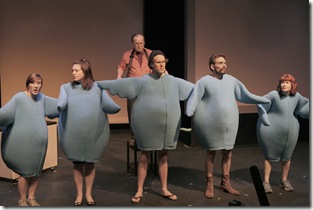
    A living newspaper has an even greater obligation than conventional theatre to watermark early, often and obviously. For example, when we staged the Twitter stream of the Maurice Clemmons manhunt (He killed four Puget Sound cops in cold blood), we did not alter a single word of the tweets, though obviously, since there were over five thousand, we had to whittle them down considerably. We knew we could not give an accurate portrayal of what it was like to witness this stream in real time. No one could. Not only was it a moment passed, but in a way it was a meta-moment. No one person witnessed it in its entirety. So we posited the next best thing. We staged the stream as a symphony of actorsNEW NEW NEWS Twitter Chorus, Photo by Chris Bennion dressed in blue bird suits, evoking the Twitter logo. We weren’t just trying to be funny (though god I hope we were). We were saying, “Obviously we can’t give you the literal truth. Pay no attention to the blue bird suits if you don’t want to, but every (often idiotic) word these actors declaim was actually tweeted over that 3-day ordeal.” (Here‘s a segment on this section by Seattle’s NPR affiliate KUOW did .)
    Not only did Mike refuse to use watermarks, he actively defumigated the theatre of all its delicious anti-sanctity.

    “… Mike told at least me time and time again [that the story] was true. He insisted that “This is a work of non-fiction” be printed in playbills.” 

    Alli Houseworth,
    former marketing/communications director
    at Woolly Mammoth Theatre Company. 
    (You can read her excellent essay by clicking here.)

    Mike didn’t want a watermark within a mile of any house he played. He wanted us to believe every word he charmed us with. And now he encourages his defenders to ridicule and condescend to the very people who took him at his word. “We are all liars and hypocrites,” says Mike. There is something particularly vicious about the man who would punish others simply for being the victims of his sins.

    Act Like it Matters

    The worst thing I heard in response to Daisey’s dishonesty was this from a friend of a friend on Facebook:

    “I never believe you theater folk – you’re a rascally bunch.”

    Yeah, we’re rascally. But sometimes we are able to illuminate stories that journalists themselves are not willing to touch, like when NewsWrights covered the closing of the P-I. And sometimes we are able, like Daisey, to tell a story like Agony/Ecstasy, in such a moving way that we inspire people, perhaps otherwise impossible to inspire, to action. However, in order to poach a bit on journalism’s turf we have to be trusted.  Do we really want to give up this wonderfully fertile ground just because Mike Daisey lied and then excused his lies as so much “theatre”? Do we really want to let him claim sanctuary in our church where we have established traditions stretching across millennia of being scrupulously honest about our dishonesty?

    In answer to this question, the silence from big house artistic administrators so far has been pristine. Clearly theatre has a leadership vacuum in addition to its identity and relevance crises. No one seriously denies that we are simply not producing enough new, fresh, locally sourced material to keep our audiences engaged like Shakespeare’s were, or even Shaw’s. Projects like Daisey’s and NewsWrights United’s help mitigate the problem, but only if we take the issue of truthfulness seriously. We have to act like it matters. We have to show our audiences that we give the issue of truth consideration and respect, or they will walk away from us forever.

  • Art Picks up Journalism’s Slack Again

    I went on record a while ago saying that I will not be doing reviews here at Just Wrought.  However, in order to make a couple of larger points later, I will have to stipulate some things about Mike Daisey’s performance last night at the Seattle Rep’s production of his new one-man show, The Agony and the Ecstasy of Steve Jobs.  Here’s why:  I was pressing my way out of the theatre after the show, doing my best to spare myself and Kurt Beattie the awkwardness that always ensues when we try to casually chit-chat, when I overheard an older and obviously well-off man say to his wife, “I’ll be interested to see how his [meaning Daisey’s] performance grows after a couple weeks.  I mean, this was only just opening night after all.”

    Yeah. 

    So let’s get something straight from the start: Mike Daisey’s performance was brilliant, alternatively hilarious and harrowing; funny and furious: one moment cannily manipulative and the next heartbreakingly earnest, and it only grew more compelling as the evening progressed.  Frankly, I expected no less.  Daisey is a brilliant performer.  Full stop.  What’s more, he’s a consummate professional, meaning that he will bring that brilliance to every performance he does of this piece or any other, night after night, week after week, venue after venue.  To engage in speculation about whether Daisey’s performance will improve or decline after a couple weeks is to indulge in the worst kind of aesthetic fetishism, and worse: it lets you off the hook of the message. 

    Unfortunately, this hobbyist’s game has been getting played more and more here in Seattle.  “Hans Altwies’s performance was brilliant the other night,” says the canny theatre-goer, making plain that she not only knows Hans Altwies by name, but also understands the nuances of his work well enough to gauge when he’s brilliant and when he’s not.  Well, I got news for ya, knowing theatre-goer.  Hans Altwies is always brilliant.  Like Mike Daisey, Hans is a consummate theatre professional, and he’s going to give you the acting goods in great plays, okay plays and terrible plays alike.  What’s more, Hans is not the only brilliant actor in Seattle: we have at least a hundred world class actors in this town—way more than we can sustain with a living wage.  What we do not have in huge supply are shows that matter, right here and right now to our fellow citizens.  (Yes, I understand Of Mice and Men is moving.  But no, I do not agree that staging it yet again can make a wit’s worth of difference in most people’s lives.)   The Agony and the Ecstasy of Steve Jobs is different.  In his show Mike is telling stories that you simply cannot and will not hear anywhere else—true stories about the lives of our fellow human beings who make, by hand, the “shit”—as Mike calls it– that we consume.

    If you are reading this on a digital device (and how could you not be?) Mike provides a journalistic investigation that is as intimately connected to your life as the technology you are using right now.  He did the risky leg work that no “professional reporter” was willing to do, and he got past the corporate obfuscation that no other journalist could breech.  If you want to hear these stories in the next few weeks, the only way you can do it is to show up at a specific place, the Seattle Rep, at a specific time and listen to Mike tell them to you.  If you say to me that the Rep’s tickets are too pricey, I will listen respectfully and sympathetically, but I will counter with a question of my own: how much did your phone cost?  Was it more or less than a ticket to Mike’s show?  And how can you really assess how much it really cost, unless you find out how it was made and by whom?

  • Let’s Put a Bullet in the Ugliest Rumor

    Let’s Put a Bullet in the Ugliest Rumor

    Much as I may seem to like banging on Seattle’s Big Houses here at Just Wrought, I am compelled to make clear from the outset of this essay that they are not the perpetrators but rather the victims of the ugliest rumor currently hovering like a toxic miasma over the Seattle theatre scene.  To understand this you need to understand that beyond the Big Houses, and the dwindling mid-sized houses, and even the small alternative theatres, there exists a whole other tier of arts professionals that exercise a huge influence on the operations of these producing entities, while putting little if any actual creative “skin in the game.”  I am talking about the “booster class” of arts organizations– entities like Theatre Puget Sound, ArtsFund, PONCHO, and the boards of directors at every mid to large theatre in this town.

    These institutions tend to be led by well-meaning, “right-thinking” liberal-minded members of the upper upper middle class (formerly the “Upper Class” before the rich began to resent being called “rich”).  The boosters usually come from a corporate background and tend to have adopted standard corporate best practices as articles of faith.  (Full disclosure: I work at a large bio-tech company for my day job.  So I am both tainted by the American corporate ethos as well as intimately familiar with it.)  The Booster Class sees themselves as the noble guardians and advisors of the Artist Class.  They believe they understand quite a bit better than their artistic little brethren how the big bad real world works; and they are convinced that the best way to ensure the survival of the art form they are boosting—in this case theatre—is to apply the rules and philosophies of business to their operation.  Thus, we get general, inoffensive/ineffective, broad spectrum marketing campaigns like ArtsCrush, or the cold-blooded shuttering of the Empty Space because its board of directors decided it was not performing to the standards of a viable Silicon Valley startup.

    That sad story brings us to the ugliest rumor: that many of the leaders at or near the top of these booster organizations believe that Seattle just isn’t big enough, rich enough, or cultured enough to sustain three major League of Resident Theatres (LORT) venues like A Contemporary Theatre, Intiman Theatre and The Seattle Repertory Theatre.  One of these will have to go, goes the thinking, preferably in the next few years.  Whether this happens via out right murder, like the aforementioned Empty Space, or merger, like the recent marriage of Seattle Shakespeare Company to The Wooden O, remains to be determined; but either way, murder or merger, what seems to the corporate-minded like a necessary act of cultural husbandry will in fact be an irrevocable disaster for the cultural ecology of Seattle.  We have to make sure it never happens.

    I understand that to corporate eyes, the Seattle theatre is overdue for a down-sizing.  No other town of our population size has asmany large regional theatres.  In corpo-speak there are all kinds of economies of scale to be leveraged and redundancies to be eliminated by closing one of the Big Three or merging it with another.  What this analysis overlooks is that theatres are less like widget-manufacturers and more like ecosystems.  Diversity matters.  For Seattle to make a run at world class status as a theatre town, it needs all of its Big Houses, plus a lot more middle-sized spaces, and it needs all of them to be as different from each other as possible.

    Of course, sadly the Big Three have done everything possible over the last fifteen years to make themselves less distinguishable from each other as an Applebee’s® is from a Red Robin® is from a T.G.I. Friday’s®.  They hire the same actors, designers and directors.  They fight for the same plays, semi-fresh from New York.  When called on their lack of local freshness, they hold up for cover the same one or two nice playwrights, local or not, call them “local” and call it good, while hoping that the call for “local” goes the way of the Empty Space.  (It won’t.)

    Instead, they should privately strive and publicly argue for what sets them apart from their competitors.  (Yes, Big Three, I said “competitors.”  The concept might make you squeamish, but your Booster bosses don’t share your scruples, and your audience actually enjoys an honest rivalry.)  The Bigs should also locally source as many of the stories they stage as possible.  (Just ask Tom Douglas: great local restaurants start with great local ingredients.)  Finally they should develop an aesthetic and stick with it, building their artistic corps around this defining core. 

    That’s right, B3: pull the artists you like working with in house.  As celebrated local scenic designer Matthew Smucker once plaintively exclaimed in the comments section of this blog:  “Freelance is killing us all, so give us all a home.”  Oh, and while I’m ranting: stop choosing safe plays.  Theatres are built to contain danger so that audiences can experience it without actually being damaged.  When you consistently choose safe plays, or direct dangerous plays safely, you smother the internal fires of our art form.  Instead of strategizing to survive, strive to make a difference.

    The differences matter; and as happy irony would have it, they better ensure your survival.  When theatres are truly diverse, audiences will care about diversity.  Then they will make ticket purchases based on it.  People will go to all three venues to marvel at the differences, like enjoying varied species at the zoo.  As it is now, they aren’t convinced they are missing anything if they fail to catch Intiman’s latest because they are fairly certain that eventually they will see something similar at ACT. 

    Now, in all fairness, I could be wrong.  The rumor could be baseless.  When I recently checked my sources,  a certain much more knowledgeable colleague of mine said:  “The movement toward ‘consolidation’ of big houses, which was at one time aimed at ACT and Intiman, and then at the Rep and Intiman, is now largely over.”  What’s more, apparently there is a counter rumor circulating that the booster organizations which were originally pushing for these mergers (ArtsFund and PONCHO, to varying degrees) are now in worse shape than the theatres themselves.  There might even be a movement afoot to merge them.  Hah!  True or not, you cannot help relishing the poetic justice.

    Still, we have to stay vigilant.  Seattle cannot lose even one of these Big Houses, and the boosters who seek to “right-size” Seattle theatre need to be convinced that our theatre scene is fatter than an average city’s because Seattle is destined for greatness.  Let’s put a bullet in this rumor once and for all.  Let every leader at every booster organization even remotely associated with the survival of the Intiman, ACT and the Rep publically avow the following:

    I understand that for Seattle to rise to its rightful place as a world class theatre town it cannot afford to lose any of its three LORT theatres.  I will do everything in my power to ensure the survival of the Intiman Theatre, A Contemporary Theatre and the Seattle Repertory Theatre in perpetuity, and I will reject any attempt to destroy or dilute their potential diversity whether by murder or merger.

    Further, I will demand that these institutions maximize the differences among themselves, so that a truly vibrant and viable theatrical ecology can thrive here, such that the loss of any one of these theatres will be utterly irrevocable, and thus unthinkable.

    Now, this is not too much to ask, is it?

    Step forward, Boosters!  And take the pledge!

  • Chicago Blog Examines 5th/Rep Payola Mess, Slaps Playwrights Pointlessly

    Chicago Blog Examines 5th/Rep Payola Mess, Slaps Playwrights Pointlessly

    http://www.adaptistration.com/2010/05/04/desperate-playwrights/

    Drew McManus, in his blog on orchestra administration, makes an excellent examination of the Fifth Avenue Theatre’s pay-to-play scandal, including pointing out that by “sub-leasing” the time it bought on KING 5’S New Day Northwest,  Seattle’s 500-pound gorilla of a Big House effectively gate-keeps what kinds of arts organizations will get this television coverage.  However, his title “Desperate Playwrights”, casts over an otherwise thoughtful essay a pall of outrageous ignorance about modern American theatre.  I guess he’s going for some sort of pun-ished quarter-rhyme with “Desperate Housewives”, but really, given how lamely that joke lands, I find myself wondering if Mr. McManus gave his internal editor the day off.  One hopes, in vain I suppose, that a self-described arts consultant would be a little less tone deaf to insult people who, among other things, write insults for people for a living.  (Well, okay, it ain’t much of a living.)  Talk about blaming the innocently by-standing victims.  Associating playwrights with the 5th Avenue Theatre’s silly slimy behavior, and those that joined them, is like blaming Bram Stoker for Count Chocula.

  • The Seattle Rep and the Fifth Avenue Take a Walk on the Sleazy Side

    I will be honest: although I always hope for the best, I never really expected the Big Houses here in Seattle to have some sort of Road-to-Damascus conversion and start doing the right thing. I always assumed they would continue to offer safe and staid programming and promote it with safe and staid marketing techniques.  So when I read in this week’s Stranger that the Fifth Avenue was paying for coverage on KING 5 TV’S New Day Northwest without making it plain that the coverage was sponsored, I was actually genuinely shocked.  And I have to confess, it gave me a bit of pleasure, because I honestly did not think that, given their tepid programming, the Big Houses could ever possibly shock me again.

    Folks, this story will get spun by the culpable spinners.  Those of us who are appalled by this supremely less than ethical behavior will be branded as naïve and bitter; but this is exactly the sort of thing the Bush Administration tried to pull. 

    …the White House, … spent taxpayer money to produce local TV-news segments advocating policies of the Bush administration. The Government Accountability Office condemned these paid-for “news” segments as “covert propaganda,” but the White House instructed agencies to ignore the GAO findings.

    “As a former journalist, I’m horrified to be compared with the Bush administration,” Larson said. “This isn’t a news program—it’s an entertainment program.”

    If the Rep and the Fifth cannot see what they did was wrong, then they have no business offering us art that purports to be honest, edgy, and untainted by corporate equivocation.

    ***

    PS:  Brendan Kiley suggests here that all the Big Houses, plus the little ones like WET, too,  owe him back pay for covering them, but I would further suggest that NewsWrights United covered the Seattle theatre press in last fall’s It’s Not in the P-I: A Living Newspaper about a Dying Newspaper, so perhaps they in turn owe us a little som’n-som’n.  Granted, I wrote about Misha Berson and Joe Adcock. (You can watch the video here. ) and left out  Kiley, because, let’s face it, he’s just too boring.  But Brendan?  If you’re willing to make me an offer I’ll happily write a play about how you wrote an article about how the Fifth bought buzz and convinced the Rep to join their ethically dubious enterprise, for what I can only imagine was what they saw as the high-ground cover the Rep could offer them if the shit hit (which it did).  Forget cover, Big Houses.  Your cover is blown.  Get started living right, or get started dying.  There are no longer any in-betweens.

    PPS:  A year and a half a go The Stranger gave me a hunk of change for being a “Genius”.  Obviously, this is a bogus award, the sole purpose of which was to get me to push traffic over to their website.  So go, damn you, go!  I don’t want them asking for their money back!

    PPPS:  I hate loving The Stranger, but given the connect-the-dots drawing of Mohammad they ran on the front of this issue, how can I help my damned self.