Just Wrought

Recovering playwright, once won a STRANGER Genius Award for theater. Now writing a bloated novel about… G-d help me! Theatre.

Tag: Theatre Puget Sound

  • Let’s Put a Bullet in the Ugliest Rumor

    Let’s Put a Bullet in the Ugliest Rumor

    Much as I may seem to like banging on Seattle’s Big Houses here at Just Wrought, I am compelled to make clear from the outset of this essay that they are not the perpetrators but rather the victims of the ugliest rumor currently hovering like a toxic miasma over the Seattle theatre scene.  To understand this you need to understand that beyond the Big Houses, and the dwindling mid-sized houses, and even the small alternative theatres, there exists a whole other tier of arts professionals that exercise a huge influence on the operations of these producing entities, while putting little if any actual creative “skin in the game.”  I am talking about the “booster class” of arts organizations– entities like Theatre Puget Sound, ArtsFund, PONCHO, and the boards of directors at every mid to large theatre in this town.

    These institutions tend to be led by well-meaning, “right-thinking” liberal-minded members of the upper upper middle class (formerly the “Upper Class” before the rich began to resent being called “rich”).  The boosters usually come from a corporate background and tend to have adopted standard corporate best practices as articles of faith.  (Full disclosure: I work at a large bio-tech company for my day job.  So I am both tainted by the American corporate ethos as well as intimately familiar with it.)  The Booster Class sees themselves as the noble guardians and advisors of the Artist Class.  They believe they understand quite a bit better than their artistic little brethren how the big bad real world works; and they are convinced that the best way to ensure the survival of the art form they are boosting—in this case theatre—is to apply the rules and philosophies of business to their operation.  Thus, we get general, inoffensive/ineffective, broad spectrum marketing campaigns like ArtsCrush, or the cold-blooded shuttering of the Empty Space because its board of directors decided it was not performing to the standards of a viable Silicon Valley startup.

    That sad story brings us to the ugliest rumor: that many of the leaders at or near the top of these booster organizations believe that Seattle just isn’t big enough, rich enough, or cultured enough to sustain three major League of Resident Theatres (LORT) venues like A Contemporary Theatre, Intiman Theatre and The Seattle Repertory Theatre.  One of these will have to go, goes the thinking, preferably in the next few years.  Whether this happens via out right murder, like the aforementioned Empty Space, or merger, like the recent marriage of Seattle Shakespeare Company to The Wooden O, remains to be determined; but either way, murder or merger, what seems to the corporate-minded like a necessary act of cultural husbandry will in fact be an irrevocable disaster for the cultural ecology of Seattle.  We have to make sure it never happens.

    I understand that to corporate eyes, the Seattle theatre is overdue for a down-sizing.  No other town of our population size has asmany large regional theatres.  In corpo-speak there are all kinds of economies of scale to be leveraged and redundancies to be eliminated by closing one of the Big Three or merging it with another.  What this analysis overlooks is that theatres are less like widget-manufacturers and more like ecosystems.  Diversity matters.  For Seattle to make a run at world class status as a theatre town, it needs all of its Big Houses, plus a lot more middle-sized spaces, and it needs all of them to be as different from each other as possible.

    Of course, sadly the Big Three have done everything possible over the last fifteen years to make themselves less distinguishable from each other as an Applebee’s® is from a Red Robin® is from a T.G.I. Friday’s®.  They hire the same actors, designers and directors.  They fight for the same plays, semi-fresh from New York.  When called on their lack of local freshness, they hold up for cover the same one or two nice playwrights, local or not, call them “local” and call it good, while hoping that the call for “local” goes the way of the Empty Space.  (It won’t.)

    Instead, they should privately strive and publicly argue for what sets them apart from their competitors.  (Yes, Big Three, I said “competitors.”  The concept might make you squeamish, but your Booster bosses don’t share your scruples, and your audience actually enjoys an honest rivalry.)  The Bigs should also locally source as many of the stories they stage as possible.  (Just ask Tom Douglas: great local restaurants start with great local ingredients.)  Finally they should develop an aesthetic and stick with it, building their artistic corps around this defining core. 

    That’s right, B3: pull the artists you like working with in house.  As celebrated local scenic designer Matthew Smucker once plaintively exclaimed in the comments section of this blog:  “Freelance is killing us all, so give us all a home.”  Oh, and while I’m ranting: stop choosing safe plays.  Theatres are built to contain danger so that audiences can experience it without actually being damaged.  When you consistently choose safe plays, or direct dangerous plays safely, you smother the internal fires of our art form.  Instead of strategizing to survive, strive to make a difference.

    The differences matter; and as happy irony would have it, they better ensure your survival.  When theatres are truly diverse, audiences will care about diversity.  Then they will make ticket purchases based on it.  People will go to all three venues to marvel at the differences, like enjoying varied species at the zoo.  As it is now, they aren’t convinced they are missing anything if they fail to catch Intiman’s latest because they are fairly certain that eventually they will see something similar at ACT. 

    Now, in all fairness, I could be wrong.  The rumor could be baseless.  When I recently checked my sources,  a certain much more knowledgeable colleague of mine said:  “The movement toward ‘consolidation’ of big houses, which was at one time aimed at ACT and Intiman, and then at the Rep and Intiman, is now largely over.”  What’s more, apparently there is a counter rumor circulating that the booster organizations which were originally pushing for these mergers (ArtsFund and PONCHO, to varying degrees) are now in worse shape than the theatres themselves.  There might even be a movement afoot to merge them.  Hah!  True or not, you cannot help relishing the poetic justice.

    Still, we have to stay vigilant.  Seattle cannot lose even one of these Big Houses, and the boosters who seek to “right-size” Seattle theatre need to be convinced that our theatre scene is fatter than an average city’s because Seattle is destined for greatness.  Let’s put a bullet in this rumor once and for all.  Let every leader at every booster organization even remotely associated with the survival of the Intiman, ACT and the Rep publically avow the following:

    I understand that for Seattle to rise to its rightful place as a world class theatre town it cannot afford to lose any of its three LORT theatres.  I will do everything in my power to ensure the survival of the Intiman Theatre, A Contemporary Theatre and the Seattle Repertory Theatre in perpetuity, and I will reject any attempt to destroy or dilute their potential diversity whether by murder or merger.

    Further, I will demand that these institutions maximize the differences among themselves, so that a truly vibrant and viable theatrical ecology can thrive here, such that the loss of any one of these theatres will be utterly irrevocable, and thus unthinkable.

    Now, this is not too much to ask, is it?

    Step forward, Boosters!  And take the pledge!

  • Why is Theatre Puget Sound Diluting its Mission?

    Why is Theatre Puget Sound Diluting its Mission?

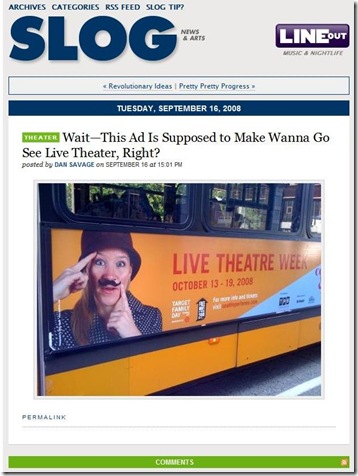
    Yes, we all cringed when we saw the Theatre Puget Sound (TPS) ads for Theatre Week in years past.   Apparently some PR firm had been hired in Sioux Falls, South Dakota and given the very specific instructions to create a campaign that would confirm every uninitiated civilian’s suspicion about just how lame and goofy live theatre can be.  Bowler hats, canes and dorky “del arte” facial expressions were de rigueur.  Some one who did not know better could easily have gotten the impression that every show in Seattle was some variation of a Godspell Hell.

    The comments to Dan Savage’s Slog post here about this flip phone pic  below sum up the general response hilariously.  Comment number 5 buttons them all together, thusly: “Perhaps it is a typo… perhaps it is supposed to read “Live Theatre Weak”

    Screen shot from Slog

    If you are tempted to riposte in the comments with that hoary Seattle arts chestnut of an excuse: “They were doing the best they could”, please spare us, because anyone looking to encapsulate the thrill of theatre photographically need look no further for examples than any of the images pushed out over the last few years by WET. (Sorry, I just can’t bring myself to cave and call them “Washington Ensemble Theatre” just because some litigious trust-funded ensemble in NYC got jealous of WET’s success.  See here .)

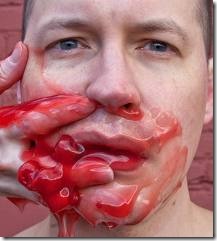
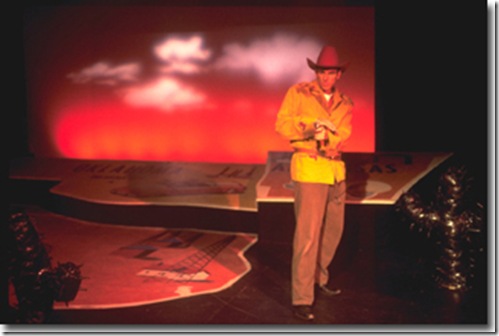
    Promotional photo from WET's Hedda Gabbler redux: blahblahblahBANG Promotional photo for WET's Titus Androncius

    Promotional photo for WET's RoboPop

    (Just how and why is it that WET can make headphones so sexy?)

    As much as Seattle’s theatre professionals longed for a fresh and empowering marketing campaign from TPS to hook people into big and small local theaters around town, the last kind of change most of us would have wished for is what rolled out this Spring.

    Announcing Arts Crush,
    The Month-Long Arts Festival

    on April 19, 2010, at 5:30 pm | Category: Arts Crush

    As you may already know, Theatre Puget Sound is planning an expansion of our highly successful Live Theatre Week festival.  In an effort to build upon the momentum of that program and address the expressed needs of the larger arts community, we decided to expand our scope and build a more diverse and inclusive month-long festival modeled after Live Theatre Week.

    This October, Theatre Puget Sound will present Arts Crush, a month-long festival that connects artists and audiences with invigorating new experiences at hundreds of events across the region.  More than 200 arts organizations and innumerable artists from all over the Puget Sound will come together as a united arts community to share arts experiences with people of all kinds….

    So Theatre Week becomes Arts Crush, and somehow, the theatre artists (mostly actors, actually) that make up TPS’s membership, all of the sudden become, without being asked, patrons of all the arts, because, you know, we make so much money on the stage.  Where are the other major discipline-specific arts organizations that are joining TPS in this move towards expansiveness?  There are none.  TPS basically owns Arts Crush, in conjunction with broad based arts funders like Seattle Office of Arts & Cultural Affairs.  None of the non-theatre-but-still-discipline-specific organizations like Velocity Dance or Seattle Chamber Music come even close to matching TPS’s size or influence.

    Before I go on, let’s take a quick look at TPS’s mission, shall we?

    TPS is a member-driven organization whose main goals are the nurturing of a healthy and vibrant theatre community, developing strong ties among the region’s theatre professionals, raising the visibility of the region’s theatre scene on national and international levels, and finding ways to develop new and diverse audiences.

    Nowhere in the paragraph above is there any mention of cross-discipline arts promotion.

    So why is TPS diluting its mission?  My best guess is fear, with a touch of pointless power grab thrown in for flavor.  The move is part of a larger strategy to beat a tasteful and bloodless retreat from world class status.  The thinking goes like this, “Theatre is suffering.  And so are all the arts.  The core audience for theatre in the Northwest overlaps the core audiences for all of the other arts.  Let’s expand our scope, control that shrinking core and hope to hold the ground we have.  We can give up the castle to control the wider, albeit weakened, kingdom.”

    Of course this runs counter to what I and many of my colleagues believe is the best strategy to not only save theatre in Seattle but also elevate it to world class status at the same time.  We believe now is the time go on the offensive: to advance, not retreat; to push forward bold new and innovative plans for making a completely different and fresh sort of theatre.  We certainly do not think we should be spending our limited resources promoting “arts” in general.  That sort of “yay arts!”, “up with people!” advocacy ultimately helps no one.

    TPS’s desperation is showing.  Just this week an email went out from extending the deadline for applications to the Arts Crush festival.  A cynic has to wonder why.  Could the dilution of the TPS’s core mission have anything to do with it? <
    /p>

    Turning Theatre Week into Arts Crush is a mistake.  Theatre artists are rightfully reluctant to underwrite an effort that has expunged the word “theatre” from its name.  (If you played professional shortstop in Seattle, and the Mariners began a promotional campaign promoting all sports, but omitting the word “baseball” from its title, would you be worried, irritated or both?)  TPS should rethink this move.  Seattle needs a theatre advocacy organization that can keep its focus.  If TPS wants to be something other than it is, they should be honest about it and change their moniker to “APS” for Arts Puget Sound.  Of course, if they did that you would have to wonder what it would do to their membership rolls.

  • Fooled Again? The Seattle Outrageous Fortune Discussion

    Estragon: I can’t go on like this.

    Vladimir: That’s what you think.

    Allow me to share with you the opening paragraph of an amazing essay that Carl Sander brought to my attention a few weeks ago:

    The American non-profit theatre movement is nearing disaster.  Without an adequate sense of tradition or sense of social responsibility, it is in danger of becoming a movement whose only purpose is self-perpetuation.  This idealistic movement begun some generations ago has been unable to achieve a living wage for its actors, a livelihood for its playwrights; it demands that its designers accept twelve to fifteen productions a year just to make ends meet, and forgoes its responsibility to train directors while permitting, under the heading of financial survival, the average income of its audience members to climb higher and higher until this once bastion of social ideas and aesthetic concerns as become the plaything of the upper middle class and the very wealthy.

    Isn’t that amazing?  Doesn’t that paragraph just go straight to the heart of our current situation, and by doing so make you a little bit more hopeful that smart people are talking about theatre’s endemic crisis in such an insightful way, since surely, if we talk about this cogently and passionately, we will inevitably move toward making things better?

    There is only one problem.  This paragraph was written by Richard Nelson for an essay in PAJ: A Journal of Performance and Art in 1983.  So whether you like it or not, whether you knew it or not, these problems are way over a quarter of a century old.  And since Nelson’s incendiary bit of insight was published, absolutely nothing has changed.

    Last Monday, a bunch of Seattle theatre folk sat in a room and listened to Todd London, Ben Pesner,  and Tory Bailey present their findings on the state of the American playwright– findings which culminate in a book called Outrage Fortune: The Life and Times of the New American Play.  I cannot heap enough praise on these professionals for their efforts not only in researching and authoring this book but in their willingness to tour the country to discuss it.  Thank you, London, Voss and Pessner, as well as Tory Bailey, Executive Director of the Theatre Development Fund. Thank you from the bottom of my heart.  I hope we happy few in Seattle can make progress worth your effort.  I hope this, while understanding that hope is not a plan.

    I fretted over how best to how best to shape my thoughts about the day, and then I realized I already had a loose outline in the form of the bite-sized tweets I was firing off live from the room.

    Roll Call” and “Good Mix and Size

    The first two blog posts were longer than what I could manage later, and were dedicated to making note of the very impressive cross-section of artists and administrators who came to share in the discussion.  I am proud of my city for the turnout.  My only caveat: I did not see a large number of actors– certainly nowhere near the proportion they hold in the larger theatre community.  If playwrights really want to get traction in making locally grown new plays a priority then we are going to have to do a better job of convincing local actors why this is important.  I have myself been petulant on this point  in the past and pledge to do better.

    Within “Good Size and Mix” I posted the first of many quotes that I enjoyed: “We are finished with talking with playwrights in one room and artistic directors in another.  This tour is the first salvo of setting playwrights and artistic directors in a room talking to each other.” Soon after I began tweeting quotes with little or no context.  I will try to make up for that here.

    Commissions are what a theatre gives a playwright they like when they don’t want to produce your play.

    Boy howdy, ain’t that the truth!  Understand if you can that in the upside-down, through-the-looking-glass world that is regional theatre everything you learned about money and investment flies out the window.  The larger the commission the less likely the theatre is to actually produce what they have paid you to wright.  Why?  Because it is easier to score a grant funding a commission than it is to get one large enough to underwrite an entire production of a new play.  In the regional theatre world, commissions are an easy win.  The playwright gets paid.  The theatre looks generous.  So long as everyone calls it good, it’s good, right?  (Note: actual play seen by actual audience not included.)

    “‘Everyone wants the same ten playwrights.’– Anonymous Artistic Director

    I ripped this from one of London’s slides.  It is a key point from the book.  There was no argument on Monday from anyone representing the Big Houses, nor have their season selections provided any compelling contradictory evidence.  Plus, when it comes to locally grown, that list of ten can be reduced to one: Steven Dietz, who, while beloved of all, has actually lived in Austin for the past half decade. 

    “Right now Q&A has bogged in a rather tedious, though I suppose necessary analysis of the survey methodologies.”

    Typical Seattle talkback static. “I need to show you how smart I am by questioning your research process while agreeing with its conclusions.  Really, I just want everyone to know I’m smart.  Does everyone know that now?  Great.  I’ll sit down.  What were we talking about?”

    “Things are looking up. A touch of crazy has blossomed in the room.”

    I would live to rue these words, after someone stood up and complained at length about how no one in New York wanted to produce her one-woman show about the day JFK was shot.   Crack-pottery suits the status quo defenders because it helps them lump the legitimate playwrights in with lunatic amateurs.  They can then turn to their boards, shake their heads sadly, and say, “You see what I have to deal with?  You don’t pay me enough to screen out these maniacs.”

    “Okay, now it’s become a pattern– unique to Seattle?– that crazy flowers are dominating Q&A because the smart folks are too smart to pipe up.”

    See above.  But note that the smart people are complicit as well.  And I admit, I too was biting my tongue and sitting on my hands.  But in my defense, I get to mouth off a lot, and was genuinely interested in what other folks had to say.  Come on good folks, speak up!

    “Good question leading to discussion of potential of collaboration across theaters of differing sizes. In other words, a pipeline. Duh.”

    This is what we we need to be talking about, friends: a pipeline: some way of delivering plays across the tiers of theatres in this town.  Todd London talked about how incredibly hard this is to do, and I do not doubt it.  So was going to the moon.  So was writing Hamlet.  So is raising a family.  Can we try something hard?  Can we as Seattleites lead a cultural change instead of hoping Austin figures it out?  (Which by the way, according to London, Austin may already be doing.)

    “Good question from a good friend involved in development asking to identify a “sweet spot” for breaking down silos so that all the people in this room can better collaborate towards developing new work (ideally locally grown).”

    Some sort of pipeline is the sweet spot, I am convinced.  There are other options worthy of research and development: playwright residencies, season slots dedicated to new work, etc.,  but I figure those will be a lot harder for the Big Houses to swallow than a pipeline, which they will wager they can quickly abandon when the pressure’s off (i.e. ACT’s abandonment of its highly successful FirstACT program.)  So I say, let’s convince them to build the pipeline and then let’s defend it vigorously.  Keep the pressure on, forever, forcing them to pull the plug only at their p.r. peril.

    “A little bit of fireworks there. ‘Not enough good plays for the Big Houses.’ ‘Aesthetic absolutes.’ ‘You either get what you want or you don’t.”

    Finally voices from the Big Houses start piping up.  At times to call me out by name to both praise and dismiss me in the same breath.  I am used to this tactic.  It has never cut much ice with me.  Praise is a director’s easy currency.  Many actors crave it.  It soothes them.  There is nothing wrong with this.  At the moment, however, I happen to have my playwright hat on, and I have been to Hollywood.  I know exactly how much such praise is worth.  Instead, I prefer to focus on fighting words, such as “We are looking for excellence and not finding it.”  Bullshit.  You are not looking.  And when pressed, you praise the shit out of anything handed to you in the hopes that the playwright will just go away like a happy little puppy that just got its head patted.  Save the praise.  Let’s do a production.

    “I actually don’t think the system is broken. Just limited resources.”

    Wishful thinking from a Big House voice.  Why is the Center House Theatre packed with people for this discussion if the system ain’t broken?  Are we all crackpots?  Did this all somehow get fixed since Richard Nelson wrote his essay in 1983?  In fairness, you have to expect that this argument will be trotted out, and even perhaps welcome it.  There are people who believe all is essentially well.  Best to know who they are so you can properly provide them  the evidence otherwise.

    “What are you willing to sacrifice?”

    I find this question fascinating.  Primarily aimed at playwrights, the essence is: are you willing to give up a living wage to practice your art?  Are you willing to give up your career to make these changes you are asking for? 

    Answers:  Done and done. 

    I started wrighting plays over twenty years ago understanding I would likely never gain a livelihood from it.  How many actors my age can say the same?  I also hope it is clear by now what I have personally anted up by speaking out here.  Any hopes I had for a nice Dietzian career in this town are herewith spent as payment to sit down  at the bargaining table.  I will not, however, sit without asking absolutely everyone else at that table what they are willing to stake to make this conversation happen.  Are you willing to give up your livelihoods in the theatre to fix this?  Are you willing to sacrifice everything you were hoping for individually, all your preconceptions, to make theatre better in Seattle and across the nation?  Or are you going to defend the status quo because it has gotten you this far?

    Louis Broome wants your figurative head on a platter if you currently make your living at one of Seattle’s not-for-profit theaters.  I just want your actual heart, in your chest, pumping warm blood to your brain so you can have a conversation about producing local plays that matter to the audiences you have never yet managed to reach.  I do not intend to let anyone off the hook because they are having a bad year, or a good year (yes, again, congratulations ACT) or because they absolutely know what quality is and they cannot find it here, the home to some of the finest playwrights living.  Given that I have nothing left to lose, and that I have very little power to comfort the afflicted, I will settle for afflicting the comfortable.

    But let’s not get too excited here.  Heck, it isn’t as if this cause is urgent.  We have at least another 27 years till someone, maybe only 15 years old now, digs up these essays and says, “Damn.  Nothing’s changed.  But we can’t go on like this.”

    That’s what you think, kid.

  • Who should go to the OUTRAGEOUS FORTUNE Discussion? Actors

    I thought I might be able lay low and abandon my series of short screeds about who should come to the March 1 Outrageous Fortune discussion (details below), but my colleague, the actor and incomparably astute analyst of the Seattle theatre scene, Rebecca Olson was not having it.  This from a recent Face Book round robin:

    Rebecca Olson
    I’m still waiting to hear why actors should go to the Outrageous Fortune discussion. Especially since it starts at 9 am, and you know how us actors are about getting up early.
    Fri at 11:56am ·

    Paul Mullin
    Rebecca, I’m feeling very lazy about banging the drum for OF lately. I’ve got a little of SP’s skepticism, so I’ve kind of petered out. But if you give me one good reason why actors should go, I’ll write the essay.
    Fri at 12:29pm

    Rebecca Olson
    I thought you were supposed to tell me why to go? (Yawn. Stretch.) Maybe I’ll go take a nap, then drink some whiskey and bitch to someone about how local actors are not appreciated by the Big Houses. That’s probably more helpful.
    Fri at 12:44pm

    Paul Mullin
    Wow! And I thought Chris Comte was unaccountably nasty. You’ve raised the bar, Olson. What was that you were saying about warm fuzzies, SP?
    Fri at 12:53pm

    S.P. Miskowski
    @Rebecca, if it helps to inspire you, I can tell you what the city’s most glamorous AD says to friends about the acting pool in Seattle.
    Fri at 1:07pm

    Scot Augustson
    SP: Seattle has a glamorous AD?
    Fri at 1:29pm

    Rebecca Olson
    …. Okay – here’s why actors should go: because we’re all in the same Seattle boat, together – and if we stick together and support each other (as the wise Mr. Dietz gently reminded us) it will only help – that includes reaching across the disciplines. And if that’s too warm and fuzzy just appeal to our vanity: what actor doesn’t want a playwright to write a role just for them? This is another incentive to make friends with local playwrights and get their plays produced.
    Fri at 1:35pm

    Paul Mullin
    Perfect. I’ll write the essay.
    Fri at 1:38pm
     

    Of all the artists that play at this game of theatre, playwrights and actors are the most closely related.  If you go back far enough on the timeline of artistic evolution you can see that we were once the same species, called “storyteller.”  Then at some point, between 3,000 -10,000 years ago, when civilizations as we understand them came to fruition, a split occurred, allowing for what biologists call “speciation”.  Actors continued to tell stories, in a live and interactive, i.e. theatrical way, but someone else actually provided the script.  This speciation was never completely delineated, however.  There are still plenty of fertile hybrids. Shakespeare, Moliere, Shepard, and myself (see how I worked that?) all started as actors and then mutated.  Many, like me and all those I just put myself in the company of, continued acting long after they took up the pen.

    A false opposition has taken root here in Seattle, one that often pits actors against playwrights and vice versa.  Playwrights will sometimes mock actors for their short-sightedness: their willingness to sacrifice all artistic vision for their hopes of the next gig and the eternally elusive “living wage.”  Actors will sometimes join the entrenched artistic administrators in their dismissal of local playwrights as essentially backwoods whiners with nothing genuine on the line.  But the fact is, we are close cousins.  We share nearly all of our creative DNA.  And we are artistic equals.

    We do not, however, need each other equally.  You read that correctly.  Actors do not need playwrights as much as playwrights need them.  What Greg Carter once argued at the 2008 Stranger Shit Storm is true.  There are enough excellent plays already extant in the canon that even if another good one were never written, there would still be plenty of strong material for actors and directors and designers to work with simply by pulling classics off the shelf, be they Hamlet, The Adding Machine, or Glenngary Glen Ross.

    You really don’t need us, my player cousins.  And if you have never had the experience of originating an utterly new character for the stage, then I am not likely, nor inclined, to sell you on its merits.

    So come if you feel like it.  Or not.  We need you.  Desperately.  But we are also your family, and it is a shabby family indeed that makes a cousin beg.

    Theatre Puget Sound hosts
    Outrageous Fortune
    March 1, 2010
    9AM – 1PM

    Detail: 9am – 10:30 Presentation by author Todd London

    Break – snacks
    10:40 – 12:00pm Q & A in large group
    Break – lunch type snacks
    12:10 – 1pm small group breakouts and report back

    Center House Theatre

    rsvp: TDFRSVP@tpsonline.org

    Theatre Development Fund, the national service organization, is convening a meeting of playwrights, artistic directors, funders, theatre managers an
    d others in conjunction with Theatre Puget Sound at the Center House Theater in Seattle on March 1, 2010 from 9:00am-1:00pm to stimulate conversation and action to support new American play production. Tory Bailey, executive director of Theatre Development Fund, Todd London, artistic director of New Dramatists, and co-author Ben Pesner will lead the gathering, which will begin with a presentation of the results of an intensive study of new play production in America and then open out to an inclusive conversation.

    TDF has just released the book OUTRAGEOUS FORTUNE: THE LIFE AND TIMES OF THE NEW AMERICAN PLAY written by Todd London and Ben Pesner, with research consultant Zannie Giraud Voss. The book, drawing on six years of research, examines the lives and livelihoods of American playwrights today and the realities of new play production from the perspective of both playwrights and not-for-profit theatres. The study represents the most comprehensive field study in the history of the not-for-profit theatre to analyze new play production practices and the economics and culture of playwriting in America. Set against a backdrop of dwindling audiences for dramatic work, OUTRAGEOUS FORTUNE: THE LIFE AND TIMES OF THE NEW AMERICAN PLAY makes clear the urgent need for new conversations and practices if the American play is to flourish.

    The March 1 meeting will share the study findings and facilitate the beginning of a conversation in which participants can identify possible ways to improve conditions for the production of new American plays, community by community. We hope that a wide group of individuals from the theatre community in the Seattle area will join this conversation.

  • Who should go to the OUTRAGEOUS FORTUNE Discussion? Playwrights

    Just the other day I was messaging back and forth with another Seattle playwright about an email I got back from a high level administrator at one of Seattle’s Big Houses.  I could not be sure, but it certainly seemed like the administrator’s reply to my question had been artfully edged with venom.  I told my playwright friend I hoped it was, since that might offer some small sign that this particular individual was not quite as oblivious as we local writers imagined.  My colleague replied.  “Sometimes I just hate the game.”

    I understand this sentiment.  Given that, as currently played, the game is heavily handicapped against locally grown works, it is easy to hate.  But hate leaves the enlightened human very little choice.  There is no healthy way to embrace hate, you can only let it go. Thus “letting the game go” becomes the noble path.

    The entrenched powers expect local playwrights to hate the game. They count on it.  They prefer us marginalized, embittered and powerless.  Once there, they hope we make the “noble” choice and let the hateful game go, liberating ourselves to live happy lives as enlightened, and most importantly, quiet ex-artists.  As for audiences, other theatre artists, funders and boards of directors, the putative artistic leadership  in Seattle would have them believe the game simply does not exist.  “Things are as they are, as they have been, as they ever will be, because there is no other way.”  The last thing the entrenched administrators want is for local playwrights to play the game, to play it well, and by playing, change it.  Let me repeat that point, for emphasis and clarity: the Big Houses do not want to this game to change.  They like their jobs.  They want their jobs to exist exactly as they exist right now until they choose to retire or move on.  Their standing strategy is attrition.  Play long enough and the opposition will abandon the board.

    I am not ready to leave.  I honestly do not think my friend is either.  But playwrights are a funny bunch.  We straddle two realms, the lone wolf world of solitary authorship and the messy melee of creative theatrical collaboration.  We are naturally suspicious of “group think” and “movements.”   We instinctively scorn politics and dream of an ideal world where local theaters consider our plays on the merits.  Would it were so, but “so” it is not.  The time has come to admit that even lone wolves hunt better as a band.

    Fellow playwrights, this is happening.  This game is getting played.  Over the past few months, partly because of this book, Outrageous Fortune, people are talking about playwrights, new plays and “locally grown” in ways that they never have before.  The discussion will continue live and unscripted on March 1 at the Center Houses Theatre.  Big gambits are opening on the board, and while we playwrights may be many moves behind, we still have our queen, creativity.

    Theatre Puget Sound hosts
    Outrageous Fortune
    March 1, 2010
    9AM – 1PM

    Detail: 9am – 10:30 Presentation by author Todd London

    Break – snacks
    10:40 – 12:00pm Q & A in large group
    Break – lunch type snacks
    12:10 – 1pm small group breakouts and report back

    Center House Theatre

    rsvp: TDFRSVP@tpsonline.org

    Theatre Development Fund, the national service organization, is convening a meeting of playwrights, artistic directors, funders, theatre managers and others in conjunction with Theatre Puget Sound at the Center House Theater in Seattle on March 1, 2010 from 9:00am-1:00pm to stimulate conversation and action to support new American play production. Tory Bailey, executive director of Theatre Development Fund, Todd London, artistic director of New Dramatists, and co-author Ben Pesner will lead the gathering, which will begin with a presentation of the results of an intensive study of new play production in America and then open out to an inclusive conversation.

    TDF has just released the book OUTRAGEOUS FORTUNE: THE LIFE AND TIMES OF THE NEW AMERICAN PLAY written by Todd London and Ben Pesner, with research consultant Zannie Giraud Voss. The book, drawing on six years of research, examines the lives and livelihoods of American playwrights today and the realities of new play production from the perspective of both playwrights and not-for-profit theatres. The study represents the most comprehensive field study in the history of the not-for-profit theatre to analyze new play production practices and the economics and culture of playwriting in America. Set against a backdrop of dwindling audiences for dramatic work, OUTRAGEOUS FORTUNE: THE LIFE AND TIMES OF THE NEW AMERICAN PLAY makes clear the urgent need for new conversations and practices if the American play is to flourish.

    The March 1 meeting will share the study findings and facilitate the beginning of a conversation in which participants can identify possible ways to improve conditions for the production of new American plays, community by community. We hope that a wide group of individuals from the theatre community in the Seattle area will join this conversation.

  • Who should go to the OUTRAGEOUS FORTUNE Discussion? Anyone Who Has a Full-Time Permanent Job at a Seattle Regional Theater

    Who should go to the OUTRAGEOUS FORTUNE Discussion? Anyone Who Has a Full-Time Permanent Job at a Seattle Regional Theater

    Hypothetical: if my actions made it plain to you that I neither knew nor cared that you existed, would it be rude, or perhaps just presumptuous, for me then to insist that you care deeply if I died? Or would it just be weird?

    Essentially this is the position that Seattle’s regional theaters put me and every single one of my local but nationally known playwrighting colleagues. “You have to understand,” say good friends of mine working at the Big Houses. “We are simply trying to survive here. Surely, you don’t want to see us go out of business. Surely that wouldn’t help your career as a playwright.”

    Surely not.

    Let me state categorically that I do not want to see any of Seattle’s Big Houses go out of business. (My play Louis Slotin Sonata was the Empty Space’s last production before being killed by its board, so I have a deep and personal understanding of the pain such an irrevocable loss can inflict.) Let me state further that I understand that such a catastrophe would surely not help my career as playwright. Here’s the problem. Would it hurt?

    Probably not.

    If I have seemed at times radical or outrageous in my banging on the Big Houses, let me assure you, gentle reader, that among my nationally known local playwright colleagues I am, in fact, a moderate voice.  Allow me to introduce to you, if you do not already know him (and sadly I fear that the artistic leaders at all of the Seattle’s Big Houses suffer from this specific ignorance), Louis Broome, author of the Ovation Award-winning Texarkana Waltz.

    This is from his recent blog reviewing Outrageous Fortune.

    If the tax-exempt laws that have sickened theater were repealed, the very next day almost all of the theaters would shut down and a bunch of administrators would be out of work. The players – the actors, playwrights, designers and directors, who were already out of work most of the time anyway – would no longer have the theaters to blame for their sorry state. They would have to either give up the theater and get day jobs, or figure out a way to make theater pay the rent.

    I love Louis. I love that he is part of this conversation. I see a lot of holes in Louis’s broader manifesto, i.e. all theatre must be for profit. But I am not prepared to wager he will not fill them in time and with cunning. I am dubious of and vaguely bored with his calls for revolution. But I half-wonder if this is not just my own personal aversion to that word. Others, younger and less jaded, will not necessarily share this particular semantic qualm. Louis stands as a healthy reminder, for anyone who cares to listen, of just how broken the theatre has become and just how frustrated we playwrights are with the administrative machines that have knowingly continued down a path they can see leads nowhere, all the while warning us artists not to say anything negative less we hasten their demise.

    So you see, we playwrights run a spectrum. Some care deeply and unconditionally that the Big Houses exist. Some, like Louis, could not care less. And some of us, like myself, have decided at long last to make our caring contingent on getting a little love in return. So show us you care, you happy few who make your living off this thing of ours. Show up on Monday, March 1. It will mean a lot to us. And we have long memories.

    Theatre Puget Sound hosts
    Outrageous Fortune
    March 1, 2010
    9AM – 1PM

    Detail: 9am – 10:30 Presentation by author Todd London

    Break – snacks
    10:40 – 12:00pm Q & A in large group
    Break – lunch type snacks
    12:10 – 1pm small group breakouts and report back

    Center House Theatre

    rsvp: TDFRSVP@tpsonline.org

    Theatre Development Fund, the national service organization, is convening a meeting of playwrights, artistic directors, funders, theatre managers and others in conjunction with Theatre Puget Sound at the Center House Theater in Seattle on March 1, 2010 from 9:00am-1:00pm to stimulate conversation and action to support new American play production. Tory Bailey, executive director of Theatre Development Fund, Todd London, artistic director of New Dramatists, and co-author Ben Pesner will lead the gathering, which will begin with a presentation of the results of an intensive study of new play production in America and then open out to an inclusive conversation.

    TDF has just released the book OUTRAGEOUS FORTUNE: THE LIFE AND TIMES OF THE NEW AMERICAN PLAY written by Todd London and Ben Pesner, with research consultant Zannie Giraud Voss. The book, drawing on six years of research, examines the lives and livelihoods of American playwrights today and
    the realities of new play production from the perspective of both playwrights and not-for-profit theatres. The study represents the most comprehensive field study in the history of the not-for-profit theatre to analyze new play production practices and the economics and culture of playwriting in America. Set against a backdrop of dwindling audiences for dramatic work, OUTRAGEOUS FORTUNE: THE LIFE AND TIMES OF THE NEW AMERICAN PLAY makes clear the urgent need for new conversations and practices if the American play is to flourish.

    The March 1 meeting will share the study findings and facilitate the beginning of a conversation in which participants can identify possible ways to improve conditions for the production of new American plays, community by community. We hope that a wide group of individuals from the theatre community in the Seattle area will join this conversation.

  • Who should go to the OUTRAGEOUS FORTUNE Discussion? Marketing & Publicity Managers

    I have been scanning through the minutes of the recent San Francisco discussion of Outrageous Fortune, blogged in real time here by Karen McKevitt.  There’s a lot of great stuff, but this particular nugget leapt out at me.

    [Question:]  “When a movie is produced, they market it to an audience, not the audience.  It seems if you did the former, you’d expand audiences.”

    [Answer:] “On the subject of marketing and [audience development], it describes a feeling from playwrights that theatres aren’t doing it successfully.  The theatres know this, but have fallen into a bind of subscription season.  But playwrights also say that marketing departments [don’t] want to hear from them about how to market their play, unless they’re a playwright of color.  Playwrights haven’t been part of the larger conversation about audience development.”

    Marketing and publicity managers stand at a crucial and fatally overlooked nexus of original theatrical endeavor and its potential audiences.  We need eager ambitious innovative thought leaders excelling in these roles.   (You would think that bigger theaters might be able to poach some young people who are just entering the job market having studied these disciplines and hitting the wall finding their dream position in the current depression.) 

    Publicity and marketing departments do need to be much more willing to collaborate with playwrights to brainstorm ways to reach and bring in new audiences for locally grown new plays, but perhaps more importantly, playwrights need to be equally willing to get their hands dirty doing  some bona fide promotion.  Heck, we might even deign to consider writing plays based on what audiences want instead of whatever brilliant obscure idea we have been obsessing over for a decade.  (This admonishment comes, mind you, from the guy who wrote about Frank Sinatra, the Chinese Massacre at Rocks Springs, and IBM’s existence as a corporate person all in the same over-wrought, self-indulgent and quintessentially wonderful play.)

    If you are involved in marketing , publicity or public relations for a local theater, please come on March 1 (details below, RSVP to guarantee a seat).  We need your insights.  And if do not work in those areas, but you just have brilliant ideas on how to promote theatre, please come as well, because I want to hear them.  (And possibly steal them.)

    Theatre Puget Sound hosts
    Outrageous Fortune
    March 1, 2010
    9AM – 1PM

    Detail: 9am – 10:30 Presentation by author Todd London

    Break – snacks
    10:40 – 12:00pm Q & A in large group
    Break – lunch type snacks
    12:10 – 1pm small group breakouts and report back

    Center House Theatre

    rsvp: TDFRSVP@tpsonline.org

    Theatre Development Fund, the national service organization, is convening a meeting of playwrights, artistic directors, funders, theatre managers and others in conjunction with Theatre Puget Sound at the Center House Theater in Seattle on March 1, 2010 from 9:00am-1:00pm to stimulate conversation and action to support new American play production. Tory Bailey, executive director of Theatre Development Fund, Todd London, artistic director of New Dramatists, and co-author Ben Pesner will lead the gathering, which will begin with a presentation of the results of an intensive study of new play production in America and then open out to an inclusive conversation.

    TDF has just released the book OUTRAGEOUS FORTUNE: THE LIFE AND TIMES OF THE NEW AMERICAN PLAY written by Todd London and Ben Pesner, with research consultant Zannie Giraud Voss. The book, drawing on six years of research, examines the lives and livelihoods of American playwrights today and the realities of new play production from the perspective of both playwrights and not-for-profit theatres. The study represents the most comprehensive field study in the history of the not-for-profit theatre to analyze new play production practices and the economics and culture of playwriting in America. Set against a backdrop of dwindling audiences for dramatic work, OUTRAGEOUS FORTUNE: THE LIFE AND TIMES OF THE NEW AMERICAN PLAY makes clear the urgent need for new conversations and practices if the American play is to flourish.

    The March 1 meeting will share the study findings and facilitate the beginning of a conversation in which participants can identify possible ways to improve conditions for the production of new American plays, community by community. We hope that a wide group of individuals from the theatre community in the Seattle area will join this conversation.

  • Who should go to the OUTRAGEOUS FORTUNE Discussion? Stagehands

    Who should go to the OUTRAGEOUS FORTUNE Discussion? Stagehands

    Pretty much everyone connected with Seattle theatre knows something about its dirty little secret: the stage actors union, Actors Equity of America (or just “Equity”) refuses to grant Seattle the same kind of showcase contracts, readily available in Los Angeles, New York and Chicago, that allow union actors to work for free in very small theatres (99-seats or less).  But there is another theatrical union that, like Equity, is run from big market cities thousands of miles way, with, like Equity, near zero regard for the particular needs and aspirations of local theatre artists. The International Alliance of Theatrical Stage Employees (IATSE) (known to show folks as “Eye Yatzee”) represents the stagehands who run the shows at the big houses in Seattle.  Because of IATSE, my favorite venue in this town has been relegated to a pitiful existence as a glorified rehearsal hall.

    Before Dan Sullivan had built, at his personal behest and to his narrowly focused Broadway launching pad specifications, the crappy toy proscenium known a The Leo K Theater, the Seattle Rep had a different second space where you could see glorious world premiere productions like The Cider House Rules – Part I.  I speak with awe and ardor of a warm, open, bare bones black box called the PONCHO Forum.

    With the magic number of 99 seats, the PONCHO is the perfect space for developing locally grown new plays.  But IATSE requires that two members get full scale wages whenever it is used for performance.  So the labor costs of merely turning the lights on effectively obliterate any potential revenue.  Thus, by demanding two union jobs, IATSE gets zero.  And Seattle gets zero production use out of the perfectly useful PONCHO.

    There is no reason to believe IATSE members actually give a damn about developing new work in Seattle, or that they ever will.  Actually, they get fatter from the big Broadway touring shows offered at the Paramount, Fifth Avenue, and increasingly–and to their increasing shame– big houses like Intiman, which last year imported an Othello whole cloth from New York instead of hiring the actors locally.

    After 25 years as a theatre professional, I understand that stage hands cannot be begged, cajoled or threatened.  They can, however, be bribed.  So, if you are an IATSE member and you come to this discussion of Outrageous Fortune, simply show me your current union card and after the discussion I will personally walk you to the Lower Queen Anne bar of your choosing where the first round will be on me.  Maybe over that drink you can explain to me how keeping the PONCHO dark makes anything better.

    Theatre Puget Sound hosts
    Outrageous Fortune
    March 1, 2010
    9AM – 1PM

    Detail: 9am – 10:30 Presentation by author Todd London

    Break – snacks
    10:40 – 12:00pm Q & A in large group
    Break – lunch type snacks
    12:10 – 1pm small group breakouts and report back

    Center House Theatre

    rsvp: TDFRSVP@tpsonline.org

    Theatre Development Fund, the national service organization, is convening a meeting of playwrights, artistic directors, funders, theatre managers and others in conjunction with Theatre Puget Sound at the Center House Theater in Seattle on March 1, 2010 from 9:00am-1:00pm to stimulate conversation and action to support new American play production. Tory Bailey, executive director of Theatre Development Fund, Todd London, artistic director of New Dramatists, and co-author Ben Pesner will lead the gathering, which will begin with a presentation of the results of an intensive study of new play production in America and then open out to an inclusive conversation.

    TDF has just released the book OUTRAGEOUS FORTUNE: THE LIFE AND TIMES OF THE NEW AMERICAN PLAY written by Todd London and Ben Pesner, with research consultant Zannie Giraud Voss. The book, drawing on six years of research, examines the lives and livelihoods of American playwrights today and the realities of new play production from the perspective of both playwrights and not-for-profit theatres. The study represents the most comprehensive field study in the history of the not-for-profit theatre to analyze new play production practices and the economics and culture of playwriting in America. Set against a backdrop of dwindling audiences for dramatic work, OUTRAGEOUS FORTUNE: THE LIFE AND TIMES OF THE NEW AMERICAN PLAY makes clear the urgent need for new conversations and practices if the American play is to flourish.

    The March 1 meeting will share the study findings and facilitate the beginning of a conversation in which participants can identify possible ways to improve conditions for the production of new American plays, community by community. We hope that a wide group of individuals from the theatre community in the Seattle area will join this conversation.

  • Who should go to the OUTRAGEOUS FORTUNE Discussion? Theatre-Goers

    As I walk backwards up through the list of those who need to come to the March 1 discussion of Outrageous Fortune, I see that it is time to talk about audiences.  Frankly, for theatre makers, it should never not be time to talk about audiences,  but anyone who knows this business knows that one of its dirty little secrets is how often we relegate our customers’ needs and desires to the far back seats of the balcony, while we place our own craving for idiosyncratic expression square in the down center hot spot.

    All of the current arguments about the questionable health of theatre and the debatable need for new plays have the audience silently lurking at the bottom of them, waiting for some bold conclusions and and bold new steps.  Are we serving them?  Have we lost them forever?  Is there a way to express ourselves without tossing them out with the masturbatory bath water? 

    We do a lot of self-back-patting in the theatre.  “What I Did for Love” and other auto-congratulatory paeans to our sacrifices as show people make for popular pabulum;  but honestly, self-love is not—has never been— enough.  If we ever want them to come back with the enthusiasm and loyalty capable of sustaining a long drive towards world class theatre, then we  need to show audiences a love greater, more encompassing than the love we have for own own voices and our damnable phantom “living wage.”

    So, if you are a Seattle theatre-goer, let me first apologize for our art form’s pernicious self-involvement.  It is an occupational hazard, of course, but there is still no enduring excuse for it.  You really are the most important component of what we do.  And if you are even half as concerned or curious about the health of theatre in Seattle as we are, then please come to this event.  Listen, and better yet, chime in.  We need to understand your needs more clearly in order to better serve you.

    Theatre Puget Sound hosts
    Outrageous Fortune
    March 1, 2010
    9AM – 1PM

    Detail: 9am – 10:30 Presentation by author Todd London

    Break – snacks
    10:40 – 12:00pm Q & A in large group
    Break – lunch type snacks
    12:10 – 1pm small group breakouts and report back

    Center House Theatre

    rsvp: TDFRSVP@tpsonline.org

    Theatre Development Fund, the national service organization, is convening a meeting of playwrights, artistic directors, funders, theatre managers and others in conjunction with Theatre Puget Sound at the Center House Theater in Seattle on March 1, 2010 from 9:00am-1:00pm to stimulate conversation and action to support new American play production. Tory Bailey, executive director of Theatre Development Fund, Todd London, artistic director of New Dramatists, and co-author Ben Pesner will lead the gathering, which will begin with a presentation of the results of an intensive study of new play production in America and then open out to an inclusive conversation.

    TDF has just released the book OUTRAGEOUS FORTUNE: THE LIFE AND TIMES OF THE NEW AMERICAN PLAY written by Todd London and Ben Pesner, with research consultant Zannie Giraud Voss. The book, drawing on six years of research, examines the lives and livelihoods of American playwrights today and the realities of new play production from the perspective of both playwrights and not-for-profit theatres. The study represents the most comprehensive field study in the history of the not-for-profit theatre to analyze new play production practices and the economics and culture of playwriting in America. Set against a backdrop of dwindling audiences for dramatic work, OUTRAGEOUS FORTUNE: THE LIFE AND TIMES OF THE NEW AMERICAN PLAY makes clear the urgent need for new conversations and practices if the American play is to flourish.

    The March 1 meeting will share the study findings and facilitate the beginning of a conversation in which participants can identify possible ways to improve conditions for the production of new American plays, community by community. We hope that a wide group of individuals from the theatre community in the Seattle area will join this conversation.

  • Who should go to the OUTRAGEOUS FORTUNE Discussion? Board Members

    As pledged, I am walking upside-down through the list I posted earlier of those whom I think should show up to the March 1 public discussion of the incendiary new treatise, Outrageous Fortune.  Today’s pick: boards of directors.

    Over-generalizing, Seattle theatre artists are neither overly fond nor trusting of the people who sit on the boards at performing arts institutions in this town.  The larger the house, the stingier the trust.  Can you blame us?  We watched while the board at the Empty Space killed that 40-year old institution over a $70,000 debt.  We reeled helplessly when Giant Magnet’s board summarily fired Artistic Director Andrea Wagner without so much as an explanation.  We blinked in dumbfounded deference when the board at Intiman signed off on Bart Sher’s hand-picking his New York-based  successor without so much as a conversation with any of us, the artists who live here. 

    What we understand with painful clarity is that these boards hold the ultimate power of life or death over our not-for-profit theaters,  plus the power of hired or fired over the leaders who run them; and yet we really understand very little about how they function or why.  I myself regret the fact that while I am familiar with nearly every theatre artist who has been working for more than a few years in this small town,  I do not personally know a single board member at any of Seattle’s Big Houses.  And even more chillingly, I have a feeling damned few of them know me or my work.  I plan on changing that, because I have started to believe that the boards will play a key role in making Seattle theatre world class.

    So, in the extremely unlikely event that you are a reading this and you sit on the board of one of Seattle’s many theaters, please consider attending the event described below.   Come, listen, talk, and then decide whether you agree that locally grown new works fulfill an integral role in a healthy theatre ecology.  Or conversely, help me understand why keeping your distance from artists like myself is actually a better idea.  For my part,  I would love to personally say hello, shake your hand, and introduce you to some of the rest of the artists who make the the existence of the institutions you oversee possible.

    Theatre Puget Sound hosts
    Outrageous Fortune
    March 1, 2010
    9AM – 1PM

    Detail: 9am – 10:30 Presentation by author Todd London

    Break – snacks
    10:40 – 12:00pm Q & A in large group
    Break – lunch type snacks
    12:10 – 1pm small group breakouts and report back

    Center House Theatre

    rsvp: TDFRSVP@tpsonline.org

    Theatre Development Fund, the national service organization, is convening a meeting of playwrights, artistic directors, funders, theatre managers and others in conjunction with Theatre Puget Sound at the Center House Theater in Seattle on March 1, 2010 from 9:00am-1:00pm to stimulate conversation and action to support new American play production. Tory Bailey, executive director of Theatre Development Fund, Todd London, artistic director of New Dramatists, and co-author Ben Pesner will lead the gathering, which will begin with a presentation of the results of an intensive study of new play production in America and then open out to an inclusive conversation.

    TDF has just released the book OUTRAGEOUS FORTUNE: THE LIFE AND TIMES OF THE NEW AMERICAN PLAY written by Todd London and Ben Pesner, with research consultant Zannie Giraud Voss. The book, drawing on six years of research, examines the lives and livelihoods of American playwrights today and the realities of new play production from the perspective of both playwrights and not-for-profit theatres. The study represents the most comprehensive field study in the history of the not-for-profit theatre to analyze new play production practices and the economics and culture of playwriting in America. Set against a backdrop of dwindling audiences for dramatic work, OUTRAGEOUS FORTUNE: THE LIFE AND TIMES OF THE NEW AMERICAN PLAY makes clear the urgent need for new conversations and practices if the American play is to flourish.

    The March 1 meeting will share the study findings and facilitate the beginning of a conversation in which participants can identify possible ways to improve conditions for the production of new American plays, community by community. We hope that a wide group of individuals from the theatre community in the Seattle area will join this conversation.