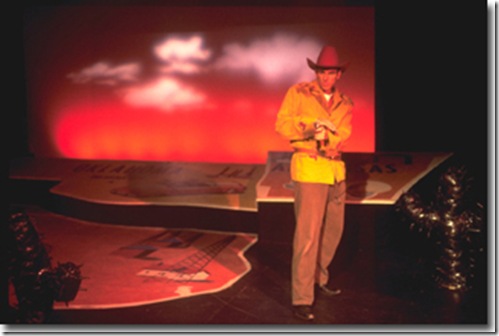
Estragon: I can’t go on like this.
Vladimir: That’s what you think.
Allow me to share with you the opening paragraph of an amazing essay that Carl Sander brought to my attention a few weeks ago:
The American non-profit theatre movement is nearing disaster. Without an adequate sense of tradition or sense of social responsibility, it is in danger of becoming a movement whose only purpose is self-perpetuation. This idealistic movement begun some generations ago has been unable to achieve a living wage for its actors, a livelihood for its playwrights; it demands that its designers accept twelve to fifteen productions a year just to make ends meet, and forgoes its responsibility to train directors while permitting, under the heading of financial survival, the average income of its audience members to climb higher and higher until this once bastion of social ideas and aesthetic concerns as become the plaything of the upper middle class and the very wealthy.
Isn’t that amazing? Doesn’t that paragraph just go straight to the heart of our current situation, and by doing so make you a little bit more hopeful that smart people are talking about theatre’s endemic crisis in such an insightful way, since surely, if we talk about this cogently and passionately, we will inevitably move toward making things better?
There is only one problem. This paragraph was written by Richard Nelson for an essay in PAJ: A Journal of Performance and Art in 1983. So whether you like it or not, whether you knew it or not, these problems are way over a quarter of a century old. And since Nelson’s incendiary bit of insight was published, absolutely nothing has changed.
Last Monday, a bunch of Seattle theatre folk sat in a room and listened to Todd London, Ben Pesner, and Tory Bailey present their findings on the state of the American playwright– findings which culminate in a book called Outrage Fortune: The Life and Times of the New American Play. I cannot heap enough praise on these professionals for their efforts not only in researching and authoring this book but in their willingness to tour the country to discuss it. Thank you, London, Voss and Pessner, as well as Tory Bailey, Executive Director of the Theatre Development Fund. Thank you from the bottom of my heart. I hope we happy few in Seattle can make progress worth your effort. I hope this, while understanding that hope is not a plan.
I fretted over how best to how best to shape my thoughts about the day, and then I realized I already had a loose outline in the form of the bite-sized tweets I was firing off live from the room.
“Roll Call” and “Good Mix and Size”
The first two blog posts were longer than what I could manage later, and were dedicated to making note of the very impressive cross-section of artists and administrators who came to share in the discussion. I am proud of my city for the turnout. My only caveat: I did not see a large number of actors– certainly nowhere near the proportion they hold in the larger theatre community. If playwrights really want to get traction in making locally grown new plays a priority then we are going to have to do a better job of convincing local actors why this is important. I have myself been petulant on this point in the past and pledge to do better.
Within “Good Size and Mix” I posted the first of many quotes that I enjoyed: “We are finished with talking with playwrights in one room and artistic directors in another. This tour is the first salvo of setting playwrights and artistic directors in a room talking to each other.” Soon after I began tweeting quotes with little or no context. I will try to make up for that here.
Boy howdy, ain’t that the truth! Understand if you can that in the upside-down, through-the-looking-glass world that is regional theatre everything you learned about money and investment flies out the window. The larger the commission the less likely the theatre is to actually produce what they have paid you to wright. Why? Because it is easier to score a grant funding a commission than it is to get one large enough to underwrite an entire production of a new play. In the regional theatre world, commissions are an easy win. The playwright gets paid. The theatre looks generous. So long as everyone calls it good, it’s good, right? (Note: actual play seen by actual audience not included.)
“‘Everyone wants the same ten playwrights.’– Anonymous Artistic Director”
I ripped this from one of London’s slides. It is a key point from the book. There was no argument on Monday from anyone representing the Big Houses, nor have their season selections provided any compelling contradictory evidence. Plus, when it comes to locally grown, that list of ten can be reduced to one: Steven Dietz, who, while beloved of all, has actually lived in Austin for the past half decade.
Typical Seattle talkback static. “I need to show you how smart I am by questioning your research process while agreeing with its conclusions. Really, I just want everyone to know I’m smart. Does everyone know that now? Great. I’ll sit down. What were we talking about?”
“Things are looking up. A touch of crazy has blossomed in the room.”
I would live to rue these words, after someone stood up and complained at length about how no one in New York wanted to produce her one-woman show about the day JFK was shot. Crack-pottery suits the status quo defenders because it helps them lump the legitimate playwrights in with lunatic amateurs. They can then turn to their boards, shake their heads sadly, and say, “You see what I have to deal with? You don’t pay me enough to screen out these maniacs.”
See above. But note that the smart people are complicit as well. And I admit, I too was biting my tongue and sitting on my hands. But in my defense, I get to mouth off a lot, and was genuinely interested in what other folks had to say. Come on good folks, speak up!
This is what we we need to be talking about, friends: a pipeline: some way of delivering plays across the tiers of theatres in this town. Todd London talked about how incredibly hard this is to do, and I do not doubt it. So was going to the moon. So was writing Hamlet. So is raising a family. Can we try something hard? Can we as Seattleites lead a cultural change instead of hoping Austin figures it out? (Which by the way, according to London, Austin may already be doing.)
Some sort of pipeline is the sweet spot, I am convinced. There are other options worthy of research and development: playwright residencies, season slots dedicated to new work, etc., but I figure those will be a lot harder for the Big Houses to swallow than a pipeline, which they will wager they can quickly abandon when the pressure’s off (i.e. ACT’s abandonment of its highly successful FirstACT program.) So I say, let’s convince them to build the pipeline and then let’s defend it vigorously. Keep the pressure on, forever, forcing them to pull the plug only at their p.r. peril.
Finally voices from the Big Houses start piping up. At times to call me out by name to both praise and dismiss me in the same breath. I am used to this tactic. It has never cut much ice with me. Praise is a director’s easy currency. Many actors crave it. It soothes them. There is nothing wrong with this. At the moment, however, I happen to have my playwright hat on, and I have been to Hollywood. I know exactly how much such praise is worth. Instead, I prefer to focus on fighting words, such as “We are looking for excellence and not finding it.” Bullshit. You are not looking. And when pressed, you praise the shit out of anything handed to you in the hopes that the playwright will just go away like a happy little puppy that just got its head patted. Save the praise. Let’s do a production.
“I actually don’t think the system is broken. Just limited resources.”
Wishful thinking from a Big House voice. Why is the Center House Theatre packed with people for this discussion if the system ain’t broken? Are we all crackpots? Did this all somehow get fixed since Richard Nelson wrote his essay in 1983? In fairness, you have to expect that this argument will be trotted out, and even perhaps welcome it. There are people who believe all is essentially well. Best to know who they are so you can properly provide them the evidence otherwise.
“What are you willing to sacrifice?”
I find this question fascinating. Primarily aimed at playwrights, the essence is: are you willing to give up a living wage to practice your art? Are you willing to give up your career to make these changes you are asking for?
Answers: Done and done.
I started wrighting plays over twenty years ago understanding I would likely never gain a livelihood from it. How many actors my age can say the same? I also hope it is clear by now what I have personally anted up by speaking out here. Any hopes I had for a nice Dietzian career in this town are herewith spent as payment to sit down at the bargaining table. I will not, however, sit without asking absolutely everyone else at that table what they are willing to stake to make this conversation happen. Are you willing to give up your livelihoods in the theatre to fix this? Are you willing to sacrifice everything you were hoping for individually, all your preconceptions, to make theatre better in Seattle and across the nation? Or are you going to defend the status quo because it has gotten you this far?
Louis Broome wants your figurative head on a platter if you currently make your living at one of Seattle’s not-for-profit theaters. I just want your actual heart, in your chest, pumping warm blood to your brain so you can have a conversation about producing local plays that matter to the audiences you have never yet managed to reach. I do not intend to let anyone off the hook because they are having a bad year, or a good year (yes, again, congratulations ACT) or because they absolutely know what quality is and they cannot find it here, the home to some of the finest playwrights living. Given that I have nothing left to lose, and that I have very little power to comfort the afflicted, I will settle for afflicting the comfortable.
But let’s not get too excited here. Heck, it isn’t as if this cause is urgent. We have at least another 27 years till someone, maybe only 15 years old now, digs up these essays and says, “Damn. Nothing’s changed. But we can’t go on like this.”
That’s what you think, kid.