Just Wrought

Recovering playwright, once won a STRANGER Genius Award for theater. Now writing a bloated novel about… G-d help me! Theatre.

Author: jefferyr

  • blue yonder

    Falling is good falling is fun falling is
    natural it will kill you some day today
    South San Francisco is fog-ended through
    the morning but the afternoon will break
    deep and clear like you always get
    at least once an autumn even
    though it’s August and it’s warm it’s
    autumn just the same.

    You’ve seen these skies before broken
    only by fighter jets screeching circles
    around the city smoking on its end
    beauty is woven into everything
    horrible maybe so we know to let it in.

    “The model could be throttled back” someone
    says on the conference call poets unaware

  • Ikkyū

    Recently I was having some drinks with some of the NewsWrights United team after a rather intense creative session. Somehow the string of topics led to haiku or Zen or something that put me in mind of the great whore-loving, haiku-scribing Zen Master from the 15th Century, Ikkyū. I mentioned him. Everyone laughed. They thought I was making him up. I wish I had been. I wish I had that kind of imagination. But no, once again, the truth outshines my paltry attempts at fiction. To follow is an essay I wrote about Ikkyū some years back for a text-only proto-social networking site called Everything2.com.

    here I am simply trying to get into your head
    you think you were born you die what a pity
    1

    Zen masters are infamous as a group for their peculiarity and iconoclasm, so to set yourself off as peculiarly iconoclastic among them is quite a feat, and yet such was the attainment of Ikkyū Sōjun, the abbot of Kyoto’s Daitokuji Temple, who called himself “Crazy Cloud”.

    sin like a madman until you can’t do anything else
    no room for anything more

    Ikkyū was born in 1394 A.D., the bastard son of Emperor Go Komatsu and his favorite lady-in-waiting2. When the Empress got word of the pregnancy, she banished Ikkyū’s mother to one of the poorest sections of Kyoto. At six he began his Zen training as an acolyte at Ankokuji Temple. He would strain sorely at the reins of temple discipline for the rest of his life, but it was there that he began quickly mastering the dual arts of poetry and calligraphy. (The modern Western disconnect between composing verse and physically placing it on the paper would be as absurd to the medieval Japanese mind as dancing having nothing to do with choreography.)

    I’ve burnt all the holy pages I used to carry
    but poems flare in my heart

    After his first master died, Ikkyū sought another in the legendarily severe abbot Kasō. His new master lived up to his reputation, leaving Ikkyū to wait outside at the temple gate for five days and then pouring a bucket of water on his head before admitting him. Some ten years later Ikkyū achieved enlightenment upon hearing a crow’s caw. He went to Kasō with the good news, but his master scorned: “This is only the enlightenment of an arhat. You are not a master yet.”

    The disciple replied. “That suits me fine. I despise masters.”

    Kasō barked out a laugh. “Yes! And with that, you are a master.”

    one of you saved my satori paper I know it piece by piece you
    pasted it back together now watch me burn it once and for all

    Kasō died when Ikkyū was thirty-five years old.

    my dying teacher could not wipe himself unlike you disciples
    who use bamboo I cleaned his lovely ass with my bare hands

    Astounded with grief, Ikkyū spend the next four decades of his life bouncing around from temple to temple, whorehouse to sake bar.

    ten fussy days running this temple all red tape
    look me up if you want to in the bar whorehouse fish market

    a crazy lecher shuttling between whorehouse and bar
    this past master paints south north east west with his cock

    when I was forty-seven everybody came to see me
    so I walked out forever

    don’t hesitate get laid that’s wisdom
    sitting around chanting what crap

    At age seventy-seven the fiery monk fell in love with a blind teen-age girl named Mori.

    I was like an old leafless tree until we met green buds burst and blossom
    now that I have you I’ll never forget what I owe you

    your name Mori means forest like the infinite fresh
    green distances of your blindness

    I’d sniff you like a dog and taste you
    then kiss your other mouth endlessly if I could white hair or not

    Five years later, two years into his ninth decade of life, Ikkyū was appointed abbot of Daitokuji Temple, his beloved master Kasō’s old job. This particular Zen lineage would, two hundred years later, produce the famous master Hakuin as just one of its important dharma heirs.

    if there’s nowhere to rest at the end
    how can I get lost on the way?

    Ikkyū died at the age of 87.

    long life
    the wild pines want it too

    It’s the keenly direct, contemporaneous feel of Ikkyū’s verse that stands out for me. Compared to him, other prominent figures in the Zen canon feel like constructs, mouthpieces– important, but not intimate. Ikkyū is unquestionably a person, talking to you, not 600 years ago, right now.

    don’t worry please please how many times do I have to say it
    there’s no way not to be who you are and where

    fuck flattery success money
    all I do is lie back suck my thumb

    all koans just lead you on
    but not the delicious pussy of the young girls I go down on

    why is it all so beautiful this fake dream
    this craziness why?

    stare at it until your eyes drop out
    this desk this wall this unreal page

    nature’s a killer I won’t sing to it
    I hold my breath and listen to the dead singing under the grass

    don’t wait for the man standing in the snow
    to cut off his arm help him now

    the crow’s caw was okay but one night with a lovely whore
    opened a wisdom deeper than what that bird said

    self other right wrong wasting your life arguing
    you’re happy really you are happy

    only one koan matters
    you

    ********************************************

    1All translations of Ikkyū’s verse are from Stephen Berg’s excellent Crow with No Mouth. If you’re at all intrigued, buy it. You’ll read it for the rest of your life.

    2When his mother died, she left behind this brief note:

    To Ikkyū:

    I have finished my work in this life and am now returning to Eternity. I wish you to become a good student and to realize your Buddha-nature. You will know if I am in hell and whether I am always with you or not.

    If you become a man who realizes that the Buddha and his follower Bodhidharma are your own servants, you may leave off studying and work for humanity. The Buddha preached for 49 years and in all that time found it not necessary to speak one word. You ought to know why. But if you don’t and yet wish to, avoid thinking fruitlessly.

    Your Mother,
    Not born, not dead.
    September first.

    P.S. The teaching of Buddha was mainly for the purpose of enlightening others. If you are dependent on any of its methods, you are naught but an ignorant insect. There are 80,000 books on Buddhism and if you should read all of them and still not see your own nature, you will not even understand this letter. This is my will and testament.

    3Even as a young boy, Ikkyū exhibited some of Zen’s cagier instincts. His master owned a rare and precious antique teacup, which one day a fellow acolyte of Ikkyū’s happened to break. When the master showed up, Ikkyū took the pieces from the other boy and hid them behind his own back. Facing the master he asked: “Sensei, why do people have to die?”

    The master replied, “This is the natural way. Everything has to die having fulfilled its allotted time to live.”

    Ikkyū showed his master the pieces of his precious cup: “Sensei, it was time for your cup to die.”

    Sources:

    Berg, Stephen. Crow with No Mouth. Copper Canyon Press, 1989.

    Stevens, John. Masters: A Maverick, a Master of Masters, and a Wandering Poet. Kodansha International, 1995.

    Reps, Paul & Nyogen Senzaki. Zen Flesh, Zen Bones. Tuttle Publishing, 1985.
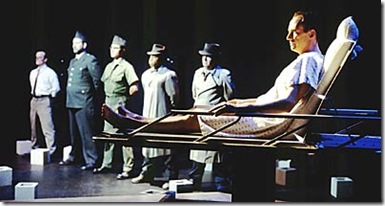
  • My Two Favorite American Playwrights

    I have two favorite American playwrights, for two very different reasons.  The first is, of course, the playwright whose plays I adore most. You don’t have to be a playwright to understand that. The second, however, I adore for peculiarly playwrightish reasons, because for five decades he has stood against the metastasizing mediocrity and mendacity in an art form increasingly led and misled by directors, and worse, artistic directors, and worst of all, artistic administrators.

    Imagine my delight when I read today in an article in the Village Voice, my second favorite playwright giving props to my first:

    VILLAGE VOICE : … They talk about you as part of a tradition of great American playwriting, as an inheritor to O’Neill, to Williams, to Miller.

    ALBEE: Everybody forgets the most important of those: Thornton Wilder. If you’re going to have those three others on that list, you have to include Wilder. O’Neill is a very powerful playwright, but he has a tin ear. Wilder had a beautiful ear. Especially with Our Town and The Skin of Our Teeth. That talent is extraordinary.

    VV: Have you seen the revival of Our Town?

    EA: Oh, it’s the best production of it I’ve ever seen. Without question. Because it understands that the play is not a Christmas card. It’s a tough, existentialist play. If you’re not crying in the first 10 minutes that you’re there, you’re at the wrong play.

    I remember my own mentor, Thomas Babe, saying of Our Town, it should cut through you like a buzz saw.

    Some other gems from Albee’s interview:

    VV: What makes someone a good director of your work?

    EA: To realize that the proper function of a director is to do an accurate translation of the play from the page to the stage. If the play is lousy, I suppose a director could improve it, as can actors. The better the play, the more damage they and the actors can do.

    And:

    EA: … The people who run the economics of the theater should be shot.

    VV: How has Off-Broadway changed in 50 years?

    EA: When we did Krapp’s Last Tape and The Zoo Story, ticket prices were $2. It cost $1,500 to produce. Now, it would cost $300,000, and tickets are $65 to $70. And it has very little to do with inflation. Everyone’s greedier these days.

    The old man is right, especially here in Seattle. If I had to run a rough estimate from the top of my head, I would have to say that the number of conversations I have had with actors over the last five years about their struggle for a living wage as artists outnumbers by a factor of five the conversations I have had with them about great plays and how to make them.

    The struggle goes on. But you will notice, I hope, that the discussion, so very earnest and loud last March, about how to fix the system, has already, just five months later, run silent.

    Long live Edward Albee and his advocacy for greatness.

  • I’m Running Ads Now

    I have produced Just Wrought for about eight months now: a hugely fun, time-sucking, gut-wrenching adventure.  Honestly, I did not expect to make as many new friends as I have here in this short time.  What a delightfully unexpected added benefit to an endeavor for which I anticipated nothing in return except the satisfaction of finally saying publically what I was already telling any weary colleague willing to share a beer or coffee with me.  Recently, however, I was offered another unlooked-for opportunity for compensation, this one a bit more negotiable as legal tender.  Specifically, a company called TicketNetwork inquired about whether I would be willing to run a short text blurb in exchange for a monthly payment that was in the neighborhood of the combined costs of running the site.  I knee-jerked negatively at first: “What would ads say about my motivations for ranting?”  But when I really thought it through, I could not come up a single good reason not to run some advertising on the site so long as it:

    • Occupied a relatively small amount of space,
    • Did not come with any editorial quid pro quos attached, either explicitly or implicitly,
    • Was for a product or service generally inoffensive to myself or my readership as I understand them.

    On the other hand, I could rather easily see some reasons for running some revenue generating content:

    1. The site costs money: not much but some.  I already subsidize much of my artistic efforts with an unrelated day job.  If the blog can pay for itself–disregarding for now the still uncompensated time it takes me to create the content– then all the better.
    2. A company willing to pay to appear on the site means someone believes the site reaches people.  That is a belief I tend to want to share and reinforce.
    3. NewsWrights United is currently working on the second edition of A Living Newspaper.  (You can learn more about NewsWrights , and keep up to date on our doings by “liking” our FaceBook page, click here.)  This new edition, titled The New New News, will cover the current mega-crisis of journalism.  As a contributing playwright/reporter, one of my assigned beats is on-line monetization, i.e. how do the sites where we  get our news pay for themselves, or not?  Believing that one of the best ways to know a subject is to live it, I welcome this chance to try and monetize my own site, and understand the challenges from the inside.

    So, all of the above considered I decided to go ahead with this next step in my blogging adventures.  The ad appears in the right hand column under a heading called “Links.”

    Everything I do here at Just Wrought is to some degree an experiment in which I welcome your feedback, positive and negative.  This step is no different.  I really would like to hear your thoughts about my decision to run this modest advertisement.  And in the future, I trust you will keep me honest, letting me know if the ads become too numerous, distracting or inappropriate, or worse still, if it seems like they are skewing my message.

  • More Details on A Red Orchid’s Production of Louis Slotin Sonata in Chicago

    Click here for some more detailed coverage that just broke around the upcoming production of Slotin in Chicago.  An insightful quote from the director, Karen Kessler plus bios of the cast and design team.  Heck, I’d go see this show even if I hadn’t written it.  (And usually that’s about the only thing that will get me into a theatre seat.)

    Kidding, kidding.

    Sort of.

  • Louis Slotin Sonata gets a Nice Nod in The Huffington Post

    Louis Slotin Sonata gets a Nice Nod in The Huffington Post

    In response to a recent article in The Guardian which argued that most plays involving science come off as pretty lame, Lauren Gunderson, on The Huffington Post yesterday, made an artful argument to the contrary:

    [Science] adds reality to our stories, and adds story back into our reality. Science is built for the stage. The very act of scientific discovery is one of the most dramatic in the human experience. Dramatic because it changes everything, and it can be made of nothing but silence. An epic thought still fits on a stage and in a human being. That can be giant drama.

    Gunderson goes on to present a list of plays that is— dare I say it?—scientific in its evidentiary scope and completeness.  In the category of “wild theatrical rides” she kindly places Louis Slotin Sonata.

    Given that the play will be getting a brand new production in Chicago at A Red Orchid Theatre this September, I am especially grateful for the favorable mention.  (Apparently no slouches, Red Orchid will be moving its last production Off-Broadway.)

    Gunderson is right: science and art are kissing cousins.  Time was when no one even bothered to make a distinction between the disciplines.  I would not go that far now, but I would welcome my colleagues in the theatre to look more deeply into the world of science for their inspiration.  Stories like the race to decode the human genome will be told and retold for generations to come.  For modern playwrights they are the kind of source material that Caesar’s fall and the War of the Roses were for Shakespeare.  Theatres that cannot or will not strive and risk to tell these stories that are impacting people’s lives right now will not survive as anything other than museums.

    Sodom Saki Full Length by Paul Mullin

  • 14/48 Goes on King 5 TV

    One of my favorite perennial offerings in my number one favorite dying medium finally gets the attention it deserves from my second favorite dying medium.  And my elevated sources on the 14/48 Steering committee swear to me that they didn’t even pay to play!  (The folks at the Fifth Avenue and the Rep must feel a little cheated.)

  • A Sample of Marya’s Wisdom

    A Sample of Marya’s Wisdom

    Click here for some wisdom about teaching art and doing art from Marya Sea Kaminski, one the finest actors and people I know.  She’s easily one of the top ten reasons Seattle has a shot at being a world class theatre town.  I only hope I get to play with her again on some fun project, like I did with The Ten Thousand Things

    Here she is in her final scene of the Washington Ensemble Theatre world premiere of that play, in the fabulous “octopus dress” designed for her by Heidi Ganser.

  • Why is Theatre Puget Sound Diluting its Mission?

    Why is Theatre Puget Sound Diluting its Mission?

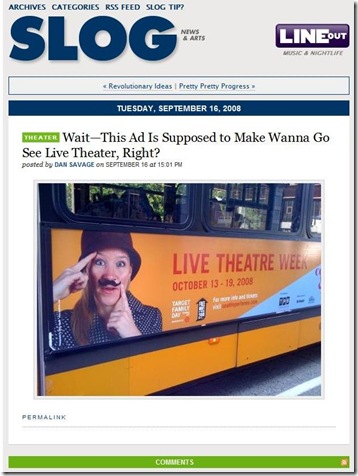
    Yes, we all cringed when we saw the Theatre Puget Sound (TPS) ads for Theatre Week in years past.   Apparently some PR firm had been hired in Sioux Falls, South Dakota and given the very specific instructions to create a campaign that would confirm every uninitiated civilian’s suspicion about just how lame and goofy live theatre can be.  Bowler hats, canes and dorky “del arte” facial expressions were de rigueur.  Some one who did not know better could easily have gotten the impression that every show in Seattle was some variation of a Godspell Hell.

    The comments to Dan Savage’s Slog post here about this flip phone pic  below sum up the general response hilariously.  Comment number 5 buttons them all together, thusly: “Perhaps it is a typo… perhaps it is supposed to read “Live Theatre Weak”

    Screen shot from Slog

    If you are tempted to riposte in the comments with that hoary Seattle arts chestnut of an excuse: “They were doing the best they could”, please spare us, because anyone looking to encapsulate the thrill of theatre photographically need look no further for examples than any of the images pushed out over the last few years by WET. (Sorry, I just can’t bring myself to cave and call them “Washington Ensemble Theatre” just because some litigious trust-funded ensemble in NYC got jealous of WET’s success.  See here .)

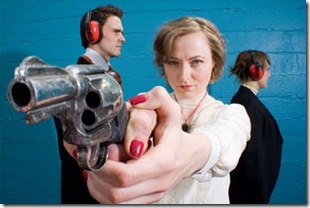
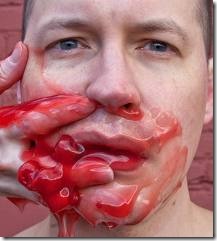
    Promotional photo from WET's Hedda Gabbler redux: blahblahblahBANG Promotional photo for WET's Titus Androncius

    Promotional photo for WET's RoboPop

    (Just how and why is it that WET can make headphones so sexy?)

    As much as Seattle’s theatre professionals longed for a fresh and empowering marketing campaign from TPS to hook people into big and small local theaters around town, the last kind of change most of us would have wished for is what rolled out this Spring.

    Announcing Arts Crush,
    The Month-Long Arts Festival

    on April 19, 2010, at 5:30 pm | Category: Arts Crush

    As you may already know, Theatre Puget Sound is planning an expansion of our highly successful Live Theatre Week festival.  In an effort to build upon the momentum of that program and address the expressed needs of the larger arts community, we decided to expand our scope and build a more diverse and inclusive month-long festival modeled after Live Theatre Week.

    This October, Theatre Puget Sound will present Arts Crush, a month-long festival that connects artists and audiences with invigorating new experiences at hundreds of events across the region.  More than 200 arts organizations and innumerable artists from all over the Puget Sound will come together as a united arts community to share arts experiences with people of all kinds….

    So Theatre Week becomes Arts Crush, and somehow, the theatre artists (mostly actors, actually) that make up TPS’s membership, all of the sudden become, without being asked, patrons of all the arts, because, you know, we make so much money on the stage.  Where are the other major discipline-specific arts organizations that are joining TPS in this move towards expansiveness?  There are none.  TPS basically owns Arts Crush, in conjunction with broad based arts funders like Seattle Office of Arts & Cultural Affairs.  None of the non-theatre-but-still-discipline-specific organizations like Velocity Dance or Seattle Chamber Music come even close to matching TPS’s size or influence.

    Before I go on, let’s take a quick look at TPS’s mission, shall we?

    TPS is a member-driven organization whose main goals are the nurturing of a healthy and vibrant theatre community, developing strong ties among the region’s theatre professionals, raising the visibility of the region’s theatre scene on national and international levels, and finding ways to develop new and diverse audiences.

    Nowhere in the paragraph above is there any mention of cross-discipline arts promotion.

    So why is TPS diluting its mission?  My best guess is fear, with a touch of pointless power grab thrown in for flavor.  The move is part of a larger strategy to beat a tasteful and bloodless retreat from world class status.  The thinking goes like this, “Theatre is suffering.  And so are all the arts.  The core audience for theatre in the Northwest overlaps the core audiences for all of the other arts.  Let’s expand our scope, control that shrinking core and hope to hold the ground we have.  We can give up the castle to control the wider, albeit weakened, kingdom.”

    Of course this runs counter to what I and many of my colleagues believe is the best strategy to not only save theatre in Seattle but also elevate it to world class status at the same time.  We believe now is the time go on the offensive: to advance, not retreat; to push forward bold new and innovative plans for making a completely different and fresh sort of theatre.  We certainly do not think we should be spending our limited resources promoting “arts” in general.  That sort of “yay arts!”, “up with people!” advocacy ultimately helps no one.

    TPS’s desperation is showing.  Just this week an email went out from extending the deadline for applications to the Arts Crush festival.  A cynic has to wonder why.  Could the dilution of the TPS’s core mission have anything to do with it? <
    /p>

    Turning Theatre Week into Arts Crush is a mistake.  Theatre artists are rightfully reluctant to underwrite an effort that has expunged the word “theatre” from its name.  (If you played professional shortstop in Seattle, and the Mariners began a promotional campaign promoting all sports, but omitting the word “baseball” from its title, would you be worried, irritated or both?)  TPS should rethink this move.  Seattle needs a theatre advocacy organization that can keep its focus.  If TPS wants to be something other than it is, they should be honest about it and change their moniker to “APS” for Arts Puget Sound.  Of course, if they did that you would have to wonder what it would do to their membership rolls.

  • Science in Plays on NPR from 2004

    Forgot about this one. Blessings on NPR for perpetually archiving these stories and making them so easy to access so long after the fact.