Just Wrought

Recovering playwright, once won a STRANGER Genius Award for theater. Now writing a bloated novel about… G-d help me! Theatre.

Author: jefferyr

  • Remembering my Ballard House Playmates

    Remembering my Ballard House Playmates

    Almost exactly this time last year we were gearing up to open the world premiere of Ballard House Duet, with Custom Made Play Project and Washington Ensemble Theatre. Not many people saw the show, and between now and then, the production sort of got lost in the very fun, ever shifting, always sexy shuffle that is Seattle Theatre.

    For me, however, the production will always loom large and poignant. The play came from a very personal place, and represents the last world premiere for the stage in which I expect to participate. And so, remembering back to a year ago, I am deeply grateful to Rebecca Olson for asking me to write Ballard House Duet; and for then agreeing, along with Hana Lass, to an unconventional process of development that began with me prying into their personal and professional biographies. I am grateful Erin Kraft for agreeing to direct it and giving me so much desperately needed developmental feedback. I am grateful to Annie Lareau for taking the helm when Erin had to step away for personal reasons. And I am grateful to all the people who gave freely of their time and talent to make sure the play went up and succeeded as a work of art. I’m looking at you Brandy Beauchamp, Peter Dylan O’Connor, Hannah Victoria Franklin, Doug Mazzeo, Betsy Schwartz, Jen Taylor, and everyone else that I know I’m forgetting in my encroaching senescence.

    I hope you all have had a great year, and will go one to an even better one in 2014.

    Ain’t got no rain barrel,
    Ain’t got no cellar door.
    But we’ll be jolly friends,
    Forever more, more, more, more, more.

  • Sandbox Radio Live! Makes a Bold New Move

    Sandbox Radio Live! Makes a Bold New Move

    Sure bigger isn’t always better, and art doesn’t always thrive when it moves to a fancier-panted venue. I know I’d rather have seen the Beatles work the Cavern Club in Liverpool—or even better, one of the Hamburg dives they learned their chops in—rather than Shea Stadium, where even they couldn’t hear themselves play.

    So there are inevitably doubters about Sandbox Radio LIVE’s move to the much larger venue of ACT’s Falls Theatre for its upcoming episode, January 13, 2004.  But here’s the thing: for about three years running we have sold out every live taping of SBRL! that we have produced at West of Lenin, our perfectly cozy little venue in Fremont. That means there are people—lots of people—actually, that would like to experience the unique fun of witnessing the live recording of our podcasts who can’t, simply because we don’t have seats for them. 

    This move can help us reach more people with our unique live performance offering which is quite literally (old-school usage) different from anything you have ever seen, featuring some of Seattle’s finest actors performing brand new locally sourced material generated by some of Seattle’s finest playwrights and (ahem) former playwrights.Beatles at the cavern club

    In short, this is the kind of bold artistic risk that deserves your reward. So how can you help? Just come!  Click this link and order your tickets so that we can have friendly butts in every new seat we’re adding.  Help us spread the fun of Sandbox Radio Live! Do it for the Beatles!  (It’s what Pete Best and Stu Sutcliffe would’ve wanted.)

    The details:

    January 13, 2014 at 8:00pm

    ACT’s Falls Theatre

    Running Time: 2 hours (including an intermission)

    The Food of Love includes new short audio plays from Seattle playwrights Vincent Delaney, Elizabeth Heffron, and Wayne Rawley, a fresh new episode of Paul Mullin’s noir-angel serial Markheim, the latest adventure of Scot Augustson’s hilarious Cousin Katie, special guest Jeopardy champ Ken Jennings, our fabulous live sfx, original music from Jose “Juicy” Gonzales and the Sandbox Radio Orchestra, and more surprises, all recorded in front of you, our “studio” audience.

    Oh, and know that you can always enjoy the fun of Sandbox Radio, going back to our very first episode, by clicking below and downloading the podcasts:

    Here: https://itunes.apple.com/us/podcast/sandbox-radio-live/id452830642

    Or here: http://www.stitcher.com/podcast/sandbox-radio-live?refid=stpr

    PS !  You can message me privately for a discount code which will save you 25% off your ticket price.

    Food of love banner

  • The Naked Truth

    We come East again, but this time leave you behind
    to join us in a week for the beach piece. I fill time
    taking the boys to Lincoln’s lap, and a DC city pool, where
    they hold their own, elbows and knees, with the laughing
    black kids, playing Marco Polo, diving for a torn goggles’ strap.
    Two days later we wander a vast strutted cavern crammed
    with the spent super-toys of a spent super-nation:
    Black Bird, Discovery, Enola Gay. Then we head north. 

    Driving towards it on roller coaster roads, the younger one
    says he can smell my brother’s farm, meaning some tumbler
    turns in this kid’s wild heart from my life as a kid: thick summer
    crunching into color come Fall. And he being born across the country
    in a city awed by mountains; and the other one grunting
    his blue naked way into a megalopolis once awed only by itself,
    but hushed, over the months he grew alive inside you, by towers
    of anguished empty light. I can’t help but be grateful something rises
    in these two to this air which smothered  my blood for so long, even
    when the older boy barfs a mile shy of the farm, and I have to pull
    over to sluice the puke from the plastic bag into a corn field.

    That night I drink with my brother in a country bar not completely
    different from the one we grew up in as stock boys, though this
    one feels like the future: fluorescent and empty, safer and ugly.
    He preaches to me, sipping whiskey from a cup made for cough syrup,
    how my work needs to change the world in a big way for the better; but
    I deflect him with my best Mother Teresa: We can do no great things,
    only small things with great love.
    And I half-believe it, too.

    Two days later, coming on midnight, the kids crashed in
    their grandmom’s living room, my niece and my boys,
    gunshot-sprawled across the sofa and blown-up air mattress. 
    Me stretched on a futon in my Mom’s extra room calculating
    days  till you join us, thoughts finally weirding into dreams
    when a quiet note chimes and the phone purrs vibration.
    Glowing at my touch a text, a picture, makes no sense at first
    but then I see them: full and perfect, nipples piqued:

    “The girls miss you.”

    The bonfire my brother builds the next night back at the farm
    seems hopeless at first after that day’s thunderstorms, but
    my brother doesn’t truck in hope, never has.  He works at it.
    Big things for the better make a life worth living, and a few flashes
    of gasoline will burn the dampness from the ground, such that
    careful application of kindling brings, within half an hour, an inferno
    roaring higher than anything we dare encourage in the tinderbox West. 
    Hunks of smoldering float above the trees, open letters to parts of the world
    where hope still waits for gasoline and my brother’s good intentions.

    Let this Mason-Dixon humidness set free what, two nights ago,
    your dry Seattle skies took up, radio riddling the ether (though
    there is no ether: turns out there’s no need.) Let them hum to me
    an image (though there is no hum: photons keep mum till we
    teach them to speak) joyful, girly gift to thrill me, and feed,
    as I grow old and older, my sulking need— when I can’t have
    you when I want you, and I think it’s your fault.
    If that’s not a child’s heart, whose is?

    Nature abhors a vacuum, and so fills herself up with all this us.
    Time hates a naked singularity: and so everything is just nothing
    wearing knickers. These are the laws, described by men as blind
    as me; yet somehow you flaunt them. With a chime and a purr
    and a gleam you give, playfully, teasingly, everything; but also
    somehow hold so much more back; because you know the truth
    is never naked enough, and neither are you.

  • If you can’t seem to find the right adjective, try not using one.

  • Sexy New Acting Edition of THE SEQUENCE

    Sexy New Acting Edition of THE SEQUENCE

    Original Works Publishing has just released a sweet, sexy and sleek new edition trade acting edition of my play The Sequence, about the real-life race to decode the human genome. The new edition features a flat binding, super-gloss cover, larger print, ample margins for blocking, and extra pages for notes.

    Original Works is a great outfit, with plenty of new titles from some of the hottest American playwrights including Elizabeth Heffron, Jeff Goode, Gwydion Suilebhan, Adam Szymkowicz and on and on. If The Sequence ain’t your cup of tea, you’ll still likely find something at OWP that is. Head on over and check out their deeply impressive catalog of hard copy and electronic titles.

  • Finally Face to Face with the Other Racer

    Finally Face to Face with the Other Racer

    Last night I got to meet a man I’ve known for 10 years, albeit only in the very arcane and narrow way that a playwright can know one of his living subjects. In addition to being an actual living person, J. Craig Venter is a character in my play The Sequence, which dramatizes the real-life race to decode the human genome.  Venter drove the private side of the race, while Francis Collins, now head of the NIH, drove the public side as then head of the Human Genome Project. Some years ago, I had the honor of meeting Dr. Collins at an early public reading of the play at George Mason University. He came late, sat in the last available seat, in the front row about eight feet from the actor playing him. It was the most nerve-wracking night of my life. But when the reading was over and the bows were taken, Collins graciously, spontaneously joined the post-play discussion. And at the reception after, Collins happily chatted with my all my friends, as well as my mom, brother and niece who had driven down from Maryland to attend.  He later emailed me asking for a signed copy of the play to give his mother. Collins impressed me as a deeply affable and approachable person.  Dr. Venter, however, proved more elusive—that is, until last night when I attended his lecture at Town Hall Seattle, at which he introduced his new book, Life at the Speed of Light, which details his recent efforts to “boot up” an artificial organism from DNA code “written” by his team.

    I learned a lot of things last night.  Here’s a sampling, in order of increasing “inside baseball” genome geekery:

    “That dust in your house?  That’s you!”

    This direct quote from Venter came as he described how life is a constant process of renewing worn out proteins. If the trash doesn’t get removed, you wind up with some particularly nasty afflictions like Alzheimer’s and Mad Cow Disease

    Life happens because of Brownian Motion.

    Brownian Motion, the constant random motion of water molecules, theoretically confirmed by Albert Einstein, creates a turbulence within living cells with a force comparable to a Richter 9 earthquake.  This constant agitation drives the enzymatic processes that allow life to exist and do all the cool things that life does. Brownian Motion is temperature and phase state-dependent, which is a fancy way of saying life requires water in a liquid state.

    Biological teleportation is coming.

    Instead of transporting organisms, we will beam their digital genomic code to far flung places, like disease control centers around the globe during a pandemic, or even farther, to places, like Mars.  And conversely,when we do find life on Mars (for Venter it’s a “when” not an “if”) we will sequence it’s DNA in situ there, then beam back the digital code to earth so that the Martian life-form can be “printed” into terrestrial existence, for… ya know… further investigation.

    Artificial life gets watermarked.

    “We think it’s very important, when making a synthetic species, to mark the species as synthetic.”  Gee, Craig. Ya think?! So Venter’s team inserted “watermarks” into the DNA of their artificial organism: widely recognizable English phrases consisting of quotes from James Joyce, Robert Oppenheimer and Richard Feynman.  Shortly after Venter’s team first published their results, they got a call from the Joyce estate demanding to know why permission hadn’t been sought.* My friend attending with me last night, who had also seen a reading of The Sequence at Seattle Public Theatre a few weeks ago, remarked how ironic it is that Venter should be so irked, when back in the 1990’s he was an outspoken advocate of gene patenting. As my buddy put it, “Intellectual property law can be a bitch.”

    Artificial life needs kill-switches. 

    If (more likely when) we introduce human-designed organisms into the wide world beyond the laboratory, which we might do for any number of legitimate purposes — health care, food production, energy production, environmental clean-up, reversal of global warming, etc.— we are going to want to the means to – ahem—un-introduce them.

    Venter became an amateur science historian. 

    In his lecture he frequently referenced the fairly obscure work of 18th and 19th Century scientists and thinkers, the ideas of whom he seems to have used for inspiration and guidance when sailing the uncharted seas of artificial life creation. As an amateur science historian myself, this charms me.

    Venter and I share a fascination with a brilliant little book by the guy who gave us the “neither-dead-nor-alive” cat.

    What is Life?, was published in 1944 by quantum physicist Erwin Schrödinger. In it, nearly a decade before Watson and Crick’s discovery of DNA’s structure and mechanisms, Schrodinger posited that the information processing required for the propagation of life might in fact be the result of a simple digital code.  Some day I need to write an essay about “What is Life?” It’s an eminently accessible book for the lay reader, and in it Schrodinger goes on to posit theories much more outlandish than digital life.  Indeed the entire book seems to point at a potentially universe-reversing conclusion that life might provide a powerful negating counter-punch to the seemingly unbreakable 2nd Law of Thermo-dynamics, such that entropy may not, in fact, have the final word that we have all been taught it must.

    Not even scientists get to fudge history.

    Both Venter, and the comparable genius who introduced him, the University of Washington’s own Leroy Hood, worked hard at times last night to needlessly and speciously burnish Venter’s legacy. For instance, Hood asserted in his introduction that Venter made his company Celera’s work product freely available during the  genome race  as a reference for competitors, like Collins’ team at HGP, who were also attempting to  read every one of the 3 billion letters of the genome. In fact the opposite was true. The public side HGP data was used by Celera to double-check its enormously long, but doubtfully accurate sequences. (The “Shotgun” sequencing technique which Venter developed was fast, but sloppy.) Celera  held their sequences under wraps as private and proprietary information which they hoped to sell in a paid subscription model like Bloomberg Professional Services.  That plan never came to fruition.

    Venter’s DNA was not God’s gift to humanity.

    After getting fired from Celera, the company he founded, Venter publically released the bombshell news that the genome sample the company sequenced was not, as it should have been, from a randomly selected anonymous donor but rather from Venter himself. He had snuck his own DNA into the lab at the very beginning of the process. Last night Lee Hood maintained that Venter’s bizarre action has been widely praised in the scientific community and beyond, when in fact, it is almost universally viewed as an ethically questionable stunt of astounding hubris.

    Venter was against junk DNA before he was for it.

    Junk DNA is one of the great mysteries of biology. Over 98% of the human genome is noncoding DNA, meaning it doesn’t get translated into proteins. It just sits there, doing what? Maybe nothing. When asked a question about junk DNA last night, Venter said he had always argued against a commonly held notion that junk DNA has little value; but actually back at his first company TIGR, he was indeed dismissive of junk DNA. Here’s a snippet from early in The Sequence, before Craig decides to join the genome race:

    KELLIE:  So tell me.  Why is it so important to sequence the human genome?

    CRAIG:  It’s not.

    KELLIE:  It’s not?

    CRAIG:  No.  95 percent of it is junk.  I’m only interested in the five percent that does something.  The sequences that make up genes.  I don’t care if we ever sequence the other stuff.

    Nitpicking aside, I had a delightful evening. If nothing else, seeing Venter up close and personal helped reassure me that I had gotten him right in The Sequence, capturing his brash confidence and brilliance, his impatient pursuit of achievement.

    My play is at least a blip on Venter’s radar. 

    Upon the lecture’s conclusion, I bought Life at the Speed of Light and stood in line to have Venter sign it. I had also brought along a copy of The Sequence which I personalized to him during the lecture. “For J. Craig Venter. Thank you for driving this amazing story, and this astounding achievement in human history. ” When it was my turn to get my book signed I said, “Dr. Venter, my name is Paul Mullin and I wrote this play about you.”  I handed him the script along with his book to sign.

    “Oh, so you’re the guy,” he said.

    “Yes. I am the guy.”

    We smiled at each other and shook hands.

    “Can I make changes to this?” he jokingly asked.

    “Sure,” I countered “Mark it up and sent it back to me.” I wasn’t really joking.

    Then he signed my book and we wished each other well.  Alas, I didn’t get a picture.  Maybe next time.

    *The quote was from Joyce’s Portrait of the Artist as a Young Man. “To live, to err, to fall, to triumph, to recreate life out of life.” I could’ve have told them that Joyce’s people are notoriously stingy with permissions.  The issue is now moot, however, since most of Joyce’s major works fell into public domain on January 1, 2012.  Thank goodness!

  • SIFF Lord

    SIFF Lord

    In 1995, the independent feature film I wrote and starred in was accepted to the Seattle International Film Festival. Finally, after ten years struggling in the theatre, I was clearly on my way to a long, satisfying, and integrity-adorned career as a film artist. My movie was fresh, bold and brilliant, as was my acting in it. In the spring of 1995 these notions had the certainty of blue skies in May.

    Of course, it should be noted, this was Seattle, where the certainty of blue skies, in May or otherwise, can prove, well, somewhat illusive.

    I received an invitation to a kick-off party in the SIFF hospitality suite on the twenty-somethingth floor of the downtown Sheraton. I went with my buddy, a then Seattle actor, who now lives and thrives in Hollywood, as so many then Seattle actors do. My buddy had starred in a different indy feature accepted by the festival. I had issues with his film’s script but mostly kept these qualms to myself. I was on the edge of tremendous success, you’ll recall, so I could afford to be beneficent.

    My buddy and I had fun at the kick-off party, even though we didn’t really know anybody else, the others mostly being from outside Seattle and certainly outside the Seattle theatre scene. We ate the free food and drank the free booze and jabbered at each other passionately, all in the prodigious quantities that relatively young actors and playwrights are wont to indulge free food, free booze and passionate jabbering. We laughed louder and louder as we got drunker and drunker. We started getting odd looks. International film folk, as it turns out, are not as boisterous as Seattle show folk. Lesson learned. We started to feel out of place, and then, because it was still early in the evening, started to wonder why we were lingering. We were pleasantly and sufficiently lit to go find some other fun. We wound up at The 211 Pool Hall, then located on 2nd Avenue above the Speakeasy internet café.

    In my memory, the 211 Pool Hall remains one of the most beautiful and inspiring interior spaces I have ever had the privilege to set foot in. This was a pool hall, plain and simple, but its plainness and simplicity evoked something profoundly holy. This was a sanctum. Nowadays most places with pool tables crank loud music. At the 211 there was no music at all. Nothing to hear but the murmur of conversations and the soft clicks of balls colliding, occasionally punctuated by the rifle crack of some shark’s powerhouse break, all echoing off the institutional blue-green walls and double high ceilings. For a poor artist working stiff like me, the 211 was somewhere I could go for two hours of serenity and a pitcher of beer, and still not be more than ten bucks lighter when I left.

    I’m not sure if that night my buddy and I went was the same that Hans Altweis was obliged to wear the “I’m a Whistler” sign. The 211’s “No Whistling” rule was prominently posted and inviolable, along with “No Massé Shots.” Today, those of us lucky enough to know Hans, or at least his work as an incomparably gifted actor, won’t be surprised to learn that he was undaunted by such a silly-seeming rule; but fewer of us are lucky enough to have known the counter-waitress Annie, the 211’s squat but fierce enforcer. Annie was even less daunted by Hans than Hans was by silly rules, and thus it was he came to wear the “I’m a Whistler” sign around his neck for the remainder of his stay in the pool hall that night. To be completely accurate, and fair to Hans, I should note that he wore his cardboard penance with the kind of gracious grin that only a man supremely confident in his charms can display, especially in the face of a starkly righteous moral authority utterly unswayed by such charms.

    But I digress. As I said, I’m not even sure it was that night that Hans joined us. All I know is we had a great time playing good cheap pool, drinking good cheap beer, and when we left I went home to my studio apartment to get some sleep because my director/producer and co-producer were flying into SeaTac the next morning.

    I picked them up and drove them directly to the Sheraton to check into the festival, around eleven a.m. The woman behind the hospitality suite’s greeting desk must have recognized me from the night before because she stood up instinctively and pushed her palm out like a traffic cop, saying, “The bar is closed.” Of course, my colleagues found this deeply hilarious. It was pretty damned funny, come to think of it. The woman, however, never completely lost her look of panic, even as I explained that I was simply there to help my colleagues check in. Another woman joined her and they began to help us through the process. When I gave them my name for my set of festival comps, they hunted through their roster, but found nothing. They looked again. Nothing. I tried to be cool, even helpful. “Well, I must be on some sort of list. I was invited to the kick-off party last night.”

    One of them went back into the bedroom being used as an inner office.  A few moments later she came back with an older guy. A fervid whispering conference simmered among the three SIFF staffers. The guy, a supervisor ostensibly, consulted the roster himself. He asked me my name again. I spelled it. They consulted another list. He looked at me. He said my name, brow furrowed in a effort to remember something.

    I said, “Right. That’s me.”

    And then it dawned for the guy. He turned to his colleagues and said softly but loud enough for everyone in the room to hear: “I think I know what the problem is. He’s just the screenwriter.”

    And there it was, the first shoe dropping through my blue sky dream of an illustrious film career. 

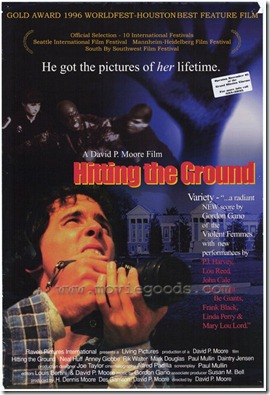
    John Hartl, then critic for The Seattle Times hated everything about my movie except for the soundtrack, which was written by Gordon Gano of The Violent Femmes (and features, on various tracks, the lead vocal contributions of John Kale, Frank Black, Lou Reed, P.J. Harvey, The Might be Giants and the front woman for the 4 Non Blondes.) Hartl made a point of singling out my script for excoriation. “Fatally overwritten” he called it. I took this to mean that if you didn’t leave the cinema at some point during the screening—to get, say, some popcorn, or use the rest room— my screenplay could quite literally kill you. Maybe he meant something different, but I found my interpretation more consoling. I mean, come on! “Fatally overwritten!?” That’s fucking power! My wife likes to assure me that this will be the inscription for my tombstone.

    “Here lies Paul Mullin. Fatally overwritten.”

    (more…)

  • December 10, 2008

    December 10, 2008

    When plays get done but plays aren’t being written, it’s like using plumbing or computers but having no one around who actively plumbs or programs.  Your knowledge base gets finicky and fix-oriented.

  • Running around like cuts with our heads chickened off.

  • If there were no such thing as beauty and ugliness we wouldn’t be able to understand that there’s no such thing as beauty and ugliness.