Just Wrought

Recovering playwright, once won a STRANGER Genius Award for theater. Now writing a bloated novel about… G-d help me! Theatre.

Category: Ballard House Duet

  • Remembering my Ballard House Playmates

    Remembering my Ballard House Playmates

    Almost exactly this time last year we were gearing up to open the world premiere of Ballard House Duet, with Custom Made Play Project and Washington Ensemble Theatre. Not many people saw the show, and between now and then, the production sort of got lost in the very fun, ever shifting, always sexy shuffle that is Seattle Theatre.

    For me, however, the production will always loom large and poignant. The play came from a very personal place, and represents the last world premiere for the stage in which I expect to participate. And so, remembering back to a year ago, I am deeply grateful to Rebecca Olson for asking me to write Ballard House Duet; and for then agreeing, along with Hana Lass, to an unconventional process of development that began with me prying into their personal and professional biographies. I am grateful Erin Kraft for agreeing to direct it and giving me so much desperately needed developmental feedback. I am grateful to Annie Lareau for taking the helm when Erin had to step away for personal reasons. And I am grateful to all the people who gave freely of their time and talent to make sure the play went up and succeeded as a work of art. I’m looking at you Brandy Beauchamp, Peter Dylan O’Connor, Hannah Victoria Franklin, Doug Mazzeo, Betsy Schwartz, Jen Taylor, and everyone else that I know I’m forgetting in my encroaching senescence.

    I hope you all have had a great year, and will go one to an even better one in 2014.

    Ain’t got no rain barrel,
    Ain’t got no cellar door.
    But we’ll be jolly friends,
    Forever more, more, more, more, more.

  • My Last Play Reading

    My Last Play Reading

    You might rightly judge that title to be half fib, depending on how you read it.  The upcoming public reading of  Philosophical Zombie Killers, happening on September 14 at 7:30 pm at Freehold Theatre, will certainly, and happily, not be the last public reading of a play of mine. The Sequence is scheduled to be read on October 12 at 2pm at the Bathhouse Theater at Green Lake.  (More details here.)  But Philosophical Zombie Killers is indeed my last full-length play. I have no plans to write another, and no great prospects for future full production of this, or any other play I have written. On September 15, the day after this reading, I will officially step away from the theatre. I have no plans to return. Of course threads of sadness run through this decision, but it is also interwoven with hope, and anticipation of new adventures. I hope you’ll wish me well. And if you can, I hope you’ll come see this reading. Here, below the fold, is the press release with all the info:

    (more…)

  • Experimental Results

    Experimental Results

    I made a promise to myself a while back that if I was going to use the word “experiment” in association with my work as a theatre artist, I had to do so more like a scientist and less like some avant garde poser.  As I said in my earlier post “Putting the Fail back in “Experimental”: 

    Any actual scientist understands that true experiments have rules and consequences. Experiments are tests of hypotheses hoping to become theories; and theories, in order to prove useful, must be falsifiable.  In other words, true experiments by definition contain the possibility of failure.

    I would add that good scientists publish their results whether or not they find them gratifying.  And that’s exactly what I intend to do here and now regarding the experiment of publishing my play Ballard House Duet simultaneously with its recent world premiere.  (I enthusiastically explained my reasons for initiating this experiment here.)

    So as of this posting, here is how my sales break down by channel:

    Not a data/chart nerd like me?  Okay, here are my plain English conclusions:

    1. I have too much unsold inventory.  If I had listened to my publisher and ordered the number of books he recommended I’d be sitting on a mere 3% overhang now, which would have been right in the estimator’s sweet spot.
    2. “Show sales” was my strongest channel, which is gratifying, since offering the script simultaneously with performances was the main point of this effort.  If I did this again I would lean even more heavily into this channel: maybe invest in a more visually pleasing display than the cardboard box with the words “Scripts for Sale – $10” scrawled on the front of it in ballpoint pen.

    The bottom line is I turned a profit about three eBay sales ago.  I am now $19.59 richer for this experience; but based solely on the data, I would have to give myself a C +, since I moved only 78 % of my product. 

    Of course, it is much harder to quantify all the things I have learned from the experience, not to mention all the nerdy fun I have had.  Here’s a quick list:

    • People will buy scripts at a show, but they have to be reminded, in the pre-show speech and then again at intermission and after the show.  The display of scripts has to be prominent.  You have to make buying them easy and fun.
    • eBay is not the best means of selling a script on line.  It wound up costing me $2.31 out of every $10 script I sold on-line.  Given the cost of printing, that left me with very little margin to take any profit.  If it hadn’t been for show sales, with their much wider margin, I would still be bleeding red ink at this point.

    The best outcome of this experiment was, of course, the chance to talk about the experiment itself: to revisit the question of whether it makes sense to publish play scripts simultaneously with world premiere productions, and more specifically, whether it makes sense for a playwright to put up his own capital to do so. I would say the short answers to these questions are, “Yes, with some improvements in the process.” And “No, a playwright already banks enough when he or she antes up their play for staging.”

    Fellow playwright Joshua Conkel chimed in on Facebook to point out, “…In the U.K. it’s common to get the script at the show. It costs a few pounds and it also serves as the program…. Oberon Books does it. And then of course the script goes out to bookstores and all that. It’s great!”  Perhaps as Seattle grows as one of the nation’s hothouses for locally grown new theatre, it might behoove us as to explore a script sales model like the UK’s, though it should also be noted that the simultaneous publishing experiment has been run quite extensively here in decades past. Bret Fetzer explained in comments posted on my earlier blog:

    The experience of Rain City Projects — which published plays in conjunction with productions for over ten years… was that when the theater promoted selling the script, it succeeded, and when they didn’t, it didn’t. The single most significant factor, by an order of magnitude, was having someone hold up the script in a preshow speech and say “This is for sale in the lobby; if you enjoyed the show, we encourage you to buy the script.” Other approaches — such as plugging the script for sale in a program ad — had a fraction of the impact of a live preshow plug.

    Over time, theaters became less invested in promoting scripts. There was a trend away from preshow speeches, and even the theaters that still did them just wanted the speaker to say the essentials and get off the stage. Most of the theaters producing new plays were small, volunteer-run organizations, so there was no one to consistently make a plug for the script, and trying to educate a rotating crew of house managers about this was too much to accomplish on top of all the other stuff that had to get done. Everyone supported the idea of selling the scripts in the abstract, but in practice it fell by the wayside.

    But the main reason Rain City Projects stopped publishing individual scripts was that, as these were brand new plays getting their first production, a majority of playwrights learned a lot of new things and did significant rewrites after the production. Immediately the scripts were obsolete and the playwrights didn’t want them sold or distributed….

    My experience working with Original Works Publishing, eBay and Amazon Direct Publishing leads me to believe that new technologies and processes might allow theatres and playwrights to keep their inventory small and flexible enough to offer scripts, either in hard copy or electronically, such that some of the challenges Rain City Projects faced might now be mitigated. 

    One conclusion seems certain: folks who bought my script seem very pleased indeed to be able to own a permanent document  of an otherwise inherently ephemeral experience.  Theatre is fleeting, but perhaps we theatre artists could work a bit harder to bottle some of our volatile moonshine for future times.

    (more…)

  • Simultaneous Publication: Legit Experiment or Hat on a Hat?

    Simultaneous Publication: Legit Experiment or Hat on a Hat?

    Sometimes when you risk a lot with a piece of art, it pays to find ways to risk even more. Or at least that’s the counter-intuition behind the newest wrinkle in the Custom Made Play Project. A couple days ago a box arrived at my house containing exactly fifty copies of my soon-to-world-premiere play Ballard House Duet. Given the unique circumstances of its development (which I blog about in some detail here), the idea light-bulbed to offer a published version of the play simultaneously with its world premiere production.  After all, we custom made this play for two local actors, Hana Lass and Rebecca Olson: a Seattle story for Seattle audiences in the purest vein of locally and organically grown new theatre.  What better way to underscore how we are trying to change the way plays are made than to offer tangible printed proof of the pudding for sale.

    So I emailed my friend and colleague Jason Aaron Goldberg, president of Original Works Publishing in Los Angeles.  OWP publishes acting edition scripts and licenses productions of plays by “bold, original, and adventurous playwrights from around the globe.” I currently have three plays in their catalogue:  An American Book of the Dead* – The Game Show†, The Sequence, and The Good Ship Manhattan.  Other Seattle playwrights have plays with OWP as well. For example, Elizabeth Heffron’s Mitzi’s Abortion received some strong productions around the country after OWP’s decision to publish it. 

    I think it is fair to say that Jason was less than enthused by my idea. He told me OWP had looked at simultaneous publishing before, but never pulled the trigger. They prefer for a play to have a production history in advance of publishing it. This only makes sense. Productions work the kinks and flaws out of a play, not to mention garner reviews from which you can pull quotes for the script’s back cover. I, however, pressed my proposal. I agreed to absorb the financial risk of printing the scripts if OWP was willing to risk a bit of its institutional reputation on the experiment. Jason graciously agreed.

    So now you get to vote on whether this experiment succeeds or fails. I have 45 scripts to sell, each individually numbered and personally signed by me. I have priced them nearly a buck cheaper than what OWP sells my scripts for on their website.  If we do another publishing run of Ballard House Duet, they won’t be sold by me, won’t be signed by me, and won’t be part of a limited numbered edition: so why not buy one now while it’s cheap and special?

    Here are the ways you can buy, in descending order from best to next next best:

    • Go buy your tix to the show now (click here), then buy a script at the door.  (While supplies last.)
    • Ping me with a way to send you my snail mail address.  Once I do, send me a check for $10, and I’ll send you back a script.  (I’ll eat  the postage on this option.)
    • Buy a script on Ebay by clicking here, for $10 plus postage.  (This option allows PayPal.)

    Vote now: the simultaneous publication experiment: success or failure?

  • Bespoken Word

    Bespoken Word

    Have you ever had clothes custom-made for you? I have never been rich enough to afford such a luxury; but theatre, never ceasing to infuse my life with ironies, provided me once with an opportunity to have a pair of 16th Century “pumpkin-pants” plus doublet perfectly cut and stitched to my then much slimmer proportions for a run as Berowne in Love’s Labour’s Lost. Rich or poor, ironic or not, it is always a superbly satisfying feeling to have a something fit you like a second skin. I imagine actors must feel a similar satisfaction when roles are tailor-written for them, which is exactly what I have done for two extraordinary Seattle actors, Hana Lass and Rebecca Olson, in a play called Ballard House Duet, premiering in a little over two weeks at Washington Ensemble Theatre.

    It started with an email from Olson back in June of last year, asking if I would be interested in being the guinea pig playwright for her proposed project to develop new plays written specifically for local actors. For this first outing, she said, the actors would be herself and Hana Lass.

    I responded with interest. It certainly sounded like a strong move toward the sort of locally grown new work I had been advocating here at Just Wrought. I told her my one caveat was I wanted only to write: no producing, no promotion, no administration.  Having served as Newswrights United’s Executive Producer, and having just staged the second of two fully produced Living Newspapers, I was burned out with wearing other hats.

    Rebecca agreed to my proviso, which then left us facing the proto-existential question: how to start?  Okay, so I am writing for Rebecca and Hana, but what am I writing? What kind of characters do I build for them? What kind of story? Would the play require additional actors? Would I write specifically for them as well, or write now and cast later?  I decided to pull a trick out of my NewsWrights bag.  I set up casual interviews with each actress. I wasn’t sure what I was looking for.  Maybe it was just an excuse to indulge my nosiness without seeming too creepy.  I drafted up a list of questions which, digital packrat that I am, I still have.

    Questions for Hana and Rebecca

    What kind of roles do you get type cast in?

    What kind of role have you always wanted to play but never got a chance to?

    Do you have a sister(s)?  {Clearly I was already thinking in that vein.}

    Tell me about your relationship to her.

    If you could change one thing about your sister what would it be?

    What are your weaknesses as a performer?  Strengths?

    What are my weaknesses as a playwright?  Strengths?

    If there’s one thing you could change about Western / American Culture what would it be?

    I had a lot of fun indulging my nosiness under the guise of art.  I found out way more about Hana and Rebecca than I ever could have through casual conversation.  Crucially, I discovered that the three of us all had a close relationship with someone who suffered from the very real disease of hoarding. I seized on this as the foundation for the play, literally the ground on which my characters would play. I also confirmed through these conversations that my instinct to make the characters sisters was dead on; but it also raised a problem:  Rebecca and Hana look nothing alike, not even close.  No one would buy them as biological sisters.  “Fine. They’re adopted,” I decided.

    Next I concluded there was no up-side in expanding the character sheet.  I would focus on the two sisters, tracking them back and forth through time.  If they needed to interact with other characters, the audience would have to play them.  I was already experimenting with this technique in another, weirder play I am devloping, Philosophical Zombie Killers.  This piece for  Custom Made Play Project would give me the opportunity to test it in a more realistic framework. 

    Armed with my interview notes and my burgeoning ideas, I started to build a proto-draft, one plot point and/or dialogue scrap at a time. What I didn’t know, I left blank.  From the outset, I was determined to see these two singing.  My own sisters sang all the time in my house, as did my mother, who sang opera as a young woman, and still sings in two church choirs.  My wife also sings opera and jazz.  So somehow, on stage or off, family for me is inextricably mixed up with music: specifically female voices.

    Point by point, emerging limitations made the play grow.  This is not surprising.  Problems are a playwright’s best friend. Conflict is our soup; obstacles, the chewy nuggets we chop into it.  The unique qualities of my two performers sharpened my focus and maximized my momentum.  For the first time in a long time, there was something— or rather someone or some ones— tugging from the other side.

    Hana claims I had a first draft within two weeks of the second interview, but my rather anal-retentive record keeping shows it was more like five.  Still, that’s a damned fast turn-around for me.  The play has come a long way since this first stab, but the basic shape of the plot and the relationships has survived and expanded.

    The most remarkable aspect of the process, which I feel cannot be emphasized enough, is that Ballard House Duet simply would not exist if we three specific people had not existed and offered it some part of ourselves. Without Hana and Rebecca to build them for, Holly and Heidi simply would have never occurred to me. Not only would the story have gone untold, it would have gone unconceived.  For me that fact is fundamentally astounding and magical.

    I have no idea yet if the play succeeds or fails.  We will need an audience for that final analysis. (That’s where you come in.  Go get your tix!) What I do know is that the experiment itself was completely, utterly worth it. I encourage every playwright to give this sort of personal tailoring a try. 

    Despite how exciting this Custom Made Play Project has been, it only seems like we are doing something new and innovative. The truth is most of the plays we praise in the canon were created bespoke for specific actors. Following this old process is not immediately easy or intuitive, but in the die-press production line, hub-and-spoke distribution network that is 21st Century American Theatre, Seattle is perfectly poised in its Goldilocks perfection— not to big, not to small— to revive a method that can maximize the vitality of locally grown new works for stages across the nation.

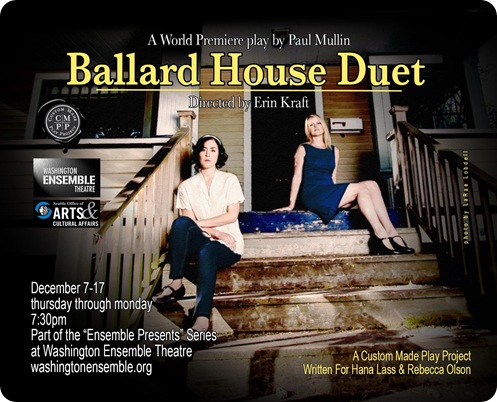
  • Ballard House Duet’s Poster is Here!

    Ballard House Duet’s Poster is Here!

    There’s nothing quite like a show’s  poster going live to underscore the message: “This sh*t is happening!”

    You can get your tix here.  (Do the math. {Small house + short run} * {dynamite cast + crackerjack production team} = early sellout!)

    You can stay up-to-date  on additional Ballard House Duet information as it comes available by “liking” the Custom Made Plays Project Facebook page here.

    And as always, I’ll do my best to keep you up to date here at Just Wrought. More fun news is on the way, I promise!

  • Ballard House Duet: Just the Facts

    Ballard House Duet: Just the Facts

    Blogging is hard. You have to keep posts short to hold people’s attention, but then a project comes along like Ballard House Duet and all I want to do is tell everyone every little thing about it. I want to describe why it’s been so important to me creatively: how it’s been so fun, but also stretched me; why I think every playwright should try custom writing for individual actors; why I think the play tells a locally grown story Seattleites can uniquely identify with; and on and on.

    I am, however, going to show some restraint, by limiting myself in this post to delivering the simple facts.  Ballard House Duet grew out of local actor Rebecca Olson’s idea to commission plays crafted especially for individual actors in Seattle. Says Olson:

    The process begins with a blank page; the actors themselves are the basis for the play, and the actors stay attached to the script from conception through performance. The project includes development, workshops and full production of the finished scripts. This model allows the playwrights to draw on the individual and collective experiences of the artists they are working with. The resulting plays are more satisfying to produce and more resonant with local audiences.

    Olson offered me the honor of being the premiere guinea pig playwright. Hana Lass is Rebecca’s castmate, and Erin Kraft leads the project as director and unofficial dramaturg (though Hana and Rebecca certainly had a hand in that as well. More on that later.)

    We kick this premiere off on December 7 (‘cuz nothing bad has ever happened on that date, right?) and run for two short weeks in a small house, so you’re gonna wanna get your tix quick, by clicking here.

    Here’s a synopsis . . .

    Heidi doesn’t say the word “adopted”.  Holly’s her full sister, even if she is half-Asian and Heidi’s all American.  Somehow Holly inherited Aunt Nana’s religion gene, while Heidi got Mom’s need to be the center of attention.  Now in their 30’s the two sisters have agreed to clear out their hopelessly hoarding great aunt’s house, but when Heidi shows up a week late, hoping to film the process for a reality show, the past and future explode, scattering the shrapnel of strong, deeply hidden betrayals and even stronger, more deeply hidden loyalties.  As they wade through a lifetime of accumulated possessions – and personal grudges – Holly and Heidi must decide: What has value and what are they better off just throwing away?

    And here are the production details . . .

    WHAT:  Ballard House DuetA Custom Made Play Project & World Premiere

    WHO:  Written by Paul Mullin  for actresses Hana Lass and Rebecca Olson; directed by Erin Kraft.

    WHEN:  December 7-17th, 2012, Thursdays through Mondays at 7:30pm; Sneak Peak Thursday Preview, December 6th @ 7:30pm

    WHERE:  608 19th Avenue East, at The Little Theatre in Capitol Hill

    TICKET INFORMATION:  Tickets are $15-$25 and are available at the door or in advance at www.washingtonensemble.org.

  • A Bountiful Fall Harvest for Seattle’s Locally Grown

    A Bountiful Fall Harvest for Seattle’s Locally Grown

    Seattle’s scene for locally grown plays has always been stronger than your average mid-sized city’s, but anything good is worth fighting to make better. That’s why I mouthed off over two and a half years ago with an essay titled “Theatre takes Place: Why Locally Grown Plays Matter”.  I listed some bullet points explaining why the development of new plays is so crucial to the health of any great theatre scene:

    • “Local actors evolve a better understanding of how their contribution … can be generative as well as interpretive.
    • “Local audiences evolve a better understanding of how plays get made and how they can participate in the process….
    • “Local funders evolve a better understanding of their roles as patrons of the arts…
    • “Local funders, artists, and administrators …[can see] the development of plays as actual investments, with the potential to pump profits back to Seattle in several ways.”
    • I even complained that the then recently introduced TPS  Gregory Awards had a category for “outstanding director” but none for playwright, a blunder since rectified.

    Mouthing off is fun, but theatre is a collaborative art form.  Unless others join the fray it isn’t much more than meaningless monologue.  Happily, the last few years have shown just how much a modest city can grow as a theatre town when a group of motivated professionals put their collective mind to it.  For instance, last year A Contemporary Theatre finally took another chance on a local playwright by producing Yussef El Guindi’s  Pilgrims Musa and Sheri in the New World.  The gamble paid off big-time: El Guindi won The Harold and Mimi Steinberg/ATCA New Play Award (plus the $25,000 that comes with it), and American Theatre Magazine just published the script in its current September 2012 issue.

    Keri Healey’s new play Torso, produced by Printer’s Devil Theater, mesmerized everyone I know who saw it.  I suspect it is no coincidence that Keri has been short-listed for a Stranger Genius Award this year.  Torso recently doubled down on local impact with its currently running second production on Orcas Island.

    These are just two stand-out success stories from many.  And this fall promises another bountiful harvest of locally grown new theatre.  Again, just to name and explain a few (with a promise to blog separately on some as they come closer):

    14/48 outdoors for the first time ever

    A few weeks ago I raved about the glorious gamble the 14/48 steering committee was then making by staging their first “Kamikaze” festival, but this weekend they are amping up their Summer of Risk by staging the instant theatre festival outdoors for the first time in their 15 year history.  Tickets are free (also a new twist) so it’s hard to see how you could afford to miss it. (More info here.)

    The Betty Plays

    Beloved local actor Betty Campbell doesn’t get around as easily as she used to, so five local playwrights, myself included, wrote four short plays tailored to her unique and extraordinary talents.  This special Theater Schmeater offering is the sort of one-of-a-kind live experience that only happens in Seattle.  (Click here for more information  and here for reservations.)

    NCTC’s Foreclosure by Vince Delaney

    One of Seattle’s hottest acting ensembles workshops one of Seattle’s hottest playwrights, as he tackles an issue facing Americans nationwide  There aren’t many performances scheduled for this pre-world premiere, so you better reserve early.

    Sandbox Radio Live!

    1. The podcast from Episode 5: “An Unexpected Twist” recently dropped.  (A blog on that to come.)
    2. A “Best Of” show kicked ass at Bumbershoot!  (Check out this review.)
    3. And Episode 6: “Something Wicked This Way” is coming very soon: October 1 at West of Lenin.

    Why is Sandbox Radio Live! so important to Seattle’s locally grown theatre movement?  Because it happens every quarter and every quarter it gets better.  Because nearly every play, poem or commercial is written by top local playwrights and performed by top local actors.  Because it is fresh local “produce” at its best and most consistent.

    Custom Made Plays

    In my opinion this may just be the most exciting new wrinkle in Seattle’s locally grown scene, and not just because I have the good fortune of being the inaugural playwright.  Brainchild of local actress Rebecca Olson, the Custom Made Play Project  is dedicated to matching Pacific Northwest playwrights with local actors to develop and produce new plays of regional significance.  In my case, after interviewing my collaborating actors, Ms. Olson and Hana Lass, I tailor-made the soon-to-world- premiere Ballard House Duet to their unique talents and qualities.  Because of that, I am painting with colors I have never used before, and I’m loving it.  The resulting script simply would not exist were it not for these unique one-on-one collaborations. That fact excites me.

    Here’s another fact: Seattle is the best city in the country—maybe even the world— for locally grown theatre.  And we are only getting better and better at growing it.  As you can see from the small sampling above, it’s going to be an awesome autumn harvest.  It makes you wonder what next winter, spring and summer will bring.