Just Wrought

Recovering playwright, once won a STRANGER Genius Award for theater. Now writing a bloated novel about… G-d help me! Theatre.

Category: An American Book of the Dead – The Game Show

  • The Bardo of American Heroes of Violence

    The Bardo of American Heroes of Violence

    (. . . . The Bardo Wheel lights up and the Spokesmodels roll out a cannon, then blindfold Barry, place a tri-corner hat on his head, and hand him a cannoneer’s linstock with a burning match on its end.)

    ANNOUNCER: Barry, you hold in your hand a cannoneer’s linstock. To your immediate right sits a six-pounder field piece from the Revolutionary War.

    HOST: This oughta be old hat for you, Barry, what with all that dress-up soldier you used to play oh so many lives ago.

    BARRY: Well um, actually, Blink: by the time of the Civil War, cannons were fired by tugging a length of cord called a lanyard.

    HOST: Barry?

    BARRY: Yeah, Blink.

    HOST: Shut it and shoot it.

    BARRY: Okay.

    HOST: Sweethearts, spin that wheel!

    (The wheel is spun. Barry fires the cannon blowing a hole through the panel reading: “The Bardo of American Heroes of Violence.” These letters glow while everything else fades to black. Lights up on the Bardo Guide standing in the audience, dressed like a park ranger.)

    BARDO GUIDE: Please step forward and watch your step as you enter the Bardo.

    (She clears her throat.)

    BARDO GUIDE: Oh brave and freely born, having failed once again to grasp the clear light of reality, you are now entering the Bardo of American Heroes of Violence. Be warned, the apparitions you see here are merely illusory projections of your own in-between consciousness. Please pay attention, but not too much attention, lest your fears and desires cause your rebirth in a world of violence.

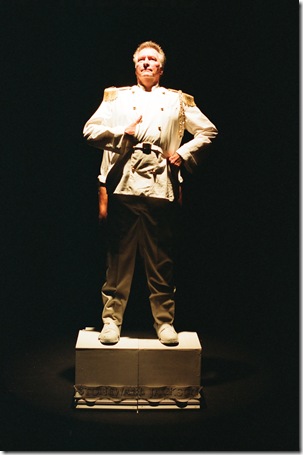
    (Lights up on Stonewall Jackson.)

    BARDO GUIDE: Behold the great General, Thomas “Stonewall” Jackson. His right hand wields the scabbardless sword of righteous reckoning. His left palm is upturned in prayer. In this aspect he gives battle to the infidel invaders of the South. In his other left hand, General Jackson holds the half-sucked lemon of legend.

    STONEWALL: I have always suffered an acute dyspepsia. Lemons help ease this discommodity and soothe a parched mouth.

    BARDO GUIDE: Clutched in Stonewall’s other right hand is the Westminster Shorter Catechism of Presbyterianism.

    STONEWALL: And I quote: the duty which God requireth of man, is obedience to his revealed will.

    In this Holy War between Union and Confederacy, the Lord Almighty alone will decide who is right. Duty is ours; the consequences are God’s.

    BARDO GUIDE: His third right hand brandishes the Confederate battle flag. His third left, the plain black flag.

    STONEWALL: Flying the black flag informs the enemy that surrender will never be begged nor quarter given. A fight to the last man alive. We must not merely defend ourselves, we must attack! Give me three swift columns stabbing North and I will hold you hostage the richest cities of Pennsylvania, New Jersey and New York.

    BARDO GUIDE: One of his officers once let a particularly brave squad of Union cavalry escape.

    STONEWALL: No, sir. You must kill them all. I do not want the enemy brave; I want him dead.

    BARDO GUIDE: Behold the bardo demon/saint “Stonewall” Jackson.

    STONEWALL: The punishment of national sins must be confined to this world, as there are no nationalities beyond the grave.

    BARDO GUIDE: Do you admire him? Despise him? He is nothing but your own true self disguised. Realize this, or be reborn in a world of violence.

    Now, adjust your eyes now to the shadows and concentrate. If you focus hard enough, you may envision Stonewall’s bardo wife.
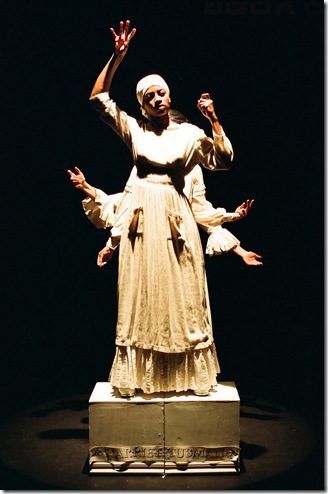
    Harriet Deified(Harriet appears half in shadows.)

    HARRIET: Harriet Tubman.

    BARDO GUIDE: Friend of the Hopeless, Ally of the Night, runaway slave turned Underground Railroad Conductor. Her right arm upraises the living symbol of her people’s salvation — the North Star.

    HARRIET: On a clear night running, just keep it in front of y’all to find yo way to freedom. Cloudy nights ye gots to feel the tree trunks for the mossy side.

    BARDO GUIDE: In her left hand she holds a pistol: insurance against passengers who might lose nerve and try to turn back.

    HARRIET: I’ll give you the same choice the Good Lawd gives every body: git free or die. I done my share of digging. Won’t take me long to plant what’s left of you in this soft Dixie dirt.

    BARDO GUIDE: Be not afraid, oh free and brave. Conductor Tubman will free over 300 slaves, and never lose a passenger.

    In her middle right hand she holds forty thousand dollars.

    HARRIET: That’s nearly a million to you these days.

    STONEWALL: The Confederate reward for her capture, dead or alive.

    HARRIET: I guess I’s one pricey little slave girl now.

    BARDO GUIDE: In her middle left hand she holds an open book.

    HARRIET: Any book’ll do.

    BARDO GUIDE: Harriet can’t read.

    HARRIET: Says so on my wanted poster, or so dey tell me. But as long as I hold dis book right side up dem slave dawgs take me for a free nigger girl who done know’d how to read.

    BARDO GUIDE: In her lower right hand she wields a Sharps carbine.

    HARRIET: For a little more long-range firepower.

    JACKSON: Her weapon of choice for rising against her native land.

    HARRIET: Shoot. My native land is freedom.

    Up until your first Gulf War, I am the first and only woman to lead an American combat expedition. I takes me a battalion of 600 black freedmen, and I raid up and down Carolina River plantations. One day we free 750 slaves. Cain’t nearly fit ‘em all on the boats. Lawd, it’s a good day.

    BARDO GUIDE: Her lower left hand is empty.

    HARRIET: Folks give me money ‘cuz they thinks I’s po. But ders plenty folk more po dan me. What folks give I jist pass on down. Lawd knows I don’t need much to live.

    BARDO GUIDE: Both husband and wife maintain a constant state of prayer in this bardo, as they did in life.
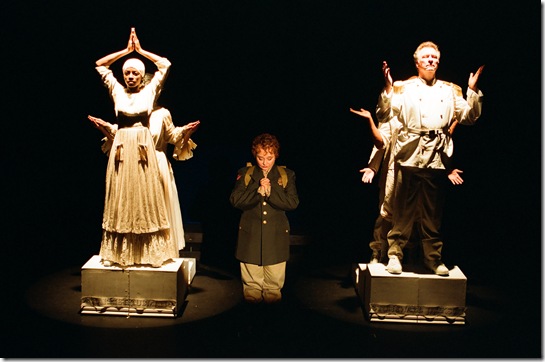
    The Bardo of the American Heroes of ViolenceSTONEWALL: “Heavenly Father, make this rag-tag Shenandoah army an army rather of God.”

    HARRIET: “Lawdy, unharden Pharaoh’s heart, and let him let my people go out this Egypt, or better yet, put his hard heart in front of my bullet and I’ll soften it myself.

    BARDO GUIDE: On the Eve of the American Revolution, their first child Crispus Attucksis born.
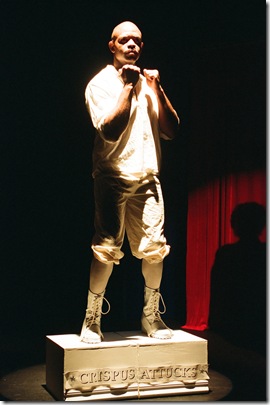
    (Lights up on Crispus Attucks.)

    CRISPUS: Crispus Attucks.

    BARDO GUIDE: Half–black, half Nantucket Indian, like his bardo mother he ran away from slavery at an early age.

    CRISPUS: Became a sailor. One of the few things they’ll let a dark man do for a decent wage.

    BARDO GUIDE: In his left hand he holds a length of rope.

    CRISPUS: I’m a rope-maker. Learned it at sea. What else you gonna do when you’re stuck on a whaler three years?

    Lately the Redcoats been moonlighting in town, taking our jobs. We tussle with the lobster-backed bastards sometimes, if they come in our pubs. One winter night, me and the boys had a few and then had some fun with a lone British guard out on patrol.

    BARDO GUIDE: In his right hand Crispus holds a snowball.

    CRISPUS: We pelted him good. Next thing we know, a crowd’s gathered round.

    BARDO GUIDE: In the subsequent murder trial, future Founding Father John Adams stands as defending counsel for the British soldiers. He calls the crowd—

    STONEWALL: “A motley rabble of saucy boys, negroes and molattoes, Irish teagues and outlandish jack tarrs.”

    CRISPUS: That’s us all right, all pelting this lobster good. Then don’t ya know a whole squad of lobsters shows up. High, mighty Sergeant tell us to disperse. Shoves his bayonet at me.

    “Man, get that knitting needle out my face.”

    (A single gunshot. Crispus staggers backwards.)

    CRISPUS: They shot–

    (A musket volley. Crispus crumples.)

    CRISPUS: They shot us dead… for chunking… snowballs.

    (Emma Goldman enters.)

    EMMA: They shot my brother dead for throwing snowballs. There’s your precious government for you; and your glorious Boston Massacre– a snow ball fight.

    CRISPUS: That’s my sister.

    EMMA: Emma Goldman.

    Maybe your illustrious John Adams is right. Maybe my brother Crispus was nothing more than a saucy jack-tarr thug looking for trouble. But aren’t all revolutions ultimately sparked by such men? Where would you be without my brother, Crispus?

    CRISPUS: Man, get that knittin’ needle out my face.
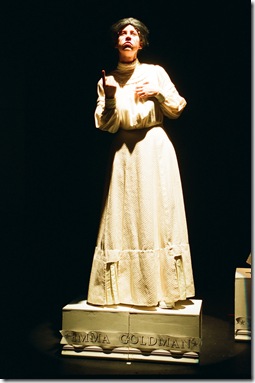
    Emma Goldman 1EMMA: Such men are supersensitive beings driven to violent expression, even at the sacrifice of their own lives, because they cannot supinely witness the suffering of their fellows.

    CRISPUS: Well, we was just chunkin’ snowballs.

    EMMA: Why am I an Anarchist? Because all forms of government rest on violence.

    HARRIET: Dat’s my daughter Emma. In one hand she hold a flower.

    EMMA: It’s for you. It’s freedom. It’s sex. It’s creativity. It’s a promise of change for the better. Everybody– not just the rich, but everybody– has the right to beautiful, radiant things.

    STONEWALL: In her other hand, she holds a bomb.

    EMMA: The killing of a tyrant, an enemy of the people, is in no way to be considered the taking of a life.

    HARRIET: She hold a flower.

    EMMA: Love is an art, I am the artist. I love children and springtime and most of all I love my freedom.

    STONEWALL: She holds a bomb.

    EMMA: Violence is inevitable, never mind what Jesus said. Human nature does and must resist repression. Government is violence. Fire fights fire.

    STONEWALL: The flower is a bomb.

    HARRIET: The bomb is a flower.

    BARDO GUIDE: The weight in one hand tugs her forwards. The weight of the other yanks her back. And so she dances… and so she always will.

    HARRIET: That chil’ sho do like to dance.

    EMMA: If I can’t dance, it’s not my revolution.

    BARDO GUIDE: Does Emma intrigue you? Repulse you? Either way takes you back to your world of violence.Audie Murphy
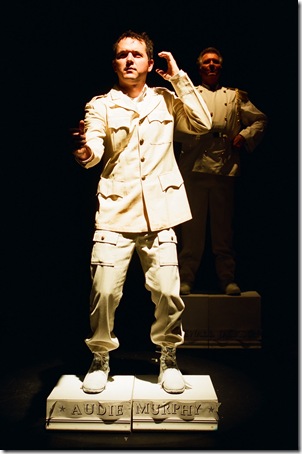
    Instead, oh bravely born, look again and behold the second son of the Bardo.

    (Lights up on Audie.)

    MURPHY: Audie Murphy.

    BARDO GUIDE: The most decorated soldier of America’s most beloved war,

    MURPHY: WW II.

    BARDO GUIDE: Audie sits atop a burning tank destroyer. His left hand holds a field phone wired back to rear artillery. His right hand grips the trigger of the mounted machine gun.

    AUDIE: The Krauts are advancing across an open field of snow. Most of my whole platoon’s already scattered, but I’ll be damned if I’m runnin’. They already pinned me with every medal they’ve got. ‘Bout all that’s left now is for some medic to split my dog tags, and today seems as good as any… so long as I can take some Jerrys with me.

    BARDO GUIDE: Careful. Audie is the most dangerous vision here. For most Americans, he’s damned near irresistible.

    AUDIE: As soon as the Kraut infantry marches within range I start mowing ‘em down like carnival ducks. Oil smoke covers me like a nightmare. They got no clue where the lead’s comin’ from, and I got no qualms; no pride; no remorse. Rules of war are simple. Got a gun in your hand? You’re a soldier– fair game. You only become human again once I put a bullet in you.

    BARDO GUIDE: Careful now. Breathe him in and breathe him out.

    AUDIE: I take a breather both to let the barrel cool and call in some big stuff. This 50 caliber ain’t even gonna dent those tanks.

    (A telephone rings.)

    BARDO GUIDE: Battalion.

    AUDIE: This is Murphy. We’re under attack. I need artillery: a round of smoke at coordinates thirty-ought-five dash sixty, and tell those joes to shake the lead out.

    BARDO GUIDE: How many krauts?

    AUDIE: Six tanks I can see, maybe a couple hundred infantry.

    BARDO GUIDE: Good god! How close?

    AUDIE: Close enough. Gimme that damned fire!

    STONEWALL: Ah, artillery. Lord, how I love a good cannon fight. Nothing like it to raise the blood.

    BARDO GUIDE: It isn’t just Stonewall’s blood that’s rising, is it? You’ve wanted to be Audie ever since you first played war as a kid. Fully automatic death in one hand. A direct line to the wrath of God in the other.

    Wait!

    Let’s take a break. Relax. You can be Audie practically any time you want, but it could just be an eternity before you get a chance to see the big picture this clearly again.

    Look back into the darkness, and see his sister…

    (Lights up on Molly and her cannon.)

    MOLLY: Molly Pitcher.

    STONEWALL: Just as there is no Stonewall–

    HARRIET: –Without Harriet.

    EMMA: No death.

    CRISPUS: Without sex.

    AUDIE: There just can’t be an Audie—

    MOLLY: –Without Molly.

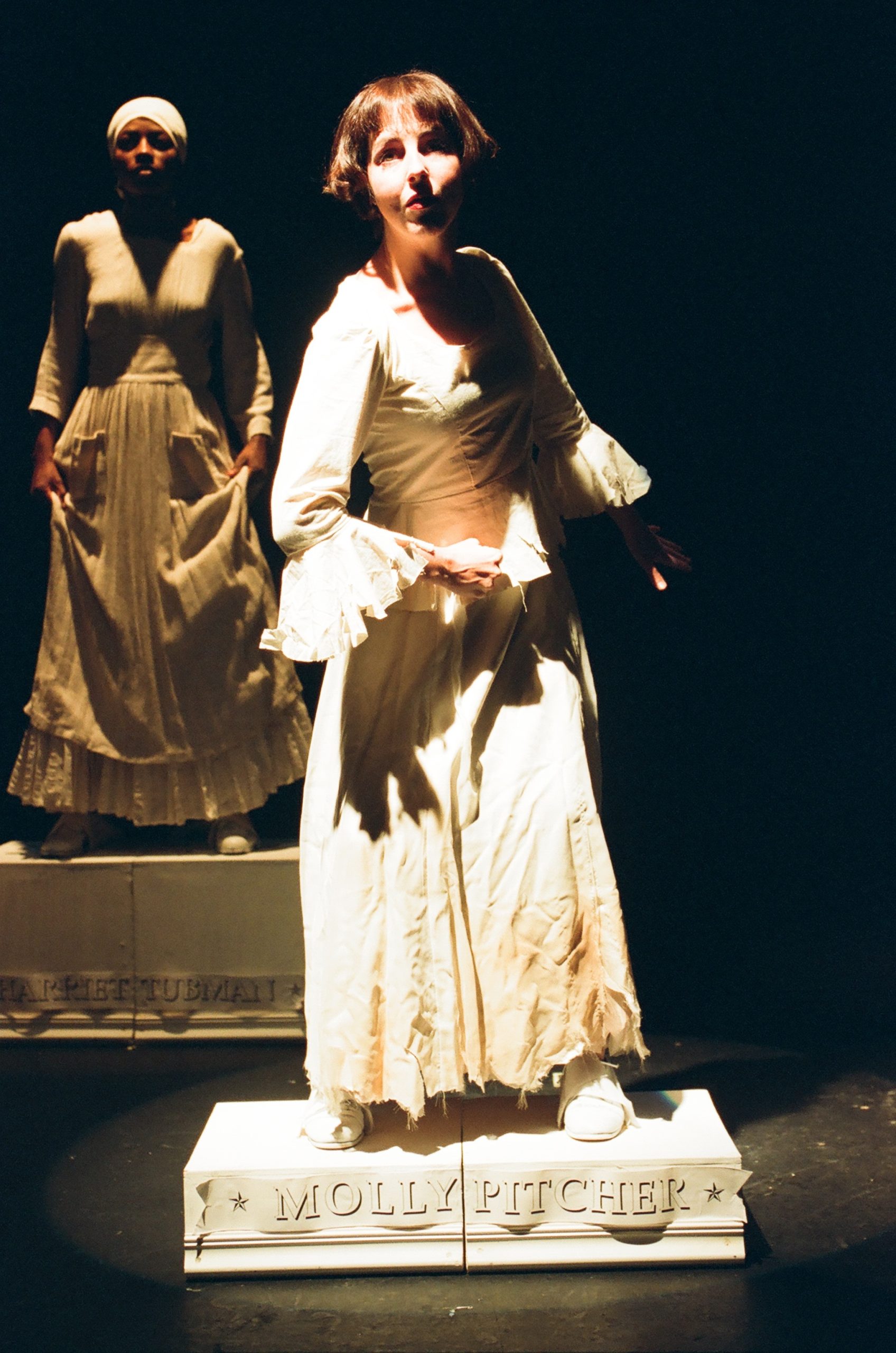
    BARDO GUIDE: Behold, Molly Pitcher stands before you. Water jug in one hand, cannon ramrod in the other.
    Molly Pitcher 2

    All History knows for sure about Molly Pitcher is that she was almost certainly not named “Molly”… or “Pitcher”. According to legend, her husband mans a field piece in the Continental Army.

    MOLLY: All the boys in the battery get frightfully parched in the heat of battle and good ol’ Molly does her best to keep ‘em cool.

    CRISPUS: She’s getting pretty sweaty herself.

    MOLLY: You just mind your gun, soldier.

    BARDO GUIDE: Suddenly, her husband is hit by a musket ball.

    STONEWALL: Damnation! The field piece is undermanned and will have to retreat.

    EMMA: But wait! Molly picks up the ramrod and takes her man’s position. The revolution will continue, regardless of sex.

    (A phone rings.)

    MOLLY: Battalion.

    AUDIE: This is Murphy. We’re under attack. I need artillery.

    MOLLY: I’m here for you.

    AUDIE: Give me smoke at nine-one-one, nine-eleven, nineteen ninety nine nine NINE NEIN!–

    MOLLY: –Roger that!

    AUDIE: –And tell those girls to shake the lead out.

    CRISPUS: How many Ivans?

    AUDIE: A thousand planes I can see, a couple million infantry.

    MOLLY: Dear God! How close?

    AUDIE: Close enough. Gimme that damned fire!

    MOLLY: Molly rams the round home!

    STONEWALL: And fire!

    (The cannon fires. A shell whistles in.)

    AUDIE: A squad of black pajamas disappears in a cloud of snow.

    MOLLY: How’s that?

    AUDIE: Good! But they’re closin’! Move 50 over and keep firing for effect.

    STONEWALL: Fire!

    (The cannon fires.)

    BARDO GUIDE (shouting over the fray): You’ve waited too long, bravely born. Now you’ve come to the place where all hell forever breaks loose.

    MOLLY: How close are they?

    AUDIE: 50 over, and keep blasting.

    STONEWALL: Fire!

    BARDO GUIDE: I tried to warn you. But you couldn’t resist.

    STONEWALL: Duty is ours, the consequences are God’s.

    MOLLY: How close are they now?

    AUDIE: 50 over. Keep it coming.

    HARRIET: Lawd, unharden Pharaoh’s heart, or put it in front of my bullet and I’ll soften it myself.

    STONEWALL: Fire!The Violence Bardo shooting mode
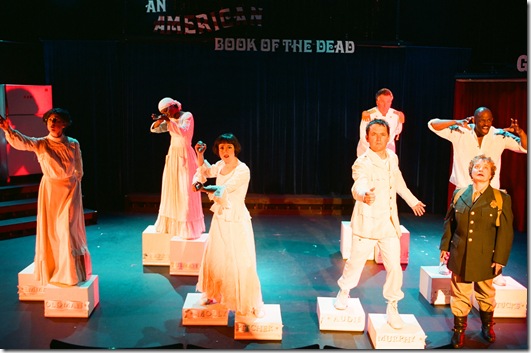
    MOLLY: How close are they?

    AUDIE: 50 over and keep firing for effect.

    STONEWALL: Fire!

    BARDO GUIDE: At the battle of Second Manassas, Jackson loses the tip of his left finger to a cannon ball.

    (Stonewall’s finger disappears.)

    MOLLY: How close are they to your position?

    AUDIE: Hold the phone; I’ll let ya chat with one of the bastards.

    CRISPUS: Man, get that knittin’ needle out my face.

    AUDIE: I check my machine gun for damage, then squeeze the trigger. The chatter of the gun is like sweet music. Three hadjis stagger and crumple in the snow.

    CRISPUS: Shot us… dead… for chunkin’ snowballs.

    EMMA: Never mind what Jesus said, fire fights—

    EMMA & STONEWALL (simultaneously): FIRE!

    (Loud crashing explosion.)

    AUDIE: My tank destroyer shudders under another direct hit.

    MOLLY: Are you still alive, my love?

    AUDIE: I think so. Correct fire: 50 over.

    I feed another belt into the machine gun and grab the trigger again, boring into anything that moves, slowly travers-ing the barrel.

    STONEWALL: You must kill them all. I do not want the enemy brave; I want him dead.

    AUDIE: Twelve bodies slump in a stack position. Methodically I give ‘em another thorough burst, and pick up the phone.

    Battalion, correct fire. 50 over.

    MOLLY: Are you all right, lover?

    AUDIE: I’m all right, Sergeant. What are your postwar plans? Just give me that fire.

    STONEWALL: Fire!

    BARDO GUIDE: At Chancellorsville, after being mistakenly shot by his own troops, Stonewall Jackson loses his arm to the surgeon’s saw.

    (Stonewall’s entire arm disappears.)

    He dies days later of pneumonia.

    STONEWALL: Two short months shy of the Battle of Gettysburg.

    (Stonewall disappears.)

    BARDO GUIDE: Do you mourn the loss of American gallantry? Well, snap out of it! There’s no time!

    AUDIE: The barrage lands within fifty yards of me. The shouting, screaming, cheese-eating, freedom-hating, evil-doers caught in it are silent now.

    Sergeant, this is my last change. Correct fire: 50 over; and keep firing for effect.

    MOLLY: 50 over? That’s your own position.

    AUDIE: I don’t give a damn. 50 over.

    (A shell whistles in for an eternity, then, instead of an explosion, utter silence. The bardo heroes freeze and the Bardo Guide steps into a special.)
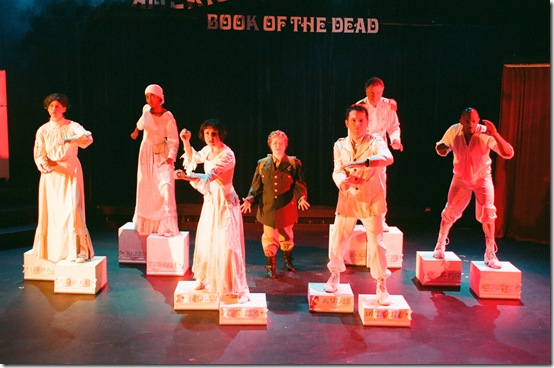
    The Violence Bardo Unpacked 2

    BARDO GUIDE: Oh free and bravely born, you have passed through the Bardo of American Heroes of Violence. At any time you could have detached yourself from these visions, achieving perfect peace and enlightenment. But… you blew it. Hey, don’t feel so bad. Happens to the best of us, and the worst of us. Fact is, it pretty much happens to all of us. But it is surely now your fate to be reborn yet again in a world of violence.

    On behalf of the United States of Transcendence, I thank you for visiting. Please step carefully when exiting the bardo.

    (Blackout.)

  • Experimental Results

    Experimental Results

    I made a promise to myself a while back that if I was going to use the word “experiment” in association with my work as a theatre artist, I had to do so more like a scientist and less like some avant garde poser.  As I said in my earlier post “Putting the Fail back in “Experimental”: 

    Any actual scientist understands that true experiments have rules and consequences. Experiments are tests of hypotheses hoping to become theories; and theories, in order to prove useful, must be falsifiable.  In other words, true experiments by definition contain the possibility of failure.

    I would add that good scientists publish their results whether or not they find them gratifying.  And that’s exactly what I intend to do here and now regarding the experiment of publishing my play Ballard House Duet simultaneously with its recent world premiere.  (I enthusiastically explained my reasons for initiating this experiment here.)

    So as of this posting, here is how my sales break down by channel:

    Not a data/chart nerd like me?  Okay, here are my plain English conclusions:

    1. I have too much unsold inventory.  If I had listened to my publisher and ordered the number of books he recommended I’d be sitting on a mere 3% overhang now, which would have been right in the estimator’s sweet spot.
    2. “Show sales” was my strongest channel, which is gratifying, since offering the script simultaneously with performances was the main point of this effort.  If I did this again I would lean even more heavily into this channel: maybe invest in a more visually pleasing display than the cardboard box with the words “Scripts for Sale – $10” scrawled on the front of it in ballpoint pen.

    The bottom line is I turned a profit about three eBay sales ago.  I am now $19.59 richer for this experience; but based solely on the data, I would have to give myself a C +, since I moved only 78 % of my product. 

    Of course, it is much harder to quantify all the things I have learned from the experience, not to mention all the nerdy fun I have had.  Here’s a quick list:

    • People will buy scripts at a show, but they have to be reminded, in the pre-show speech and then again at intermission and after the show.  The display of scripts has to be prominent.  You have to make buying them easy and fun.
    • eBay is not the best means of selling a script on line.  It wound up costing me $2.31 out of every $10 script I sold on-line.  Given the cost of printing, that left me with very little margin to take any profit.  If it hadn’t been for show sales, with their much wider margin, I would still be bleeding red ink at this point.

    The best outcome of this experiment was, of course, the chance to talk about the experiment itself: to revisit the question of whether it makes sense to publish play scripts simultaneously with world premiere productions, and more specifically, whether it makes sense for a playwright to put up his own capital to do so. I would say the short answers to these questions are, “Yes, with some improvements in the process.” And “No, a playwright already banks enough when he or she antes up their play for staging.”

    Fellow playwright Joshua Conkel chimed in on Facebook to point out, “…In the U.K. it’s common to get the script at the show. It costs a few pounds and it also serves as the program…. Oberon Books does it. And then of course the script goes out to bookstores and all that. It’s great!”  Perhaps as Seattle grows as one of the nation’s hothouses for locally grown new theatre, it might behoove us as to explore a script sales model like the UK’s, though it should also be noted that the simultaneous publishing experiment has been run quite extensively here in decades past. Bret Fetzer explained in comments posted on my earlier blog:

    The experience of Rain City Projects — which published plays in conjunction with productions for over ten years… was that when the theater promoted selling the script, it succeeded, and when they didn’t, it didn’t. The single most significant factor, by an order of magnitude, was having someone hold up the script in a preshow speech and say “This is for sale in the lobby; if you enjoyed the show, we encourage you to buy the script.” Other approaches — such as plugging the script for sale in a program ad — had a fraction of the impact of a live preshow plug.

    Over time, theaters became less invested in promoting scripts. There was a trend away from preshow speeches, and even the theaters that still did them just wanted the speaker to say the essentials and get off the stage. Most of the theaters producing new plays were small, volunteer-run organizations, so there was no one to consistently make a plug for the script, and trying to educate a rotating crew of house managers about this was too much to accomplish on top of all the other stuff that had to get done. Everyone supported the idea of selling the scripts in the abstract, but in practice it fell by the wayside.

    But the main reason Rain City Projects stopped publishing individual scripts was that, as these were brand new plays getting their first production, a majority of playwrights learned a lot of new things and did significant rewrites after the production. Immediately the scripts were obsolete and the playwrights didn’t want them sold or distributed….

    My experience working with Original Works Publishing, eBay and Amazon Direct Publishing leads me to believe that new technologies and processes might allow theatres and playwrights to keep their inventory small and flexible enough to offer scripts, either in hard copy or electronically, such that some of the challenges Rain City Projects faced might now be mitigated. 

    One conclusion seems certain: folks who bought my script seem very pleased indeed to be able to own a permanent document  of an otherwise inherently ephemeral experience.  Theatre is fleeting, but perhaps we theatre artists could work a bit harder to bottle some of our volatile moonshine for future times.

    (more…)

  • Rain City Projects Rocks It World Class with Vol. 3 of Manifesto Series

    Rain City Projects Rocks It World Class with Vol. 3 of Manifesto Series

    So I know you are going to find this hard to believe, but I was recently getting into it with a fellow playwright about the failures of the New York-centric hub-and-spoke model of new play development.  His argument was the tired old saw: “If you want the best product, you have to get it from the where all the best gather to produce it.”  If I recall correctly, he gave as an example: “If you’re were looking for a new sensei for your martial arts dojo, you would to look to Okinawa.”  I really have no idea what that means.  I did, however, offer the counter that if I want the best cheese, beer, wine, meats, fish, fruit and vegetables, I don’t really need to look beyond the Pacific Northwest.  Then I posted a helpful link on his Facebook wall to my essay “Theatre Takes Place: Why Locally Grown Plays Matter.”

    The link disappeared within an hour.  So much for the free exchange of ideas.  I suppose when it comes to thoughts on theatre, the proper direction of flow is one-way from New York City to everywhere else.  

    But honestly, I don’t even need to argue when amazing Seattle institutions like Rain City Projects regularly put world class money where my big mouth is.  Case in point, their upcoming release of Volume 3 of their Manifesto Series, a regularly published anthology of great Northwest Plays.

    Can I even express to you how honored I was to be included with the likes of Yussef El Guindi recent winner of The Harold and Mimi Steinberg/ATCA New Play Award, or my personal heroine Elizabeth Heffron, or Stranger Genius Award winner Chris Jeffries or the fiercely incomparable Bret Fetzer and Stephen McCandless, all hand-selected by the nationally renowned playwright and playwriting teacher Naomi Iizuka?

    Nope. I don’t believe I can, but— dammit!— I can try.

    This coming Sunday we will be celebrating Volume 3’s release with free readings from several of the collected plays.  I’ll be there.  Yussef and Elizabeth mentioned they might be, too. So why don’t you come on down so we can sign your copy, hot, fresh, and locally sourced, right off the presses!?

    Here are all the crucial details from Rain City Projects:

    Rain City Projects is releasing the third book in its Manifesto series – anthologies of plays by Northwest playwrights. We’re very excited this time to have an anthology of seven plays selected by Naomi Iizuka who started by writing a manifesto of what theater should be and then chose plays she felt exemplified her vision. Please join us for a reading of short excerpts from Ms. Iizuka’s delightful manifesto and from the plays she chose including:

    Language Rooms by Yussef El Guindi

    Clubfoot by Bret Fetzer & Stephen McCandless

    Mitzi’s Abortion by Elizabeth Heffron

    Vera Wilde by Chris Jeffries

    An American Book of the Dead by Paul Mullin

    Live! From the Last Night of My Life by Wayne Rawley

    and Wizzer Pizzer by Amy Wheeler

    Sunday, April 15th at 2:00pm

    The reading is FREE and will be held at Elliott Bay Book Company 1521 10th Ave, Seattle, WA 98122

    Manifesto v. 3 will be available for purchase along with Manifesto v. 2 (edited by Steven Dietz) and Manifesto v. 1 (edited by Erik Ehn).

  • IBM and Microsoft, Sittin’ in a Tree

    IBM and Microsoft, Sittin’ in a Tree
    Available Now
    imageBuy Now

    While I have stated publically I hate being prescient, there are times when I don’t mind too much.  With the massive Occupy movements afoot I thought I should note that I was talking about the absurdities of Corporate Personhood long before it was popular.

    Check out this section of An American Book of the Dead*- The Game Show†.

    (more…)

  • The Bardo of The Salted Wife

    The Bardo of The Salted Wife

    Is it possible to engender genuine horror in an audience through a live stage experience?  That is the standing question for this series of scripts, excerpts and essays which I will be posting throughout this  Halloween season.

    ***

    Sometimes a piece of theatre is crafted specifically and solely as a work of horror.  In recent times, The Woman in Black leaps to mind, but we should also remember that the Grand Guignol in Paris was one of the most successful and longest running commercial theaters of all time. 

    More often, a play will contain components of horror while the larger story lands squarely in the territory of tragedy, e.g. Hamlet or MacBeth. And sometimes, but much more rarely, horror rears its head in a comedy, like my own reincarnation romp, An American Book of the Dead – The Game Show. It is early in the play, and things are cooking along nicely in full farce fashion, as game show host Blink Bodie yucks it up with contestants and Spokesmodels, when suddenly a solid wall of stylized terror stops the fun cold, and, ideally, disorients the audience enough that I can start to really —ahem—“muck” with them.

    Ripped right out of Howard Zinn’s  absolutely essential A Peoples History of the United States, this section is my attempt at staging one of the nastiest tidbits from our nation’s nascent colonization. This isn’t legend.  Zinn cites the Journals of the House of Burgesses of Virginia legislature for this piece of history. So it seems consuming others for one’s one survival and delectation is as old, if not older, as the idea of America itself.

    (more…)

  • Lost and Found

    Lost and Found

    Circle X Theatre’s world premiere of An American Book of the Dead – The Game Show, designed by Gary Smoot, was the most visually evocative production of any show I have ever written.   The tableaus and scenic effects were so unique and so profoundly stunning that it’s damned near impossible to describe them in words.  So imagine how depressing it has been these nine years to think that the only two surviving images of the show were this…

    And this…

    Kevin Fabian as Blink and the spokesmodels (Jamie Bullock & Daniele O'Loughlin) from the Circle X Theatre World Premiere of An American Book of the Dead- The Game Show.

    Now don’t get me wrong: the incomparable Kellie Waymire ravishes us posing above as the troubled proto-supermodel Jacqui Potts*; and Blink Bodie (Kevin Fabian) flanked by his spokesmodels (Jamie Bullock & Daniele O’Laughlin) wrapped in Old Glory certainly hits the “American” part of the title on the nose.  On the other hand, not only do both shots fail to tell us anything novel about the show, they also, more importantly, don’t tell us what we don’t know about it, thus piquing our curiousity enough to maybe come see.  Compare them with this newly unearthed shot, again of Kellie as Jacqui…

    Kellie Waymire as Jacqui Potts in the all together.

    This not only screams “sex”, but “mystery”, “exposure”, and somehow, oddly, “death” itself.  If we had captioned this “Jacqui Potts about to enter the bardo realm by dropping acid and posing nude for the first time”, we might just have been able to get your butt in one of Circle X’s seats, mightn’t we?   Why we did not try to sell the show with the countless more evocative images than those first two, I will probably never know.  The fact is, however, that because those two shots were used for publicity, they alone survived.  Or so I thought for nearly a decade.

    A lot of life got lived between 2002 and now, and the rolls of film that all of us knew were captured in that meticulous marathon photo call somehow disappeared  somewhere along the way.  I confirmed the loss when I started blogging here at Just Wrought and wanted to write about how I love to work with designers as early as possible in the development process.  Even though I was living in New York City when I wrote ABOD and Gary Smoot lived in Los Angeles, we somehow managed to meet in Seattle over a long post-9/11 Thanksgiving weekend, and in the living room of Gary’s boss’s house we brainstormed ways to stage the bizarre effects I was imagining.

    I described the process in my essay on designers:

    We needed three isolation booths for the afterlife contestants.  I wanted something straightforward and on the nose, similar to the glass boxes they used in Twenty-One.  Naturally, Gary zagged off my zig.  We went through a lot of ideas, including bubble packs for life-sized action heroes, file cabinets and morgue drawers.  Finally he landed on simple genius, and of course had the skill and the luck to bring it together:  three identical, perfectly white refrigerators, with plastic magnet letters to spell out each enclosed contestant’s name. When the intense gelled Fresnels were focused on them, the white surface utterly transformed into whatever deeply saturated color the lighting designer chose to call up.  The “contestents” blithely climbed in and out of them, emerging unexpectedly from one after entering another, like so many peas in a karmic shell game.  For the audience the layers of meaning dawned almost imperceptibly but no less forcefully for that: the three fridges were uniquely American icons of consumption, comfort, death and banality all at once, and as they were signifying these things, it was also obvious that they were nothing more or less than refrigerators, or isolation booths, or maybe some vast gentle joke played on everyone from patron to playwright.  When Gary’s designing the sense of play never leaves the play, even if the play involves death at its very core.

    When I wrote that I had no reason to believe anyone would ever again be able to see what I was trying to describe.  When I called Gary to ask if he had captured any photos for his own records, he said he might have, but that he would have to dig for them when he had some free time.  That’s Smoot code for, “It ain’t gonna happen.”  Gary never has free time.  Even so, a few months later he told me he had looked and hadn’t find anything.  Now we were both bummed.

    Then, a few months later, I was on the phone with Tim Wright, the current Artistic Director of Circle X, pitching him a new script when a mini-miracle occurred.  Tim casually mentioned that he had the ABOD production shot negatives and if I wanted, he would send them to me!  The rest was logistics.  This past week I got the negs developed to digital at a respectable mom and pop photo shop, and spent most of Saturday uploading the images to Flickr and Face Book and tagging them with the names of old friends.*    I smiled all day as folks involved with the production chimed in to say hello, share memories,tag more photos and grab shots for the profile pics.

    So you wanna see those fridges, and how well they worked?  Well, in lieu of a few thousand words, here’s a few pictures…

     Barry goes into the isolation booth Tommy Hennessy mourns  Surge gets a Karma inversion Tanya squares off with Surge

     The Rat Pack in the Bardo of Louie Prima 4

    *Deep inside information:  It is a testament to Kellie’s wide-spectrum of talent and tireless dedication that she also helped to sew and hang the sumptuous red curtain behind her in this shot.

    Not to mention death: Kellie Waymire died in 2003.

    *You can enjoy the full set on Flickr, here… 

    Available Now
    image
    imageBuy Now