Just Wrought

Recovering playwright, once won a STRANGER Genius Award for theater. Now writing a bloated novel about… G-d help me! Theatre.

Category: Locally Grown Plays

  • Bespoken Word

    Bespoken Word

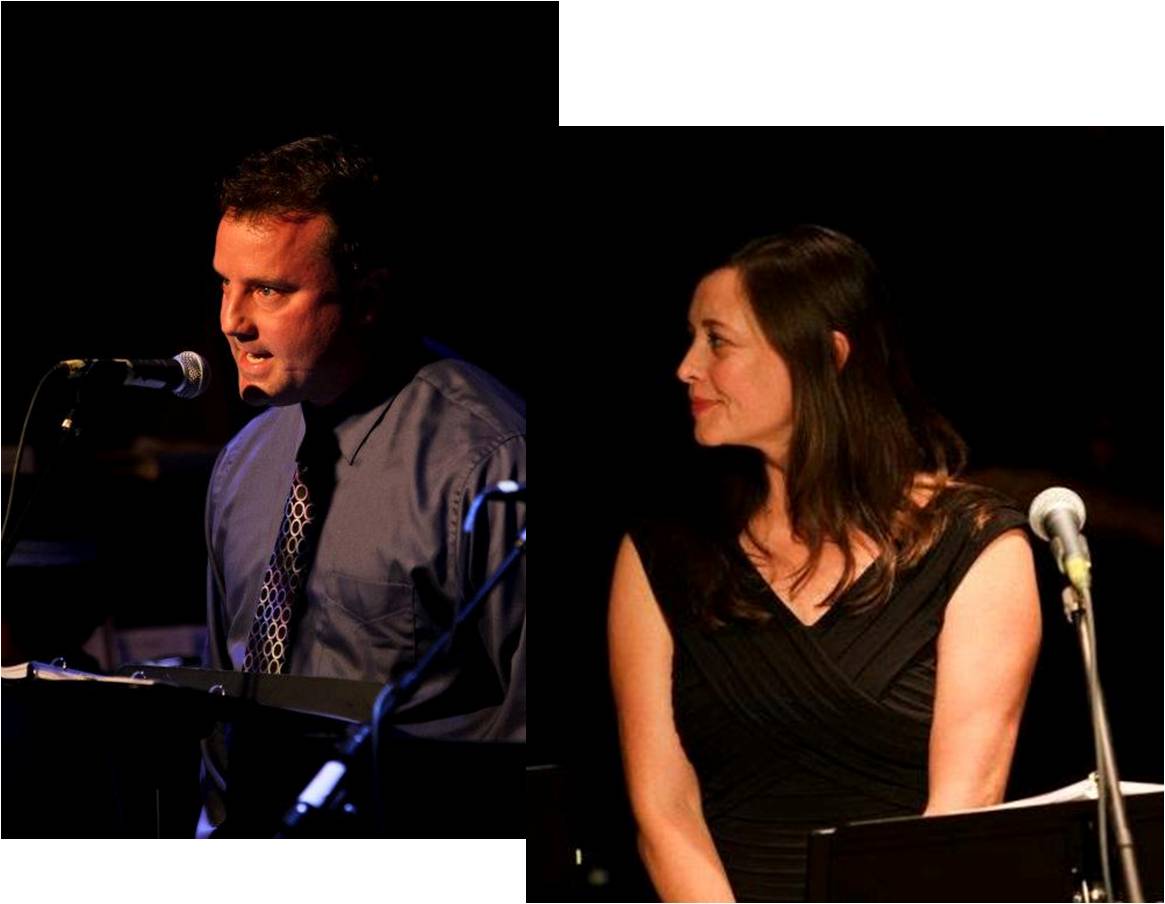
    Have you ever had clothes custom-made for you? I have never been rich enough to afford such a luxury; but theatre, never ceasing to infuse my life with ironies, provided me once with an opportunity to have a pair of 16th Century “pumpkin-pants” plus doublet perfectly cut and stitched to my then much slimmer proportions for a run as Berowne in Love’s Labour’s Lost. Rich or poor, ironic or not, it is always a superbly satisfying feeling to have a something fit you like a second skin. I imagine actors must feel a similar satisfaction when roles are tailor-written for them, which is exactly what I have done for two extraordinary Seattle actors, Hana Lass and Rebecca Olson, in a play called Ballard House Duet, premiering in a little over two weeks at Washington Ensemble Theatre.

    It started with an email from Olson back in June of last year, asking if I would be interested in being the guinea pig playwright for her proposed project to develop new plays written specifically for local actors. For this first outing, she said, the actors would be herself and Hana Lass.

    I responded with interest. It certainly sounded like a strong move toward the sort of locally grown new work I had been advocating here at Just Wrought. I told her my one caveat was I wanted only to write: no producing, no promotion, no administration.  Having served as Newswrights United’s Executive Producer, and having just staged the second of two fully produced Living Newspapers, I was burned out with wearing other hats.

    Rebecca agreed to my proviso, which then left us facing the proto-existential question: how to start?  Okay, so I am writing for Rebecca and Hana, but what am I writing? What kind of characters do I build for them? What kind of story? Would the play require additional actors? Would I write specifically for them as well, or write now and cast later?  I decided to pull a trick out of my NewsWrights bag.  I set up casual interviews with each actress. I wasn’t sure what I was looking for.  Maybe it was just an excuse to indulge my nosiness without seeming too creepy.  I drafted up a list of questions which, digital packrat that I am, I still have.

    Questions for Hana and Rebecca

    What kind of roles do you get type cast in?

    What kind of role have you always wanted to play but never got a chance to?

    Do you have a sister(s)?  {Clearly I was already thinking in that vein.}

    Tell me about your relationship to her.

    If you could change one thing about your sister what would it be?

    What are your weaknesses as a performer?  Strengths?

    What are my weaknesses as a playwright?  Strengths?

    If there’s one thing you could change about Western / American Culture what would it be?

    I had a lot of fun indulging my nosiness under the guise of art.  I found out way more about Hana and Rebecca than I ever could have through casual conversation.  Crucially, I discovered that the three of us all had a close relationship with someone who suffered from the very real disease of hoarding. I seized on this as the foundation for the play, literally the ground on which my characters would play. I also confirmed through these conversations that my instinct to make the characters sisters was dead on; but it also raised a problem:  Rebecca and Hana look nothing alike, not even close.  No one would buy them as biological sisters.  “Fine. They’re adopted,” I decided.

    Next I concluded there was no up-side in expanding the character sheet.  I would focus on the two sisters, tracking them back and forth through time.  If they needed to interact with other characters, the audience would have to play them.  I was already experimenting with this technique in another, weirder play I am devloping, Philosophical Zombie Killers.  This piece for  Custom Made Play Project would give me the opportunity to test it in a more realistic framework. 

    Armed with my interview notes and my burgeoning ideas, I started to build a proto-draft, one plot point and/or dialogue scrap at a time. What I didn’t know, I left blank.  From the outset, I was determined to see these two singing.  My own sisters sang all the time in my house, as did my mother, who sang opera as a young woman, and still sings in two church choirs.  My wife also sings opera and jazz.  So somehow, on stage or off, family for me is inextricably mixed up with music: specifically female voices.

    Point by point, emerging limitations made the play grow.  This is not surprising.  Problems are a playwright’s best friend. Conflict is our soup; obstacles, the chewy nuggets we chop into it.  The unique qualities of my two performers sharpened my focus and maximized my momentum.  For the first time in a long time, there was something— or rather someone or some ones— tugging from the other side.

    Hana claims I had a first draft within two weeks of the second interview, but my rather anal-retentive record keeping shows it was more like five.  Still, that’s a damned fast turn-around for me.  The play has come a long way since this first stab, but the basic shape of the plot and the relationships has survived and expanded.

    The most remarkable aspect of the process, which I feel cannot be emphasized enough, is that Ballard House Duet simply would not exist if we three specific people had not existed and offered it some part of ourselves. Without Hana and Rebecca to build them for, Holly and Heidi simply would have never occurred to me. Not only would the story have gone untold, it would have gone unconceived.  For me that fact is fundamentally astounding and magical.

    I have no idea yet if the play succeeds or fails.  We will need an audience for that final analysis. (That’s where you come in.  Go get your tix!) What I do know is that the experiment itself was completely, utterly worth it. I encourage every playwright to give this sort of personal tailoring a try. 

    Despite how exciting this Custom Made Play Project has been, it only seems like we are doing something new and innovative. The truth is most of the plays we praise in the canon were created bespoke for specific actors. Following this old process is not immediately easy or intuitive, but in the die-press production line, hub-and-spoke distribution network that is 21st Century American Theatre, Seattle is perfectly poised in its Goldilocks perfection— not to big, not to small— to revive a method that can maximize the vitality of locally grown new works for stages across the nation.

  • Ballard House Duet’s Poster is Here!

    Ballard House Duet’s Poster is Here!

    There’s nothing quite like a show’s  poster going live to underscore the message: “This sh*t is happening!”

    You can get your tix here.  (Do the math. {Small house + short run} * {dynamite cast + crackerjack production team} = early sellout!)

    You can stay up-to-date  on additional Ballard House Duet information as it comes available by “liking” the Custom Made Plays Project Facebook page here.

    And as always, I’ll do my best to keep you up to date here at Just Wrought. More fun news is on the way, I promise!

  • “An Unexpected Twist” Exceeds as Expected

    “An Unexpected Twist” Exceeds as Expected

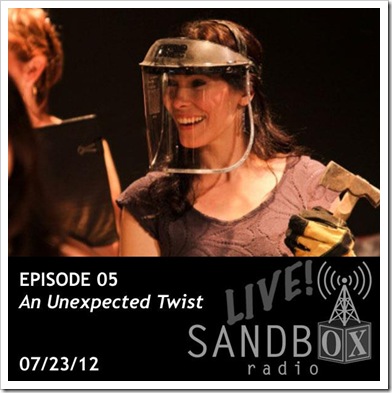
    Sandbox Radio Live!: Episode 5, “An Unexpected Twist”

    recorded at West of Lenin on July 23, 2012

    Download here. 

    @2:35      “Markehim: Episode 5″ by Paul Mullin
    @16:58     “A Work of Art” adapted from the story by Anton Chekhov
    @ 26:00    PSA – Little Bit Theraputic Riding Center by Elizabeth Heffron
    @ 28:25    “Sound Thieves” by Emily Conbere
    @ 42:09    “Au Fond Du Temple Saint” by Georges Bizet
    @ 47:08     PSA – World Arts Access by Scot Augustson
    @ 50:56     “Rally” a poem by Reginald André Jackson
    @ 58:21     “Lactar” by Elizabeth Heffron
    @ 1:12:12  “A Sousa Salsa” arranged by John Engerman
    @ 1:15:38  “The Bleak End of the Woods” by Scot Augustson
    @ 1:30:36   Finale/Credits

    Tracy Hyland in An Unexpected Twist: This is how I feel when I listen to Sandbox Radio on line, only I don’t feel this beautiful.

    Every time the podcast of a Sandbox Radio Live! episode drops, I write a little blog about it.  And every time I do, I say something like, “This episode is the best one yet.”  And every time I say it, I believe it.  But I fear that you’ll stop believing me if I keep saying so.  So…  what’s the solution?

    Unsure, I press ahead.

    Well, here’s one pretty objective way we get better.  Each episode we try to fold a new writer or two into the mix.  This time, with our episode “An Unexpected Twist” we presented a new play by relative newcomer-to-Seattle, Emily Conbere, and a poem by long-time local actor Reginald André Jackson. Speaking as someone who has written for Sandbox Radio since its inception, it’s a little unnerving when a newbie like Emily so masterfully makes her debut.  Her “Sound Thieves” leverages all the peculiarities, good and bad, of crafting stories for the fecund darkness of the mind.  (I know, because our July show was completely sold-out.  So without a single spare seat for a freeloading playwright, I sat under the risers, my view of the stage totally blocked by audience legs.  I swear this is the very best way to experience radio theatre: live but blind.)  My favorite moment: Annette Toutonghi as Gloria, a mom trying to convince a shopkeeper who illicitly fences stolen sounds, to sell her some zoo noise to cheer up her son.

    SHOPKEEPER:  Individual zoo animals are twenty-five.  A cacophony is fifty.

    GLORIA:  I only got twenty dollars.

    SHOPKEEPER:  Prices are prices.

    GLORIA:  And I’ve… I’ve got my dignity.

    SHOPKEEPER:  I don’t know what that means.

    GLORIA:  I’ll give you my … (much huskier voice) dignity.

    SHOPKEEPER:  Ah!  You don’t say!

    Other favorite moments include Leslie Law and Heather Curtis Mullin singing “Au Fond Du Temple Saint” by Georges Bizet, Jim Gall as the title role in Elizabeth Heffron’sLactar”, and of course, Scot Auguston, gift-wrapping the evening with the final offering, “The Bleak End of the Woods”, a stark noir detective story for forest animals.  (See if you can spot my wife’s radio acting debut cameo as Charday the Squirrel’s mom.)  As always, I listened with unbridled envy as Scot tossed off comic brilliance as easily as peeling bananas.

    CHARDAY THE SQUIRREL:  So, who’s missing?

    JOE THE POSSOM:  Clementine.

    CHARDAY:  Clementine?  Let that old windbag stay missing.

    JOE:  Charday!

    CHARDAY:  She’ll turn up like the bad penny she is.

    JOE:  I went to look for her and she wasn’t home.

    CHARDAY:  Wasn’t home?

    JOE:  Was not home.

    CHARDAY: That doesn’t make sense.  She’s a turtle.  She’s always home.

    So how do I convince you that while each episode is great in its own right, each one is better than the ones that precede it?

    Aha!  I know the solution! Go listen to the podcasts and decide for yourself.

    PS: Advance reservations for our next episode, “Something Wicked this Way” become available tomorrow, September 14, at Brown Paper Tickets.  Click here.

    PPS: Per my tradition, I’m posting the transcript of Markheim: Episode 5 below the fold.

    (more…)

  • A Bountiful Fall Harvest for Seattle’s Locally Grown

    A Bountiful Fall Harvest for Seattle’s Locally Grown

    Seattle’s scene for locally grown plays has always been stronger than your average mid-sized city’s, but anything good is worth fighting to make better. That’s why I mouthed off over two and a half years ago with an essay titled “Theatre takes Place: Why Locally Grown Plays Matter”.  I listed some bullet points explaining why the development of new plays is so crucial to the health of any great theatre scene:

    • “Local actors evolve a better understanding of how their contribution … can be generative as well as interpretive.
    • “Local audiences evolve a better understanding of how plays get made and how they can participate in the process….
    • “Local funders evolve a better understanding of their roles as patrons of the arts…
    • “Local funders, artists, and administrators …[can see] the development of plays as actual investments, with the potential to pump profits back to Seattle in several ways.”
    • I even complained that the then recently introduced TPS  Gregory Awards had a category for “outstanding director” but none for playwright, a blunder since rectified.

    Mouthing off is fun, but theatre is a collaborative art form.  Unless others join the fray it isn’t much more than meaningless monologue.  Happily, the last few years have shown just how much a modest city can grow as a theatre town when a group of motivated professionals put their collective mind to it.  For instance, last year A Contemporary Theatre finally took another chance on a local playwright by producing Yussef El Guindi’s  Pilgrims Musa and Sheri in the New World.  The gamble paid off big-time: El Guindi won The Harold and Mimi Steinberg/ATCA New Play Award (plus the $25,000 that comes with it), and American Theatre Magazine just published the script in its current September 2012 issue.

    Keri Healey’s new play Torso, produced by Printer’s Devil Theater, mesmerized everyone I know who saw it.  I suspect it is no coincidence that Keri has been short-listed for a Stranger Genius Award this year.  Torso recently doubled down on local impact with its currently running second production on Orcas Island.

    These are just two stand-out success stories from many.  And this fall promises another bountiful harvest of locally grown new theatre.  Again, just to name and explain a few (with a promise to blog separately on some as they come closer):

    14/48 outdoors for the first time ever

    A few weeks ago I raved about the glorious gamble the 14/48 steering committee was then making by staging their first “Kamikaze” festival, but this weekend they are amping up their Summer of Risk by staging the instant theatre festival outdoors for the first time in their 15 year history.  Tickets are free (also a new twist) so it’s hard to see how you could afford to miss it. (More info here.)

    The Betty Plays

    Beloved local actor Betty Campbell doesn’t get around as easily as she used to, so five local playwrights, myself included, wrote four short plays tailored to her unique and extraordinary talents.  This special Theater Schmeater offering is the sort of one-of-a-kind live experience that only happens in Seattle.  (Click here for more information  and here for reservations.)

    NCTC’s Foreclosure by Vince Delaney

    One of Seattle’s hottest acting ensembles workshops one of Seattle’s hottest playwrights, as he tackles an issue facing Americans nationwide  There aren’t many performances scheduled for this pre-world premiere, so you better reserve early.

    Sandbox Radio Live!

    1. The podcast from Episode 5: “An Unexpected Twist” recently dropped.  (A blog on that to come.)
    2. A “Best Of” show kicked ass at Bumbershoot!  (Check out this review.)
    3. And Episode 6: “Something Wicked This Way” is coming very soon: October 1 at West of Lenin.

    Why is Sandbox Radio Live! so important to Seattle’s locally grown theatre movement?  Because it happens every quarter and every quarter it gets better.  Because nearly every play, poem or commercial is written by top local playwrights and performed by top local actors.  Because it is fresh local “produce” at its best and most consistent.

    Custom Made Plays

    In my opinion this may just be the most exciting new wrinkle in Seattle’s locally grown scene, and not just because I have the good fortune of being the inaugural playwright.  Brainchild of local actress Rebecca Olson, the Custom Made Play Project  is dedicated to matching Pacific Northwest playwrights with local actors to develop and produce new plays of regional significance.  In my case, after interviewing my collaborating actors, Ms. Olson and Hana Lass, I tailor-made the soon-to-world- premiere Ballard House Duet to their unique talents and qualities.  Because of that, I am painting with colors I have never used before, and I’m loving it.  The resulting script simply would not exist were it not for these unique one-on-one collaborations. That fact excites me.

    Here’s another fact: Seattle is the best city in the country—maybe even the world— for locally grown theatre.  And we are only getting better and better at growing it.  As you can see from the small sampling above, it’s going to be an awesome autumn harvest.  It makes you wonder what next winter, spring and summer will bring.

  • Sandbox Radio Shoots Bumber

    Sandbox Radio Shoots Bumber

    I know, I know.  The biggest complaint about Sandbox Radio Live! is that the super fun recording sessions are always sold out, making it damned tough to watch the magic being made.  Of course, the final magic is always eventually available to you as a podcast.  In fact, Episode 5: “An Unexpected Twist” just recently dropped and is available here .

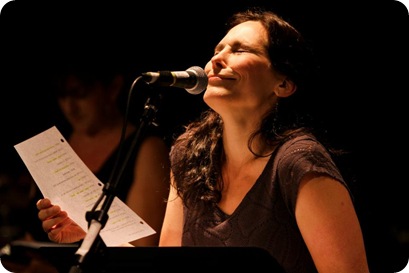
    Tracy Hyland

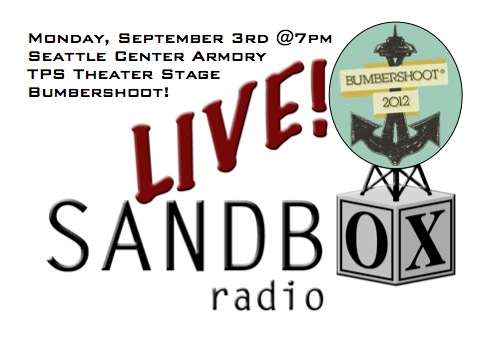
    But now Seattle’s beloved arts festival Bumbershoot is offering a one time solution to this conundrum.  This coming Labor Day (September 3) is your chance to see a “best of Sandbox Radio Live!” at the Center Theatre in the Armory, which has about thrice as many seats as our usual venue.  We will start at 7pm and pack an episode’s worth of fabulousness in just one hour. 

    Here’s what’s in store:

    “Notes from the Workplace” by Vincent Delaney

    “Why We Run” by Scot Augustson

    PSAs for Hanford Challenge and World Arts Access

    A blues tune from Charles Leggett and The Sandbox Radio Orchestra.

    Ads from “The Back of the 358” and a teaser for what’s coming in Markheim by Paul Mullin

    “T-Minus” by Elizabeth Heffron

    “Barcarolle” from Tales of Hoffman featuring special guest soprano Heather Curtis Mullin,  and more!

    You read that correctly.  My wife will be singing.  And I will be acting: reprising my role of Sam, Prince of the World, in my on-going noir angel detective series, Markheim.  That makes this Bumbershoot performance the very first time that Heather and I have shared a professional stage.  So come see Sandbox Radio Live! at Bumbershoot and watch some hot history being made.

    Paul & Heather Mullin

  • One Great Year One–Sandbox Radio Live!

    One Great Year One–Sandbox Radio Live!

    Back in April we staged the fourth episode of Sandbox Radio Live, “The Chase” rounding out a year of producing this unique offering of all local theatre talent.  The podcast of this last show is now available here.


    Episode 4, “The Chase”
    recorded at West of Lenin on April 16, 2012

    @1:42    “Stewart and Miriam” by Elizabeth Heffron
    @10:52   “Markheim: Episode 4” by Paul Mullin
    @25:40   “Why We Run” by Scot Augustson
    @29:35   “Ain’t Gonna Chase After You” Charles Leggett
    @33:25   “The Back of the 358 #4” by Paul Mullin
    @34:50   “Straight With Chaser” by Ki Gottberg
    @42:54   “Always Disappearing” by Juliet Pruzan
    @56:20   “The Back of the 358 #5” by Paul Mullin
    @57:40   “Child of the Second Tier” by Elizabeth Heffron
    @1:04:32 “I’m Always Chasing Rainbows”
    @1:07:53 “The Back of the 358 #6” by Paul Mullin
    @1:09:45 “Squeeze Play” by Vincent Delaney
    @1:22:00 “Finale/Credits

    It was a great evening, as the Sandboxers have really hit their stride generating and performing work intended especially for the pleasures of listening.  For me the standouts of the evening were poems by Scot Augustson and Elizabeth Heffron, “Why we Run” and “Child of the Second Tier”; plus Charles Leggett’s hard blowing “Ain’t Gonna Chase After You” blues, getting its sassy behind kicked by Leslie Law’s second mic vocals.

    In July we’ll kick off a whole new year, with Episode 5 “An Unexpected Twist”, be there to share the making of the magic.

    And per tradition, below the fold you’ll find the script for Episode Four of Markheim, should you care to follow along as you listen.

    (And thanks again to John Ulman for taking such great photos!)

    (more…)

  • White Boy Can Take a Punch

    The only thing disappointing about an evening of theatre like last night’s Hoodies Up! is that it only happens once and then it’s gone forever. I suppose that’s part of what makes it special. I certainly felt blessed to watch some truly gift actors bring back to life a cherished chapter from my days working in D.C.  Witnessing such miracles is one of the unique perks of being playwright that helps explain my continuing gluttony for its punishments.

    Because it is unlikely that my contribution to last night’s offerings will ever be staged again, I offer the script here to anyone who missed it and might want to check it out in script form.

    (more…)

  • Theatre Requires Hope Beyond Logic

    Nobody in the last fifty years has gone to live theatre to kill time like they would slip into a cineplex.  Nobody has sat and blankly watched theatre like they would TV because they don’t have anything better to do. There is always something better to do.  People go to the theatre because they hope—more often than not against their better judgment—that what they will experience there will change them, open them up, break down some poisoned part of them, help them live with some unbearable pain, give them more hope.  People who go to the theatre are frequently disappointed.

    Tyrone Brown asked me to share with my colleague Sharon Williams the honor of giving the curtain speech at tonight’s sole performance of Hoodies Up!, a series of short plays inspired  by the Trayvon Martin tragedy.  Tyrone surely intends for us to keep our remarks exquisitely brief and practical tonight, but as I started thinking about it my brain, as it is sometimes wont to do, erupted in about five different directions.  These moments of mind spasm are, in part, why I created Just Wrought: that is, to spare everyone me blathering on at curtain speeches and the like.  Here’s what I won’t be saying tonight:

    My reason for joining the Hoodies Up! writers team can be boiled down into one word: selfishness. I wanted to work with Tyrone Brown, a director whom most folks in the “Seattle theatre know” recognize as a coming powerhouse. I wanted to write for African American actors, a chance as rare as hen’s teeth in the Pacific Northwest and, sadly, in the nation at large. I wanted to tell a story I had never publically told before, from a time in my life that I cherish. All good selfish reasons. (When I start doing theatre for non-selfish reasons let’s all start worrying, okay?)

    Hermann Göring famously declared, “When I hear the word ‘culture’ I reach for my gun.” Nazism at its nastiest, and most honest.  Fascists hate art and anything else they don’t understand, or that causes people to prick their ears up and say, “Whoa!  What’s going on?”  Of course, there’s a simple syllogistic trick that flips fat-headed Göring on his ear: “When I hear the world ‘gun’ I reach for my culture.”  That’s what Tyrone did when he began processing the Trayvon tragedy, and that’s what the writers he invited did in turn, and then in turn the actors and directors.  Tonight it’s your turn: the audience, the final hopeful piece of this hope-against-reason puzzle. Tonight, when you come watch Hoodies Up! you’ll be reaching for your culture, and countering the insidious icon of the gun that holds America mesmerized.  You will be taking the risk of being bored, confused, annoyed and generally disappointed, but you will have chosen hope over every empty and utterly logical reason why you shouldn’t have bothered.

    Because theatre requires hope beyond logic. 

    Just like living.

  • Please Let the Daisey Debacle Mean More Theatre/Journalism, not Less.

    Please Let the Daisey Debacle Mean More Theatre/Journalism, not Less.

    A lot has already been said about the revelation that Mike Daisey fabricated many portions of his one-man show, The Agony and The Ecstasy of Steve Jobs: a piece he previously passed off as entirely truthful reportage, most egregiously on This American Life, a nationally broadcast public radio program. I leave it to wiser minds to sort through all but one of the many questions Mike’s transgressions raise, reserving for scrutiny only that which I feel I am particularly qualified to examine: what impact will Mike’s dishonesty have on the intersection of theatre and journalism?

    A huge number of people are familiar with Daisey’s work creating and performing topical monologues at some of the most prestigious venues in America, from the Seattle Rep to New York’s Public Theatre to the Woolley Mammoth in Washington, D.C. A much smaller number of people know of the work produced by NewsWrights United, a theatre company I co-founded and serve as Executive Director. We dramatize news using a form invented in the early 20th century called the living newspaper, and all of our stories are researched and written by local Seattle playwrights. (Memorable examples include Scot Augustson staging the farcical misadventures of a reporter/photographer duo sent to Detroit a week early to cover the Seahawks only Superbowl appearance; and on the serious side, Pamela Hobart Carter’s lyric poem/play about the psychic damage done by the Green River Killer.) On first appearances, NewsWrights United and Mike Daisey seem to occupy similar territory in the art/news nexus, but in actuality I believe we do something fundamentally different, and if I can tease apart for you these differences, I earnestly hope to convince you that coverage of news in the theatre is something worth saving even if Mike Daisey’s methods are not.

    I predict two reactions to this crisis from artistic administrators at U. S. regional theatres. The first is already in evidence. Institutions that have already booked Mike will mostly stick with him, echoing his essential tack: “Yeah, lying to the public radio program TAL was wrong, but lying in the theatre is obviously eminently forgivable. After all—heck!—isn’t all theatre lying?” Artistic administrators are not widely known for the courage of their convictions, however, so I further predict that over the next year or two, while the controversy dies down, they will quietly divest themselves of as much Daisey stock as possible, so long as it doesn’t cost them too much to dump it. What’s worse, I also predict they will take the dreadfully wrong-headed step of underscoring this divestment with an abandonment of all new work that explores the intersection of theatre and journalism. (The exception to this new silent ban will be, perversely, Mike’s inevitable one-man apologia, which regional houses will be falling over each other to stage.)

    But forsaking the theatre/journalism intersection does not have to be our future. With hard work, honest self-examination and courage we can take this opportunity not to withdraw but advance the genre. As a once and, with luck, future practitioner of news theatre, I venture to offer some practical advice on how we might achieve this.

    Expand the Pool

    Beyond his extraordinary talent as a storyteller, Mike’s shows appeal to regional theaters across the country because they are cheap and easy to mount. Most important, they are portable. If you are looking to plug a little topicality into your otherwise staid season, you cannot do it more easily than by giving Mike a call.

    Living newspapers are much more difficult. To create effective alternatives to the Daisey Debacle, you have to give up some of the conveniences of the one-man show; most crucially, you have to give up the idea of “one-man.” Actual plays are vast collaborative efforts, featuring dialogue among and between more than one player on stage. The play development process contains a built-in organic vetting process that zeroes in on “truth” even when the story, like Agony/Ecstasy, is more accurately classified as fiction.

    For instance, I am working with Rebecca Olson’s project Custom Made Plays to develop a script for her and another actor. Every week I sit in a room with them and the director, carefully combing through the script with questions. The process is gentle but relentless, and when a false note gets rooted up, we pounce to replace it with something more “honest.” Many of the moments in Agony/Ecstasy that Daisey promised us were real were not. In retrospect, they reek of bad fiction now that we know that is exactly what they are.

    I reach into my satchel, and I take out my iPad. And when he sees it, his eyes widen, because one of the ultimate ironies of globalism, at this point there are no iPads in China. …. He’s never actually seen one on, this thing that took his hand. I turn it on, unlock the screen, and pass it to him. He takes it. The icons flare into view, and he strokes the screen with his ruined hand, and the icons slide back and forth. And he says something to Cathy, and Cathy says, “He says it’s a kind of magic.”

    Daisey’s a fine writer and I have no doubts he could have avoided this tripe, offering instead something genuinely brilliant, if he had only admitted it was fiction in the first place and then collaborated with performers and a director to sharpen it.

    Living newspapers expand the pool in more than one dimension. Beyond just other actors in the room, you must also let in other writers. How much would anyone trust a newspaper with only one reporter who also served as the sole editor? NewsWrights United engaged several local playwrights for its living newspaper about the demise of the actual newspaper, The Seattle Post-Intelligencer. By spreading the attack, we were able to cover a number of different beats—sports, politics and arts coverage at the P-I—in a wonderfully varied spectrum of styles, some of which implicitly “watermarked” their stories as fictionalization (but more on “watermarking” later.) Using more artists allows you to cover more kinds of stories, leading to another way to better provide theatrical news…

    Up Your Local Content

    It certainly was exciting to watch “David” Mike take on “Goliath” Apple from the stage of my local regional theatre; and certainly my local regional theatre enjoys, along with regional theatres across the country, the imprimatur of international relevance when such a story as Agony/Ecstasy gets told.  However, we lose a huge opportunity when our big houses keep mounting the very same one-man show, instead of staging local news that actually has as much, if not more, to do with the lives of local audiences as does Applegate. Let’s dare to flip the model and have each theatre produce its own living newspapers, telling stories about their own communities, and sure, plugging in national stories such as those Mike tells when appropriate.

    I promise you: locally grown journalistic theatre is not only doable, it’s been done. In NewsWrights United’s last effort, The New New News: A Living Newspaper, we locally sourced nearly all of our stories about the crisis in journalism brought on by the digital age. Our play It’s Not in The P-I: A Living Newspaper about a Dying Newspaper gave voice to locally beloved P-I reporters so that a community eager to hear their tales finally had the opportunity that no other medium would give.  We also broke important exclusives into the buy-out process that the Heart Corporation used to cherry-pick and union bust their newsroom as they shuttered the print version of The Seattle P-I and moved to an all on-line edition.  It didn’t hurt that one of our founding producers, Tom Paulson, is a professional journalist, formerly the P-I’s science reporter, and currently writing for NPR’s Global Health site, Humanosphere.

    Use “Watermarks”

    Not everything that takes place in a theater is theatre. If this is news to you, you might not be to blame. The theater = theatre fallacy is happily perpetrated by artistic administrators to fill their seasons with the easiest fare to produce. (Click here to see my essay on this.) True theatre is rife with “watermarks” built into both the text and context of a play to remind you, sometimes explicitly but mostly implicitly, that what you are seeing is to some degree false.

    “Watermarks?” You say. “How come I’ve never heard of these watermarks before?” Well, for two reasons: One, I just started using the term in a theatrical context about a week ago when I was trying to explain why Mike should not be allowed to take refuge in our art form. Two, watermarks are so endemic to theatre that we tend to look right through them, like reading glasses. The Greeks used masks as watermarks. Shakespeare and his contemporaries stitched their plays out of the watermarking fabric of Iambic pentameter. Not a single tradition within our grand form lacks them, but an exhaustive list is superfluous to this argument, because the definition of theatre is the ultimate watermark: two or more people staging a live dialogue (before you ask, no, it doesn’t have to be with words) within the physical perception of other people. Think about it. Someone tells you a story on the street. She could be lying. She could be telling the truth. But two or more people obviously acting out a story in front of you? Without question there’s some tomfoolery going on here.

    Of course there is an important stipulation implicit to the tradition of tomfoolery and even blatent dishonesty in the theatre: we demand ardent honesty about our dishonesty. We tell you were going to lie, before we do it, while we do it, and after we do it.

    If we shadows have offended,
    think but this; and all is mended
    that you have but slumbered here
    while these visions did appear 

    When you reach the certainty that we paltry players are lying, you can begin to understand that we are actually telling the truth. Daisey could have easily entered this tradition. He could have done all the good works he claims to have hoped to have done within it. Instead he took the risk that selling fiction as non-fiction would get him further. It did. But he got caught. And now he’s run back into our house claiming sanctuary. Brother Daisey has forgotten that theatre’s unwritten canon is as unyielding as the ecclesiastic: the crimes of the church can be punished within the church. If he wants sanctuary here, he will have to work hard and long at his penance.

    Here’s a simple rule of thumb about watermarks: a theater (i.e. the venue) cannot serve as a watermark; theatre (i.e. the work of art) must contain the watermarks that prove it false, and thus prove it true theatre. Otherwise you’re just some guy telling me a story and if you tell me explicitly that what you’re saying is true, I am likely to take you at your word.

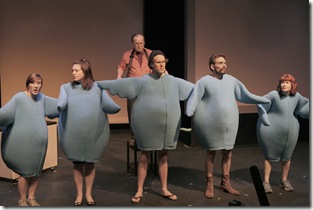
    A living newspaper has an even greater obligation than conventional theatre to watermark early, often and obviously. For example, when we staged the Twitter stream of the Maurice Clemmons manhunt (He killed four Puget Sound cops in cold blood), we did not alter a single word of the tweets, though obviously, since there were over five thousand, we had to whittle them down considerably. We knew we could not give an accurate portrayal of what it was like to witness this stream in real time. No one could. Not only was it a moment passed, but in a way it was a meta-moment. No one person witnessed it in its entirety. So we posited the next best thing. We staged the stream as a symphony of actorsNEW NEW NEWS Twitter Chorus, Photo by Chris Bennion dressed in blue bird suits, evoking the Twitter logo. We weren’t just trying to be funny (though god I hope we were). We were saying, “Obviously we can’t give you the literal truth. Pay no attention to the blue bird suits if you don’t want to, but every (often idiotic) word these actors declaim was actually tweeted over that 3-day ordeal.” (Here‘s a segment on this section by Seattle’s NPR affiliate KUOW did .)
    Not only did Mike refuse to use watermarks, he actively defumigated the theatre of all its delicious anti-sanctity.

    “… Mike told at least me time and time again [that the story] was true. He insisted that “This is a work of non-fiction” be printed in playbills.” 

    Alli Houseworth,
    former marketing/communications director
    at Woolly Mammoth Theatre Company. 
    (You can read her excellent essay by clicking here.)

    Mike didn’t want a watermark within a mile of any house he played. He wanted us to believe every word he charmed us with. And now he encourages his defenders to ridicule and condescend to the very people who took him at his word. “We are all liars and hypocrites,” says Mike. There is something particularly vicious about the man who would punish others simply for being the victims of his sins.

    Act Like it Matters

    The worst thing I heard in response to Daisey’s dishonesty was this from a friend of a friend on Facebook:

    “I never believe you theater folk – you’re a rascally bunch.”

    Yeah, we’re rascally. But sometimes we are able to illuminate stories that journalists themselves are not willing to touch, like when NewsWrights covered the closing of the P-I. And sometimes we are able, like Daisey, to tell a story like Agony/Ecstasy, in such a moving way that we inspire people, perhaps otherwise impossible to inspire, to action. However, in order to poach a bit on journalism’s turf we have to be trusted.  Do we really want to give up this wonderfully fertile ground just because Mike Daisey lied and then excused his lies as so much “theatre”? Do we really want to let him claim sanctuary in our church where we have established traditions stretching across millennia of being scrupulously honest about our dishonesty?

    In answer to this question, the silence from big house artistic administrators so far has been pristine. Clearly theatre has a leadership vacuum in addition to its identity and relevance crises. No one seriously denies that we are simply not producing enough new, fresh, locally sourced material to keep our audiences engaged like Shakespeare’s were, or even Shaw’s. Projects like Daisey’s and NewsWrights United’s help mitigate the problem, but only if we take the issue of truthfulness seriously. We have to act like it matters. We have to show our audiences that we give the issue of truth consideration and respect, or they will walk away from us forever.

  • A Delicious Sampler of Sandbox Radio Live

    Sandbox Radio Live from Sandbox Radio on Vimeo.