Just Wrought

Recovering playwright, once won a STRANGER Genius Award for theater. Now writing a bloated novel about… G-d help me! Theatre.

Category: Philosophy

  • Hakuin and the Baby

    Hakuin and the Baby

    One very powerful way to court luck is to consider with some specificity just how lucky you already are. As I continue to do just that, here’s another early essay, from my days as a stay-at-home dad when our first son was still just a baby and this country was gearing up for our ill-fated invasion of Iraq.

    * * *

    The Zen Master Hakuin was praised by his neighbors as one living a pure life.

    A beautiful Japanese girl whose parents owned a food store, lived near him. Suddenly without any warning, her parents discovered she was with child.

    This made her parents angry. She would not confess who the man was, but after much harassment at last named Hakuin.

    In great anger the parents went to the master, “Is that so?” was all he would say.

    After the child was born it was brought to Hakuin. By this time he had lost his reputation, which did not trouble him, but he took very good care of the child. He obtained milk from his neighbors and everything else the little one needed.

    A year later the girl-mother could stand it no longer. She told her parents the truth—that the real father of the child was a young man who worked in the fishmarket.

    The mother and the father of the girl at once went to Hakuin to ask his forgiveness, to apologize at length, and to get the child back again.

    Hakuin was willing. In yielding the child, all he said was: “Is that so?”

    — from Zen Flesh, Zen Bones

    It is the koan-like nature of even the simplest—especially the simplest—zen stories to keep haunting you until you crack them or, perhaps more accurately, until they crack you.

    I was a teenager when I first came across this story, quoted in my sister’s college textbook Religions of the World (a book that so fascinated me that I’ve kept it to this day.)  What struck me most back then is this bizarrely unflappable “Zen Master” and how he simply takes a baby into his care based on accusations he knows to be false. One can only imagine he is completely unprepared for parenthood (something any teenage boy can sympathize with); and the fact that he greets the challenge without seeming to blink an eye was truly astounding to me then, and now. It definitely fanned the flames of my interest in Zen. These guys, it seemed, could face anything, at a moment’s notice.

    Now, 15 years later, having practiced Zen for twelve years and having been a dad for one, and a stay-at-home Dad for half of that time, what strikes me as most astounding isn’t the first part of the story, Hakuin taking the baby into his care, but the second: Hakuin willingly giving up the child when these frighteningly fickle grandparents came round to retrieve the kid. To me, this utterly unfathomable. No way could I do it: not with my own baby boy, not with any child with whom I had spent the first year of life. You become so invested, so attached—indeed, so in love—with a baby that it is hard to be away from them for more than a couple of days.

    But here’s Hakuin, a year later, doing what must be the right thing, again merely on the word of some not-so-likeable people. What’s the lesson here? I’m not completely sure. I’m still learning it. I think it has to do with the profound choices we’re inevitably faced with, often spur of the moment, and how it is incumbent on us to stay as even-keeled as we can when facing them.

    By all commonly accepted standards, Hakuin has every right to react with moral outrage, both at the initial accusation, and again when the family came round later to collect the baby like so much forgotten baggage. So why doesn’t he? Well, the easy answer is: he’s a Zen Master. Such fellows don’t truck much with moral outrage. But I think the question is worth a little more digging than that.

    In the West, not really knowing any better, we tend to equate “Zen Master” with “wizard” or “ascended being”, or perhaps more pejoratively, “empty shell”, or even worse, as a fundamentalist family member of mine once called anyone claiming to be Buddhist: “amoral idol worshipper”. But what if, when you’ve stripped away the ritualistic trimmings specific to Zen practice, all “Zen Master” really means is “complete human being”? Then Hakuin’s actions make a perfect sort of sense. He saw the truth in front of him—a child that needed care—and he cared for the child. Then later, when he saw a family who recognized their error and wanted to become whole again, he gave the kid up. I cannot think that, just because Hakuin was a Zen Master, he felt no pain at parting with the child. I infer that his practice allowed him the equanimity to face the pain with courage and without adding more suffering to the world through outrage.

    The world is suffering right now, arguably more so than usual. Many of us on the Left are perhaps rightfully outraged at the ignorance, self-righteousness and high-handed hypocritical moralism that has brought us to this pass. Maybe we should ask ourselves, though, how far our outrage will get us in solving the problem. I seek counseling from a man who is the abbot of a Zen temple, and may some day achieve the official rank of “Roshi” or “Master” in the Rinzai Dharma lineage. (Hakuin is an extremely important reformist link in this patriarchy.) When I expressed to him my anger and frustration over the current political situation, he told me the best thing I could do for the political future is bring my son up well. Talk about long-term solutions to short-term problems! 

    So those are some of my thoughts on Hakuin and his baby. I feel like there’s more to say, but… I have to go take care of my boy. He’s turning one in a week. And you can call me a hypocrite, but I thank the lord I ain’t no Zen Master, and ain’t nobody taking him away from me.

    * * *

    My son turns 10! at the end of May. Being his dad is easily one of the top three things I have ever done in my life. That will never change nor can  anyone ever take that away from me. In that, I have it over on even Hakuin. 

    I understand that my current hunt for luck has a facetiousness about it, like a billionaire arguing that he’s not as rich as everyone thinks he is. I’m the Mitt Romney of being blessed.  I have so much I don’t even know how much I have. Like Hakuin, I’ll take it, knowing that in a year, or at any moment, it can be taken back. True luck doesn’t rest in the having, but the being. And being cannot be done anywhere but here or any when but now.

  • Make Me One with Everything

    Make Me One with Everything

    Luck is a sympathetic magic, to be coaxed with metaphor and token.  So I have decided to troll for a streak of it by posting a run of early essays that I wrote for Everything2, a quasi-prophetic mash-up of Face Book and Wikipedia, if the former only allowed text and the latter had a sense of humor. 

    The following essay was written in 2003 during the build up to invasion of Iraq.

    * * *

    It’s got to be the oldest Zen joke in the West . . .

    There’s a barbecue at the Zen Buddhist Temple, and the Zen Master’s working the grill. A young monk reverently approaches. The Roshi looks up, smiles and says, “Wanna hotdog?”

    The monk replies: “Please, Master, make me one with everything.”

    Besides being pretty darned cute, this joke, I’ve always suspected, has something deeper to say about Western attitudes, toward Zen in specific, Eastern thought more broadly, and most generally of all, our poorly perceived relationship to each other and the universe at large.

    I’ve been a practicing Buddhist for twelve years now (ironically enough, ever since around the time of the last war brought to you by the Bush family.) For most of that time, I’ve kept my mouth shut about my practice, for a couple of simple reasons. First and foremost, it’s just considered bad Zen form to prattle on about it. “Him who’ll tell ya, don’t know. Him who knows, won’t tell ya” (my hillbilly stab at Lao Tzu’s Tao Te Ching). Secondly, upon hearing that I’m a Buddhist, most people tend to react to the novelty of it, rather than the substance. “That’s wild!”. . . “That’s crazy!”. . . “Only you, Paul!”. . . “We’ll see how long that lasts!” Since Buddhism is decidedly not a religion of conversion, I see little up side in telling people I follow it. But in these darkening days of terror and hatred and waste, I’ve begun to feel that it’s incumbent on me to pipe up about a practice that has helped me face these things; and while it may not be everyone’s cup of tea, it may just offer some unique and rarely considered perspectives on our world and our place in it.

    So what’s the problem with “make me one with everything?” In a nutshell: you can’t make someone, even yourself “one”, any more than you can make yourself obey the law of gravity. You are one with everything, whether you like it or not, and that oneness necessitates inevitabilities and responsibilities that all of us as human beings ignore at our peril and the greater suffering of everyone.

    For instance, some examples of the inevitabilities: you will die, I will die, everyone who will ever read this will die. Death is inevitable. Pretty simple stuff so far, right?

    Here’s another inevitability, directly related to the first: you will suffer, I will suffer, everyone who reads this will suffer (though hopefully not because they read this).

    And another: what you do, and don’t do, reverberates throughout existence. You can’t avoid this through hiding. You can’t wall off your section of existence and hope that all the awful and inevitable things happening on the other side won’t creep across. They will. Why? Because any wall you build is an illusion. Why? Because you are one with everything, whether you asked for it or not, whether you like it or not.

    So that brings us to our responsibilities. And these are not Buddhist responsibilities, per se. Remember, one doesn’t become one with everything because one is a Buddhist; you just are, and because you just are, and because as part of the unique blessing/curse of being a sentient human being, you know you are, you have to acknowledge that your responsibility is to everyone and everything.

    Americans love being heroes. We’re shocked when we hear that most of the world doesn’t see us that way. “Don’t these ungrateful bastards realize we saved their asses in WWII?” (I’ve said these very words myself on many beer-sodden occasions.) But from the one with everything perspective, storming Normandy and all the rest of it was less heroic than the Hollywood media machine would have us fool ourselves into believing. We saved ourselves by storming those beaches, just as much as anyone. And while there’s nothing ignoble about self-preservation, it’s not necessary to lord it over a bunch of people who happen to live in Europe, and who lost a lot more lives than we did.

    Americans are very comfortable being powerful, because we are so convinced that we are right. And much of the time we are. Alas, the universe responds with an profound “So what?” For just as you can’t make someone “one with everything”, you cannot coerce someone to be free, and you cannot force someone to give up force. You can only force them to force you to use more force. The Buddha recognized such recursively misguided action as a trap. He compared it to trying to still the ripples of a pond by patting them down with your hand. (In the case of our recent actions in Iraq, I’d compare it to smacking an oar down on the water. These violent ripples we’re currently creating won’t go away in our lifetime.)

    Regarding these actions, many Americans throw up their hands and say, “Better them than us.” But the point is: there is no “them”, only us. Some of our glibber war advocates say “You can’t make an omelet without breaking eggs.” I just wonder if enough thought and pause was given to the question, “Do we really need the omelet? Aren’t our geopolitical love handles big enough?”

    From the Buddhist perspective, every bullet fired, is fired at your own head, or, if you find it more terrifying, your own child’s head. The upside of this is that every kind act—every bow, every smile—is an action done for—a bow made to—a smile smiled for—everyone. In our actions in the world, it is our responsibility to ask ourselves, very simply: are we adding to its suffering, or healing it? Every day we must ask the question, and every day, change the answer based on what the day gives us and what we give in return (though of course, we are the day, and it us.)

    This is the Buddhist practice in a nutshell.

    Call me crazy.

  • The Cathedral of Saint John the Divine

    I decided at the beginning of this year to focus a little bit more than usual on luck: to court it a bit, if that makes sense. Luck is one of those wonderful inventions that cannot really exist— not in any empirical way— but that nevertheless human beings can still learn a lot by considering. For instance, I spent a lot of last week constructing an essay I felt compelled to write defending my chosen art form from prevarications that would weaken it. Contrary to what some assumed, it brought me no joy to make my arguments. It felt like duty. But then, as luck would have it, someone I did not know read that essay and reached out with an email to thank me for it.  We became Facebook friends and I noticed that this person had a professional relationship with one of my favorite places on earth, the Cathedral of St. John the Divine. I flashed on a long forgotten essay I wrote nearly nine years ago for an on-line gathering site for weirdoes and writers and weirdo writers called Everything2.

    I repost it here as a burnt offering to luck.

    I don’t believe in God.

    I pretty much don’t believe in God.

    Okay… here’s the deal:

    I believe in God. . .

    . . . but only in one place: the Cathedral of St. John the Divine in New York City. Apparently, the universe is constructed in such a manner that the omnipotent, omniscient—though obviously not omni-present— deity known for the most part in these parts as “God”, only exists– as far as I can tell– when I exist within the walls of this largest Gothic cathedral in the world.

    I can vouch for this phenomenon going back to late 1999 when I first stepped inside the church, its cool echoing darkness enveloping me immediately. I was living up on the edge of Harlem at the time, and began going often. I’d walk in past the periodic light shafting down from the stained glass, sit on one of the chairs (the nave has no permanent pews) and strike up an ongoing conversation on hold since my earnest Catholic childhood.

    Hello Old Man. It’s me.

    These were not supplications, but rather heartfelt chats between one very good old friend and another. I didn’t have to genuflect or cross myself to gain access to this communication. It’s certainly telling that I don’t feel this presence at all at, say, St. Patrick’s Cathedral down on 50th and Madison, shouldered up against Rockefeller Center and all those other much taller skyscrapers. If God lives there, he’s the God of Pinstripes and Napoleon Complexes and Rudy Giuliani.

    We moved to Queens in the late fall of ’99 and my visits to St. John’s became rarer but no less ardent– in fact, maybe more so, since a two-train, 45-minute pilgrimage was involved.

    And then, less than two years later, the world changed for New Yorkers and for everyone. I found myself in Our meeting place almost every other day, two trains or not. The conversations grew ever more urgent, but also so private that I couldn’t even bring myself to write about them in my personal journal:

    9/25/01

    St. John’s again.
    Talking with God.
    Private stuff.
    Wondering: Is faith a means or an end?
    Or is the question nonsense? 

    Sometimes I’d cry. Sometimes I’d feel God feeling me cry and letting me know that it was understood.

    On December 7, 2001, while I watched TV in the living room, my wife took a home pregnancy test. From the bathroom I heard a calm but distinct, “Uh-oh.” Back then I didn’t know just how damned accurate those things have gotten, but still I had a gut inkling that this time it was for real. I had a whole new thing to talk to God about, a whole new way to be scared. 

    Old Man, help me be a good old man.

     On December 18, 2001, I turned on the TV just to be dosed with a whole new horror. 

    12/18/01

    8:12
    St. John’s is burning; a five alarm fire.
    God damn.
    What a lousy, lousy year.
      

    In my head I drove a pathetic devil’s bargain worthy of Winston Smith in room 101. “Take the goddamned Twin Towers”, I practically prayed to Satan, “Just leave me my St. John’s.”

    The firefighters, already crowned in glory, waded into the burning church which was home to, among so many other things, the largest memorial to fallen FDNY prior to 9/11. Commanders on the scene rapidly made the decision to use high-tech lasers to find their way through the smoke instead of following the common sense course of action: smashing through priceless, irreplaceable stained glass to vent it (adding a James Bond-esque/art connoisseur quality to their already enormous reputation for heroism). Within hours the fire was extinguished. But who knew how long the church would be closed to visitors?

    In March of 2002 I got a short-term temp gig up at Columbia University. I walked by St. Johns on my lunch break, saw where soot still blackened the stones of the northern transept. My heart heavy and anxious, I climbed the front stairs and went in. It still smelled of burnt wood inside, and the gift shop, where the fire started, was still boarded up, but I knew instantly that the conflagration had done nothing to fumigate my Old Friend from the place. I sat down to chat.
    In the end, you can only ask Him for a sample of his Grace, a slightly wider perspective than the one you’re sitting in. It seems like a small thing writing about it now, but such an epiphany is really the only miracle there is. Art can offer it sometimes. Perhaps that’s why I decided to become an artist.

    And becoming one I am still.

    Now I live in Seattle and have no place to talk to God. 

    Cathedral of St John the Divine

  • New Zen Digs

    New Zen Digs

    Him what knows, won’t tell ye.
    Him who’ll tell ye, don’t rightly know.
    The Hillbilly’s Tao

    When I tell people I’m a Zen Buddhist the conversation usually goes something like this:

    Wait.  What?

    I’m a Zen Buddhist.

    You? You’re a Zen Buddhist?

    Yes.

    You are? Mr. Angry Pants? Mr. Be-Careful-of-Daddy’s-Martini? Mr. Picks-a-Fight-with-You-‘Cuz-He-Likes-You?… You’re a Zen Buddhist?

    Yes.

    Really?

    Yes. Really. I mean, ask yourself, who needs it more? Do you really want to imagine what I’d be like if I hadn’t been meditating on a daily basis for the last 21 years?

    Thankfully, these conversations do not happen very often. The first rule of Zen Club is you do not talk about Zen Club. Plus, seriously, I find it awkward and somewhat humiliating to discuss Zen in a culture that uses the word to promote everything from skin moisturizer to coffee blends to sex lube. Barnes and Noble contains a whole section devoted to Zen in every one of its superstores, but I can count on one hand clapping the people I know, outside of my temple, who have ever seriously practiced. I suppose it’s easier to sit and read a book than it is to just sit.  Wait.  I don’t suppose; I know.  But hard or not, just sitting’s how the magic happens.

    I usually practice zazen, or “seated meditation” by myself, at home or on my special bench overlooking Elliott Bay near my work or down by Green Lake on the weekends.  However the community of practice, or “sangha”, is one of the three wheels that make the Buddhist tricycle go.  So I understand it is my responsibility as well as my inordinate blessing to practice with a temple as often as I can.  That’s where Dai Bai Zan – Cho Bo Zen Ji comes in.

    I first starting going to Dai Bai Zan – Cho Bo Zen Ji (translated as “The Listening to the Dharma Zen Temple on Great Plum Mountain”) back in 1991.  (You can check out the temple’s website here.) My good friend and collaborator in the Seattle theatre scene, John Sylvain, turned me on to the place. Back then the temple was a tiny living room in the International District behind the Wonder Bread Factory.  The rest of the house was where the abbot Genki Takabayashi lived. I remember being so intimidated the first couple times I went to beginner’s night that I had to steel myself to open the front door of the small house that had nothing but a wooden sign painted with the words “Clear Quiet Clean” to identify it as a zendo.  Could I really sit still for twenty-five minutes without moving or making a noise, then get up, stretch for half a minute, then do it again for almost half-an-hour?

    A wizened little Japanese man, like some embarrassingly trite Hollywood stereotype of a Zen master, the abbot Genki Roshi,  would sit next to the huge bell, stiller than stone.  Most weeks, Genjo Marinello, the American-born vice-abbot would sit next to him and lead the question-and-answer period afterwards; but one night it was just me and Genki.  It was like sitting with a ghost.  I struggled with, and eventually let go of, my irrational fears that the old man would forget I was there and fall asleep or just decide to go all hardcore Zen on me and sit for three hours without a break.  As I breathed, I calmed down.  The two meditation periods passed like fleeting dreams. Genki Osho served tea. Bowed. And then left me there alone. In that moment I began to understand what all the hype over Zen was about… nothing. Absolutely nothing. Absolutely gorgeous, clear and life-affirming.

    Genki Roshi had little English and never spoke at “Introduction to Zen” nights, though he often served the tea. (If you’ve never been served tea by a genuine Zen master, well, all I can say is, you’re missing nothing– the huge, beautiful, inner-eye-opening nothing that I mention above.) However, at longer half-day and week-long retreats the Roshi would give a commentary on some selection from the Buddhist canon. Genki would sit like a monument for an interminable moment before speaking, then squinch up his face and growl softly:

    Booodhaaah?… Booodhaaah?… No Boodhah… No BOODHAH!YOU da Booddhah!… No Shinking. [No thinking]. Shtraytuh cuhhting. [Straight cutting].

    YOU da Booddhah!… You da BOODHAH!

    Genjo sitting beside him, would then translate. “Genki Roshi asks you to consider Mumon’s commentary on the 33rd Case, Baso’s ‘No Mind, No Buddha’….” It wasn’t uncommon for Genjo to take ten minutes “translating” something  Genki said in 30 seconds.

    After a year or two the temple lost the lease on the little house in the I. D., and was forced to take up residence in the back room of an Aikido dojo on Aurora Avenue up around 76th Street North of Greenlake. This was a strange and difficult transitionary period in my life as well. I was going through a divorce, living hand-to mouth on temp jobs in a comfortable enough but tiny studio on Capitol Hill: alone, no phone, no TV, no social life, no car. About all I could count on was, if zazen was scheduled for an evening, and if I made the hour-long two-transfer bus trek to the temple, someone—maybe just one someone– Genjo or Genki or some other ranking member of the temple—would be there to just sit with me.

    I usually keep my mouth shut during Q & A sessions, but one night, when it was just me and Genjo, and I had endured both sits with a big sore heart and tears rolling down my face, I asked if he had any advice on how to get through really, really hard times. His answer was simple. Maintain the practice, and remember to have compassion: compassion for others of course, but first and foremost, compassion for myself. He told me to sit, and listen to my pain; witness it; notice that with each breath, somehow, I was getting through it.

    Five years later Genjo Osho officiated at my wedding to the most inside-and-out beautiful woman I have ever met. Shortly thereafter, Heather and I moved to New York City, but I never sought out a temple there. I guess I was too afraid of the Yuppie Zen factor that plagues big rich cities like New York and San Francisco. When our first baby boy came into the world, we decided to move back to Seattle, where I resumed attending Dai Bai Zan – Cho Bo Zen Ji, back in its own house again on Capitol Hill.

    This past Fall, the temple relocated to a larger building on Beacon Hill at 1733 S. Horton St., just five blocks of the Beacon Hill Light Rail station.  In January, I finally had the honor and pleasure of sitting zazen in these new digs.  Then in February I attended a “mini-sesshin”. (A mini-sesshin is a half-day meditation retreat.  A full sesshin can last a week or more.)

    Contrary to what Amazon would have you believe, the best introduction to Zen practice is not downloading the latest book to your Kindle, but rather practicing zazen itself. Dai Bai Zan – Cho Bo Zen Ji offers an excellent and extremely accessible introduction to seated meditation at the Tuesday night “Introduction to Zen” which begins promptly at 7:30 pm. (Allow yourself at least ten minutes extra: the last thing you want to do is barge in late on a zazen session.)

    If you are as intimated as I was 21 years ago, then contact me and I’ll go with you.  That’s what sangha’s all about.

  • doyle

    doyle

    Imagine a science fiction species that loses weight by breathing and poops bacteria instead of digested food. Can you picture it? If not, my friend doyle has a suggestion: go look in a mirror.

    I met doyle on the internet. I feel closer to doyle than some people I have shared a bathroom with for years. I have only met doyle once in person. I want doyle to bury me.

    All of that is tangential to the main point, which is that doyle has a blog called Science teacher and I think you should follow it.

    Michael Doyle was born in Northern New Jersey, a good-for-nothing Mick like so many no-good-for-nothing Micks born in Northern New Jersey. (By the way, he prefers to refer to himself as “Oirish” as if that were somehow more PC.) He worked briefly as long shoreman. He went to med school. He became a pediatrician and worked in the ER and the projects. Think about that for a second. An emergency room pediatrician in Newark. You may think you know hell, but doyle has a crisper acquaintance with the place.

    The reason I call doyle “doyle” and not “Michael Doyle” or “Michael” or “Dr. Doyle” or even “Doyle”, is that “doyle” was all I knew him by for months. We met as contributors to an on-line gathering site for weirdos and writers and weirdo writers called Everything2, a quasi-prophetic mash-up of Face Book and Wikipedia if the former only allowed text and the latter had a sense of humor. I’m not sure the following piece is the first thing I ever read  of doyle’s, but I do remember it arrested me. He  was on pilgrimage to some mid-western city where his sister had recently died in a car crash.

    December 9, 2004 (person)

    The driver seat is still intact–inside scattered cd’s with burgundy stains, her impossibly colored scarf, glass, pens. A bottle of chardonnay meant to be shared with her love survived. The other side of the car is splayed open, a gaping wound letting in rain, letting in sunshine.

    I picked up a couple of cd’s–Frankie Allison and the Odd Sox….and now my hands with bright red blotches, my sister’s blood when she bled for the last time. I absently rubbed my hands on my jeans–the bright red dulled to burgundy again. I took the scarf with me.

    Last summer a feral cat mutilated a mourning dove near my garden. I gave it water. It took a little. It hopped a few feet. It died. Its partner would not leave. It looked sad. A tiny puff of feathers still marks where the broken bird fell.

    Her ashes are in a cardboard box, decorated with construction paper, stickers, sparkly glue, and (of course) hearts.

    I kept going back in the car, not sure what I was looking for, but sure I would not find it.

    At least I got something right this week.

    Doyle and I hit it off early. He seemed to like my plays about science and my doggerel poems. I liked pretty much everything he wrote.

    During my teaching rounds, I will occasionally show pediatric residents wheat berries, and ask them what they think they are. These fine young minds have been charged with teaching nutrition to parents, so quizzing them about the most common source of grain calories in this part of the world should be fair game.

    I have yet to have an American born physician get it right.

    My other Everythingian buddy “iceowl” grew up with doyle and liked to fascinate me with stories about him. (Keep in mind when you read the following that iceowl has been to Antarctica three times and has written about it better than Hemmingway ever could have.)

    [Doyle’s] done much more for humanity than I have.  I’m just a silicon valley idiot…  He is one of those guys who is blessed to do well doing exactly what he wants in the world.  Classic Joseph Campbell example of, “Following your bliss.”  He wants very little from the world, and gives a lot.  So, Doyle couldn’t possibly do anything he didn’t want to do because the worst that happens is he gets nothing for his efforts, and he’s perfectly happy sleeping under the highway overpass if it comes to that …..  He just wants to do things none of us could stomach for more than a day – like dodging bullets and the cops both while illegally vaccinating kids in inner city Newark.

    Five years ago doyle hung up has white physician’s coat and traded it for the white lab coat of a high school science teacher. He calls his students his “lambs”, though I suspect few of them understand how closely he has observed the slaughter in his former life.

    In his blog he mixes the same blend of adoration and frustration that I came to love him for at Everything2. Here he is breathlessly elevating a discourse on respiration to a paean of the universe, because as he sees it— and trust me, doyle sees it as it is— there is no meaningful difference between the two. (I’ll do my best to capture doyle’s rapturously manic formatting.)

    Carbon dioxide that traveled through the hearts 
    of every child in our class.

    Carbon dioxide expelled as a sigh, 
    broken down by a few brain cells that would
    rather do anything but this school thing.

    We ruin it, this carbon dioxide communion, reducing it to hieroglyphics on a page, to be regurgitated by spilling bubbles on a sheet, a religiously messy communion of sorts sterilized to a formula:

    C6H12O6 +6 O2 =>  6H2O + 6CO2

    And yet, for a moment, the moment before eating the bean, a few students allow themselves the beauty and the power of the story to let them believe what they’ve always known to be true, that this whole life business, as messy and complicated and incomprehensible as it seems, gets down to this:

    Each living thing, every living thing, shares an intimate bond that goes beyond the language of science, beyond the language of art, beyond human boundaries.

    The universe belongs to all of us, as we belong to it.

    No matter how we do in school, no matter what we know, now matter what we do.

    I would trade all the biochemical pathways we “teach” for a child’s grasping, for more than a moment, that we are indeed the stuff of the universe around us, and that this stuff cycles through us, is us.

    Without an iota of the effort I put into it, Doyle writes the way I yearn to, with a high-wire walker’s combination of improvisation and precision. Because he flat-out knows so much, thanks to an enormous education and equally enormous experience, he can produce an uncannily free of flow of ideas without the so-much-smoke-blowing of so many formally educated, professionally self-identified “writers”. After I’ve been steeping myself in his prose for a while, I start to feel my own prose improving, taking flight. It could just be my imagination; but given how much both doyle and I believe in imagination, I’ll take it.

    Neil Gaiman first introduced me to the Talmudic legend of the 36 Tzaddikim in his Sandman series. “They say that the world rests on the backs of 36 living saints – 36 unselfish men and women. Because of them the world continues to exist. They are the secret kings and queens of this world.” I’m not going to come out and say Doyle is a Tzaddik. Such a pronouncement would be absurd, given the the legend’s clear and emphatic stipulation that no one can know who the 36 are. 

    I just have my suspicions is all.

    Photo by Susan LaRusse Eckert, used with permission of the subject, who only asked that I note: “She’s a little pissed off at me now–I tend to do that. I’d be much obliged if you mentioned that I’m truly sorry for my, um, knuckleheadedness.”
  • The Causes of Monsters

    The Causes of Monsters

    The first is the glory of God.

    The second, His wrath.

    The third, too great a quantity of semen.

    The fourth, too small a quantity.

    The fifth, imagination.

    The sixth, the narrowness or smallness of the womb.

    The seventh, the unbecoming sitting position of the mother, who, while pregnant, remains seated too long with her thighs crossed or pressed against her stomach.

    The eighth, by a fall or blows struck against the stomach of the mother during pregnancy.

    The ninth, by hereditary or accidental illnesses.

    The tenth, by the rotting or corruption of the semen.

    The eleventh, by the mingling or mixture of seed.

    The twelfth, by the artifice of wandering beggars.

    The thirteenth, by Demons or Devils.

    Ambroise Paré, Monstres et Prodiges (1573) 

    I was in Dick Rhodes’ living room leafing through a scrap book he had handed me when I came across this excerpt pasted to a page surrounded by various pictures of grotesques. I’ve had these moments before: something reaches out from a different dimension and gently tugs me towards it, letting me know that a relationship has just begun, and will quite probably last for the rest of my life. This is how I discovered John Gardner, not in some creative writing class as most of the folks I know who know of him did, but at the Cockeysville Branch of the Baltimore County Public Library when I was scanning the shelves and came across the tangle of antlers that is the dustcover of Freddy’s Book. How different would my writing– my life!– be had I not discovered Gardner to mentor me from beyond the grave?

    This list of causes struck me with its simple boldness and poetry. Of course, Paré is a physician from that era when science and art were siblings that still shared the same room. Even though they bickered and weren’t crazy about the arrangement, they occasionally enjoyed each other’s company and shared a common set of interests and language for talking about them. (I flatter myself and you, gentle reader, that we can, perhaps bring the kids back together again.)

    The wonderful matter-of-factness of the list is due to the very fact that, as far as Paré ‘s concerned, he is dealing in matters of fact. Birth defects had causes, and those causes ranged from the blatant and incomprehensible intercession of God, such as the blind man in the Gospel of John, born that way for no reason other than that Jesus might one day give him sight and thus prove “. . . the works of God might be magnified in him . . . “; to the more mundane fakery of traveling beggars:

    I have a recollection being in Angers, in 1525, that a wicked scoundrel and beggar had cut off a hanged man’s arm– already stinking and infected– which he had tied to his vest, letting it lean on a small fork against his side. . . . One Good Friday, the people, seeing his rotted arm, gave him alms, thinking it was real. The beggar having wiggled this arm around for a long time, finally it came loose and fell to the ground. . . thereupon he was led off as a prisoner, then condemned to get the whip, by order of the magistrate, with the rotted arm hung around his neck.*

    I think most of us boys can relate to the third and fourth causes of monsters, and nearly everyone to the fifth.

    This list, this wonderful found object, has inspired me to think in a different way about a challenge I’ve been mulling for over a year now: the problem of horror in theatre. Instead of a full-length, single subject play, I’m thinking now of attacking it one short experiment at a time; for if Paré proves anything here, it’s that horror has a variety of sources.

    I’m further inspired to generate my own, modern list of the causes of monsters. Here’s what I have so far (and I welcome your suggestions):

    rumsfeld poking his eyes out

    The Modern Causes of Monsters

    The first is the glory of scientific ascendance.

    The second is the ignorance of its limits.

    The third, too small a quantity of faith.

    The fourth, too great a quantity.

    The fifth, imagination.

    The narrowness of an individual mind or smallness of one’s heart.

    The seventh, the incessant, uninvited malfeasant fiddling of extra-terrestrial entities who, while floating above us like condescending hydrocephalic, wing-plucked fruit bats, or occasionally swooping down to probe us into ignominy, never seem to take the time to realize that we have feelings and sometimes feelings get hurt.

    The eighth, by a fall or blow struck against a nation once too many times impregnated with pride.

    The ninth, unnozzled anger.

    The tenth, by rotting or corruption of the soul, if it exists.

    The eleventh, by the mingling or mixture of misunderstood Easternisms, if it does not.

    The twelfth, by the artifice of hungry-to-be-sentient corporate entities.

    The thirteenth, is the glory of God.

    The thirteenth, is His wrath.

    *From Janis L. Pallister’s translation, On Monsters and Marvels, The University of Chicago Press, 1982.

    (This essay was written in 2004 and originally posted  to the wild and woolly text-only writers’ site, Everything2.com.  I repost  it here essentially as it appeared, including the annoying formatting.)

  • You Don’t Have to Hold On

    You Don’t Have to Hold On

    I have maintained that we are better off trying to determine what art does rather than defining it.  I even went so far to make a list in an essay called “The Uses of Art”, in which I promised to flesh out each enumerated “use” with an essay of its own.  (Of course I miserably defaulted on that pledge.)  Further, I have always assumed— like a lot of folks, I suspect— that the best art always sticks with you: it goes into your library for reference and reuse, which is why I can still recite verbatim Puck’s “If-we-shadows-have-offended” Midsummer Night’s Dream show-closer three decades after playing the role.  And when I fail to hold on to a piece of art, I tend to feel a little guilty.  After all, is it not a little shameful to have forgotten easily a hundred times more poetry and painting, music and movies, than I have ever remembered?  Was all that art wasted on me?  

    The 13th Century Sufi poet Jelaluddin Rumi and his modern American interpreter Coleman Barks have convinced me otherwise.  Just as art has a variety of uses, it also has many mechanisms.

    “There is a South Indian story about soap.  Soap is the dirt we buy.  We introduce it to the dirt we have, and the two dirts are so glad to see each other they come out and mix!  They swim together in the warm pleasurable water and, at just the right moment, the washer lifts the cloth of our true being free of both soap and dirt.  Mystical poetry and other practices may function this way, as soap that dances with what disturbs our clarity.  Then at some moment they drop away and leave us clean, ready to be worn again.”

    –From Coleman Barks introduction to a chapter in his collection
    The Essential Rumi

    Sometimes art doesn’t stay with you.  And sometimes that’s best.  How disgusting and useless would it be if the film from every bar of soap you’ve ever used still remained on your body?  Some art is meant to mix with parts of you and then rinse off, parts and art together.

    So the next quiet night you read a poem, and then find you’ve forgotten the entire thing the next morning, don’t berate yourself.  Instead, give yourself a pat on the back for being spiritually hygienic. 

    Rumi himself this time: 

    “. . . Enjoy this being washed
    with a secret we sometimes know,
    and then not.”

  • Time is Memory and Might not Exist

    Time is Memory and Might not Exist

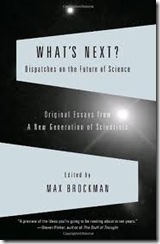
    I like to book surf. If something I am enjoying references another intriguing book, I try to hunt it down. And if that second book mentions a third tempting tome, I go after that too, following the thread as far as it will take me. In his book The Shallows, Nicholas Carr cites some research described in What’s Next? Dispatches on the Future of Science, a collection of 18 short and eminently readable essays by scientists working at the cutting edge of their respective fields.

    In a piece called “Brain Time”, David M. Eagleman recounts his investigations into how the brain reconciles multifarious streams of incoming data into a coherent perception of “now”: a feat much harder than it seems. Unlike fiber optics, neurons don’t communicate at anything near light-speed. Indeed, the signal from a pin prick to your toe takes considerably longer to reach your brain than one given simultaneously to your nose. So how does the brain register them as concurrent? Or as Eagleman asks: 

    Why didn’t you feel the nose-touch when it first arrived? Did your brain wait to see what else might be coming up the pipeline of the spinal cord until it was sure it had waited long enough for the lower signal from the toe? Strange as that sounds, it may be correct. It may be that that unified polysensory perception of the world has to wait for the slowest overall information.  Given conduction times along limbs, this leads to the bizarre but testable suggestion that tall people may live further in the past than short people.

    Also, different senses communicate to our brains at different speeds, which, if you think about it, isn’t exactly news. It’s why we start foot-races with gunshots and not light-flashes.

    So how does the brain resolve all these variously arriving inputs into a unity? Well, the answer Eagleman postulates is as fascinating as it is simple. We understand the world by involving ourselves in it:

    It has been shown that the brain constantly recalibrates its expectations about arrival times. And it does so by starting with a single, simple assumption: if it sends out a motor act (such a as a clap of hands), all the feedback should be assumed to be simultaneous and any delays should be adjusted until simultaneity is perceived. In other words, the best way to predict the expected relative timing of incoming signals is to interact with the world: each time you kick or touch or knock on something, your brain makes the assumption that the sound, sight and touch are simultaneous.

    Eagelman is keen to emphasize that the perception he is investigating here is conscious awareness. Humans, like all higher animals, are completely capable of making “pre-conscious” decisions with their spinal cords, which is how you can remove your hand from the hot stove before the pain even registers. This difference between pre-conscious perception and consciousness itself leads Eagleman to stare down the ultimate question: what do we need the latter for anyway?

    What is the use of perception, especially since it lags behind reality, is retrospectively attributed, and is generally outstripped by automatic (unconscious) systems?  The most likely answer is that perceptions are representations of information that the cognitive systems can work with later.  Thus it is important for the brain to take sufficient time to settle on its best interpretation of what just happened rather than stick with its initial, rapid interpretation.  Its carefully refined picture of what just happened is all it will have to work with later, so it had better invest the time.

    Humans don’t have sharp claws, or big teeth, or wings or echo-location.  We have something ultimately much more powerful: clear, cogent, handily referable memories. We experience time as a stream because that’s the best, and perhaps only way to accurately record experience with the level of retrievable complexity that we require to be, well, human. In fact, Eagleman concludes by casting doubt on the notion of time as a scientifically sound first principle.

    Most of our current theoretical frameworks include the variable t in a Newtonian, river-flowing sense.  But as we begin to understand time as a construction of the brain, as subject to illusion as the sense of color is, we may eventually be able to remove our perceptual biases from the equation. Our physical theories are mostly built on top of our filters for perceiving the world, and time may be the most stubborn filter of all to budge out of the way.

    With this line of thought, Eagleman follows down a trail blazed by Henri Bergson and Kurt Gödel, whose evocative investigations of time have been all too often ignored or poorly understood by serious scientists and philosophers over the last century.

    Implications for Theatre:

    What’s more, Eagleman may have unwittingly stumbled on an answer to the most persistently nagging question of my chosen art form: why is live theatre so much more excruciating than movies or TV when it’s bad, and so much more powerfully transcendent on those much rarer occasions when it is good?  Well maybe it is because film and TV do most of your brain’s work for you, pre-packaging all the various elements of sight and sound into a perfectly corroborated unified mega-signal. In the theatre, the data hits our brains like it does in real life—like it did on the savannah a million years ago— as an unreconciled rough draft. Our brains are working harder in the theatre to piece it all together.  Film and television tell our brains stories; theatre makes our brains do the telling. (For my own theatrical explorations of time’s mutability, check out my play The Ten Thousand Things.)

    David M. Eagleman’s bio says that in addition to serving as the director of Baylor College of Medicine’s Laboratory for Perception and Action, he is also the author of a book of fiction called Sum: Forty Tales from the Afterlives. Cowabunga baby! Surf’s up!

  • The Uses of Art

    The Uses of Art

    Art…

    • Reminds us we are going to die
    • Keeps us interested in living
    • Breaks us open
    • Gives hope
    • Devastates
    • Terrifies
    • Delights
    • Comforts the afflicted
    • Can help us to shut the fuck up for a blesséd moment
    • Afflicts the comfortable
    • Makes us human*
    • Magnifies the greater glory of God
    • Joins the long conversation
    • Engenders reasonless gratitude
    • Offers the means to become other people
    • Demonstrates unprovable truth.

    I have been noodling on this list for years, mostly because I like to have reasons handy when I teach playwriting. (An investigation of the uses of playwriting would open a whole other can of worms.)  I have arranged these in a loose, ostensibly amusing order of my own choosing. I would be truly delighted to hear suggestions for additions, adjustments and deletions.

    Over the last century or so we have tended to shy away from objectivity in the arts and have emphatically discarded any objective means of defining exactly what art is. “It can’t be done,” we shrug; or we toss down the glib gauntlet, “Art is whatever I say it is”, knowing full well that if that were true, then art would be, by extension, whatever anyone says it is, and by further extension, simply everything. And when something is “everything”, it achieves equivalence to “nothing.” Or perhaps even less than that.

    So I would like to suggest that art might only be objectively defined in the context of its utility. Or in plainer words, in order to know what art is, we have to talk about—and maybe can only talk about— what art does.

    I understand I have no special standing to proffer such a list. I quit college after my sophomore year. My plays are only rarely and mostly marginally produced. I am an administrative coordinator at a biotech company, a husband, a father and a person. That last post is the only one I believe entitles me to talk about art; but I stand fiercely by that standing, because, after all, if art is not for persons, then for whom is it?

    My plan over the next few months, or—let’s be honest—years, is to write a short essay about every one of the uses I listed above, and maybe even some I have not yet thought of— maybe some that you suggest. Please be warned, however, that my track record for delivering on promised essays is spotty at best. 

    Happy Holidays.

    2010

    *Not always a good thing.

    Even if there isn’t One.

    5/28/14 To see my more recent essay, “The Misuses of Art”, please click here.

  • Ikkyū

    Recently I was having some drinks with some of the NewsWrights United team after a rather intense creative session. Somehow the string of topics led to haiku or Zen or something that put me in mind of the great whore-loving, haiku-scribing Zen Master from the 15th Century, Ikkyū. I mentioned him. Everyone laughed. They thought I was making him up. I wish I had been. I wish I had that kind of imagination. But no, once again, the truth outshines my paltry attempts at fiction. To follow is an essay I wrote about Ikkyū some years back for a text-only proto-social networking site called Everything2.com.

    here I am simply trying to get into your head
    you think you were born you die what a pity
    1

    Zen masters are infamous as a group for their peculiarity and iconoclasm, so to set yourself off as peculiarly iconoclastic among them is quite a feat, and yet such was the attainment of Ikkyū Sōjun, the abbot of Kyoto’s Daitokuji Temple, who called himself “Crazy Cloud”.

    sin like a madman until you can’t do anything else
    no room for anything more

    Ikkyū was born in 1394 A.D., the bastard son of Emperor Go Komatsu and his favorite lady-in-waiting2. When the Empress got word of the pregnancy, she banished Ikkyū’s mother to one of the poorest sections of Kyoto. At six he began his Zen training as an acolyte at Ankokuji Temple. He would strain sorely at the reins of temple discipline for the rest of his life, but it was there that he began quickly mastering the dual arts of poetry and calligraphy. (The modern Western disconnect between composing verse and physically placing it on the paper would be as absurd to the medieval Japanese mind as dancing having nothing to do with choreography.)

    I’ve burnt all the holy pages I used to carry
    but poems flare in my heart

    After his first master died, Ikkyū sought another in the legendarily severe abbot Kasō. His new master lived up to his reputation, leaving Ikkyū to wait outside at the temple gate for five days and then pouring a bucket of water on his head before admitting him. Some ten years later Ikkyū achieved enlightenment upon hearing a crow’s caw. He went to Kasō with the good news, but his master scorned: “This is only the enlightenment of an arhat. You are not a master yet.”

    The disciple replied. “That suits me fine. I despise masters.”

    Kasō barked out a laugh. “Yes! And with that, you are a master.”

    one of you saved my satori paper I know it piece by piece you
    pasted it back together now watch me burn it once and for all

    Kasō died when Ikkyū was thirty-five years old.

    my dying teacher could not wipe himself unlike you disciples
    who use bamboo I cleaned his lovely ass with my bare hands

    Astounded with grief, Ikkyū spend the next four decades of his life bouncing around from temple to temple, whorehouse to sake bar.

    ten fussy days running this temple all red tape
    look me up if you want to in the bar whorehouse fish market

    a crazy lecher shuttling between whorehouse and bar
    this past master paints south north east west with his cock

    when I was forty-seven everybody came to see me
    so I walked out forever

    don’t hesitate get laid that’s wisdom
    sitting around chanting what crap

    At age seventy-seven the fiery monk fell in love with a blind teen-age girl named Mori.

    I was like an old leafless tree until we met green buds burst and blossom
    now that I have you I’ll never forget what I owe you

    your name Mori means forest like the infinite fresh
    green distances of your blindness

    I’d sniff you like a dog and taste you
    then kiss your other mouth endlessly if I could white hair or not

    Five years later, two years into his ninth decade of life, Ikkyū was appointed abbot of Daitokuji Temple, his beloved master Kasō’s old job. This particular Zen lineage would, two hundred years later, produce the famous master Hakuin as just one of its important dharma heirs.

    if there’s nowhere to rest at the end
    how can I get lost on the way?

    Ikkyū died at the age of 87.

    long life
    the wild pines want it too

    It’s the keenly direct, contemporaneous feel of Ikkyū’s verse that stands out for me. Compared to him, other prominent figures in the Zen canon feel like constructs, mouthpieces– important, but not intimate. Ikkyū is unquestionably a person, talking to you, not 600 years ago, right now.

    don’t worry please please how many times do I have to say it
    there’s no way not to be who you are and where

    fuck flattery success money
    all I do is lie back suck my thumb

    all koans just lead you on
    but not the delicious pussy of the young girls I go down on

    why is it all so beautiful this fake dream
    this craziness why?

    stare at it until your eyes drop out
    this desk this wall this unreal page

    nature’s a killer I won’t sing to it
    I hold my breath and listen to the dead singing under the grass

    don’t wait for the man standing in the snow
    to cut off his arm help him now

    the crow’s caw was okay but one night with a lovely whore
    opened a wisdom deeper than what that bird said

    self other right wrong wasting your life arguing
    you’re happy really you are happy

    only one koan matters
    you

    ********************************************

    1All translations of Ikkyū’s verse are from Stephen Berg’s excellent Crow with No Mouth. If you’re at all intrigued, buy it. You’ll read it for the rest of your life.

    2When his mother died, she left behind this brief note:

    To Ikkyū:

    I have finished my work in this life and am now returning to Eternity. I wish you to become a good student and to realize your Buddha-nature. You will know if I am in hell and whether I am always with you or not.

    If you become a man who realizes that the Buddha and his follower Bodhidharma are your own servants, you may leave off studying and work for humanity. The Buddha preached for 49 years and in all that time found it not necessary to speak one word. You ought to know why. But if you don’t and yet wish to, avoid thinking fruitlessly.

    Your Mother,
    Not born, not dead.
    September first.

    P.S. The teaching of Buddha was mainly for the purpose of enlightening others. If you are dependent on any of its methods, you are naught but an ignorant insect. There are 80,000 books on Buddhism and if you should read all of them and still not see your own nature, you will not even understand this letter. This is my will and testament.

    3Even as a young boy, Ikkyū exhibited some of Zen’s cagier instincts. His master owned a rare and precious antique teacup, which one day a fellow acolyte of Ikkyū’s happened to break. When the master showed up, Ikkyū took the pieces from the other boy and hid them behind his own back. Facing the master he asked: “Sensei, why do people have to die?”

    The master replied, “This is the natural way. Everything has to die having fulfilled its allotted time to live.”

    Ikkyū showed his master the pieces of his precious cup: “Sensei, it was time for your cup to die.”

    Sources:

    Berg, Stephen. Crow with No Mouth. Copper Canyon Press, 1989.

    Stevens, John. Masters: A Maverick, a Master of Masters, and a Wandering Poet. Kodansha International, 1995.

    Reps, Paul & Nyogen Senzaki. Zen Flesh, Zen Bones. Tuttle Publishing, 1985.