Just Wrought

Recovering playwright, once won a STRANGER Genius Award for theater. Now writing a bloated novel about… G-d help me! Theatre.

Category: Seattle

  • The SOAP Poster!

    The SOAP Poster!

    I have said it before: one of the most exciting moments for this playwright is when the posters for a world premiere drop into circulation. Something about it says, “Yup, this is happening all right.” And I really love this one for SOAPFest. (Thanks to Sean Williams of Gigantic Planet for the evocative design.)

    I plan on writing more later about why this upcoming festival of short world premiere plays is particularly special for me, but for now, let me simply share SOAPFest’s press release below the fold so you can have all of that important information now.

    Remember, SOAPFest is three nights only in a small venue.  Tickets are on sale here, now!  So . . . you know what to do.

    (more…)

  • Markheim Collides with the Seattle Superhero Scene

    Markheim Collides with the Seattle Superhero Scene

    In the upcoming episode of Markheim, to be recorded live, next Monday, April 29 at West of Lenin as part of Sandbox Radio Live!

    MARKHEIM:  Is that Didge up there?

    STANK:  He doesn’t go by “Didge” anymore.

    MARKHEIM:  That’s some get up he’s got on.

    STANK:  That’s his superhero gear.

    MARKHEIM:  And that thing on his face?

    STANK:  His mask. He made it from his hair.

    MARKHEIM:  Charming.

    DIDGE (over the bullhorn):  Many of you knew me by my street name. But I’m wanna tell you today “Didge” is dead. This is someone new. Someone stronger. In the bible the greatest hero was a man with long hair named Samson. He was invincible.

    MARKHEIM:  Kid needs to read that book a bit more closely. . . .

    Get your tickets here,  now, while they last.

  • A Super Skip Ahead Sneak Peek

    A Super Skip Ahead Sneak Peek

    This from Markheim, two episodes ahead.

    IOPHIEL: Welcome, friends from Hell. I know it seems a little cramped, but you’re actually inside the globe. Not the globe some call “the Show”, but rather a 3-D neon map of it. It was placed on top of this building as a beacon of truth, because beneath us human beings used to work at finding out the truth and then sharing it by printing it on folded sheets of cheap paper so their fellow human beings could read and know it.

    I’m sort of a truth history trivia buff, in case you couldn’t tell.

    Sadly, this globe we’re in, well, it’s not really a beacon any more. The truth-tellers that used to work below, are all gone: sacked and scattered. And once again humans will have to struggle to find another way. But that’s not what we’re here about tonight. Tonight, we’re about fighting fire with fire.

    Tickets are on sale now for Sandbox Radio Live! Episode 8: “Fools Rush In”.  Reserve yours at Brown Paper Tickets here.

  • Record Corrector

    Saying that what Mike Daisey does isn’t theatre is not equivalent to saying that what Jackson Pollock painted isn’t art. Rather, it’s equivalent to saying what Jackson Pollock painted isn’t photography. I make this argument in greater detail in my essay, “The Solo Show: A Risk Averse Artistic Administrator’s Best Friend” which is, beyond a reasonable doubt, what Omar Willey refers to in his withering list of “nonsense” and “childish territorialism” nestled within his hot-off-the-virtual presses criticism of Culturebot’s recent evening  Everyone’s a Critic. Omar’s essay is worth the read despite the red herrings and half-thrown gauntlets. Just as— I like to think— my essay on one-person shows is also worth a glance, despite its putative shortcomings.

    Easily one of the three smartest people I know, Omar Willey is a mensch’s mensch. His contributions as the founding publisher of The Seattle Star are profound, and his thinking on how criticism can make Seattle theatre better is vital to the conversation, no matter how proudly he praises his own prolixity and opacity. (Trust me: it’s quite not as bad as he hopes.) If, however, Omar were always right, I would be compelled to worship him as a fearsome god, instead of treasuring him, as I do, for the dear friend he is.

  • A Few Things Wonderful about “Something Wicked…”

    A Few Things Wonderful about “Something Wicked…”

    You’re not crazy. You’re just overdue. There hasn’t been a new episode of Sandbox Radio Live! in over three months! 

    Relax. 

    Episode Seven: Eye of the Beholder  is on its way, packed with the sort of goodies you’ve grown accustomed to: plays by Elizabeth Heffron and Vincent Delaney, music by Jose Gonzales and the astounding Sandbox Radio Orchestra, my own noir-angel detective series, Markheim (word has it Sam’s due for a drop in), all tied together by Leslie Law’s expert, effervescent direction. Plus you can expect some brand new stuff like a poem by Elizabeth Austen read live by the author, or a brand new comic serial by Scot Augustson set in Seattle. (You’ll want to order your tix quick, since we always sell out.)

    But before we get to all that, I need to make up for a deleterious omission. With all the crazyness of the holiday season, plus world premiering my first full-length play in four years, Ballard House Duet, I neglected my self-appointed duty of telling you the things I love about the previous episode of Sandbox Radio Live! –  Something Wicked This Way (available for download here.)

    “Backscatter” by Vincent Delaney

    Big Stu does his duty on the Sound FX TableVince never disappoints with his sharp suspenseful writing, but this turn at modern horror would make Rod Sterling go goggle-eyed.  All props to the Sandbox Radio sound fx team.  Give a listen and tell me they don’t make it sound exactly like an airport. (This brings up a larger fascination for me when listening to these podcasts: how the live audience participates in and fuels the recording. There’s this extraordinary recursively looping sensation as you listen to them listening to you listen to the show in the future.) My favorite character in this one had to be Big Stu.  Somehow Eric Ray Anderson manages to add 300 pounds through the sheer suggestive power of his voice.

    “The Back of the 358 –  #7” by Paul Mullin

    Not much I want to say about these since I wrote them, except maybe that Kathryn Van Meter utterly nails the drunk chick.  Oh, and also, the likelihood that there will be any new pieces in this vein is slim,  given how King County Metro’s elimination of the Free Ride Zone has completely flattened the floridly diverse ecosystem that was once the back of the #358.

    “Muscle Memory” by Omar Willey

    This chillingly smooth and nasty pastoral will captivate you into a skin-crawling reverie.

    “Quinceñera of the Damned” by Scot Augustson

    What do you get when Mexican kitsch culture collides with Austrian Alpine snobbery in a fairytale context?  Something you can be pretty sure Scot Augustson conceived. Favorite line (impeccably delivered by the peerless Annette Toutonghi): “Gunter will think I’m a crazy clown gypsy whore.”

    “The Back of the 358 – #8″ by Paul Mullin

    It’s never not unnerving to have to relive my #358 adventures as staged by some of Seattle’s finest actors.

     “Here it Comes” by Charles Leggett with the Sandbox Radio Orchestra

    Chuck and friends rock another original blues number, this time folding some astro-physics in, cuz… ya know… Chuck rolls like that.

     “The Back of the 358 #9” by Paul Mullin

    Please tell me this trip is almost over. If this woman punches or pukes on me, I’m gonna be highly irked.  (Favorite line {which I can say in modesty because I overheard it}: “At least in jail I get three meals a day and someone to love me.”)

    “The Raven” by Edgar Allen Poe

    No one intones the American classics like Richard Ziman.  And his sweet spot is Poe. 

    “The Sorcerer’s Apprentice” by Paul Dukas, arranged by Bruce MonroeRob Witmer blowing Some Sorcerer's Music

    A mind-crackingly original arrangement: the kind of blastingly cool cut you can only get at Sandbox Radio.

    “Markheim – Episode 6” by Paul Mullin

    Per custom, I’m including the script for this below the fold.

    “The Back of the 358 #10” by Paul Mullin

    So long shirtless drunk chick!  May you find the peace that eludes your every semi-lucid thought.

    “Shadow of Agnes” by Emily Conbere 

    I raved about Emily’s first Sandbox Radio outing, “Sound Thieves” here, but who knows?  She could’ve fluked her debut success. She didn’t. This piece seals the deal and is quite possibly one of the creepiest short pieces I’ve ever heard.

    Amy Love in Something Wicked

    Again, don’t take my word for it.  Go to the podcast and listen.  And then get your tickets to our brand new show, available here through Brown Paper Tickets.

    (more…)

  • Simultaneous Publication: Legit Experiment or Hat on a Hat?

    Simultaneous Publication: Legit Experiment or Hat on a Hat?

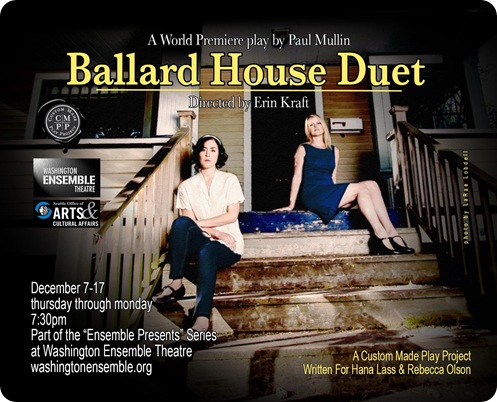
    Sometimes when you risk a lot with a piece of art, it pays to find ways to risk even more. Or at least that’s the counter-intuition behind the newest wrinkle in the Custom Made Play Project. A couple days ago a box arrived at my house containing exactly fifty copies of my soon-to-world-premiere play Ballard House Duet. Given the unique circumstances of its development (which I blog about in some detail here), the idea light-bulbed to offer a published version of the play simultaneously with its world premiere production.  After all, we custom made this play for two local actors, Hana Lass and Rebecca Olson: a Seattle story for Seattle audiences in the purest vein of locally and organically grown new theatre.  What better way to underscore how we are trying to change the way plays are made than to offer tangible printed proof of the pudding for sale.

    So I emailed my friend and colleague Jason Aaron Goldberg, president of Original Works Publishing in Los Angeles.  OWP publishes acting edition scripts and licenses productions of plays by “bold, original, and adventurous playwrights from around the globe.” I currently have three plays in their catalogue:  An American Book of the Dead* – The Game Show†, The Sequence, and The Good Ship Manhattan.  Other Seattle playwrights have plays with OWP as well. For example, Elizabeth Heffron’s Mitzi’s Abortion received some strong productions around the country after OWP’s decision to publish it. 

    I think it is fair to say that Jason was less than enthused by my idea. He told me OWP had looked at simultaneous publishing before, but never pulled the trigger. They prefer for a play to have a production history in advance of publishing it. This only makes sense. Productions work the kinks and flaws out of a play, not to mention garner reviews from which you can pull quotes for the script’s back cover. I, however, pressed my proposal. I agreed to absorb the financial risk of printing the scripts if OWP was willing to risk a bit of its institutional reputation on the experiment. Jason graciously agreed.

    So now you get to vote on whether this experiment succeeds or fails. I have 45 scripts to sell, each individually numbered and personally signed by me. I have priced them nearly a buck cheaper than what OWP sells my scripts for on their website.  If we do another publishing run of Ballard House Duet, they won’t be sold by me, won’t be signed by me, and won’t be part of a limited numbered edition: so why not buy one now while it’s cheap and special?

    Here are the ways you can buy, in descending order from best to next next best:

    • Go buy your tix to the show now (click here), then buy a script at the door.  (While supplies last.)
    • Ping me with a way to send you my snail mail address.  Once I do, send me a check for $10, and I’ll send you back a script.  (I’ll eat  the postage on this option.)
    • Buy a script on Ebay by clicking here, for $10 plus postage.  (This option allows PayPal.)

    Vote now: the simultaneous publication experiment: success or failure?

  • Bespoken Word

    Bespoken Word

    Have you ever had clothes custom-made for you? I have never been rich enough to afford such a luxury; but theatre, never ceasing to infuse my life with ironies, provided me once with an opportunity to have a pair of 16th Century “pumpkin-pants” plus doublet perfectly cut and stitched to my then much slimmer proportions for a run as Berowne in Love’s Labour’s Lost. Rich or poor, ironic or not, it is always a superbly satisfying feeling to have a something fit you like a second skin. I imagine actors must feel a similar satisfaction when roles are tailor-written for them, which is exactly what I have done for two extraordinary Seattle actors, Hana Lass and Rebecca Olson, in a play called Ballard House Duet, premiering in a little over two weeks at Washington Ensemble Theatre.

    It started with an email from Olson back in June of last year, asking if I would be interested in being the guinea pig playwright for her proposed project to develop new plays written specifically for local actors. For this first outing, she said, the actors would be herself and Hana Lass.

    I responded with interest. It certainly sounded like a strong move toward the sort of locally grown new work I had been advocating here at Just Wrought. I told her my one caveat was I wanted only to write: no producing, no promotion, no administration.  Having served as Newswrights United’s Executive Producer, and having just staged the second of two fully produced Living Newspapers, I was burned out with wearing other hats.

    Rebecca agreed to my proviso, which then left us facing the proto-existential question: how to start?  Okay, so I am writing for Rebecca and Hana, but what am I writing? What kind of characters do I build for them? What kind of story? Would the play require additional actors? Would I write specifically for them as well, or write now and cast later?  I decided to pull a trick out of my NewsWrights bag.  I set up casual interviews with each actress. I wasn’t sure what I was looking for.  Maybe it was just an excuse to indulge my nosiness without seeming too creepy.  I drafted up a list of questions which, digital packrat that I am, I still have.

    Questions for Hana and Rebecca

    What kind of roles do you get type cast in?

    What kind of role have you always wanted to play but never got a chance to?

    Do you have a sister(s)?  {Clearly I was already thinking in that vein.}

    Tell me about your relationship to her.

    If you could change one thing about your sister what would it be?

    What are your weaknesses as a performer?  Strengths?

    What are my weaknesses as a playwright?  Strengths?

    If there’s one thing you could change about Western / American Culture what would it be?

    I had a lot of fun indulging my nosiness under the guise of art.  I found out way more about Hana and Rebecca than I ever could have through casual conversation.  Crucially, I discovered that the three of us all had a close relationship with someone who suffered from the very real disease of hoarding. I seized on this as the foundation for the play, literally the ground on which my characters would play. I also confirmed through these conversations that my instinct to make the characters sisters was dead on; but it also raised a problem:  Rebecca and Hana look nothing alike, not even close.  No one would buy them as biological sisters.  “Fine. They’re adopted,” I decided.

    Next I concluded there was no up-side in expanding the character sheet.  I would focus on the two sisters, tracking them back and forth through time.  If they needed to interact with other characters, the audience would have to play them.  I was already experimenting with this technique in another, weirder play I am devloping, Philosophical Zombie Killers.  This piece for  Custom Made Play Project would give me the opportunity to test it in a more realistic framework. 

    Armed with my interview notes and my burgeoning ideas, I started to build a proto-draft, one plot point and/or dialogue scrap at a time. What I didn’t know, I left blank.  From the outset, I was determined to see these two singing.  My own sisters sang all the time in my house, as did my mother, who sang opera as a young woman, and still sings in two church choirs.  My wife also sings opera and jazz.  So somehow, on stage or off, family for me is inextricably mixed up with music: specifically female voices.

    Point by point, emerging limitations made the play grow.  This is not surprising.  Problems are a playwright’s best friend. Conflict is our soup; obstacles, the chewy nuggets we chop into it.  The unique qualities of my two performers sharpened my focus and maximized my momentum.  For the first time in a long time, there was something— or rather someone or some ones— tugging from the other side.

    Hana claims I had a first draft within two weeks of the second interview, but my rather anal-retentive record keeping shows it was more like five.  Still, that’s a damned fast turn-around for me.  The play has come a long way since this first stab, but the basic shape of the plot and the relationships has survived and expanded.

    The most remarkable aspect of the process, which I feel cannot be emphasized enough, is that Ballard House Duet simply would not exist if we three specific people had not existed and offered it some part of ourselves. Without Hana and Rebecca to build them for, Holly and Heidi simply would have never occurred to me. Not only would the story have gone untold, it would have gone unconceived.  For me that fact is fundamentally astounding and magical.

    I have no idea yet if the play succeeds or fails.  We will need an audience for that final analysis. (That’s where you come in.  Go get your tix!) What I do know is that the experiment itself was completely, utterly worth it. I encourage every playwright to give this sort of personal tailoring a try. 

    Despite how exciting this Custom Made Play Project has been, it only seems like we are doing something new and innovative. The truth is most of the plays we praise in the canon were created bespoke for specific actors. Following this old process is not immediately easy or intuitive, but in the die-press production line, hub-and-spoke distribution network that is 21st Century American Theatre, Seattle is perfectly poised in its Goldilocks perfection— not to big, not to small— to revive a method that can maximize the vitality of locally grown new works for stages across the nation.

  • Ballard House Duet’s Poster is Here!

    Ballard House Duet’s Poster is Here!

    There’s nothing quite like a show’s  poster going live to underscore the message: “This sh*t is happening!”

    You can get your tix here.  (Do the math. {Small house + short run} * {dynamite cast + crackerjack production team} = early sellout!)

    You can stay up-to-date  on additional Ballard House Duet information as it comes available by “liking” the Custom Made Plays Project Facebook page here.

    And as always, I’ll do my best to keep you up to date here at Just Wrought. More fun news is on the way, I promise!

  • This Change is Playwright Approved

    This Change is Playwright Approved

    Theatre tradition runs rife with jokes, sayings and funny stories about actors and playwrights, and their divergent natures.

    Question: How many playwrights does it take to change a light bulb?

    Answer: The light bulb doesn’t need any changes.

    * * *

    Question: What’s the difference between a working Seattle actor and a large pepperoni pizza?

    Answer: A large pepperoni pizza can feed a family of four.

    * * *

    “The average actor craves approval; the above average playwright craves disapproval.”

    These clichés occasionally harbor a smidgeon of truth, but persist as mostly empty stereotypes. However, I do hold one difference between playwrights and other theatre artists to be true and fundamental: we tend to have a keener long-term view of the theatrical environment. This only makes sense. Our work cycle runs to years, whereas most other theatre artists live tactically, month to month; at most, season to season. Playwrights simply scan a farther horizon. (So no, I was not using my psychic powers when I predicted earlier than most the demise of the Intiman as we know it.)

    All this is to say my eagle eyes tell me that ACT just made an exquisite choice by appointing John Langs to the position of Associate Artistic Director, and thereby giving him and his family a reason to make Seattle their permanent home. (You can read a detailed run down of John’s new duties here.)  Unlike other hotshot directors who have been recruited from afar to fill similar roles at Seattle Big Houses, Langs is no elitist carpet bagger. His roots run deep here in Seattle, at Big Houses and small, with him directing work by writers running a gamut from Shakespeare to, well, me.

    Seattle actors love Langs, and he loves them. Seattle playwrights respect Langs, and he respects them. (A dual-facing fact I wish were true for more Seattle Big House administrators.) I won’t tell you John Langs can single-handedly drag Seattle theatre to excellence—he can’t; but he is the piece that perfectly fits a missing part of the puzzle here. Langs has shepherded more excellent new plays to world premiere than any other director I know. He gets why new work is so vital to Seattle’s health as a World Class theatre town. He also gets how nurturing it can help his own career in a way that staging the latest New Yorker-approved off-Broadway hit never could.   

    ACT’s choice is a win for everyone. Langs will grow his already formidable career here instead of elsewhere, and he will grow his fellow Seattle artists with him. For John, Seattle isn’t a stepping stone.  It’s the destination.

    Confidential to John:  carve an hour out of your swamped schedule and let me be one of the first of many to buy you a congratulatory cocktail so I can properly say:

    “Welcome, welcome, a thousand times, welcome. 

    Now… get to work!”

  • Custom Made Love for the Loveliest Lady

    Custom Made Love for the Loveliest Lady

    I make a lot of outrageous claims about Seattle as a theatre town, and a lot of outrageous demands, too. I stand by all of them. But the claim I am most eager to defend at the moment is that Seattle is the best city in the world for locally grown plays: that is, new work written for Seattleites, by Seattleites, with Seattle audiences  in mind.  We do it quarter after quarter over at Sandbox Radio, Annex Theatre has been doing it for decades, and Printer’s Devil for only slightly less than that. Recently, local actor Rebecca Olson founded the Custom Made Plays Project dedicated solely to matching Pacific Northwest playwrights with local actors to develop and produce new plays of regional significance. (More on that exciting new wrinkle in a later blog.) Even the big lumbering mastodons are starting to get into the act, with A Contemporary Theatre recently world premiering Yussef El Guindi’s  Pilgrims Musa and Sheri in the New World to great success, and the Seattle Rep fostering a ongoing workshop of local playwrights, though, in fairness to companies fully fighting the good fight, the Rep has yet to really put its producing money where its workshopping mouth is.

    In this spirit of making theatre which is a custom fit to performers and audiences alike, allow me to introduce to you The Betty Plays, world premiering this Sunday at Theater Schmeater. These are four new short plays written for actor Betty Campbell by Scot Augustson, Pamela Hobart Carter, Paul Klein, Jim Lapan and myself, plus a short film, “Lethal Cotillion”, which was featured at the Cannes Film Festival. Says the Schmee in their press release:

    The playwrights embarked on this project because of their love for the acting talents of the brilliant Betty Campbell and their desire to see her on the stage again.  Stylistically distinct, the four plays demonstrate the prowess of Seattle’s reigning thespian septuagenarian.

    And here’s what contributing playwright, Scot Augustson said recently on Facebook:

    I’ve got a show coming up that won’t get a review, is playing just 3 Sunday afternoons. I’m guessing less than 150 people will see it. It will never be nominated for anything. The taste makers won’t declare it The Hot Ticket In Town! And yet, it gets to the core of why I stay in Seattle and make theater. . . . Betty Campbell is an incredibly talented woman who has given immeasurably to this town and this community. But, she’s been facing some physical limitations lately that make doing a whole show difficult. Pamela Hobart Carter realized that to not have Betty up in front of an audience was ridiculous. So she got a hold of a few of Betty’s fans who were also writers to create an evening of shows . . . .  It’s gonna be great, check it out. (Hmm, if we can’t get Hot Ticket, maybe we can be Best Kept Secret. )

    As for me, I first saw Betty Campbell  six years ago when were both making our “virgin” appearances in the 14/48 instant theatre festival: her as an actor, me as a writer. I watched wide-eyed as Betty stalked around the arena stage, opposite another actress, as they both shouted competing boasts to the audience about the depraved pornographic acts they were about to perform. Now, you don’t need to know Betty well to know she’s a consummate lady with a deeply sweet and genteel heart. She was playing fiercely against type.  But more importantly, she was playing fiercely. She was not cowed by material. She rose to it. And then she rose above it. She is the kind of performer that makes a playwright’s fingers itch for his keyboard.

    Here are the details for the Theater Schmeater run of The Betty Plays, should you choose to avail yourself of Scot’s delightful “secret”:

    (more…)