Just Wrought

Recovering playwright, once won a STRANGER Genius Award for theater. Now writing a bloated novel about… G-d help me! Theatre.

Category: Seattle

  • American Theatre Hearts Scot Augustson

    American Theatre Hearts Scot Augustson

    Slip this clipping into the “Seattle’s-Big-Houses-May-Not-Care-Much-about-Seattle’s-Locally-Grown-Plays-But-the-International-Media-Sure-Does” file.  You know, it’s that one that’s getting a little over-stuffed by now with pieces like NPR’s On the Media’s story about the first edition of NewsWrights United’s Living Newpaper (you can listen here), and the UK’s Guardian covering both Seattle’s hosting of the Outrageous Fortune discussion as well as Just Wrought’s vibrant comment stream regarding the Intiman debacle.

    This time it’s the vaunted magazine American Theatre giving Scot Augustson a little much deserved love for the opening of his latest Sgt. Rigsby joint, Shadow Odyssey, produced by Printers Devil Theatre at Theatre Off Jackson.  Apparently this side-bar shout out doesn’t appear on line, but only in the print version.  So I asked Scot to send me a scan.  Scot apologized to me for his “Flintstone scanning technology”.  (I’m picturing a bird with a pen in its beak, furiously copying the page and then flying with it to my house in Green Lake.  Once I take the image, he turns to the camera, shrugs and squawks, “It’s a living!”)

    I’m going to see Shadow Odyssey tonight, opening night, ‘cuz I’m cool that way.  But whatever you do, you better get your tix soon, before all the folks flying in from all over America buy up all the seats.

  • KING 5 Hearts Sandbox Radio

    KING 5 Hearts Sandbox Radio


    Taking a break from talking about the problem of horror in theatre to let you know that Nancy Guppy gave us crazy good love today on KING 5’s New Day Northwest’s “Weekend Zone”, kicking off the segment with a huge plug for Sandbox Radio, calling us Seattle’s Prairie Home Companion, only Leslie Law is “a lot better looking than Garrison Keillor”.  Well, duh, Nancy!  (Oh, and funny story, Margaret Larson has volunteered to be our foley artist.  Gee, thanks Margaret, but uh… we’ll call you, okay?)

    I am pretty sure we are all sold out on Brown Paper Tickets, but if you really want to come see the live recording, message me and I will see what strings I have left to pull.

    And of course, if you haven’t already done so, check out the podcast of Episode One.

  • Often Lie

    Often Lie

    Is it possible to engender genuine horror in an audience through a live stage experience? 

    That’s the question I started pondering a decade or so ago. Now don’t knee-jerk back some glib response. Think before you answer, and be honest. I have given a lot of thought to this, and I am still not completely sure. So this Halloween season I thought I would crack open the question again for churning with a series of scripts, excerpts and essays, in hopes that together we might strike some undiscovered insights.

    Let me kick it off with “Often Lie”, a very short play I wrote for the late-night horror series Psychopomp Presents. . ., which was produced by Paul Morgan Stetler and myself, and directed by Braden Abraham, at Capitol Hill Arts Center in October 2005 .  We billed the show thusly:

    A late night modicum of mayhem featuring world premiere plays penned to plumb the very depths of the collective unconscious.  “Lil’ Heroes” “Often Lie” and “The Reckoning” are works by three of Seattle’s most innovative playwrights: Louis Broome, Paul Mullin and Stephanie Timm.  Come on, give your dark side a joy ride!

    It was a failure.  But one of the very best kind, a true experiment wherein a hypothesis was advanced, a test was run, and data was extracted.  Our data read something like: “You cannot scare drunk hipsters after 11 pm no matter how hard you try.” 

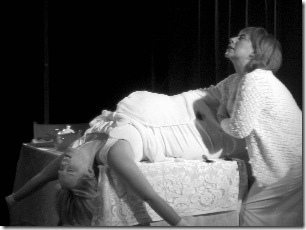
    Rebecca Olson and Amy Frazier in Stephanie Timm's "Lil' Heroes"

    The idea for my contribution “Often Lie” was essentially, “What if two random people met and discovered they were having each other’s dreams?” From here I began lightly building in my favorite freest fashion, by just randomly associating and seeing where it takes me. I thought of Queen Mab and went back to read Mercutio’s famous rant. Spiders seemed to be prominent in that speech, so I let that take me further on. I leave it to you to find the connections, such as they are. I soon decided that only one of the characters should be dreaming the other’s dream, thus leaving more opportunity to explore the “who’s dreaming who?” question. I landed on a sort of Donald-Rumsfeld-meets-Queen-Mab scenario which pleased me. I think, given the right circumstances, it might possibly frighten an audience that wasn’t simply looking to laugh and get drunker before getting laid.

    For its world premiere, I was blessed to have the dream casting of Michael Patten as “Drum” and Stephanie Shine as “Mabel”.

    Here’s the play:

    (more…)

  • A Show You Don’t Have to Come See

    A Show You Don’t Have to Come See

    How often do you get a plug for a show in which the plugger says he doesn’t really care if you come see it?  Well, that’s exactly what I’m telling about this second edition of Sandbox Radio Live: The Halloween Episode.

    Well, all right, hold on a second.  Fact is, I really would like to see you there in the audience, but our seating at West of Lenin is extremely limited and we will sell out.  So no matter what happens, some of you who show up without reservations will be frozen out, S.O.L, on the sidewalk outside, while the happy few who booked at Brown Paper Tickets early enough watch it live.  (Book ahead here.)  But do NOT despair.  It’s Sandbox Radio remember?  And the whole point of us doing it is to make a permanent recording.  Our first episode is available for you to listen to right now, for free! at iTunes.  (Listen here.)

    The podcast of Episode One, at 90 minutes, is admittedly quite sizable.  In future, perhaps The Sandbox might look at ways to create a table of contents with time-stamps so you can go to the sections of the show that most interest you.  In the mean time, download it so that you have something to play the next time you’re stuck in traffic.  You won’t regret it.  (And after you have a listen, please consider posting a review of the show.  It’s the best way for you to let us know what you do and don’t like, and it also raises Sandbox Radio’s profile on iTunes.)

    And look for the podcast of Sandbox Radio Live: The Halloween Episode coming out shortly after the live performance on October 10!

  • Unlosing the Lost Plays

    Unlosing the Lost Plays

    There are great plays that you can never experience fully. Sure, you might see them as movies, or read them as “literature”, but despite what your high school English teacher sold you, plays are not literature, any more than music or sculpture are. You may think you are special and that you can wring every artistic significance from a play by reading it; but you’re not and you can’t. There are aspects of dramatic character that only an actor can convey by speaking out loud, live, in front of you. (Not to get pedantic, but this is why we call it an audience.) Because of this, there are great plays you will never experience—at least not as plays—because of very practical reasons excluding them from the possibility of ever being professionally staged again. 

    Stalag 17 by Donald Bevan and Edmund Trzcinski* is just such a play. The original 1951 Broadway cast contained 21 men, a size which is simply not financially sustainable in today’s theatre economy. Beyond cast size, a myriad of other reasons doom to the dusty shelf some of the canon’s greatest plays. Once these plays cease to be performed, they are essentially lost to our culture as works of art, though of course they still have value as artifacts.

    To the rescue rides Seattle’s Endangered Species Project, dedicated to giving monthly staged readings of plays that seldom get full productions.   As they explain on their website:

    In the present economic straights in which regional theatre now finds itself, much of the so called established international repertoire is neglected, for various reasons: there are too many different settings, or the casts are too large, or simply, the publicity requirements of selling a play that is both “old” and unfamiliar to general audiences may seem too daunting.

    We feel that while it is an essential duty of theatres to read and develop new work, our group sees a parallel need to celebrate older or otherwise neglected plays….

    Through our free, simply staged readings, we hope to lend live voices to plays that are now silent on our bookshelves.

    It is the blossoming of projects like ESP that continually renew my faith in Seattle theatre’s progress toward World Class standing.

    Next Monday evening, September 19, at 7 pm you can defy the entropy of modern theatre and see a one-time-only reading of Stalag 17 artfully staged by director Leslie Law, with such brilliant casting as Shawn Law as Sefton (an even more natural choice than William Holden) and Richard Ziman as Sergeant Shultz.  (No, this ain’t Hogan’s Heroes Sergeant Shultz**, though he obviously inspired the sitcom role.  This German non-com has no compunction about torturing a POW on stage to determine the whereabouts of a missing American pilot.)

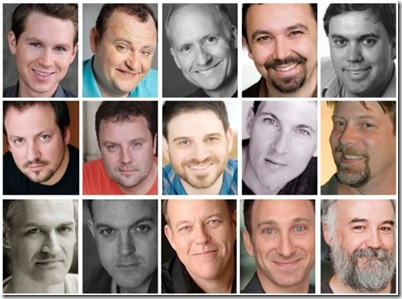
    Stalag 17 Cast featuring:  Brett Brennan, Brandon Whitehead, Allan Armstrong, Gavin Cummins, Eric Polani Jensen, Shawn Law, Paul Mullin, David Goldstein, Vincent Delaney, Keith Dahlgren, Chad Kelderman, Mike Dooly, Richard Ziman, Chris Ensweiler, Galen Joe Ozier

    Even if you only live another ten years, my best guess is that you’ll have about 12 more chances to see Twelfth Night, six to see American Buffalo, and between five and five hundred opportunities to watch something scripted by Sarah Ruhl; but unless my prodigious predictive power fails me now, you will never, not as long as you live, get another opportunity to hear Stalag 17 performed by such a cast as this.

    Don’t miss it.

    (more…)

  • Looks like A Great Discussion was Had Last Night

    And if, like me, you weren’t able to get to West of Lenin for Seattle Theatre: What’s Next? you can get a good sense of it by reading José Amador’s evocative blow-by-blow here.

  • Seattle Artists Lose an Unsung Support

    Seattle Artists Lose an Unsung Support

    When I first came to Seattle in 1990 I had only one decent paying trade to my name: I knew how to clean glass. The problem was I was spoiled. In New York I had worked mostly high-rise residential units and got paid three dollars a window by my boss/friend Patrick Shields who worked next to me and also happened to be an actor/writer himself. In Seattle the only window work I could find was with a large outfit that did commercial properties and offered a flat ten dollars an hour. Instead of a bon vivant, polymath, small business-owner working next to me, I had ex-cons, two-bit bigots and pot-smoking thugs tying my ropes. (Literally.  One guy told me getting high beforehand made him concentrate harder on the knots.) I quit after a week and took a job dishing at a breakfast cafe in Green Lake, but the money from that, barely above minimum wage, just wasn’t enough.

    The advice I got at the 1911, the dive-bar de facto headquarters of 90’s Seattle fringe theatre, situated directly across Fourth Avenue from Annex Theatre, was simple: “go to Woods.” Woods and Associates was a small, locally owned temporary and permanent placement service located in the Galland Building downtown. I protested that I had zero office experience. The advice was reiterated: “Go to Woods. They’ll take care of you.  You can even tell them you’re an actor. They like actors.”

    “They like actors!?”  What kind of outfit was this?

    An outfit, as it turns out, that I would have an ongoing professional relationship with for the next two decades. My fellow Annexers were right.  After my initial interview I was paraded around the office to meet owner Sarah Woods, Sarah’s brother Will, Sarah’s business partner Sam Hunter, plus all the rest of the folks in the placement bullpen.  It didn’t matter that I was an actor or that I had never worked in an office.  I would start out slow and simple, they told me.  First gig: the microfilm department of Northern Life Insurance, where I captured images of old annuities documents on their way to the shredder. To tame the boredom I listened to Rush Limbaugh and KPLU jazz on my Sony Walkman. Aldrich Allen, another Annexer, now dead, worked beside me.  A few years later, when I came back from shooting a movie in Maryland to find my first marriage disintegrating, I needed a job desperately. So Woods put me back at “No Life”, this time in the licensing department. It’s where I got to know William Salyers and began to hatch my plan to write a role that only an actor of his talents could pull off.  A few years later we premiered Tuesday at AHA! Theatre.

    As time went on, I even found myself temping  in the Woods office itself. I called these gigs “meta-temping”. I used to love Fridays, not only because Sarah ordered in lunch and a masseuse every week, but also because Woods, unlike any other temp service I knew, paid every week,  on the week.  Many temps came into to pick up their checks personally, giving me a chance to do a quick gossip swap with my fellow show folk, like Chris Jeffries or Josh List.

    It is not an exaggeration to say Woods was a big part of why my wife and I came back to Seattle from New York City after 9/11.  Temp work in Manhattan had completely dried up.  My unemployment was running out and I had literally no idea how I was going to support our new-born baby boy.  I was certain, however, that if we went back to Seattle, Woods would find work for either Heather or me, so that the other could stay home with the baby.  As it turned out, Heather landed the more lucrative gig—she always could stand working for lawyers more than me.  On nice days I would roll my son in his stroller downtown from Capitol Hill and often visit the folks at Woods after having lunch with Heather.  Bottom line:  after a very tough year, Woods gave us options in another city where theatre thrived.

    Woods and Associates will be closing their offices for good today.  When I spoke with Sarah yesterday she sounded upbeat: “I don’t regret the decision at all, but it I’m the one making it so I understand it’s hard for others.”  I nearly choked up when I told her what Woods had meant to me and my family over the years.  “That’s the sad part,” she replied.  “We’ve all been there for each other: the folks that work for us, the client companies.”  Certainly Woods has always been there for me.  No matter how bad a particular day gig might get, I could always think to myself, “Well, I can quit and Woods’ll take care of me: find me something.”  Now, I guess I’m on my own.  My only solace is that I’m not alone in feeling that way.

    * * *

    So here’s my request.  If you are an artist, theatre or otherwise, and Woods has helped you at some point, please chime in down in the comments section below.  Share a story if you’d like, but chime in, regardless, even with just your name.  I’d love to share a sense of how many creative folks Woods and Associates has helped over the years.

  • Sandbox Radio – Worth the Wait

    Sandbox Radio – Worth the Wait

    A bunch of us founded the Sandbox Artists Collective a few years ago “as a place for mid-career artists to explore their craft in the company of their peers.”  Unlike most assemblages of show folk, the Sandboxers weren’t in any hurrsandbox_radio_episode_01y to produce publicly as a group.  Most of us were already performing, writing and/or producing professionally elsewhere. We were not, however, completely quiet in our first years, hosting salons, like Playground in which four Sandbox playwrights wrote specifically for Sandbox actors.  Finally, however— and fully to the credit of Leslie Law’s leadership— the membership felt the urge to share what happens when we put  our collective mind into putting on a show.  The result was last month’s Sandbox Radio Live, Episode 1, available now in podcast here.

    On an individual artist’s note, Sandbox Radio Live has given me the opportunity and motivation to finally flesh out a project I have been percolating since high school.  For all that time, all I knew was that I wanted to wright a nasty noir angel detective saga.  Now you can listen to the first chapter of Markheim on the podcast, with the incomparable Charles Leggett starring in the title role of the reluctant semi-heavenly gumshoe.  Below the fold I am posting the script in case you want to follow along. 

    And be sure to attend the next episode of Sandbox Radio Live on Monday, October 10th at West of Lenin, the fabulous new theatre space in Fremont, when Markheim adjusts to life in the strange city of Seattle, and begins his search for the reasons that brought him here.  Special appearance by the fellow that Jesus Christ Himself once called “the Prince of the World.”

    (more…)

  • Was Mission Creep/Diffusion the Smoking Gun of Seattle Theatre’s Decline?

    Was Mission Creep/Diffusion the Smoking Gun of Seattle Theatre’s Decline?

    It all started with me bitching about a Stranger review.  (Come to think of it, that’s how a lot of it starts.)  Now, full disclosure, I actually wrote one of the pieces in Balagan Theatre’s outdoor show King Arthur and the Knights of the Playground, but this ain’t my first rodeo, so I can assure you I’m highly unlikely to complain about a review simply because it’s negative.  (Press is press after all.)  What bugged me was that Goldy began his analysis of the show with a quintessentially flawed premise. 

    “If the best children’s theater amuses and engages adults as much as children, then Balagan Theatre’s world premiere … doesn’t make the grade. Still, the kids seemed to love it, and you can’t beat the ticket price—free—for the next three weekends in parks around the city.” 

    So thusly irked, I posted a link to the piece on Face Book along with the following note: “Ah the old, “children’s-theatre-must-also-equally-please-adults”  trope.  How tiresome it truly is.”

    In flooded the comments and quickly the discussion drifted, fueled at times by troll-power alone, to the larger question of whether theatres should feel free to stray from their missions in pursuit of general excellence. 

    Commenter  “I’m not sure why you’re advocating for being “middle of the road” and only pleasing your base. I want theater companies to make great theater.”

    Paul Mullin Why would a children’s theatre seek to have artistic viability outside of being a children’s theatre? That’s like asking a GLBT theatre to appeal to straight audiences. It’s confounding.

    Around and around we went, with narrowly scoped opinions glibly offered as evidence for the larger dismaying trends of Seattle Theatre.

    Commenter  You’re so niche-y! Every theater wants/needs an audience. Yeah, you go after your core demographic, but it also makes sense to go after OTHER demos as well. …. Consistently ONLY targeting one group is boring and not healthy for a theater, artistically or financially.

    Paul Mullin  Can you back this opinion up with any facts? Because it seems to me to be a pretty viable business plan to know your audience and target it…. And I would further maintain that it’s exactly when arts orgs seek to please the aesthetic intelligentsia that they start going off the rails.

    Commenter  Really? So Intiman/ACT/Seattle Rep should only produce shows that appeal to its supporter base, i.e. 65 year old, upper middle class retirees? Constant revivals of Neil Simon and Vanities and Dancing at Lughnasa? Isnt’ that why the big rep houses are dying…they’re aging along with the subscriber base?

    I was just about to beg off the merry-go-round for good when a long-time friend and colleague leaned in with some extremely crisp and compelling insights.

    Rebecca Olson*  This is going to be very shocking, but I actually agree wholeheartedly with Mullin on this one. First, we need to separate the idea that having a clear mission (ie: ensemble generated new work) means doing work that isn’t new/interesting/pushing the box. Having a clear mission is exactly what non-profit organizations are required to do, and what a lot of theaters in Seattle are lacking. What makes a theater excellent is consistently excellent work. Having a clear mission that you stand behind does not make that impossible, and having a broad non-mission (ie: “Our theater is here to make theater,”) does not mandate good work. However, history does seem to be teaching us that having both – a clear mission *and* producing consistently excellent work (ie: Wooden O Theater) creates a lasting organization.

    One of the most enlightening conversations I’ve had in my theatrical life was with the late (and very much missed) Melissa Hines, who described how when the Seattle theater scene was young, the “big” theaters (Rep, ACT, Intiman, Empty Space) each had clear missions, and filled specific niches. This is a broad generalization (so please don’t nitpick,) but basically the Rep did modern classics and newish but box office safe shows from Broadway, ACT was slightly more edgy but close to the Rep, filling in the summer season when the Rep was dark, the Intiman did classics, and Empty Space did brand new/quirky/edgy work. Audiences could subscribe to all four theaters and have a completely different experience at each theater; thus, there was no “competition” for audiences.

    However, at some point the Rep/ACT/Intiman theaters began spreading out and away from their original mission/focus, and all began to look alike (and the Empty Space closed.) As the big theaters homogenized, it became increasingly clear that moving away from their original missions was not allowing them opportunities to push the envelope and try new things. Instead, it was spreading them thin with too many choices and not enough structure; when one has the opportunity to select from the entire canon, from ancient Greece to modern classics to current new regional hits, to plays not yet written, seasons start to look like a dusty college textbook of “what plays are important for you to know about” rather than an exciting collection of stories for artists and audiences to explore together. 

    In addition, this homogenization encouraged audiences to pick one theater and ignore the other theaters; since one season mirrored another, there was no reason to subscribe to all three. This created the climate of competing for an audience.

    Finally, it alienated a lot of lifetime theatergoers, who were irritated at being constantly force fed something not to their liking. While some audiences want to see Shakespeare, others want edgy new work, and some want to modern American classics. Audiences began to feel obligated to watch something they didn’t enjoy because it was part of the season they had chosen to subscribe to. Instead of educating and challenging their audiences, over time it simply lost people completely.

    Thus the crux of my conversation with Melissa, was that to have organizations that last (which are part of an artistically healthy theatre community,) we need to ask our theaters to figure out what they do that is unique and fantastic, and then ask them to do only that, and do it consistently. For example, I would be disappointed if Strawshop decided to dust off “Guys and Dolls.” On the flip side, it seems natural that 5th Avenue produced “Guys and Dolls” this year –and I would be disappointed if 5th Ave decided to try their hand at “The Laramie Project.” It isn’t that these companies are doing every kind of theater all the time; it’s that they have found their niche, and they are filling it well with consistently interesting, artistically sound productions. If I want to see a good musical, I know where to go. If I want to see productions that are intensely creative and topical, I know where to go.

    I am not suggesting an organization become boxed in by a mission that is too confining to allow it to grow, develop and mature over time (ie: Our mission is to produce the plays of Paul Mullin.) I am suggesting that having a mission that is clear but not confining (ie: Our mission is to produce the plays of Northwest playwrights) gives artists/organizations a starting point and framework for choosing their seasons, and gives audiences a clear idea of why they might (or might not) be interested in attending. Missions such as “We want to produce interesting plays that challenge our audiences,” may feel like they allow for more options, but until the statement is so obvious as to be embarrassing (let us all assume that no theater is hoping to product uninteresting plays that bore their audiences), and gives no indication why exactly that organization exists, or what it is offering the community that other theaters are not already offering.

    And I am also not suggesting that artists be completely tied to the organizations they primarily work with; if I belonged to a company that produced new plays but I wanted to do an all female version of Hamlet with myself in the title role, I should either pitch the idea to a local classical company or self-produce.  And if the artistic director of a theater who produces classical worked decided that she wanted to direct a production of a new Paul Mullin play, I would encourage her to again, find a company doing new work to pitch the idea to, or self-produce. A non-profit organization’s responsibility is to serve the community – both the artistic community and the audience. If Seattle theatre history has taught us anything, it is that while sometimes fun for the artists who are involved, muddying the water of your organization’s mission and season with random, off point productions is confusing to your audiences and does not serve the organization in the long run.

    ***

    *Rebecca is an actress based in Seattle, performing with theaters throughout the region. She also has worked extensively as a fundraiser for the arts, both on staff and as a consultant to arts groups of all sizes, as well as a volunteer for several arts boards and committees.

  • Maybe not in Seattle, but “Over There” They Care

    Maybe not in Seattle, but “Over There” They Care

    Ah, the ironies of being playwrights in Seattle: the local Big Houses and mainstream press largely ignore us, and yet the national theatre blogosphere monitors our commentary on unfolding events, especially the Intiman implosion, with the rapt glee of NASCAR fans watching a slow-motion 13 car pile up.

    And now, we’ve gone international, as the United Kingdom’s Guardian runs a blog post on our response to the Intiman Board’s somewhat bemusing announcement that they intend to ask the advice of artists on how to proceed.