Just Wrought

Recovering playwright, once won a STRANGER Genius Award for theater. Now writing a bloated novel about… G-d help me! Theatre.

Category: Seattle

  • Sandbox Radio Live! Seats Now Available

    Sandbox Radio Live! Seats Now Available

    Advance reservations are available today for the Fourth Episode of Sandbox Radio Live! “The Chase.”  Click here to assure your seat at Brown Paper Tickets.

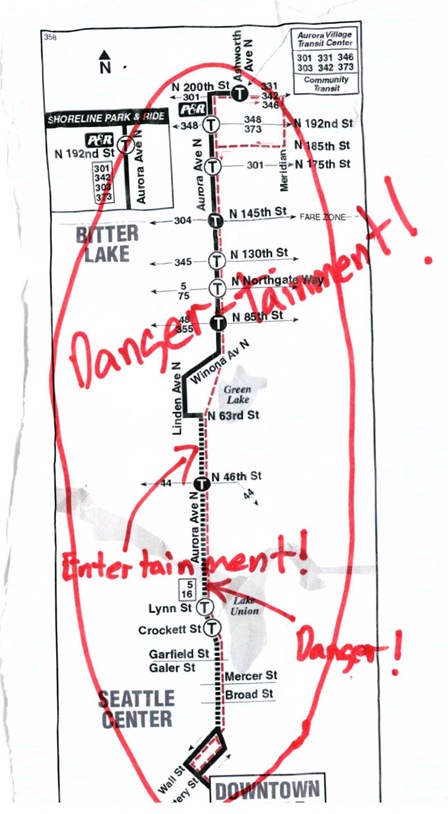
    Back in Episode 2, we had some fun with commercials for the King County Metro Line #358 Express to Aurora Village, or as I like to call it, “My Danger-tainment” bus.  Listen here to the very first one we did.  (“Read-along” script below the fold.)

    Here’s a quick review of the info on the upcoming show.

    Who:     The Sandbox Artists Collective

    What:    SANDBOX RADIO LIVE! Episode 4 “THE CHASE”

    Where:  West of Lenin (203 N. 36th Street, Seattle WA) www.westoflenin.com

    When:  Monday, April 16th, house opens at 7:30 with live music, show at 8:00pm

    How Much:   $10 suggested donation at the door, Reservations recommended! Available April 2nd: http://www.brownpapertickets.com/event/236740
     
    Sandbox Radio is conceived, produced and directed by Leslie Law.
     
    contact:  sandboxradio@thesandboxac.org
     
    Podcast available in iTunes and here:  http://www.thesandboxac.org/podcast.html

    (more…)

  • The Chase

    The Chase

    Markheim’s just a half-fallen angel trying to keep his head down and walk neutral in The Show, but a street kid stole his dog and now some Cherub has dropped down from the Fix for heaven only knows what reason.

    Seattle ain’t big enough for two expatriate angels. Sam ain’t gonna like it.  And when Sam’s unhappy, nobody’s happy.  

    Does tax season have you on the emotional lam?  Then join “The Chase”: The Sandbox Artists Collective’s fourth episode of its wildly successful SANDBOX RADIO LIVE! to be recorded before a live audience on Monday, April 16 at 8:00pm at Fremont’s newest theatre, West of Lenin.

    Entirely new, fresh and locally grown, Sandbox Radio is written, produced and performed by some of Seattle’s hottest stage talent. This latest episode, “The Chase” will include new original poems by playwrights Elizabeth Heffron and Scot Augustson, new short plays by Vincent Delaney, Ki Gottberg, Elizabeth Heffron and Juliet Waller Pruzan, plus Episode 4 of Paul Mullin’s noir-angel serial “Markheim”, original blues from Charles Leggett, and special guest chanteuse Joanne Klein.  Before the show and during intermission enjoy a beverage from our newly added bonus feature, The Sandbox Bar!   Halloween Sandbox Fun

    Members of the Sandbox Artist Collective currently scheduled to appear include: Megan Ahiers, Eric Ray Anderson, Shawn Belyea, Ki Gottberg, Mik Kuhlman, Amy Love, Charles Leggett, Todd Jefferson Moore, Peter Dylan O’Connor, Rebecca Olson, Kathryn Van Meter and Richard Ziman. Original music will be provided by Jose Gonzales and The Sandbox Radio Orchestra: including Dave Pascal, Dan Tierney and Rob Witmer.  You won’t want to miss this, and you won’t want to wait until the podcast of this episode is available online.

    Come see it LIVE! on Monday, April 16th…
     

     Sandbox Radio 4 postcard

    Who:     The Sandbox Artists Collective

    What:    SANDBOX RADIO LIVE! Episode 4 “THE CHASE”

    Where:  West of Lenin (203 N. 36th Street, Seattle WA) www.westoflenin.com

    When:  Monday, April 16th, house opens at 7:30 with live music, show at 8:00pm

    How Much:   $10 suggested donation at the door, Reservations recommended! Available at Brown Paper Tickets after April 2nd by clicking here

    Sandbox Radio is conceived, produced and directed by Leslie Law.  Contact:  sandboxradio@thesandboxac.org

    Podcast available in iTunes and by clicking  here

  • A Delicious Sampler of Sandbox Radio Live

    Sandbox Radio Live from Sandbox Radio on Vimeo.

  • New Zen Digs

    New Zen Digs

    Him what knows, won’t tell ye.
    Him who’ll tell ye, don’t rightly know.
    The Hillbilly’s Tao

    When I tell people I’m a Zen Buddhist the conversation usually goes something like this:

    Wait.  What?

    I’m a Zen Buddhist.

    You? You’re a Zen Buddhist?

    Yes.

    You are? Mr. Angry Pants? Mr. Be-Careful-of-Daddy’s-Martini? Mr. Picks-a-Fight-with-You-‘Cuz-He-Likes-You?… You’re a Zen Buddhist?

    Yes.

    Really?

    Yes. Really. I mean, ask yourself, who needs it more? Do you really want to imagine what I’d be like if I hadn’t been meditating on a daily basis for the last 21 years?

    Thankfully, these conversations do not happen very often. The first rule of Zen Club is you do not talk about Zen Club. Plus, seriously, I find it awkward and somewhat humiliating to discuss Zen in a culture that uses the word to promote everything from skin moisturizer to coffee blends to sex lube. Barnes and Noble contains a whole section devoted to Zen in every one of its superstores, but I can count on one hand clapping the people I know, outside of my temple, who have ever seriously practiced. I suppose it’s easier to sit and read a book than it is to just sit.  Wait.  I don’t suppose; I know.  But hard or not, just sitting’s how the magic happens.

    I usually practice zazen, or “seated meditation” by myself, at home or on my special bench overlooking Elliott Bay near my work or down by Green Lake on the weekends.  However the community of practice, or “sangha”, is one of the three wheels that make the Buddhist tricycle go.  So I understand it is my responsibility as well as my inordinate blessing to practice with a temple as often as I can.  That’s where Dai Bai Zan – Cho Bo Zen Ji comes in.

    I first starting going to Dai Bai Zan – Cho Bo Zen Ji (translated as “The Listening to the Dharma Zen Temple on Great Plum Mountain”) back in 1991.  (You can check out the temple’s website here.) My good friend and collaborator in the Seattle theatre scene, John Sylvain, turned me on to the place. Back then the temple was a tiny living room in the International District behind the Wonder Bread Factory.  The rest of the house was where the abbot Genki Takabayashi lived. I remember being so intimidated the first couple times I went to beginner’s night that I had to steel myself to open the front door of the small house that had nothing but a wooden sign painted with the words “Clear Quiet Clean” to identify it as a zendo.  Could I really sit still for twenty-five minutes without moving or making a noise, then get up, stretch for half a minute, then do it again for almost half-an-hour?

    A wizened little Japanese man, like some embarrassingly trite Hollywood stereotype of a Zen master, the abbot Genki Roshi,  would sit next to the huge bell, stiller than stone.  Most weeks, Genjo Marinello, the American-born vice-abbot would sit next to him and lead the question-and-answer period afterwards; but one night it was just me and Genki.  It was like sitting with a ghost.  I struggled with, and eventually let go of, my irrational fears that the old man would forget I was there and fall asleep or just decide to go all hardcore Zen on me and sit for three hours without a break.  As I breathed, I calmed down.  The two meditation periods passed like fleeting dreams. Genki Osho served tea. Bowed. And then left me there alone. In that moment I began to understand what all the hype over Zen was about… nothing. Absolutely nothing. Absolutely gorgeous, clear and life-affirming.

    Genki Roshi had little English and never spoke at “Introduction to Zen” nights, though he often served the tea. (If you’ve never been served tea by a genuine Zen master, well, all I can say is, you’re missing nothing– the huge, beautiful, inner-eye-opening nothing that I mention above.) However, at longer half-day and week-long retreats the Roshi would give a commentary on some selection from the Buddhist canon. Genki would sit like a monument for an interminable moment before speaking, then squinch up his face and growl softly:

    Booodhaaah?… Booodhaaah?… No Boodhah… No BOODHAH!YOU da Booddhah!… No Shinking. [No thinking]. Shtraytuh cuhhting. [Straight cutting].

    YOU da Booddhah!… You da BOODHAH!

    Genjo sitting beside him, would then translate. “Genki Roshi asks you to consider Mumon’s commentary on the 33rd Case, Baso’s ‘No Mind, No Buddha’….” It wasn’t uncommon for Genjo to take ten minutes “translating” something  Genki said in 30 seconds.

    After a year or two the temple lost the lease on the little house in the I. D., and was forced to take up residence in the back room of an Aikido dojo on Aurora Avenue up around 76th Street North of Greenlake. This was a strange and difficult transitionary period in my life as well. I was going through a divorce, living hand-to mouth on temp jobs in a comfortable enough but tiny studio on Capitol Hill: alone, no phone, no TV, no social life, no car. About all I could count on was, if zazen was scheduled for an evening, and if I made the hour-long two-transfer bus trek to the temple, someone—maybe just one someone– Genjo or Genki or some other ranking member of the temple—would be there to just sit with me.

    I usually keep my mouth shut during Q & A sessions, but one night, when it was just me and Genjo, and I had endured both sits with a big sore heart and tears rolling down my face, I asked if he had any advice on how to get through really, really hard times. His answer was simple. Maintain the practice, and remember to have compassion: compassion for others of course, but first and foremost, compassion for myself. He told me to sit, and listen to my pain; witness it; notice that with each breath, somehow, I was getting through it.

    Five years later Genjo Osho officiated at my wedding to the most inside-and-out beautiful woman I have ever met. Shortly thereafter, Heather and I moved to New York City, but I never sought out a temple there. I guess I was too afraid of the Yuppie Zen factor that plagues big rich cities like New York and San Francisco. When our first baby boy came into the world, we decided to move back to Seattle, where I resumed attending Dai Bai Zan – Cho Bo Zen Ji, back in its own house again on Capitol Hill.

    This past Fall, the temple relocated to a larger building on Beacon Hill at 1733 S. Horton St., just five blocks of the Beacon Hill Light Rail station.  In January, I finally had the honor and pleasure of sitting zazen in these new digs.  Then in February I attended a “mini-sesshin”. (A mini-sesshin is a half-day meditation retreat.  A full sesshin can last a week or more.)

    Contrary to what Amazon would have you believe, the best introduction to Zen practice is not downloading the latest book to your Kindle, but rather practicing zazen itself. Dai Bai Zan – Cho Bo Zen Ji offers an excellent and extremely accessible introduction to seated meditation at the Tuesday night “Introduction to Zen” which begins promptly at 7:30 pm. (Allow yourself at least ten minutes extra: the last thing you want to do is barge in late on a zazen session.)

    If you are as intimated as I was 21 years ago, then contact me and I’ll go with you.  That’s what sangha’s all about.
  • The Blessings of Getting Better: Sandbox Radio Live!

    The Blessings of Getting Better: Sandbox Radio Live!

    Like any good theatre town, Seattle tends to lavish plenty of hype on the inaugural production of a new company when that company is made up of talented veterans who have proven themselves on other stages around town. Pressure mounts on the new ensemble to make their kick-off show one of the best audiences have ever seen, thus assuring crucial momentum for the future. Of course, the inherent danger lies in forgetting that no matter how earth-shatteringly brilliant your first play is, the primary law of show business remains as immutable as gravity: you are only as good as your last gig.  A company that can never live up to the promise of its premiere production is a company destined to be loved like a first crush: fondly, but weakly, and with an ardor that fades even as the intervening years serve to burnish or blur the memory of love-at-first-sight’s luster.

    Happily, through luck, hard work and great leadership, the Sandbox Artists Collective has managed to escape that fate with its quarterly audio offering, Sandbox Radio Live. Don’t get me wrong. We had a great initial outing, back in July of last year with our first show.  And lots of delicious hype to go with it. But I don’t know anyone who would argue we couldn’t do better.  And better we did, with the second iteration, a horror-themed show turned out just in time for Halloween.

    With this third episode, however, every member of the team— writers, actors, musicians and production crew — stretched out into strong new strides: going beyond what we had done before with a confidence that surely grew out of our prior successes and failures.  Everyone seems to agree that Episode Three, “To Hell With Love” was our best show yet.  And best of all, now that the podcast is ready, you can listen and decide for yourself by clicking here.

    For me, the evening did not contain a single clunker.  I loved every segment, from Anita Montgomery’s hilarious plumbing of the particular hell that is on-line dating in “F- You, Cupid!” to Elizabeth Heffron and Leslie Law’s stirring tribute to the great radio drama talent, Norman Corwin, in the show’s finale, “Corwin on Corwin.”  And I will never forget when Elizabeth Heffron’s delightful sex romp in space “T-Minus” gloriously Lesliel Law and Heather Curtis Mullin singing their gorgeous duetdissolved into an Offenbach duet sung by Law and the shimmering soprano Heather Curtis Mullin.  As Heather herself will tell, you it’s no great accomplishment that this brought me to tears.  I’ll cry at a cell phone commercial.  But that doesn’t diminish the welling of awe I felt witnessing that unrecoverable moment of live theatre.

    Wait!  What did I just say?  “Unrecoverable?”  Bullcrap!  Due to the greater glory of Sandbox Radio you can go and recover it right now, here!   (Act I, 52:50).

    And here’s a list of all the evening’s pieces:

    Episode 3, “To Hell With Love”
    recorded at West of Lenin on January 23, 2012

    Act 1

    @1:55 “F-You, Cupid!” by Anita Montgomery
    @13:28 PSA-Coal Free Washington by Vincent Delaney
    @16:45 “Lost Love Blues” by Charles Leggett
    @22:53 “Markheim: Episode 3” by Paul Mullin
    @37:30 “T-Minus” by Elizabeth Heffron

    Act 2

    @0:00 “Angry” by Charles Leggett
    @2:48 “Charlotte Doesn’t Clean Here Anymore” by Scot Augustson
    @17:55 PSA-Communities in Schools of Seattle by Vincent Delaney
    @21:08 “Corwin by Corwin” by Elizabeth Heffron
    @40:03 Finale/Credits

    Charles Leggett IS MarkheimTrue to the night’s pattern, my own piece, the third installment of the noir angel series, Markheim, was the best one yet.  If I can modestly say so, I am really starting to find the action of the story.  And the actors, foley artists and musicians have modulated the series’ unique and tricky tone to pitch perfection.  As always, I’m providing the script for Episode Three below the fold.

    (more…)

  • Sincerely, Good Luck

    Sincerely, Good Luck

    Of course I believe in free will.  I have no choice.
    Isaac Bashevis Singer

    Imagine that I am essentially cynical and selfish. Imagine that what a friend of mine who works at one of Seattle Big Houses once told me is true: that the only reason I write this blog is because I’m mad that they won’t produce my plays.  Imagine that my outrage has always been, and will always be, essentially self-serving.  Come on.  Imagine.  Like the man says, it’s easy if you try.

    It would explain a lot actually, like why nearly a year ago I felt safe saying in a post titled “On Institutional Arrogance”:

    Allow me to honor the clarity of Intiman’s ultimatum with some clarity of my own: I hope they die.   I hope they do it soon and with a minimum of suffering.  And most of all I hope they do it without siphoning precious funds from the rest of us who make theatre in the Pacific Northwest.

    It didn’t take a psychic to know that , despite then Artistic Director, Kate Whoriskey’s guilt-trippy pandering plea, they were highly unlikely to raise the half a million dollars they were asking for in what I called their “shoot-the-puppy” campaign.  So I bet the safe money and called for them to close their doors.  Cynical.  Self-serving.  And ultimately dead accurate.

    Similarly but conversely, when the Intiman announced last August that they would keeping Andrew Russell on as “consulting artistic director” and that his goal for 2012 would be “….to establish a loose collective of playwrights, directors, actors, designers and others to devise projects for Intiman to produce, in a short “micro-season” mounted next summer…” I kept my mouth shut.  Here was a situation not so easy for a self-serving cynic to prognosticate. 

    Then in November Russell made his plans plainer.  This from The Stranger’s Slog:

    At a press conference earlier today, Intiman announced it was going to make a go of it after all, with a four-play summer festival, a repertory company of 12 actors, and artistic direction from Andrew Russell. The four-play season is a “split focus,” as Russell put it, between Intiman regulars and a potential new crowd that wants to see newer, weirder, more local work.

    Reading further down I learned that Russell had recruited for his bold new strategy some of Seattle’s most exciting (and mostly young) talents like Marya Sea Kaminski, Michael Place, and Jennifer Zeyl; topping it off by somehow snagging the venerable Dan Savage to provide the original work for Russell’s four play plan.  This was no longer a “shoot-the-puppy” campaign.  This was a “Honey-look-at–this-adorable-puppy-I-brought–home-for-Christmas!” campaign.  And a very sexy puppy at that.  When you’ve been as cynical and self-serving as I have, for as long as I have, you learn not to bet against this kind of talent.  I kept my mouth shut again and waited to see if the “phoenix Intiman” could raise the million they were now asking for.  I suspected they would.

    And late last night we found out they did.

    I have met Andrew Russell.  He was gracious enough to come hear an early reading of my new play Ballard House Duet.  Along with a handful of other trusted colleagues, he gave some truly insightful feedback.  It’s clear to me that Andrew is extraordinarily talented at motivating people and, more importantly, money.  In the world of 21st Century regional theatre, you really cannot ask for more of an artistic director.  And Andrew has a few other things going for him.  He’s young.  He’s ambitious, and unlike his predecessor Kate Whoriskey, he owes his position not to sinecure but his own pluck and determination.  In short, he earned it.  What’s more, he’s making deep connections with the amazing talent native to Seattle.  All this bodes well for the success of his career, if not necessarily for the sustained success of Intiman.  But then again, I think I have been clear in the past how much I care whether the institution we formerly knew as the Intiman lives or dies.  Instead I say, long live the talent represented in the team Andrew has assembled, and long live his own talent for recognizing and organizing it.

    And if, as I cynically suspect, Andrew ultimately winds up on the same path as a few promising rookie Mariners, eventually proving himself worthy of a trade to the Yankees in a few years, well then, I may grumble and bitch, but I will still watch in quiet admiration when he belts one over the bleachers in New York.

  • Seattle Shakespeare Gets it Right

    Seattle Shakespeare Gets it Right

    Most of us in the Seattle theatre community have been waiting anxiously to see who Seattle Shakespeare Company’s board of directors would name as the new Artistic Director.  We have seen other theatres in town screw up this decision miserably in the past, most especially by perpetrating the now infamous “nationwide search for talent”.  Thankfully, the Seattle Shakes board saw that George Mount is a locally grown talent that no one in the nation can match in perfectness for this job.  As Phil Miller, the Board’s Chairman, said in an email to Seattle Shakes supporters:

    Out of all of the criteria we had in looking for a new artistic director, George has the best balance. He’s had hands-on experience in the company’s main areas of programming and has deep ties to our arts community. His ability as both an artist and administrator won him a ringing endorsement from the Board.

    Deep ties indeed. George knows us. And we know George. He has sweated with us in cramped backstages on the fringe, and he has whispered jokes in the woods with us in Lynnwood and Issaquah and on Mercer Island as we waited to go on in some summer production of the Wooden O.  George is the opposite of a carpet bagger.  He laid the frickin’ carpet. 

    When I mentioned to George a few months back that I was rooting for him to land this position, I added that I thought it would be unwise for me to say so publically, given the very little love lost between myself and Seattle’s upper caste of arts administrators and board members.  An endorsement from me might very well have the opposite effect than intended.  George nodded sagely at this, but said nothing.  That’s George for ya.  He’s good at nodding sagely, keeping mum.

    So I am incredibly delighted to be able to come of out the closet and proclaim my deep and enthusiastic support for George, as hind-sighted as it might seem now that the deal is done.  Seattle Shakes will certainly thrive under his leadership.  And long long may that last.

    * * *

    Confidential to George:  As happy as I am for you— and I am truly delighted, as much for the entire  Seattle theatre community as I am for you— I still won’t let you off the hook about developing new work.  You can dance with the pumpkin-panted hack for as long as you like, but some day you need to do yourself and everyone else a favor and direct a world premiere.  It’s what Will would have wanted.

  • Come Hear Undo

    Come Hear Undo

    What’s better than being a playwright having a reading of a play you think might be good?   Easy.   Being an actor in a reading of play you know is good.

    Holly Arsenault was already a friend and colleague of mine when she took my playwriting class at Freehold a couple years ago.  Towards the end of the 8 weeks, we all sat down to read a nice chunk of her play Undo.  I was blown away by the wit and natural craft Holly showed in this early draft.  I swallowed my jealousy and gave her the only note I had.  “Finish this thing.”  Later, when Holly informed me she was pregnant with her first child, I’m pretty sure I said something like, “That’s amazing news!  Mazel tov!  And finish that play!”

    And in surprisingly quick time, she did.

    Come hear as I help to read it publically for the very first time, with a coterie of actors so far superior to me in their skills that I’m not really sure why Holly asked me to join them.  And yet I shall join them, confident in Holly’s play’s power to make me look good, and hopeful that somehow this old strutter can somehow return the favor.

    Here are the details:

    Undo
    A new play by Holly Arsenault
    Directed by Matthew Richter

    Featuring Basil Harris, Gretchen Krich, Hana Lass, Jonah Von Spreecken, Paul Mullin, Roy Stanton, Samar Lerman, Sarah Harlett, Tina Rowley and Zoey Cane Belyea.

    When:  Tuesday, November 29 at 7pm

    Where:  Seattle Repertory Theatre’s PONCHO Forum, 155 Mercer Street, Seattle, WA 98109.

    Face Book Event: http://www.facebook.com/events/151916888242933/

  • The Inalienable Happy Pursuit of the Living Wage

    The Inalienable Happy Pursuit of the Living Wage

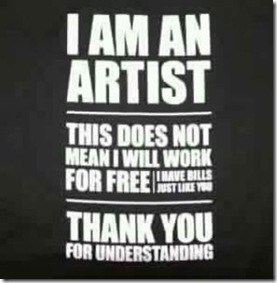
    This image has been floating around Face Book lately, accumulating plenty of “likes” on its way. 

    Well, I don’t like it.  I actually kind of hate it.  I believe that once an artist ties his or her work in a one-to-one, all-or-nothing relationship with making a buck off it, the game is done, and the moneyed powers-that-be have won it all over again.  Nothing new or good or game-changing can come out of saying you’re only going to do your art if someone pays you a living wage for it. Instead, what you are really saying is that your creativity is simply one more commodity to be bought and sold in a market-driven society owned by folks who know a lot more about money, and a lot less about creativity, than you do.

    One the other hand, I also hate the idea artists should shun the marketplace altogether. We should get paid,  as much as we possibly can in any given market. (So long as we are aware and comfortable with knowing that some markets will only offer us compensation that is utterly untranslatable into coin.)

    Up until now I have not written about the “living wage” crisis in Seattle Theatre because I did not have a good new idea on how to frame it. Then I attended the October Seattle Theatre: What’s Next? Forum, and listened with growing excitement as actor/producer Peggy Gannon kicked off a heated round-robin discussion of the issue that was finally and brilliantly summed up by Annex Theatre’s Meaghan DarlingJim Jewell’s notes from the night describe it best:

    Making a living and making art should not be mutually exclusive.

    This last point came out of our earlier discussion, but was most eloquently encapsulated by Meaghan Darling, fairly paraphrased as, “Nobody owes me a living, but I want them to not prevent me from making a living.” Big House rehearsal schedules were particularly discussed here, as the now-standard 10-6 rehearsal day precludes keeping a day job, while the economics of theatre (and of course there is much debate here) can’t offer a sustainable salary for that work (and we lamented how many amazing actors have had to leave town or the profession). We all rallied around this idea, because it is very much in the spirit of Seattle Theatre: What’s Next as a whole – it is a statement that holds within it hope and offers compromise, which seem to me essential components of productive dialogue.

    “Life, Liberty and the pursuit of Happiness.”  Despite the Tea-Bagging idiots who have co-opted their ideas and headgear, our Founding Fathers were no fools. No one can or should guarantee anyone happiness or a living wage. But when your systems—and this goes for unions and Big House administrations alike—stand in the way of the pursuit of making a decent buck from doing theatre, well, then the truth becomes self-evident, and independence must be declared.  If this be treason, let’s make the most of it!

  • Hawking Whole Theatre at “What’s Next?”

    Hawking Whole Theatre at “What’s Next?”

    Last night I joined a small but extremely energized group of theatre professionals at the second iteration of “Seattle Theatre: What’s Next?” hosted by Jim Jewell and Peggy Gannon.  I want to talk more about what was discussed and what action items came out of that discussion, but I think I will wait until Jim publishes the official minutes.  Until then, here’s a transcript of the three minute spiel that I was asked to give on what’s currently exciting me about Seattle Theatre:

    Whole Theatre

    Be careful what you wish for, sure.  But when it comes to Seattle Theater, it’s also wise to be specific what you wish for.  For a good while now Seattle’s Big House theatres have been gradually increasing the percentage of local actors they hire.  And rightfully they have then touted this change as a noble step in the direction of locally grown theatre. But let’s be honest.  We all know one of two things happened.  Either the artistic administrators of Seattle’s Big Houses all got together in a room and decided, “Hey, we should do the right thing and hire more local actors.”  Or… they all independently realized that in the current depression it was becoming cost prohibitive to fly in every actor from New York or LA.  I’ll leave it to you to decide which scenario seems more plausible.  But look, when a good thing happens it’s churlish to over-analyze the reasons for it.

    The problem is that using local actors isn’t enough.  And so when we advocate for locally grown theatre, we need to be more specific…  Whole Theatre.  Theatre that is soup to nuts local: written by local talent in collaboration with local talent.  Zero degrees of separation among everyone from the playwright to the director to the designers to the actors to the audiences. 

    Zero degrees of separation. 

    If what I am proposing sounds radical or overly ambitious, consider this: we do it all the time.  In fact, if I can brag a little, as a playwright and an actor, I have done very little in the last five years that hasn’t been Whole Theatre.  Going back to 2006, there was the Empty Space production of Louis Slotin Sonata.  When the floor needed final painting, Allison Narver was there in jeans, helping designer Gary Smoot to finish it.  I’m trying to picture one of Seattle’s Big House artistic directors doing that.  To be fair, I’m sure there are union rules against it.

    Then there was The Ten Thousand Things, which Washington Ensemble Theatre produced.  I sat in a room with the director and the designer Etta Lilienthal talking through her sketches. Later, I sat in the theatre while audience members rewrote my play one word each performance.

    And most recently there was Newswrights United producing two living newspapers, researched, written and produced by Seattleites, about Seattleites, for Seattleites.

    And of course it’s not just stuff I’m working on.  There’s the incomparable 14/48, perhaps the most consistently exciting weekend of theatre in town.  All local actors, directors, designers and crew mixing it up on plays written by local playwrights in the space of maybe ten hours, tops.

    There’s Printer’s Devil, opening yet another Scot Augustson world premiere, Shadow Odyssey in their unique committed relationship with him.

    There’s Sandbox Radio which just staged its second all original slate of short pieces, combining some of Seattle’s best actors with the best playwrights and musicians.

    And right on the horizon is Rebecca Olson’s new project Custom Made Plays, commissioning local playwrights to write for specific local actors.  I’m happy to be the playwright on the pilot play, writing for Rebecca herself and Hana Lass.

    Whole Theatre.  Theatre that hasn’t had the yummy good-for-you stuff processed out of it.  Non-corporate theatre that ain’t stale from being packaged three years ago in a theatre scene 2,700 miles away by MFA’s who have never stepped foot in your town.  Whole Theatre. Seattle’s crawling with it.  And surely it gives us the most solid shot at World Class.

    (I want to do a version of the poster that says Enjoy Whole Theatre!  Or as Shakespeare, Molière and Chekhov called it, “Theatre.”)