Just Wrought

Recovering playwright, once won a STRANGER Genius Award for theater. Now writing a bloated novel about… G-d help me! Theatre.

Tag: Paul Mullin

  • Unlosing the Lost Plays

    Unlosing the Lost Plays

    There are great plays that you can never experience fully. Sure, you might see them as movies, or read them as “literature”, but despite what your high school English teacher sold you, plays are not literature, any more than music or sculpture are. You may think you are special and that you can wring every artistic significance from a play by reading it; but you’re not and you can’t. There are aspects of dramatic character that only an actor can convey by speaking out loud, live, in front of you. (Not to get pedantic, but this is why we call it an audience.) Because of this, there are great plays you will never experience—at least not as plays—because of very practical reasons excluding them from the possibility of ever being professionally staged again. 

    Stalag 17 by Donald Bevan and Edmund Trzcinski* is just such a play. The original 1951 Broadway cast contained 21 men, a size which is simply not financially sustainable in today’s theatre economy. Beyond cast size, a myriad of other reasons doom to the dusty shelf some of the canon’s greatest plays. Once these plays cease to be performed, they are essentially lost to our culture as works of art, though of course they still have value as artifacts.

    To the rescue rides Seattle’s Endangered Species Project, dedicated to giving monthly staged readings of plays that seldom get full productions.   As they explain on their website:

    In the present economic straights in which regional theatre now finds itself, much of the so called established international repertoire is neglected, for various reasons: there are too many different settings, or the casts are too large, or simply, the publicity requirements of selling a play that is both “old” and unfamiliar to general audiences may seem too daunting.

    We feel that while it is an essential duty of theatres to read and develop new work, our group sees a parallel need to celebrate older or otherwise neglected plays….

    Through our free, simply staged readings, we hope to lend live voices to plays that are now silent on our bookshelves.

    It is the blossoming of projects like ESP that continually renew my faith in Seattle theatre’s progress toward World Class standing.

    Next Monday evening, September 19, at 7 pm you can defy the entropy of modern theatre and see a one-time-only reading of Stalag 17 artfully staged by director Leslie Law, with such brilliant casting as Shawn Law as Sefton (an even more natural choice than William Holden) and Richard Ziman as Sergeant Shultz.  (No, this ain’t Hogan’s Heroes Sergeant Shultz**, though he obviously inspired the sitcom role.  This German non-com has no compunction about torturing a POW on stage to determine the whereabouts of a missing American pilot.)
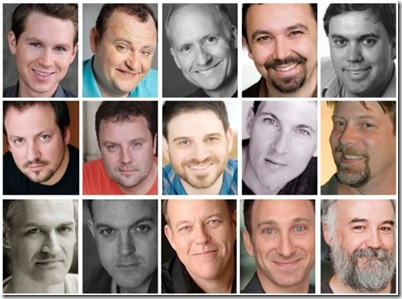
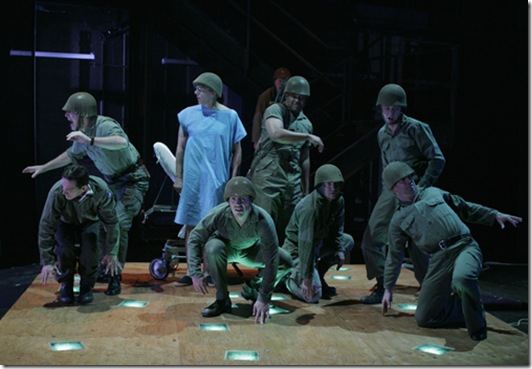
    Stalag 17 Cast featuring:  Brett Brennan, Brandon Whitehead, Allan Armstrong, Gavin Cummins, Eric Polani Jensen, Shawn Law, Paul Mullin, David Goldstein, Vincent Delaney, Keith Dahlgren, Chad Kelderman, Mike Dooly, Richard Ziman, Chris Ensweiler, Galen Joe Ozier

    Even if you only live another ten years, my best guess is that you’ll have about 12 more chances to see Twelfth Night, six to see American Buffalo, and between five and five hundred opportunities to watch something scripted by Sarah Ruhl; but unless my prodigious predictive power fails me now, you will never, not as long as you live, get another opportunity to hear Stalag 17 performed by such a cast as this.

    Don’t miss it.

    (more…)

  • Heather’s Eleventh of September

    Heather’s Eleventh of September

    I told my 9/11 story with the playwright’s notes in the program for the world premiere production of The Good Ship Manhattan,  my hemi-demi-autobiographical play about those days in New York.  That short raw essay also serves as my forward to Original Works Publishing’s printed edition of the play.  So you can check out my version of events from Sunnyside, Queens online here (go to page 4).

    My wife, however, saw the second plane hit the towers with her own eyes from mid-town Manhattan.  For the first time ever, Heather Curtis Mullin has recorded in writing her memories of that day and the days to follow; and I am so grateful that she has given me permission to share them here with you.

    I was working in the Conde Nast building at 42nd and Broadway on the morning of September 11, 2001.  I was in an extremely good mood because my husband had celebrated his birthday the night before and we had been up late but I still felt pretty good.  I was logging in and getting settled at my desk when a co-worker came out of her office and said a plane had hit “the towers.” We walked together to the conference room on the southern end of the building which looked straight downtown to the World Trade Center.  As I made that walk I remember wondering to myself if we’d even be able to see the plane or the damage. One look out the window told me something terrible had occurred. Our view allowed us to see the missing parts of the building where the plane had entered and the enormous fire raging inside. Already at this time the thick black smoke was billowing into the blue and otherwise sunny skies.

    I called my husband who was at home and asked him what was going on. He turned on the TV and informed me that a passenger airliner had hit the tower. As other co-workers began arriving at work there was some discussion as to whether this was an accident or a targeted attack. Many were convinced it was an attack and we all stood in shock and horror as the second plane hit the towers.

    I remember yelling and placing my hand to my mouth. From our vantage point we did not see the plane and the uniform fire-burst made it look like a bomb. I had the sense at this point that we were indeed under attack and wanted more than anything else to get home. I also remember looking down at Times Square below which under normal circumstances would have been crowded with tourists and not seeing a single person.

    Awhile later I called my husband from my desk and asked him what was going on. He confirmed the second plane and seemed in shock by what he was watching. He became extremely emotional when he told me people were jumping off the towers. That was the first moment that I cried and felt truly frightened. I really wanted to leave and try to return to my apartment in Sunnyside Queens, but my husband was concerned the streets would be chaotic and dangerous.

    Around 10:30 -11:00 am most of our cell phones had stopped working and dialing out of the office was met with a recorded message that said “all circuits are busy at this time” so I decided not to break the phone connection with my husband and simply set the phone down on my desk. I asked my husband to call my family in Washington State and he was able to reach my grandfather who relayed a message that at that time I was still alive and well. There was already panic from several people who were unable to reach loved ones near ground zero.

    I honestly have no idea what time the towers collapsed but I heard shouting and screaming from the conference room and went running there to investigate. All I could see was a giant cloud of black and grey smoke towering toward the sky. It ‘was then that I decided I would leave the building and make my way across Manhattan to the 59th Street Bridge.

    The subway was not running so I would have to walk the five-plus miles to my apartment building. Someone had gone to the cafeteria and made sandwiches for us to take with us, along with bottled water. Several of us were walking the same way and went together. Before I left the office I told my husband where I would meet him and what I was wearing. He told me he loved me and I hung up the phone. I walked through midtown Manhattan to the sounds of sirens wailing and F16 fighter jets patrolling the air. What struck me most was the silence. The street was thronged with people and every single one of them was speechless. As we walked across the bridge we looked downtown where the tip of the island was belching thick black smoke at least a mile into the sky. Underneath the bridge were boats loaded with firefighters headed downtown to help with the rescue efforts.

    I will never forget to this day the sight of those boats, the beautiful September sky, the black pillars of smoke wafting up, the unique stench of burning materials and the sound of feet hitting the pavement.

    I managed to meet my husband and make it safely to our apartment around 3 pm on Tuesday, September 11, 2001. Like most people we watched tv through the night and into the next morning. Finally I turned it off and went to bed but was unable to sleep  – “what is happening?” I kept asking myself. I knew that I would never be the same.

    The next day New Yorkers were asked to stay home so I did, watching TV and crying with my husband.  On Thursday I went to work but due to numerous bomb threats and the chaos of the aftermath of the terrorist attack our company graciously allowed us to go home for two days of paid leave and return the following Monday.  Again I went home to watch tv and cry – only leaving the apartment to buy beer and cigarettes!

    On Friday of that week we were all asked to hold a vigil and my husband and I went down to our local fire station where they had lost three men. Their photos were taped to the side of the station house along with flowers and candles left by neighbors. About 25 of us stood around with candles and then we started singing “God Bless America” -which most of us couldn’t remember. The firefighters stood around looking sort of uncomfortable and then one by one they all began to cry. I don’t know why but at that moment I knew I would be OK and that America would be OK.

    I still get nervous in large crowds. I still look for all the exits in large buildings and I still hate to fly. My husband and I left New York City after our first son was born in May, 2002. I just couldn’t imagine trying to survive another attack with my infant. I miss the city and I miss the towers. I still think about 9/11 every day.

  • Seattle Artists Lose an Unsung Support

    Seattle Artists Lose an Unsung Support

    When I first came to Seattle in 1990 I had only one decent paying trade to my name: I knew how to clean glass. The problem was I was spoiled. In New York I had worked mostly high-rise residential units and got paid three dollars a window by my boss/friend Patrick Shields who worked next to me and also happened to be an actor/writer himself. In Seattle the only window work I could find was with a large outfit that did commercial properties and offered a flat ten dollars an hour. Instead of a bon vivant, polymath, small business-owner working next to me, I had ex-cons, two-bit bigots and pot-smoking thugs tying my ropes. (Literally.  One guy told me getting high beforehand made him concentrate harder on the knots.) I quit after a week and took a job dishing at a breakfast cafe in Green Lake, but the money from that, barely above minimum wage, just wasn’t enough.

    The advice I got at the 1911, the dive-bar de facto headquarters of 90’s Seattle fringe theatre, situated directly across Fourth Avenue from Annex Theatre, was simple: “go to Woods.” Woods and Associates was a small, locally owned temporary and permanent placement service located in the Galland Building downtown. I protested that I had zero office experience. The advice was reiterated: “Go to Woods. They’ll take care of you.  You can even tell them you’re an actor. They like actors.”

    “They like actors!?”  What kind of outfit was this?

    An outfit, as it turns out, that I would have an ongoing professional relationship with for the next two decades. My fellow Annexers were right.  After my initial interview I was paraded around the office to meet owner Sarah Woods, Sarah’s brother Will, Sarah’s business partner Sam Hunter, plus all the rest of the folks in the placement bullpen.  It didn’t matter that I was an actor or that I had never worked in an office.  I would start out slow and simple, they told me.  First gig: the microfilm department of Northern Life Insurance, where I captured images of old annuities documents on their way to the shredder. To tame the boredom I listened to Rush Limbaugh and KPLU jazz on my Sony Walkman. Aldrich Allen, another Annexer, now dead, worked beside me.  A few years later, when I came back from shooting a movie in Maryland to find my first marriage disintegrating, I needed a job desperately. So Woods put me back at “No Life”, this time in the licensing department. It’s where I got to know William Salyers and began to hatch my plan to write a role that only an actor of his talents could pull off.  A few years later we premiered Tuesday at AHA! Theatre.

    As time went on, I even found myself temping  in the Woods office itself. I called these gigs “meta-temping”. I used to love Fridays, not only because Sarah ordered in lunch and a masseuse every week, but also because Woods, unlike any other temp service I knew, paid every week,  on the week.  Many temps came into to pick up their checks personally, giving me a chance to do a quick gossip swap with my fellow show folk, like Chris Jeffries or Josh List.

    It is not an exaggeration to say Woods was a big part of why my wife and I came back to Seattle from New York City after 9/11.  Temp work in Manhattan had completely dried up.  My unemployment was running out and I had literally no idea how I was going to support our new-born baby boy.  I was certain, however, that if we went back to Seattle, Woods would find work for either Heather or me, so that the other could stay home with the baby.  As it turned out, Heather landed the more lucrative gig—she always could stand working for lawyers more than me.  On nice days I would roll my son in his stroller downtown from Capitol Hill and often visit the folks at Woods after having lunch with Heather.  Bottom line:  after a very tough year, Woods gave us options in another city where theatre thrived.

    Woods and Associates will be closing their offices for good today.  When I spoke with Sarah yesterday she sounded upbeat: “I don’t regret the decision at all, but it I’m the one making it so I understand it’s hard for others.”  I nearly choked up when I told her what Woods had meant to me and my family over the years.  “That’s the sad part,” she replied.  “We’ve all been there for each other: the folks that work for us, the client companies.”  Certainly Woods has always been there for me.  No matter how bad a particular day gig might get, I could always think to myself, “Well, I can quit and Woods’ll take care of me: find me something.”  Now, I guess I’m on my own.  My only solace is that I’m not alone in feeling that way.

    * * *

    So here’s my request.  If you are an artist, theatre or otherwise, and Woods has helped you at some point, please chime in down in the comments section below.  Share a story if you’d like, but chime in, regardless, even with just your name.  I’d love to share a sense of how many creative folks Woods and Associates has helped over the years.

  • Sandbox Radio – Worth the Wait

    Sandbox Radio – Worth the Wait

    A bunch of us founded the Sandbox Artists Collective a few years ago “as a place for mid-career artists to explore their craft in the company of their peers.”  Unlike most assemblages of show folk, the Sandboxers weren’t in any hurrsandbox_radio_episode_01y to produce publicly as a group.  Most of us were already performing, writing and/or producing professionally elsewhere. We were not, however, completely quiet in our first years, hosting salons, like Playground in which four Sandbox playwrights wrote specifically for Sandbox actors.  Finally, however— and fully to the credit of Leslie Law’s leadership— the membership felt the urge to share what happens when we put  our collective mind into putting on a show.  The result was last month’s Sandbox Radio Live, Episode 1, available now in podcast here.

    On an individual artist’s note, Sandbox Radio Live has given me the opportunity and motivation to finally flesh out a project I have been percolating since high school.  For all that time, all I knew was that I wanted to wright a nasty noir angel detective saga.  Now you can listen to the first chapter of Markheim on the podcast, with the incomparable Charles Leggett starring in the title role of the reluctant semi-heavenly gumshoe.  Below the fold I am posting the script in case you want to follow along. 

    And be sure to attend the next episode of Sandbox Radio Live on Monday, October 10th at West of Lenin, the fabulous new theatre space in Fremont, when Markheim adjusts to life in the strange city of Seattle, and begins his search for the reasons that brought him here.  Special appearance by the fellow that Jesus Christ Himself once called “the Prince of the World.”

    (more…)

  • Maybe not in Seattle, but “Over There” They Care

    Maybe not in Seattle, but “Over There” They Care

    Ah, the ironies of being playwrights in Seattle: the local Big Houses and mainstream press largely ignore us, and yet the national theatre blogosphere monitors our commentary on unfolding events, especially the Intiman implosion, with the rapt glee of NASCAR fans watching a slow-motion 13 car pile up.

    And now, we’ve gone international, as the United Kingdom’s Guardian runs a blog post on our response to the Intiman Board’s somewhat bemusing announcement that they intend to ask the advice of artists on how to proceed.

  • Making “Nows” from Now Matters Too

    Making “Nows” from Now Matters Too

    Here’s another dirty secret for you: I am as essentially indifferent to theatre as the next 21st century adult.  I like it fine, but if you were to tell me I could never see another production of American Buffalo or Titus Andronicus, I’d find a way to somehow suck it up.  And even though I spent a good part of my youth as an actor, and managed to pay for what little college I got with a performance scholarship; and even though I still really enjoy doing it, if you were to tell me that I had some strange incurable disease, basically benign but which would strike me dead if I ever again strutted and fretted, I’d still somehow find a way to live the rest of my natural days in non-thespian peace.  But I experienced something Sunday that reminded me yet again that there is one aspect of theatre I cannot and will not give up.  So if you tried to tell me I couldn’t write another play for live performance, and I thought you meant it– well, you and I would have a bit of a war on our hands.

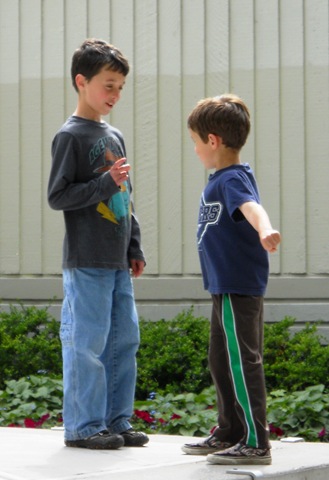
    My wife and my boys, ages nine and six, decided late Sunday afternoon to attend the opening performance of Balagan’s Theatre’s 2011 summer outdoor offering, King Arthur and the Knights of the Playground.  It was a perfect Seattle summer day, a rare enough jewel of deep greens and blues.  About a hundred and fifty of us, maybe more, gathered on the rich lawn behind the Asian Art Museum in Volunteer Park beneath some of the most glorious old trees you could ever hope to see.  There were friends, and friends of friends, and friends and family of cast members and crew, and just plain lovers of theatre, young and old; and we all watched some truly sublime goofiness with a wide open heart at its core. I wrote the section—one of five— called “The Ballad of Balin and Balan”, and based my interpretation of these two tragically fated brother-knights on the relationship of my own two sons.  Sitting there on a blanket with my mostly oblivious models, my heart was in my throat from the beginning of the piece, and I was embarrassed to have to wipe my eyes at the corny final scene:

    [They both fall to the ground, gasping.]

    BALAN:  You know what this means?

    BALIN:  We’re gonna die.

    BALAN:  Well, yeah, but something else.

    BALIN:  Yeah?  What?

    BALAN:  The curse said you would kill your best friend.

    BALIN:  Yeah.  So what?

    BALAN:  So that means I’m your best friend.  Curses can’t lie.

    BALIN:   Hey, yeah, that’s right.  And I’m your best friend.

    BALAN:  That’s right.

    BALIN:  Forever.

    It didn’t bother me one bit that my sons were more interested in the toy light sabers wielded by the actors than the fact that I had used their sweet, easy devotion to each other as my inspiration.  I’m pretty sure that if the real Richard III had a chance to see a modern Seattle production of Shakespeare’s play about him, he would be way more fascinated in the costumes, props and actual women on stage than in any resemblance to the biographical facts of his life.  (This is, by the way, another glorious feature of theatre.  We all see something deeply different.)  What blew me away was my own awareness of a profound and magical moment, wherein the very beauty of the earth seemed to host this collection of stories, as sweet and true and fresh as life itself; that my boys were watching grown men attempting to match the matchless nobility of love that children can hold for one another.  And I was part of it.  A very small, perfectly happy part of it.  And because my job was done, all I had to do was breathe and gratefully accept the moment knowing that I can have no idea what experiencing the moment might mean down the road for either of my boys, but suspecting there’s a good chance that it might mean something.

    Making plays matters.  Alas, I still have immense difficulty convincing many of my colleagues of this truth.  There’s a director in Seattle whose work I consistently admire who has maintained publicly more than once that he doesn’t believe we need any more new works for the stage because we will never have enough time or resources to produce all of the great plays that have already been written.  Many powerful decision makers in American Theatre agree, most implicitly, but some even explicitly, that the canon of theatrical literature is full: like the Bible, we cannot, should not, and even must not, add volumes to it.  I shake my head and smile at this notion, so apparently provable in the abstract, and yet so falsifiable by one deep blue green gorgeous Sunday afternoon in 
    Seattle’s Volunteer Park.

    Balan-Declan and Balin-Keelan

    Please forgive the geek metaphor, but if plays are algorithms—timeless software to be run on a particular time’s theatrical hardware (i.e. actors, sets, costumes, props, lighting and sound designs and, yes, even directorial concepts), then I want some of those future algorithms to be from my time.  Put more simply, if plays are “nows” thrown forward into “then”, then I need to believe that some of those “then-nows” will be from this now, if only so my sons’ daughters might know something of how wonderful their fathers were to each other when they were boys.

  • This is Why I am Shutting Up

    This is Why I am Shutting Up

    I kicked off 2011 here at Just Wrought with an essay called “Demons’ Year Off” in which I promised to reduce my ranting and “listen more than talk going forward”.  In a more recent piece, “Joining Averroës’ Search” I renewed my commitment to keeping quiet so that others, ideally smarter, more informed and better positioned to effect change might join the discussion.  (Admittedly, this is a bit of a quixotic gambit, given how mum most of Seattle’s artistic administrators have kept during this crisis.) Today, with his post over at the Seattlest “Open Letter to the Intiman Board”, Jim Jewell has reaffirmed my faith in the ability of smart arts professionals in this town to lead the way out of this crisis, and maybe even show the nation how it is done.

    “… For all of the difficulties facing Intiman, you have also been presented a unique opportunity. While every other theatre in town, and really in the country, tries to figure out how to make difficult transitions, shifting the earned/contributed income balance and trying to break from the failing subscription model, you have a blank slate…. This is not the time to try to fix a broken model, but to take the pieces you have and build something new. It isn’t enough to be stewards; a steward could easily work in hospice. We need you to be shepherds, to lead, and to be willing to follow, the rich flock of artistic talent in Seattle.”

    Jewell goes on to offer suggestions both bold and innovative, but neither impossible nor even all that risky, compared to the very real risk that Intiman’s board will do nothing significant at all.

    He rightly points out that the subscription/season model is a tumor that sucks the vitality out of arts institutions across the country, and he offers a sober workable alternative tempered by his experience as the former Marketing and PR Manager at Seattle Children’s Theatre, the founder and de facto leader of the marketing discussion group Holes Not Drills, and as Managing Director of NewsWrights United.

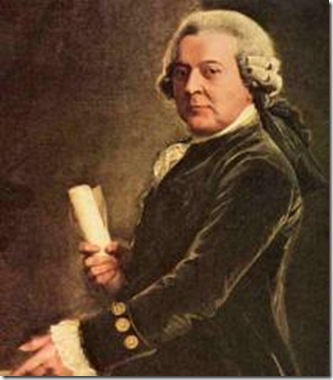
    For better or worse, whether in self-congratulation or deprecation, I can’t help but think of myself as Sam Adams in Seattle’s struggle to become a world class theatre town.  As folks are happy to point out, I have a knack for starting loud and unruly conversations; but Sam Adams, drunken loud-mouthed Tea Party-thrower that he was, was never well positioned to lead the colonies anywhere except into ever rowdier arguments.  In the end, he had to turn the struggle over to his betters and let them lead the cause. If I’m Sam Adams, then Jim Jewell is my cousin John: smarter, better informed, and better positioned to effect the change we need.

    Jim, the floor is yours.  Let facts be submitted to a candid world.

    John Adams

  • The Dream of the Black Soldier

    The Dream of the Black Soldier

    It is hard for me to imagine some future day when that day 67 years past will cease to captivate  human imagination.

    To all of the human beings whose fates were altered that day; in other words, to all of us: wherever we go, whatever we do, let us go and do it seeking peace, with the understanding that sometimes the world must be wrested back from those who would hold it in ignorance and malice.

      (…Louis opens his eyes and smiles at the audience, raising his arms out of the ice troughs like a prophet.)

    SLOTIN:  The time is come.

    DREAMER A:  It’s June the 6th, 1944.

    DREAMER B:  I’m in an amphibious landing craft headed straight for Omaha Beach.

    DREAMER A:  Normandy.

    SLOTIN:  Time is come. 

    DREAMER A:  As I look around at the other soldiers puking up their last rations–

    DREAMER B:  As the LC bounces across the channel’s heavy chop.

    SLOTIN: I realize a strange thing.

    BLACK SOLDIER:  I am a black man.

    SLOTIN:  I have always been black.

    DREAMER A:  From Arkansas maybe, or the Carolinas.

    DREAMER B:  I am the only Negro on this boat.

    BLACK SOLDIER:  Hell, I’m the only Negro in this entire invasion.

    DREAMER A:  And even with the shells lofting columns of sea and spray all around us. 

    DREAMER B:  And even with the shore looming closer and closer, and the thrill and terror pumping so thick I can taste it.

    DREAMER A:  I have to laugh.

    SLOTIN:  Because I realize there’s been some mistake:

    BLACK SOLDIER: This ain’t my war.

    DREAMER A:  The boat hits the beach. 

    DREAMER B: We can hear the bullets clanging on the other side of the steel landing ramp.

    DREAMER A:  And then down it drops.

    DREAMER B:  And we can see machine gun fire churning the water in front of us to a wall of froth.

    BLACK SOLDIER:  Ain’t nobody stepping into that.  But when I turn round, the Navy skipper’s pointing his sidearm Colt at us.  So what do we do but go?  White boys falling all around me.  Some cut to pieces by the guns, some just drowning under their gear.  But I move forward.  Kraut bullets just won’t hit me.  Ain’t my war.
          I got me a Browning automatic rifle and I start pumping her good into anything that moves up on them cliffs.  And then I’m up the cliffs.  I leave all them white boys behind dying and such down on the beach.  Ain’t got time for that.  Ain’t my war.  Every lousy Kraut blue-eyed bastard I find, I just jerk back on my B.A.R. and pump some lead in his face.
          “Damn, Fritz.  Sorry now, ain’t ya?  Should a thought a that sooner, hunh?  Now get down in hell where you belong.

    DREAMER A: And then I’m running.

    DREAMER B:  Running ahead.

    BLACK SOLDIER:  I ain’t got time for this.  This ain’t my war.

    SLOTIN:  I run past Paris.

    BLACK SOLDIER:  Sorry, Ladies.  Much as I’d like, ain’t no time for that now.

    DREAMER A:  I run forward.

    SLOTIN:  Past the Maginot line.

    DREAMER B:  Into Germany.

    BLACK SOLDIER: And I kill Krauts when I see ’em, but ain’t wasting no time neither.

    DREAMER A:  I’m running.

    DREAMER B:  Past Berlin.

    SLOTIN:  Past Hitler.

    BLACK SOLDIER:  Ain’t got time for that lousy little shit-ass now.  Let ’em eat his own lead.

    DREAMER A:  I’m running.

    DREAMER B:  I’m into Poland now.

    DREAMER A:  And then I’m there.

    SLOTIN:  Auschwitz.

    BLACK SOLDIER:  And damned if it don’t look just like “Gone With The Wind”.  Big ol’ plantation with big ol’ pearly white columns.  And who you think’s sitting up on that porch, just a-sipping on a julep but the Doctor himself.

    SLOTIN:  Mengele.

    DREAMER A:  Kill him.

    DREAMER B:  Kill him now.

    BLACK SOLDIER:  Yeah.  Now we got somebody worth killing.  I stroll on up them front steps drop my BAR from my shoulder and get set to shoot, only the gun ain’t a gun.  Just a damned stick.

    DREAMER A:  A yardstick.

    DREAMER B:  A slide rule the size of a yardstick.

    DREAMER A:  It’s hard to say.

    DREAMER B:  It’s all pretty hard to say.

    SLOTIN:  At any rate, Mengele smiles.  He gets up, and from his vest pocket draws a very small knife.

    DREAMER A:  A scalpel–

    BLACK SOLDIER: And cuts me open.

    SLOTIN:  To find the foolish Canadian Jew inside.

    BLACK SOLDIER & SLOTIN (together):  Louis.

    BLACK SOLDIER:  And right then and there it dawns on me–

    DREAMER A & DREAMER B (together):  We got trouble.

    (Blackout.)

    BLACK SOLDIER & SLOTIN (in darkness):  Louis… we need to talk, Louis.

    From Louis Slotin Sonata

  • The SunBreak Suggests Some New Strokes

    Just because I have excused myself from the debate about the future of Seattle Theatre along with the broader crisis in American Arts doesn’t mean I can’t celebrate an insightful perspective, especially when it comes from someone who sees the problem from sides I can only barely glimpse.  Michael van Baker, Editor and Publisher of The SunBreak once worked for the Seattle Opera and other non-profit arts organizations around town; and in his recent post, “Arts Marketing for Dummies”.  He sneaks us a peak of some of the lessons he learned, with promises of perhaps more and deeper observations to follow:

    Because self-preservation is the defining aspect of arts institutional life–ironically, the non-profit model virtually guarantees it–the business model warps in that direction. People begin to have trouble distinguishing between best business practices and those that have worked in the past to pay everyone’s salaries. Over time, the institution’s existence–its habits and proclivities–mediates the art presented. It’s not just a question of the popularity of one work versus another–it’s a question of box office receipts. That’s what’s being discussed when the directors meet: saleability.

    It should be discussed! Don’t get me wrong. But, as before, is anything important being left out?

    Van Baker sketches some bold fresh solutions, but with the sober understanding that they are not likely to be quickly adopted by a cadre of arts administrators who would rather sink with the ship than swim a new stroke.

    Rule: We create art and outsource/outshare the rest….

    …  As it happens, arts administrators are not the soulless quasi-corporate drones they are at times portrayed to be. So it’s already the case that most arts organizations collaborate and share a great deal, more than you might expect if you considered how competitive the marketplace is. The problem is, they collaborate inefficiently. … Every single organization reinvents the database, usually in their own way, and the results are sometimes anarchic.

    The situation is unlikely to change because, at an institutional level, there’s no apparent incentive and the loss of control disturbs leadership. Thus, database management and mining remains a core function of organizations theoretically devoted to art production.

    Van Baker also recognizes a fact which took over a year of me blogging here to sink into my thick skull:  a lot of folks, in this city particularly, would rather quibble and bitch behind backs than make any actual moves.  Says Van Baker, “Of course, the arts being what they are, there are many over-educated people willing to argue about minutiae rather than broader principle.”

    Towards the end of the piece Van Baker hints that there might be a larger, more detailed opus forthcoming.  I encourage that effort and look forward to its fruition, especially since I’m shutting up.

  • Joining Averroës’ Search

    Joining Averroës’ Search

    One of my favorite stories by Jorge Luis Borges is “Averroës’ Search”.  It’s not a very good story— Borges himself admits as much in a rather tortured apology that he tacks on at the end—but it’s a story about theatre—at least in part—and since it’s one of the only times Borges, a favorite of mine, touches on the art form that I have sunk so much of myself into, the short piece has become special to me.  I can approximate how many times I have read it by counting the different colors of pencils I have used to mark it up: dark blue, light blue, purple, green.

    The story opens with the great Islamic annotator of Aristotle lamenting the frequent appearance in the Poetics of two words  that, to a devout Muslim of the 12th Century, seem to have no meaning at all: “tragedy” and “comedy”. 

    He had come across them years earlier in the third book of the Rhetoric; no one in all of Islam could guess as to their meaning….  Yet the two arcane words were everywhere in the text of the Poetics—it was impossible to avoid them.

    In the very next paragraph Averroës takes a break from his work and looks down from his balcony. 

    …  There below, in the narrow earthen courtyard, half-naked children were at play.  One of them standing on the shoulders of another, was clearly playing at being a muezzin: his eyes tightly closed, he was chanting the muezzin’s monotonous cry,  There is no God but Allah.  The boy standing motionless and holding him on his shoulders was the turret from which he sang; another kneeling, bowing low in the dirt, was the congregation of the faithful.  The game did not last long— they all wanted to be the muezzin, no one wanted to be the worshippers or the minaret.

    For me, this is Borges at his best and most loveable: a great thinker imagining a great thinker struggling to imagine a concept that, in fact, palpably surrounds him.  As many of my friends who like to argue with me point out, theatre will always survive.  You literally cannot not have theatre.  But as Borges might counter, you can certainly have it without knowing you have it.  Perhaps that’s where we are heading.  The great Argentine did foretell the internet after all.

    Recently, in a fit of frustration that so many people seemed to miss the point of my recent post about playwrights not making a living from their plays while plenty of folks make one making theatre, I recently wrote the following self-pitying status on Face Book. 

    I somehow need to find a way to harness the average Seattle theatre artist’s endless enthusiasm for arguing into an actual force for change.

    Yes, we’re all smart. We’re all well read. We all know how to attack a straw man and cleverly defend the indefensible, but at what point do we decide we can do better and then take steps to do it?

    It’s a cliché, but it always applies: if not us, who? If not now, when?

    Maybe self pitying isn’t the right description.  Maudlin?  Mawkish?  In any case, a good friend and theatre colleague blithely chimed in: “Shut up and do a show.”  It’s good advice.  Well, again, advice isn’t really the right word.  No one telling you to shut up is giving you advice so much as dictating a directive, and a rather ironic one at that, since it’s impossible to tell someone to shut up without opening your mouth.  Still though, the person who said this has a largely gentle heart, and I know he would not want me to do anything I did not really want to do. 

    With the understanding that I did not have a lot of room to talk about Seattle theatre unless I was actually making Seattle theatre, I have been pushing pretty hard on producing over the last few years.  This spring I wrote and served as executive producer for The New New News: A Living Newspaper; a little over a year before that I served in the same capacities for It’s Not the the P-I: A Living Newspaper About a Dying Newspaper.  And before that there was The Ten Thousand Things at Washington Ensemble Theatre, The Don Juan Cult Concerto at NSCC, Tuesday and An American Book of the Dead- The Game Show at Annex Theatre.  Just listing those shows makes me smile and feel tired at the same time.  Boy, have I done some shows since coming back to Seattle in 2002!

    Now it’s 2011 and I have foundered on a fact that frightens me a bit and that I need to share with you.  I don’t want to put on another show.  Even if I did, I don’t have one.  It’s just not in me at the moment.  And I don’t know if it ever will be again.  (It feels like a long moment, frankly.)  I believe this is something that every theatre artist has to face at some point.  A future with no shows.  But just like Averroës, I will be surrounded by theatre whether I know it or not, whether I want it or not.  After all, isn’t the Intiman’s colossal failure a tragedy in the truest sense?

    So, with the understanding that one earns one’s right to speak about Seattle theatre by making Seattle theatre, I need to cash in for a while and keep my mouth shut.  I will still keep Just Wrought active, and still post here, but my advocacy for Seattle becoming a World Class theatre town, and all the kvetching and posturing that goes with it, is hereby retired indefinitely.

    It is time for me to shut up, sit back, and watch the show… as produced by others.