Just Wrought

Recovering playwright, once won a STRANGER Genius Award for theater. Now writing a bloated novel about… G-d help me! Theatre.

Tag: Paul Mullin

  • Yussef el Guindi’s Interview at HowlRound Gets me Pumped!

    Yussef el Guindi’s Interview at HowlRound Gets me Pumped!

    One of the best things about Seattle as a theatre town is that it’s small enough that you can get your arms around it.  If you care to, you can get to know pretty much everyone who is active here as an artist.  For instance, I have met Yussef el Guindi, chatted and corresponded with him, and very much enjoyed the interaction.  But thanks to Vincent Delaney’s interview of Yussef over at HowlRound, I feel like I know him so much better, and admire him all the more for it.  His thoughts on the new works scene in Seattle are fervent and hopeful without indulging in the “best-of-all-possible-cities” Pollyannaism that some successful playwrights and artistic administrators like to espouse publically here.*

    I . . . wish artistic directors were as brave as their audiences. I think audiences are much more adventurous than some artistic directors imagine. . . .

    What’s surprising to me is that you’d think the Seattle theater scene would be more open to riskier choices, in terms of choosing plays that are a little edgier, even more political. Seattle being, for the most part, a liberal city, you’d think that would be reflected in the plays selected. But perhaps more than being liberal or progressive, Seattle is also known for being very civil. We are a polite town. That politeness gene, I sense, seems to influence the selection of plays, as much as anything else. But then I’ve always felt theaters in general are inherently conservative, especially the big LORT houses. . . .

    Thanks, Yussef, for energizing and inspiring me to keep working for world class.  You being here gets us so much closer.

    * Note to said colleagues: singing desperate paeans to perfection is a particularly pernicious form of despair.  We can only have hope when it’s possible for things to get better.

  • Sh%t’s Finally Gettin’ Real over at HowlRound

    Sh%t’s Finally Gettin’ Real over at HowlRound

    After dispensing with the obligatory, “gee, ain’t-Seattle-swell?” lovey-dovey lip service, we are finally getting to some questions in the comments on Vincent Delaney’s kick-off essay that point to ways in which we can truly progress towards being a world class theatre town.

    Here’s playwright and novelist Nick Stokes:

    Not that I’m not up for drinking beer and listening to our plays, but . . . I’d also venture to say that without original work being produced on some scale, we don’t have a unique Seattle Theater scene. We just have the same theatre as everyone else and nothing to claim as our own. Which doesn’t necessarily hurt actor careers, though it does stunt those of writers and directors and perpetuates everyone’s obscurity.

    Do we as writers have a bad self-image locally? I don’t think so. I think the confidence problem is higher up the production chain. That said, the best we as artists can do to create a scene is create engaging, unique, provocative work and get it up however we can (Eclectic, West of Lenin, Fringe, self-production, etc.) … and that said, the scene will remain pretty small without some serious institutional support and a belief among those in positions of influence that we have a scene worthy of discussion and capable of national relevance.

    And here’s playwright Keri Healey (who just gave us the world class play Torso):

    Can someone in-the-know provide us with a compare/contrast look at which services are provided through all the existing new play development programs in Seattle? What does “play development” mean to each of these programs — and what are their goals with the plays/playwrights once the “development” portion of the program is over? Writers, are you getting your scripts produced at these theaters or getting help from them in securing productions at other theaters once you have gone through this process? I find that in Seattle, it’s a fairly easy process to pull a few public readings of a new script together (gathering actors and a director and getting feedback). I’ve even found producing (at a small level) to be accessible to many folks. What is most difficult, for me, are those next steps…of getting the play beyond the public readings/first production stage and onto a broader platform. I’d love to hear about the other features that are available through the various programs, if any current/past participants can chime in on those.

    Perhaps some of Seattle’s customarily silent Big House artistic administrators would finally care to weigh in during this nationally broadcast discussion of Seattle as a theatre town?  It really ain’t too late for them to join the fray.

    Or for you! 

    I know my buddy Vince would love to hear from you.

  • Hoodies Up! – Theatre for the Right Here / Right Now

    Hoodies Up! – Theatre for the Right Here / Right Now

    Witness if you will the reactions of two anonymous members of the community when The Stranger’s Slog recently publicized the casting call for  Hoodies Up!: The Trayvon Martin Protest Plays:

    1

    I am skeptical there are any new insights on the Trayvon Martin affair left that theater can illuminate

    Posted by Zebes  on April 24, 2012 at 5:49 PM

    2

    It seems premature to go on about making theater about a tragic event that NOBODY in the theater group knows anything about (except for media reports – which are notoriously unreliable).

    Only two people know what happened that night, and one is dead. It seems like they should wait for the outcome of the trial to begin a production on the story… After all, they don’t have the story yet, nobody does.

    Posted by scratchmaster joe on April 24, 2012 at 5:54 PM

    I find these reactions fascinating and telling beyond their surface trollishness.  In fact, they exemplify attitudes shared by artistic administrators at big regional theatres here in Seattle and across the country.  Boiled down, the core ideas shared by these trolls and Big House leaders are:

    • No one has anything new to say in the theatre
      (i.e. anything happening in any 21st century location can be easily addressed with a play from 16th Century England, 19th Century Norway, or 20th Century New York City.
    • If someone does have something new to say, we should wait to say it until it is old.
      (i.e. keep working on that adorable play you’re developing about the culpability of key Seattle executives in the U.S. Mortgage Meltdown. Maybe we’ll take a look at it when enough time has passed to guarantee not upsetting anyone.)

    Thank goodness  that Tyrone Brown, Brownbox Theatre, and the artists working on Hoodies Up! have chosen to ignore this advice when it comes to greeting the Trayvon Martin tragedy with something nobler and stronger than empty-headed posturing and/or meaningless violence. 

    Here’s the press release with all the information you need on this amazing event.  I hope to see you there.

    (more…)

  • Radio Reality

    Radio Reality

    One time as a kid I was sick and my dad left me at home by myself with talk radio playing in the kitchen downstairs. (Hey, it was the 70’s.) I was a touch feverish and I started to imagine that the people talking were actually sitting at my kitchen table. This tickled me immensely.

    Last night I had an opposite but even more delightful experience at Sandbox Radio Live’s Episode 4: The Chase! The venue, West of Lenin, was completely sold out— beautiful living butts in every seat.  So I had to stand in the back behind the risers, along with fellow writers Scot Auguston and Elizabeth Heffron.  I couldn’t see the actors or the Foley artists as they worked their magic, but the performances were so rich, the sound effects so convincing, the music so utterly compelling that I began to float freely in an alternate ocean of radio reality.  Because I couldn’t see Richard Ziman playing the Nazi interrogator, he became the Nazi interrogator.  When he popped a bottle of bubbly and poured it, it actually happened even though 25 feet away from me a Foley artist was faking it all with a table full of clever sound props.  I will admit that at one point I had to move forward to see with my own eyes Charles Leggett blowing his harmonica because I simply refused to believe the outrageous amazement my ears were trying to convince me of.

    Sandbox Radio is magic.  And the world class artists that generate it are led by a genius, Leslie Law, who in four episodes has managed to accomplish the most difficult task there is in show business: producing consistent excellence, over and over, and getting better each and every time.

    I don’t need you to believe me because the proof is in the Podcast coming soon!

    (You can go here for podcasts of our first three episodes.)

  • Rain City Projects Rocks It World Class with Vol. 3 of Manifesto Series

    Rain City Projects Rocks It World Class with Vol. 3 of Manifesto Series

    So I know you are going to find this hard to believe, but I was recently getting into it with a fellow playwright about the failures of the New York-centric hub-and-spoke model of new play development.  His argument was the tired old saw: “If you want the best product, you have to get it from the where all the best gather to produce it.”  If I recall correctly, he gave as an example: “If you’re were looking for a new sensei for your martial arts dojo, you would to look to Okinawa.”  I really have no idea what that means.  I did, however, offer the counter that if I want the best cheese, beer, wine, meats, fish, fruit and vegetables, I don’t really need to look beyond the Pacific Northwest.  Then I posted a helpful link on his Facebook wall to my essay “Theatre Takes Place: Why Locally Grown Plays Matter.”

    The link disappeared within an hour.  So much for the free exchange of ideas.  I suppose when it comes to thoughts on theatre, the proper direction of flow is one-way from New York City to everywhere else.  

    But honestly, I don’t even need to argue when amazing Seattle institutions like Rain City Projects regularly put world class money where my big mouth is.  Case in point, their upcoming release of Volume 3 of their Manifesto Series, a regularly published anthology of great Northwest Plays.

    Can I even express to you how honored I was to be included with the likes of Yussef El Guindi recent winner of The Harold and Mimi Steinberg/ATCA New Play Award, or my personal heroine Elizabeth Heffron, or Stranger Genius Award winner Chris Jeffries or the fiercely incomparable Bret Fetzer and Stephen McCandless, all hand-selected by the nationally renowned playwright and playwriting teacher Naomi Iizuka?

    Nope. I don’t believe I can, but— dammit!— I can try.

    This coming Sunday we will be celebrating Volume 3’s release with free readings from several of the collected plays.  I’ll be there.  Yussef and Elizabeth mentioned they might be, too. So why don’t you come on down so we can sign your copy, hot, fresh, and locally sourced, right off the presses!?

    Here are all the crucial details from Rain City Projects:

    Rain City Projects is releasing the third book in its Manifesto series – anthologies of plays by Northwest playwrights. We’re very excited this time to have an anthology of seven plays selected by Naomi Iizuka who started by writing a manifesto of what theater should be and then chose plays she felt exemplified her vision. Please join us for a reading of short excerpts from Ms. Iizuka’s delightful manifesto and from the plays she chose including:

    Language Rooms by Yussef El Guindi

    Clubfoot by Bret Fetzer & Stephen McCandless

    Mitzi’s Abortion by Elizabeth Heffron

    Vera Wilde by Chris Jeffries

    An American Book of the Dead by Paul Mullin

    Live! From the Last Night of My Life by Wayne Rawley

    and Wizzer Pizzer by Amy Wheeler

    Sunday, April 15th at 2:00pm

    The reading is FREE and will be held at Elliott Bay Book Company 1521 10th Ave, Seattle, WA 98122

    Manifesto v. 3 will be available for purchase along with Manifesto v. 2 (edited by Steven Dietz) and Manifesto v. 1 (edited by Erik Ehn).

  • The Chase

    The Chase

    Markheim’s just a half-fallen angel trying to keep his head down and walk neutral in The Show, but a street kid stole his dog and now some Cherub has dropped down from the Fix for heaven only knows what reason.

    Seattle ain’t big enough for two expatriate angels. Sam ain’t gonna like it.  And when Sam’s unhappy, nobody’s happy.  

    Does tax season have you on the emotional lam?  Then join “The Chase”: The Sandbox Artists Collective’s fourth episode of its wildly successful SANDBOX RADIO LIVE! to be recorded before a live audience on Monday, April 16 at 8:00pm at Fremont’s newest theatre, West of Lenin.

    Entirely new, fresh and locally grown, Sandbox Radio is written, produced and performed by some of Seattle’s hottest stage talent. This latest episode, “The Chase” will include new original poems by playwrights Elizabeth Heffron and Scot Augustson, new short plays by Vincent Delaney, Ki Gottberg, Elizabeth Heffron and Juliet Waller Pruzan, plus Episode 4 of Paul Mullin’s noir-angel serial “Markheim”, original blues from Charles Leggett, and special guest chanteuse Joanne Klein.  Before the show and during intermission enjoy a beverage from our newly added bonus feature, The Sandbox Bar!   Halloween Sandbox Fun

    Members of the Sandbox Artist Collective currently scheduled to appear include: Megan Ahiers, Eric Ray Anderson, Shawn Belyea, Ki Gottberg, Mik Kuhlman, Amy Love, Charles Leggett, Todd Jefferson Moore, Peter Dylan O’Connor, Rebecca Olson, Kathryn Van Meter and Richard Ziman. Original music will be provided by Jose Gonzales and The Sandbox Radio Orchestra: including Dave Pascal, Dan Tierney and Rob Witmer.  You won’t want to miss this, and you won’t want to wait until the podcast of this episode is available online.

    Come see it LIVE! on Monday, April 16th…
     

     Sandbox Radio 4 postcard

    Who:     The Sandbox Artists Collective

    What:    SANDBOX RADIO LIVE! Episode 4 “THE CHASE”

    Where:  West of Lenin (203 N. 36th Street, Seattle WA) www.westoflenin.com

    When:  Monday, April 16th, house opens at 7:30 with live music, show at 8:00pm

    How Much:   $10 suggested donation at the door, Reservations recommended! Available at Brown Paper Tickets after April 2nd by clicking here

    Sandbox Radio is conceived, produced and directed by Leslie Law.  Contact:  sandboxradio@thesandboxac.org

    Podcast available in iTunes and by clicking  here

  • Please Let the Daisey Debacle Mean More Theatre/Journalism, not Less.

    Please Let the Daisey Debacle Mean More Theatre/Journalism, not Less.

    A lot has already been said about the revelation that Mike Daisey fabricated many portions of his one-man show, The Agony and The Ecstasy of Steve Jobs: a piece he previously passed off as entirely truthful reportage, most egregiously on This American Life, a nationally broadcast public radio program. I leave it to wiser minds to sort through all but one of the many questions Mike’s transgressions raise, reserving for scrutiny only that which I feel I am particularly qualified to examine: what impact will Mike’s dishonesty have on the intersection of theatre and journalism?

    A huge number of people are familiar with Daisey’s work creating and performing topical monologues at some of the most prestigious venues in America, from the Seattle Rep to New York’s Public Theatre to the Woolley Mammoth in Washington, D.C. A much smaller number of people know of the work produced by NewsWrights United, a theatre company I co-founded and serve as Executive Director. We dramatize news using a form invented in the early 20th century called the living newspaper, and all of our stories are researched and written by local Seattle playwrights. (Memorable examples include Scot Augustson staging the farcical misadventures of a reporter/photographer duo sent to Detroit a week early to cover the Seahawks only Superbowl appearance; and on the serious side, Pamela Hobart Carter’s lyric poem/play about the psychic damage done by the Green River Killer.) On first appearances, NewsWrights United and Mike Daisey seem to occupy similar territory in the art/news nexus, but in actuality I believe we do something fundamentally different, and if I can tease apart for you these differences, I earnestly hope to convince you that coverage of news in the theatre is something worth saving even if Mike Daisey’s methods are not.

    I predict two reactions to this crisis from artistic administrators at U. S. regional theatres. The first is already in evidence. Institutions that have already booked Mike will mostly stick with him, echoing his essential tack: “Yeah, lying to the public radio program TAL was wrong, but lying in the theatre is obviously eminently forgivable. After all—heck!—isn’t all theatre lying?” Artistic administrators are not widely known for the courage of their convictions, however, so I further predict that over the next year or two, while the controversy dies down, they will quietly divest themselves of as much Daisey stock as possible, so long as it doesn’t cost them too much to dump it. What’s worse, I also predict they will take the dreadfully wrong-headed step of underscoring this divestment with an abandonment of all new work that explores the intersection of theatre and journalism. (The exception to this new silent ban will be, perversely, Mike’s inevitable one-man apologia, which regional houses will be falling over each other to stage.)

    But forsaking the theatre/journalism intersection does not have to be our future. With hard work, honest self-examination and courage we can take this opportunity not to withdraw but advance the genre. As a once and, with luck, future practitioner of news theatre, I venture to offer some practical advice on how we might achieve this.

    Expand the Pool

    Beyond his extraordinary talent as a storyteller, Mike’s shows appeal to regional theaters across the country because they are cheap and easy to mount. Most important, they are portable. If you are looking to plug a little topicality into your otherwise staid season, you cannot do it more easily than by giving Mike a call.

    Living newspapers are much more difficult. To create effective alternatives to the Daisey Debacle, you have to give up some of the conveniences of the one-man show; most crucially, you have to give up the idea of “one-man.” Actual plays are vast collaborative efforts, featuring dialogue among and between more than one player on stage. The play development process contains a built-in organic vetting process that zeroes in on “truth” even when the story, like Agony/Ecstasy, is more accurately classified as fiction.

    For instance, I am working with Rebecca Olson’s project Custom Made Plays to develop a script for her and another actor. Every week I sit in a room with them and the director, carefully combing through the script with questions. The process is gentle but relentless, and when a false note gets rooted up, we pounce to replace it with something more “honest.” Many of the moments in Agony/Ecstasy that Daisey promised us were real were not. In retrospect, they reek of bad fiction now that we know that is exactly what they are.

    I reach into my satchel, and I take out my iPad. And when he sees it, his eyes widen, because one of the ultimate ironies of globalism, at this point there are no iPads in China. …. He’s never actually seen one on, this thing that took his hand. I turn it on, unlock the screen, and pass it to him. He takes it. The icons flare into view, and he strokes the screen with his ruined hand, and the icons slide back and forth. And he says something to Cathy, and Cathy says, “He says it’s a kind of magic.”

    Daisey’s a fine writer and I have no doubts he could have avoided this tripe, offering instead something genuinely brilliant, if he had only admitted it was fiction in the first place and then collaborated with performers and a director to sharpen it.

    Living newspapers expand the pool in more than one dimension. Beyond just other actors in the room, you must also let in other writers. How much would anyone trust a newspaper with only one reporter who also served as the sole editor? NewsWrights United engaged several local playwrights for its living newspaper about the demise of the actual newspaper, The Seattle Post-Intelligencer. By spreading the attack, we were able to cover a number of different beats—sports, politics and arts coverage at the P-I—in a wonderfully varied spectrum of styles, some of which implicitly “watermarked” their stories as fictionalization (but more on “watermarking” later.) Using more artists allows you to cover more kinds of stories, leading to another way to better provide theatrical news…

    Up Your Local Content

    It certainly was exciting to watch “David” Mike take on “Goliath” Apple from the stage of my local regional theatre; and certainly my local regional theatre enjoys, along with regional theatres across the country, the imprimatur of international relevance when such a story as Agony/Ecstasy gets told.  However, we lose a huge opportunity when our big houses keep mounting the very same one-man show, instead of staging local news that actually has as much, if not more, to do with the lives of local audiences as does Applegate. Let’s dare to flip the model and have each theatre produce its own living newspapers, telling stories about their own communities, and sure, plugging in national stories such as those Mike tells when appropriate.

    I promise you: locally grown journalistic theatre is not only doable, it’s been done. In NewsWrights United’s last effort, The New New News: A Living Newspaper, we locally sourced nearly all of our stories about the crisis in journalism brought on by the digital age. Our play It’s Not in The P-I: A Living Newspaper about a Dying Newspaper gave voice to locally beloved P-I reporters so that a community eager to hear their tales finally had the opportunity that no other medium would give.  We also broke important exclusives into the buy-out process that the Heart Corporation used to cherry-pick and union bust their newsroom as they shuttered the print version of The Seattle P-I and moved to an all on-line edition.  It didn’t hurt that one of our founding producers, Tom Paulson, is a professional journalist, formerly the P-I’s science reporter, and currently writing for NPR’s Global Health site, Humanosphere.

    Use “Watermarks”

    Not everything that takes place in a theater is theatre. If this is news to you, you might not be to blame. The theater = theatre fallacy is happily perpetrated by artistic administrators to fill their seasons with the easiest fare to produce. (Click here to see my essay on this.) True theatre is rife with “watermarks” built into both the text and context of a play to remind you, sometimes explicitly but mostly implicitly, that what you are seeing is to some degree false.

    “Watermarks?” You say. “How come I’ve never heard of these watermarks before?” Well, for two reasons: One, I just started using the term in a theatrical context about a week ago when I was trying to explain why Mike should not be allowed to take refuge in our art form. Two, watermarks are so endemic to theatre that we tend to look right through them, like reading glasses. The Greeks used masks as watermarks. Shakespeare and his contemporaries stitched their plays out of the watermarking fabric of Iambic pentameter. Not a single tradition within our grand form lacks them, but an exhaustive list is superfluous to this argument, because the definition of theatre is the ultimate watermark: two or more people staging a live dialogue (before you ask, no, it doesn’t have to be with words) within the physical perception of other people. Think about it. Someone tells you a story on the street. She could be lying. She could be telling the truth. But two or more people obviously acting out a story in front of you? Without question there’s some tomfoolery going on here.

    Of course there is an important stipulation implicit to the tradition of tomfoolery and even blatent dishonesty in the theatre: we demand ardent honesty about our dishonesty. We tell you were going to lie, before we do it, while we do it, and after we do it.

    If we shadows have offended,
    think but this; and all is mended
    that you have but slumbered here
    while these visions did appear 

    When you reach the certainty that we paltry players are lying, you can begin to understand that we are actually telling the truth. Daisey could have easily entered this tradition. He could have done all the good works he claims to have hoped to have done within it. Instead he took the risk that selling fiction as non-fiction would get him further. It did. But he got caught. And now he’s run back into our house claiming sanctuary. Brother Daisey has forgotten that theatre’s unwritten canon is as unyielding as the ecclesiastic: the crimes of the church can be punished within the church. If he wants sanctuary here, he will have to work hard and long at his penance.

    Here’s a simple rule of thumb about watermarks: a theater (i.e. the venue) cannot serve as a watermark; theatre (i.e. the work of art) must contain the watermarks that prove it false, and thus prove it true theatre. Otherwise you’re just some guy telling me a story and if you tell me explicitly that what you’re saying is true, I am likely to take you at your word.

    A living newspaper has an even greater obligation than conventional theatre to watermark early, often and obviously. For example, when we staged the Twitter stream of the Maurice Clemmons manhunt (He killed four Puget Sound cops in cold blood), we did not alter a single word of the tweets, though obviously, since there were over five thousand, we had to whittle them down considerably. We knew we could not give an accurate portrayal of what it was like to witness this stream in real time. No one could. Not only was it a moment passed, but in a way it was a meta-moment. No one person witnessed it in its entirety. So we posited the next best thing. We staged the stream as a symphony of actorsNEW NEW NEWS Twitter Chorus, Photo by Chris Bennion dressed in blue bird suits, evoking the Twitter logo. We weren’t just trying to be funny (though god I hope we were). We were saying, “Obviously we can’t give you the literal truth. Pay no attention to the blue bird suits if you don’t want to, but every (often idiotic) word these actors declaim was actually tweeted over that 3-day ordeal.” (Here‘s a segment on this section by Seattle’s NPR affiliate KUOW did .)
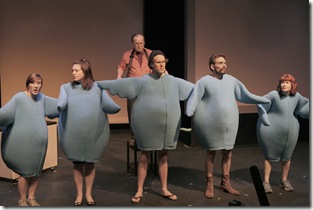
    Not only did Mike refuse to use watermarks, he actively defumigated the theatre of all its delicious anti-sanctity.

    “… Mike told at least me time and time again [that the story] was true. He insisted that “This is a work of non-fiction” be printed in playbills.” 

    Alli Houseworth,
    former marketing/communications director
    at Woolly Mammoth Theatre Company. 
    (You can read her excellent essay by clicking here.)

    Mike didn’t want a watermark within a mile of any house he played. He wanted us to believe every word he charmed us with. And now he encourages his defenders to ridicule and condescend to the very people who took him at his word. “We are all liars and hypocrites,” says Mike. There is something particularly vicious about the man who would punish others simply for being the victims of his sins.

    Act Like it Matters

    The worst thing I heard in response to Daisey’s dishonesty was this from a friend of a friend on Facebook:

    “I never believe you theater folk – you’re a rascally bunch.”

    Yeah, we’re rascally. But sometimes we are able to illuminate stories that journalists themselves are not willing to touch, like when NewsWrights covered the closing of the P-I. And sometimes we are able, like Daisey, to tell a story like Agony/Ecstasy, in such a moving way that we inspire people, perhaps otherwise impossible to inspire, to action. However, in order to poach a bit on journalism’s turf we have to be trusted.  Do we really want to give up this wonderfully fertile ground just because Mike Daisey lied and then excused his lies as so much “theatre”? Do we really want to let him claim sanctuary in our church where we have established traditions stretching across millennia of being scrupulously honest about our dishonesty?

    In answer to this question, the silence from big house artistic administrators so far has been pristine. Clearly theatre has a leadership vacuum in addition to its identity and relevance crises. No one seriously denies that we are simply not producing enough new, fresh, locally sourced material to keep our audiences engaged like Shakespeare’s were, or even Shaw’s. Projects like Daisey’s and NewsWrights United’s help mitigate the problem, but only if we take the issue of truthfulness seriously. We have to act like it matters. We have to show our audiences that we give the issue of truth consideration and respect, or they will walk away from us forever.
  • Sincerely, Good Luck

    Sincerely, Good Luck

    Of course I believe in free will.  I have no choice.
    Isaac Bashevis Singer

    Imagine that I am essentially cynical and selfish. Imagine that what a friend of mine who works at one of Seattle Big Houses once told me is true: that the only reason I write this blog is because I’m mad that they won’t produce my plays.  Imagine that my outrage has always been, and will always be, essentially self-serving.  Come on.  Imagine.  Like the man says, it’s easy if you try.

    It would explain a lot actually, like why nearly a year ago I felt safe saying in a post titled “On Institutional Arrogance”:

    Allow me to honor the clarity of Intiman’s ultimatum with some clarity of my own: I hope they die.   I hope they do it soon and with a minimum of suffering.  And most of all I hope they do it without siphoning precious funds from the rest of us who make theatre in the Pacific Northwest.

    It didn’t take a psychic to know that , despite then Artistic Director, Kate Whoriskey’s guilt-trippy pandering plea, they were highly unlikely to raise the half a million dollars they were asking for in what I called their “shoot-the-puppy” campaign.  So I bet the safe money and called for them to close their doors.  Cynical.  Self-serving.  And ultimately dead accurate.

    Similarly but conversely, when the Intiman announced last August that they would keeping Andrew Russell on as “consulting artistic director” and that his goal for 2012 would be “….to establish a loose collective of playwrights, directors, actors, designers and others to devise projects for Intiman to produce, in a short “micro-season” mounted next summer…” I kept my mouth shut.  Here was a situation not so easy for a self-serving cynic to prognosticate. 

    Then in November Russell made his plans plainer.  This from The Stranger’s Slog:

    At a press conference earlier today, Intiman announced it was going to make a go of it after all, with a four-play summer festival, a repertory company of 12 actors, and artistic direction from Andrew Russell. The four-play season is a “split focus,” as Russell put it, between Intiman regulars and a potential new crowd that wants to see newer, weirder, more local work.

    Reading further down I learned that Russell had recruited for his bold new strategy some of Seattle’s most exciting (and mostly young) talents like Marya Sea Kaminski, Michael Place, and Jennifer Zeyl; topping it off by somehow snagging the venerable Dan Savage to provide the original work for Russell’s four play plan.  This was no longer a “shoot-the-puppy” campaign.  This was a “Honey-look-at–this-adorable-puppy-I-brought–home-for-Christmas!” campaign.  And a very sexy puppy at that.  When you’ve been as cynical and self-serving as I have, for as long as I have, you learn not to bet against this kind of talent.  I kept my mouth shut again and waited to see if the “phoenix Intiman” could raise the million they were now asking for.  I suspected they would.

    And late last night we found out they did.

    I have met Andrew Russell.  He was gracious enough to come hear an early reading of my new play Ballard House Duet.  Along with a handful of other trusted colleagues, he gave some truly insightful feedback.  It’s clear to me that Andrew is extraordinarily talented at motivating people and, more importantly, money.  In the world of 21st Century regional theatre, you really cannot ask for more of an artistic director.  And Andrew has a few other things going for him.  He’s young.  He’s ambitious, and unlike his predecessor Kate Whoriskey, he owes his position not to sinecure but his own pluck and determination.  In short, he earned it.  What’s more, he’s making deep connections with the amazing talent native to Seattle.  All this bodes well for the success of his career, if not necessarily for the sustained success of Intiman.  But then again, I think I have been clear in the past how much I care whether the institution we formerly knew as the Intiman lives or dies.  Instead I say, long live the talent represented in the team Andrew has assembled, and long live his own talent for recognizing and organizing it.

    And if, as I cynically suspect, Andrew ultimately winds up on the same path as a few promising rookie Mariners, eventually proving himself worthy of a trade to the Yankees in a few years, well then, I may grumble and bitch, but I will still watch in quiet admiration when he belts one over the bleachers in New York.

  • Long Live Living Newspapers!

    Long Live Living Newspapers!

    When The Stranger asked me at the end of the year what my biggest regret of 2011 was, I said:

    I regret that due to limited resources, we had to mothball NewsWrights United prior to the Occupy movement blowing up, because I would have really liked to cover that in a living newspaper. Adjacent to that is my regret that none of the big houses in Seattle (or small, for that matter) saw fit to include making topical theatre, based on events happening right here right now, as part of their regular programming this year. 

    Well, shade my regret mitigated by the news from across the pond that my former playwriting student German Munoz has organized a living newspaper about the Occupy movement called The Occupied Times.  After spending a month researching and visiting the Occupy sites in London, emerging playwrights will present a night of short plays in the format of a living newspaper. They will act as reporters and cast a critical eye on the Occupy movement, its supporters and detractors, all under the Arcola Tent. 

    And color me even more vividly gratified when I saw that the project gave Seattle a shout-out in their press release:  “This project was inspired by It’s not in the P-I: A living Newspaper about a Dying Newspaper presented in Seattle in 2009 as a response to the closing of The Seattle Post-Intelligencer newspaper by Newswrights United.”

    Not surprisingly, The Occupied Times seems to be garnering the same sort of media excitement that the two living newspapers NewsWrights United produced in 2009 and 2011.  The London Evening Standard ran a preview of the piece   and quoted my friend German thusly:

    We want the show to explore sides of the movement that have not been heard. We’re hoping to reach people of all ages who feel they’ve made up their minds about the Occupy movement. People who either think of the protesters as a bunch of lazy hippies who don’t want to get a job, or see them as martyrs fighting the good fight against a system that is unbearably corrupt. Of course neither of these are completely true, and we want to show audiences our responses as artists and help them make up their own minds.

    I heartily encourage my friends in London to check out this fresh, locally grown theatre inspired in the crucible of the right here and the right now.  Here’s the show info:

    Six Degrees Productions presents  . . .

    The Occupied Times: A living newspaper
    about the Occupy movement

    Venue: Arcola Tent, 2-8 Ashwin Street, London, E8 3DL

    Date: Sunday 19 February, 2012

    Time: 3:00pm and 7:00pm

    Ticket prices: £12 (£10)

    Venue Box Office: 020 7503 1646 or http://www.arcolatheatre.com 

    For all enquiries and ticket requests, please contact:  German Munoz of Six Degrees Productions on 07854 231 085 or g@germanmunoz.com

    And as for my friends in Seattle, do you ever wonder why the Big Houses haven’t picked up such a wildly popular and media magnetizing idea?  Well, in fairness, maybe they will now that it is being done in London, one of the two officially approved cities for sourcing new plays.

  • Holy Fear

    Holy Fear

    More than once someone has come up to me before an opening of some play I wrote saying something like, “Oh, you’ve been doing this so long you probably don’t even get nervous anymore, right?”  My reply is always: “It’s precisely because I’ve been doing this so long that I’m terrified.  I know all the things that can go wrong.”

    In two days I will be joining the 14/48 team as an actor for the first time.  In the parlance of the Seattle’s venerable “instant theatre” festival, I’ll be a virgin, and thus forced to fetch beer from the keg for whichever veteran demands it.  The fact that I have served as a writer four times makes no difference.  Nor should it.  As an actor, I am a virgin.  I feel like a virgin.  And I have a virgin’s fears.  Or to be more accurate I should say, I expect to feel a virgin’s fears.  I just don’t feel them yet.  It’s one of the blessings of being an actor.  You really don’t need to plan that far ahead.  Actors are soldiers in the trenches. Sure, it’s their ass in the line of fire, but at least they have something to do when the lights rise and it’s time to go up and over.  A playwright, like a general, has to watch in horror– sometimes abject, sometimes surreal– from beyond the action.  Of course there is joy too, but a playwright’s joy comes only in flashes until the final curtain drops.  Until then, anything can, and often does, go wrong.

    So my 14/48 virgin actor fear hasn’t hit me yet, but I have no doubts that by the time of the first morning’s “actors’ draw”, when I find out which play I will be performing and who my director and cast-mates will be, my insides will be doing a nasty free-style crawl towards either end of my G-I tract.  And when it comes time to go onstage for the first performance, I fully expect my swollen heart to be thumping in my chest.  This is only right and proper.  It’s how human bodies process performing publically.  And it’s as it should be. 

    A healthy fear is essential to making theatre.  It is what keys us into the audience’s experience of the immediacy of the moment. If you’re not feeling it, then chances are the audience won’t be feeling much of anything.  And, alas, they’re used to that. If they want “perfection”, they stay home and watch the boob. Our fear as theatre artists fuels the whole machina ex deus that is theatre.  The audience gets off on knowing that the train can leave the tracks at any moment.  Ours is the crucible where the experiment of art is performed—not re-enacted—but embodied in flesh and sweat and spit.  If we already know we’re right— if we know from the outset that the experiment is going to succeed— then we are also already dead.  Fear is life.  Fear is holy.  And in these darkest Northwest days just after New Year’s, fear is also a much needed bolus of bright adrenaline.  I plan on nursing it until the lengthening days can take over.