Just Wrought

Recovering playwright, once won a STRANGER Genius Award for theater. Now writing a bloated novel about… G-d help me! Theatre.

Tag: Seattle

  • Day 8 / Reason 8: Amy Thone

    Day 8 / Reason 8: Amy Thone

    “Actors I know and love.”

    That is the last line of yesterday’s post. So it’s only fitting that we come now to Amy Thone, who represents, for me, the epitome of that phrase.

    But first, I need to stop and explain how I am mucking up the flow of this series of blogs, and mangling the architecture of its suspense. If I were being clever in how I promoted and distributed these little essays, I would save the best for last, and wait until day 12 to reveal my decisive reason for returning to the theatre, saying something like, “Of course, the real reason I’m going back is… ____.” But I will spare you that trivial grift and tell you right here, right now, good and early, because I remember when I first heard about the possibility and I thought to myself, “Oh crap! If Amy plays Scrooge, I’m going to have break my theatre fast to go see her.”

    Now, full disclosure: ACT’s production of A Christmas Carol features two Scrooges, playing in repertory, because the role is so demanding, and because ACT offers so many performances. (Hey, if you got a cash cow, milk it, right?) This year features the inestimable R. Hamilton Wright, a seasoned veteran in the part, alternating with Amy, a newcomer to the role. Says Ray Tagavilla, who’s playing Bob Cratchit, and is himself one of this city’s finest actors: “Bob Wright and Amy Thone as both Scrooges on different nights are 2 different shows.” Indeed, I am very tempted to go see Bob’s version, too.

    A career in theatre, especially in a town like Seattle, can produce some interesting ironies and some fairly cruel petty twists of fate, because, as long as I have known Amy (since 1991) and as much as I admire her as an artist (profoundly and unequivocally), I have never had the opportunity to work with her as a playwright.

    Ironically (I warned you there would be irony) the very first moment I met her was when Amy auditioned for a part in a play of mine at Annex Theatre. She blew the room away with her monologue, and then again, cold-reading sides from my script. We offered her the part right then and there, but she told us that she was Equity, i.e. a union actor, and could not work at Annex, a non-union shop. She explained that she was auditioning everywhere because she was new to town and wanted folks to be familiar with her work.

    Talk about heartbreak. There’s nothing quite like the disappointment a playwright feels when he knows in his bones he has the perfect person for a role right in front of him, but he can’t cast her because of the arcane rules of theatre. (Reason #373 why I left.)

    Amy and I became friends anyway, and have spent the intervening decades admiring each other’s work from across the unbridgeable gap of show biz circumstance in all its banality.

    Amy Thone playing Scrooge has dragged me back to the theatre, because, beyond her being my friend, and despite my determination to stay away, Dame Thone, as I teasingly style her, is one of those performers who will surprise you every time she walks on stage. You’re prepared for it. You know it’s going to happen, but there she is, surprising you anyway.

    I have seen at least twenty-five different actors perform Scrooge. I have even played him myself as a young man. But I know with a certainty that Amy is going to show me something about this timeless character that I have never known before. And in showing me something new about Scrooge, she will show me something new about myself. How often are we offered such a guarantee?

  • Day 6 / Reason 6 for Going Back to the Theatre: John Langs

    Day 6 / Reason 6 for Going Back to the Theatre: John Langs

    Yesterday I called out A Contemporary Theatre (ACT) as a reason for my going back to the theatre. What I didn’t include in that short essay is a disclosure of my profound bias, namely John Langs, who has been ACT’s Artistic Director for the last five years, and served on its creative staff since 2013.  You should know that for even longer than that, John has been my artistic collaborator and very good friend.

    I first met John when we were vetting candidates to direct my play Louis Slotin Sonata at Seattle’s now departed Empty Space Theatre back in 2006. He was living in Los Angeles but had directed some shows up here, including a very well received King Lear at Seattle Shakespeare Company. Before I even met with John, let alone hired him, I did my due diligence and asked around with theatre artists, mostly actors, who had worked with him. The praise they gave was effusive. To hear it from them, Langs was like some sort of directing savant always drawing the best out of every performer while making them want to do better. Their unadulterated adulation made me nervous. I get suspicious whenever I hear actors heap praise like this on a director. Stage directors have a tendency to build cults around themselves, with actors serving as acolytes. This arrangement can be deadly for a playwright trying to get a “clean” production of their play, unplagued by high concept and schmaltz . So I insisted on meeting the guy over beers. He seemed normal enough, offering questions and concerns about the script that were sharp and incisive without being arrogant or overbearing. And an additional fact helped weigh the scales in his favor: we didn’t have a lot of other options. Langs went on to give me the best production of the play it has ever had. And so when it was time to hire someone to direct the world premiere of my play The Sequence, his name was at the the top of my list. Since then John has served serious time with me in the trenches of new play development, and has became a treasured friend, remaining so long after I retired from the art form in which he continues to toil.

    From what I hear, Langs is catching some flack for ultimately deciding to open ACT back up to live audiences with the theatre’s beloved annual cash cow A Christmas Carol. As I understand it, the argument goes something like this: “In this moment of radical artistic re-envisioning and reorientation, when the theatrical slate has been nearly wiped clean, why on earth would someone restage a dusty old play based on a dusty old book by a dusty old white guy about a dusty old white guy?”

    I would love to avoid wading into the current quagmire of cultural revolution, while also pointing out that it was me calling for radically new work since the inception of this blog in 2010. So I’ll bite my tongue and offer the shortest riposte possible: theatre is an art form which feeds on repetition. And it is precisely those plays most familiar to us that can sustain the most radical re-thinkings and reimaginings, while still offering the “clean” essentials of their stories. Rob Weinert-Kendt, editor-in-chief of American Theatre explained this better than I ever could in a eulogy for the recently departed giant of American stage, Stephen Sondheim.

    This, after all, is what a canon is, if we must have canons: not invariable paragons of perfection, necessarily, but works that somehow stay alive with surprise, with the shock of recognition, with argument. The musicals Stephen Sondheim wrote with a handful of deft collaborators remain among the most teemingly alive works anyone has ever composed for the stage, and it is hard to imagine a day when they won’t feel that way. As he put it in the second volume of lyric collection/memoir, Look, I Made a Hat, “The very thing that makes theatre impermanent is what makes it immortal. In a sense, every night of a show is a revival.”

    Revival.

    The word takes on a much deeper meaning in the context of the vast challenges Seattle Theatre now faces.

    Langs understands that in order to get back to telling new stories with force, he has to let us have the old ones, with love. I don’t doubt for a second that John Langs’ future holds huge opportunities for him far beyond his work as the creative leader of downtown Seattle’s flagship theatre complex. He personifies that rare blend of cultivated charm, raw talent, and confident leadership that allows someone to excel in pretty much any career they choose: business, politics, the law. John chose the theatre— God help him— and the collective life of my plays has been bettered by that decision. The least I can do is go see this show he’s producing.

  • Twelve Days of A CHRISTMAS CAROL

    Twelve Days of A CHRISTMAS CAROL

    In twelve days, I will go to a theater to watch a play for the first time in eight years.

    In twelve days, I will go to Northgate Station with my two teenage sons, my wife, and her mother. We will climb aboard the Link light rail and ride to downtown Seattle to see A Contemporary Theatre’s perennial holiday cash-cow stage adaptation of Charles Dicken’s classic novella, A Christmas Carol. If this were three years ago, and you knew anything about my history with the theatre as an artform, this news would be, at least to some degree, surprising, maybe even shocking. This is because eight years ago I made a big public stink about retiring from the artform for good.

    So why am I going back now? Well, I have a hodgepodge of reasons, all sort of related, but they also stand on their own. So I thought I’d present them over the next twelve days, like a half advent calendar, leading up to the day we Mullins go to the show.

    Dec. 1 / Reason 1  –  A Christmas Carol: The Book

    I have always loved A Christmas Carol, going back to my first exposure to it, a radio play version put on by the various deejays, announcers, and on-air reporters  at WBAL in Baltimore, which was the city’s flagship adult contemporary radio station in the 70s. There’s nothing really like it one the air anymore, certainly not in Seattle. WBAL played a wide spectrum of pop music from the 40s forward to contemporary, but the station also ran news, sports, and hour-long interview programs featuring local figures: politicians, sure, but also local sports and entertainment luminaries. It played in the background at my house from the time my parents got up and had their first cup of coffee until they went to bed after their last cup of coffee. (I still don’t understand how Mom and Dad could drink black coffee just before sleeping.)

    I first read A Christmas Carol when I was maybe 12. It was a hard slog for me then, but I got through it, and enjoyed it, and it spooked me in all the right places. The novella is an astoundingly concise clockwork of a plot, moving the reader along relentlessly to its formalized conclusion. The language is rich: simultaneously lugubrious and cocksure.

    Old Marley was dead, to begin with. There is no doubt whatever about that.

    Was there ever an opening argument of a case stated more plainly than that? But Dickens then goes on to expand and expound, like Bach working up a fugal theme:

    Old Marley was dead as a door nail.

    Mind! I don’t mean to say that I know of my own knowledge, what there is particularly dead about a door-nail. I might have been inclined, myself, to regard a coffin-nail as the deadest piece of ironmongery. But the wisdom of our ancestors is in the simile; and my unhallowed hands shall not disturb it, or the country’s done for. You will, therefore, permit me to repeat, emphatically, that Marley was as dead as a door-nail.

    Gah! I loved it as a kid, even barely understanding it as I did. And even back then I recognized how deeply and overtly political the story was.

    Are there no prisons? Are there no workhouses?

    Can’t we just round up these people living in tents and RVs and put them somewhere we don’t have to look at them every day?

    I don’t think it’s some warm and fuzzy “Spirt of Christmas” that keeps us coming back to this book. I think it’s the author’s very sharp and very necessary spirit of radical progressive humanism.

    Dickens thought we could do better.

    And we still need to.

  • Only Took Me 22 Years to Get My Poetry on Buses

    Only Took Me 22 Years to Get My Poetry on Buses


    Poetry on Buses is a program currently hosted by King County Metro and curated by 4Culture. It began in 1992 as a presentation of poetry from the Seattle community on the placards found above the bus seats. Says the  website, “The poems are written by that person across the aisle, that kid in the back, or the professional poet.”

    I remember being a young man and new to Seattle and seeing these poems on the buses I rode, my sole mode of transportation at the time. Back then, in the early 1990s, I was so impressed and enamored of the verse I read just above the heads of my fellow riders sitting across from me that I rushed to send in some of my own work. This I did again and again; and again and again I received polite rejection letters from the program. Here is a couple of the poems I sent in through the years: 

    Word Problem:

    How many

    drops

    of rain

    are falling

    at this moment
    on this city
    in this storm

    How many

    on this patch of asphalt

    from now to now

    Count them

    And…

    Seattle

    Gull-angels sculpt the sound winds
    that tunnel through the buildings. Crying wild,
    in wide circles searching, they carve
    a city’s formless redemption; omens of torture and belief.

    What’s to ignore?
    What’s to deny?
    If a transparent pain falls shattering

    on you, what beautiful views?
    What?
    What grays, what greener than greens?


    Looking back through 20/20 critical hindsight lenses: no, I no longer think these pieces are my strongest work. But I still recognize the impulses behind them. And I still stand by those impulses. In other words, I like where my younger self is going. The impulse to create poetry in the context of a city is almost always worthwhile.

    I’m still primarily a bus rider. It’s my only way of commuting to work, since my family only has the one mini-van, which I drive maybe once or twice a week, on errands.

    The Poetry on Buses program went on hiatus for a few years, but I was excited to see on a friend’s Facebook page a few months back that it had returned and new poems were being solicited on the theme of “writing home.” I immediately sent in my piece, Instant Messenger and was utterly charmed and delighted when I got the news that it had been selected as one of the poems that would be shared on selected buses. All 365 poems will be showcased on the Poetry on Buses site, a new poem for each day of the year. My day next year will be August 24, 2015. Additionally, each week, a new portrait of a featured poet and an audio poem will offer you an extra look and a listen. (And, happily I do believe “Instant Messenger” is one of these poems as well.) 125 of the 365 poems will also appear on select RapidRide buses or stations. Some onboard our four RapidRide Poetry Buses and others as discrete poems throughout the RapidRide fleet. The bus and station poems will offer an on-the-spot poetic experience, and also invite visits to the online collection.

    More fun is coming up very soon! The Poetry on Buses launch party will be held November 10, 2014 at the Moore Theater. It’s free and all ages: a vast and necessary celebration of poetry and music, including:  

    • Readings by 36 local poets in English, Russian, Somali, Spanish and Vietnamese. (I’ll be one of the poets reading!)
    • Live music by Love City Love.
    • Special appearances by Seattle Fandango Project, Marianna and Youth Speaks Seattle.
    • The premiere of the Writing Home Collection – all 365 poems!  

    I hope I see you there!

  • A Bountiful Fall Harvest for Seattle’s Locally Grown

    A Bountiful Fall Harvest for Seattle’s Locally Grown

    Seattle’s scene for locally grown plays has always been stronger than your average mid-sized city’s, but anything good is worth fighting to make better. That’s why I mouthed off over two and a half years ago with an essay titled “Theatre takes Place: Why Locally Grown Plays Matter”.  I listed some bullet points explaining why the development of new plays is so crucial to the health of any great theatre scene:

    • “Local actors evolve a better understanding of how their contribution … can be generative as well as interpretive.
    • “Local audiences evolve a better understanding of how plays get made and how they can participate in the process….
    • “Local funders evolve a better understanding of their roles as patrons of the arts…
    • “Local funders, artists, and administrators …[can see] the development of plays as actual investments, with the potential to pump profits back to Seattle in several ways.”
    • I even complained that the then recently introduced TPS  Gregory Awards had a category for “outstanding director” but none for playwright, a blunder since rectified.

    Mouthing off is fun, but theatre is a collaborative art form.  Unless others join the fray it isn’t much more than meaningless monologue.  Happily, the last few years have shown just how much a modest city can grow as a theatre town when a group of motivated professionals put their collective mind to it.  For instance, last year A Contemporary Theatre finally took another chance on a local playwright by producing Yussef El Guindi’s  Pilgrims Musa and Sheri in the New World.  The gamble paid off big-time: El Guindi won The Harold and Mimi Steinberg/ATCA New Play Award (plus the $25,000 that comes with it), and American Theatre Magazine just published the script in its current September 2012 issue.

    Keri Healey’s new play Torso, produced by Printer’s Devil Theater, mesmerized everyone I know who saw it.  I suspect it is no coincidence that Keri has been short-listed for a Stranger Genius Award this year.  Torso recently doubled down on local impact with its currently running second production on Orcas Island.

    These are just two stand-out success stories from many.  And this fall promises another bountiful harvest of locally grown new theatre.  Again, just to name and explain a few (with a promise to blog separately on some as they come closer):

    14/48 outdoors for the first time ever

    A few weeks ago I raved about the glorious gamble the 14/48 steering committee was then making by staging their first “Kamikaze” festival, but this weekend they are amping up their Summer of Risk by staging the instant theatre festival outdoors for the first time in their 15 year history.  Tickets are free (also a new twist) so it’s hard to see how you could afford to miss it. (More info here.)

    The Betty Plays

    Beloved local actor Betty Campbell doesn’t get around as easily as she used to, so five local playwrights, myself included, wrote four short plays tailored to her unique and extraordinary talents.  This special Theater Schmeater offering is the sort of one-of-a-kind live experience that only happens in Seattle.  (Click here for more information  and here for reservations.)

    NCTC’s Foreclosure by Vince Delaney

    One of Seattle’s hottest acting ensembles workshops one of Seattle’s hottest playwrights, as he tackles an issue facing Americans nationwide  There aren’t many performances scheduled for this pre-world premiere, so you better reserve early.

    Sandbox Radio Live!

    1. The podcast from Episode 5: “An Unexpected Twist” recently dropped.  (A blog on that to come.)
    2. A “Best Of” show kicked ass at Bumbershoot!  (Check out this review.)
    3. And Episode 6: “Something Wicked This Way” is coming very soon: October 1 at West of Lenin.

    Why is Sandbox Radio Live! so important to Seattle’s locally grown theatre movement?  Because it happens every quarter and every quarter it gets better.  Because nearly every play, poem or commercial is written by top local playwrights and performed by top local actors.  Because it is fresh local “produce” at its best and most consistent.

    Custom Made Plays

    In my opinion this may just be the most exciting new wrinkle in Seattle’s locally grown scene, and not just because I have the good fortune of being the inaugural playwright.  Brainchild of local actress Rebecca Olson, the Custom Made Play Project  is dedicated to matching Pacific Northwest playwrights with local actors to develop and produce new plays of regional significance.  In my case, after interviewing my collaborating actors, Ms. Olson and Hana Lass, I tailor-made the soon-to-world- premiere Ballard House Duet to their unique talents and qualities.  Because of that, I am painting with colors I have never used before, and I’m loving it.  The resulting script simply would not exist were it not for these unique one-on-one collaborations. That fact excites me.

    Here’s another fact: Seattle is the best city in the country—maybe even the world— for locally grown theatre.  And we are only getting better and better at growing it.  As you can see from the small sampling above, it’s going to be an awesome autumn harvest.  It makes you wonder what next winter, spring and summer will bring.

  • Just Opened My Big Mouth over at HowlRound Again

    Here.

    I guess I can’t help myself.  But also I cannot help believing that unless we speak up– especially when we have this short-lived national spotlight– everyone will assume that it’s all going peachy and in the right direction, when the sweet Lord knows it ain’t.

    So join the fray if you can.  We need intelligent voices to counter the advocates of half-measures, old thinking, and worst of all: “politeness-at-all-costs.” 

  • Sh%t’s Finally Gettin’ Real over at HowlRound

    Sh%t’s Finally Gettin’ Real over at HowlRound

    After dispensing with the obligatory, “gee, ain’t-Seattle-swell?” lovey-dovey lip service, we are finally getting to some questions in the comments on Vincent Delaney’s kick-off essay that point to ways in which we can truly progress towards being a world class theatre town.

    Here’s playwright and novelist Nick Stokes:

    Not that I’m not up for drinking beer and listening to our plays, but . . . I’d also venture to say that without original work being produced on some scale, we don’t have a unique Seattle Theater scene. We just have the same theatre as everyone else and nothing to claim as our own. Which doesn’t necessarily hurt actor careers, though it does stunt those of writers and directors and perpetuates everyone’s obscurity.

    Do we as writers have a bad self-image locally? I don’t think so. I think the confidence problem is higher up the production chain. That said, the best we as artists can do to create a scene is create engaging, unique, provocative work and get it up however we can (Eclectic, West of Lenin, Fringe, self-production, etc.) … and that said, the scene will remain pretty small without some serious institutional support and a belief among those in positions of influence that we have a scene worthy of discussion and capable of national relevance.

    And here’s playwright Keri Healey (who just gave us the world class play Torso):

    Can someone in-the-know provide us with a compare/contrast look at which services are provided through all the existing new play development programs in Seattle? What does “play development” mean to each of these programs — and what are their goals with the plays/playwrights once the “development” portion of the program is over? Writers, are you getting your scripts produced at these theaters or getting help from them in securing productions at other theaters once you have gone through this process? I find that in Seattle, it’s a fairly easy process to pull a few public readings of a new script together (gathering actors and a director and getting feedback). I’ve even found producing (at a small level) to be accessible to many folks. What is most difficult, for me, are those next steps…of getting the play beyond the public readings/first production stage and onto a broader platform. I’d love to hear about the other features that are available through the various programs, if any current/past participants can chime in on those.

    Perhaps some of Seattle’s customarily silent Big House artistic administrators would finally care to weigh in during this nationally broadcast discussion of Seattle as a theatre town?  It really ain’t too late for them to join the fray.

    Or for you! 

    I know my buddy Vince would love to hear from you.

  • Seattle Star Publishes “316”

    Wow, The Seattle Star published my new poem “316“.  Kind of thrilling for me, frankly.

  • Making “Nows” from Now Matters Too

    Making “Nows” from Now Matters Too

    Here’s another dirty secret for you: I am as essentially indifferent to theatre as the next 21st century adult.  I like it fine, but if you were to tell me I could never see another production of American Buffalo or Titus Andronicus, I’d find a way to somehow suck it up.  And even though I spent a good part of my youth as an actor, and managed to pay for what little college I got with a performance scholarship; and even though I still really enjoy doing it, if you were to tell me that I had some strange incurable disease, basically benign but which would strike me dead if I ever again strutted and fretted, I’d still somehow find a way to live the rest of my natural days in non-thespian peace.  But I experienced something Sunday that reminded me yet again that there is one aspect of theatre I cannot and will not give up.  So if you tried to tell me I couldn’t write another play for live performance, and I thought you meant it– well, you and I would have a bit of a war on our hands.

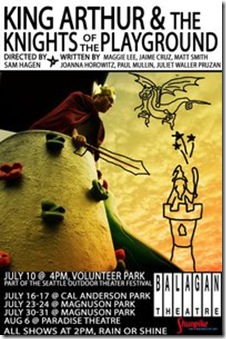
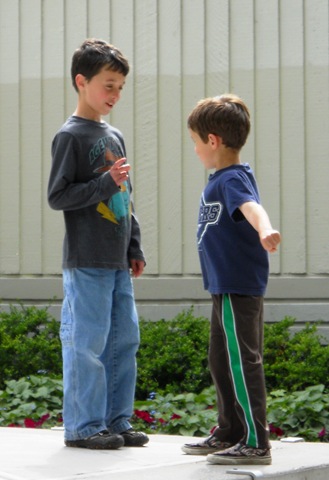
    My wife and my boys, ages nine and six, decided late Sunday afternoon to attend the opening performance of Balagan’s Theatre’s 2011 summer outdoor offering, King Arthur and the Knights of the Playground.  It was a perfect Seattle summer day, a rare enough jewel of deep greens and blues.  About a hundred and fifty of us, maybe more, gathered on the rich lawn behind the Asian Art Museum in Volunteer Park beneath some of the most glorious old trees you could ever hope to see.  There were friends, and friends of friends, and friends and family of cast members and crew, and just plain lovers of theatre, young and old; and we all watched some truly sublime goofiness with a wide open heart at its core. I wrote the section—one of five— called “The Ballad of Balin and Balan”, and based my interpretation of these two tragically fated brother-knights on the relationship of my own two sons.  Sitting there on a blanket with my mostly oblivious models, my heart was in my throat from the beginning of the piece, and I was embarrassed to have to wipe my eyes at the corny final scene:

    [They both fall to the ground, gasping.]

    BALAN:  You know what this means?

    BALIN:  We’re gonna die.

    BALAN:  Well, yeah, but something else.

    BALIN:  Yeah?  What?

    BALAN:  The curse said you would kill your best friend.

    BALIN:  Yeah.  So what?

    BALAN:  So that means I’m your best friend.  Curses can’t lie.

    BALIN:   Hey, yeah, that’s right.  And I’m your best friend.

    BALAN:  That’s right.

    BALIN:  Forever.

    It didn’t bother me one bit that my sons were more interested in the toy light sabers wielded by the actors than the fact that I had used their sweet, easy devotion to each other as my inspiration.  I’m pretty sure that if the real Richard III had a chance to see a modern Seattle production of Shakespeare’s play about him, he would be way more fascinated in the costumes, props and actual women on stage than in any resemblance to the biographical facts of his life.  (This is, by the way, another glorious feature of theatre.  We all see something deeply different.)  What blew me away was my own awareness of a profound and magical moment, wherein the very beauty of the earth seemed to host this collection of stories, as sweet and true and fresh as life itself; that my boys were watching grown men attempting to match the matchless nobility of love that children can hold for one another.  And I was part of it.  A very small, perfectly happy part of it.  And because my job was done, all I had to do was breathe and gratefully accept the moment knowing that I can have no idea what experiencing the moment might mean down the road for either of my boys, but suspecting there’s a good chance that it might mean something.

    Making plays matters.  Alas, I still have immense difficulty convincing many of my colleagues of this truth.  There’s a director in Seattle whose work I consistently admire who has maintained publicly more than once that he doesn’t believe we need any more new works for the stage because we will never have enough time or resources to produce all of the great plays that have already been written.  Many powerful decision makers in American Theatre agree, most implicitly, but some even explicitly, that the canon of theatrical literature is full: like the Bible, we cannot, should not, and even must not, add volumes to it.  I shake my head and smile at this notion, so apparently provable in the abstract, and yet so falsifiable by one deep blue green gorgeous Sunday afternoon in 
    Seattle’s Volunteer Park.

    Balan-Declan and Balin-Keelan

    Please forgive the geek metaphor, but if plays are algorithms—timeless software to be run on a particular time’s theatrical hardware (i.e. actors, sets, costumes, props, lighting and sound designs and, yes, even directorial concepts), then I want some of those future algorithms to be from my time.  Put more simply, if plays are “nows” thrown forward into “then”, then I need to believe that some of those “then-nows” will be from this now, if only so my sons’ daughters might know something of how wonderful their fathers were to each other when they were boys.

  • The Early Scoop on The New New News

    The Early Scoop on The New New News

    The early news on The New New News is in… and it’s good!

    In Mónica Guzmán Preston’s post over at Intersect, “My favorite moment from the @newswrights play ‘The New New News” (a meta- media laced headline if there ever was one), she describes:

    … one of those moments in storytelling where, in ways you couldn’t have predicted, disparate elements of narrative and meaning all come together.

    For this longtime fan of the much misunderstood mass microblogging service, it was fantastic.

    I am one NewsWright who is delighted that Monica enjoyed the show, especially since she helped us so much in the early phases of our research, suggesting leads, pointing us toward whole new stories to run down, inviting us into her “meet-ups”.  We do wonder, though, if she recognized herself in any of the characters.

    * * *

    Jose Amador, at the Seattlest says:

    There’s nothing about News that’s passive, or simple; very little that is formulaic… which is unusual and welcome in an age where everything can and will come to you. At the end of the night… one is rewarded with an excess of interesting thoughts about the world we inhabit….

    * * *

    And then The Stranger’s Brendan Kiley chimed in.  He hasn’t seen it yet, but that doesn’t stop him from recommending it:

    ….[NewsWrights United] put together The New New News—about the rise of local blogs, how the Seattle Times got a Pulitzer Prize for its readers’ Twitter coverage of the Maurice Clemmons manhunt, and what happened to Art Thiel when he started his own blog and had to get tangled with selling his own ads. Judging by their last effort and the seriousness of their material, The New New News should be scarier than the ersatz Mack the Knife.

    * * *

    I particularly enjoyed Rosemary Jone’s interview at Examiner.com because it gives NewsWrights United’s Managing Producer, Jim Jewell a chance to say why he believes in the work we do.

    Right now, theater looks to me like newspapers in the 90’s, watching changes all around them and somehow believing themselves above the change, too venerable to fail. We spend too much time in the theater talking about what theater is instead of actively engaging the form and deciding what it will be, and we aren’t too far from the crisis newspapers have found themselves in: failure to evolve.

    * * *

    So what does all this good news for NewsWrights mean to you?  Well, for one it means that if you had hoped not to leave Capitol Hill to see the show, you better order your advance reservations soon.  We have only one week at the Erickson, and it starts tonight.   The following two weekends will be staged at Theater One on the North Seattle Community College campus (advance reservations for those performances here).

    Of course, you can always risk walking up because we always hold back a quantity of pay-what-you-can seats.  You just  have to ask yourself, are you really cheaper than the majority of your Capitol Hill neighbors?  If so, show up early.  All evening performances start at 7:30 pm.  The matinee is at 2 pm.