Just Wrought

Recovering playwright, once won a STRANGER Genius Award for theater. Now writing a bloated novel about… G-d help me! Theatre.

Why is Theatre Puget Sound Diluting its Mission?

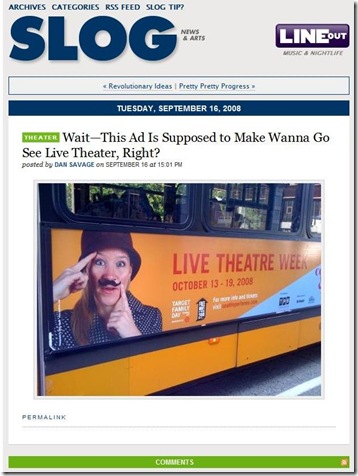
Yes, we all cringed when we saw the Theatre Puget Sound (TPS) ads for Theatre Week in years past.   Apparently some PR firm had been hired in Sioux Falls, South Dakota and given the very specific instructions to create a campaign that would confirm every uninitiated civilian’s suspicion about just how lame and goofy live theatre can be.  Bowler hats, canes and dorky “del arte” facial expressions were de rigueur.  Some one who did not know better could easily have gotten the impression that every show in Seattle was some variation of a Godspell Hell.

The comments to Dan Savage’s Slog post here about this flip phone pic  below sum up the general response hilariously.  Comment number 5 buttons them all together, thusly: “Perhaps it is a typo… perhaps it is supposed to read “Live Theatre Weak”

Screen shot from Slog

If you are tempted to riposte in the comments with that hoary Seattle arts chestnut of an excuse: “They were doing the best they could”, please spare us, because anyone looking to encapsulate the thrill of theatre photographically need look no further for examples than any of the images pushed out over the last few years by WET. (Sorry, I just can’t bring myself to cave and call them “Washington Ensemble Theatre” just because some litigious trust-funded ensemble in NYC got jealous of WET’s success.  See here .)

Promotional photo from WET's Hedda Gabbler redux: blahblahblahBANG Promotional photo for WET's Titus Androncius

Promotional photo for WET's RoboPop

(Just how and why is it that WET can make headphones so sexy?)

As much as Seattle’s theatre professionals longed for a fresh and empowering marketing campaign from TPS to hook people into big and small local theaters around town, the last kind of change most of us would have wished for is what rolled out this Spring.

Announcing Arts Crush,
The Month-Long Arts Festival

on April 19, 2010, at 5:30 pm | Category: Arts Crush

As you may already know, Theatre Puget Sound is planning an expansion of our highly successful Live Theatre Week festival.  In an effort to build upon the momentum of that program and address the expressed needs of the larger arts community, we decided to expand our scope and build a more diverse and inclusive month-long festival modeled after Live Theatre Week.

This October, Theatre Puget Sound will present Arts Crush, a month-long festival that connects artists and audiences with invigorating new experiences at hundreds of events across the region.  More than 200 arts organizations and innumerable artists from all over the Puget Sound will come together as a united arts community to share arts experiences with people of all kinds….

So Theatre Week becomes Arts Crush, and somehow, the theatre artists (mostly actors, actually) that make up TPS’s membership, all of the sudden become, without being asked, patrons of all the arts, because, you know, we make so much money on the stage.  Where are the other major discipline-specific arts organizations that are joining TPS in this move towards expansiveness?  There are none.  TPS basically owns Arts Crush, in conjunction with broad based arts funders like Seattle Office of Arts & Cultural Affairs.  None of the non-theatre-but-still-discipline-specific organizations like Velocity Dance or Seattle Chamber Music come even close to matching TPS’s size or influence.

Before I go on, let’s take a quick look at TPS’s mission, shall we?

TPS is a member-driven organization whose main goals are the nurturing of a healthy and vibrant theatre community, developing strong ties among the region’s theatre professionals, raising the visibility of the region’s theatre scene on national and international levels, and finding ways to develop new and diverse audiences.

Nowhere in the paragraph above is there any mention of cross-discipline arts promotion.

So why is TPS diluting its mission?  My best guess is fear, with a touch of pointless power grab thrown in for flavor.  The move is part of a larger strategy to beat a tasteful and bloodless retreat from world class status.  The thinking goes like this, “Theatre is suffering.  And so are all the arts.  The core audience for theatre in the Northwest overlaps the core audiences for all of the other arts.  Let’s expand our scope, control that shrinking core and hope to hold the ground we have.  We can give up the castle to control the wider, albeit weakened, kingdom.”

Of course this runs counter to what I and many of my colleagues believe is the best strategy to not only save theatre in Seattle but also elevate it to world class status at the same time.  We believe now is the time go on the offensive: to advance, not retreat; to push forward bold new and innovative plans for making a completely different and fresh sort of theatre.  We certainly do not think we should be spending our limited resources promoting “arts” in general.  That sort of “yay arts!”, “up with people!” advocacy ultimately helps no one.

TPS’s desperation is showing.  Just this week an email went out from extending the deadline for applications to the Arts Crush festival.  A cynic has to wonder why.  Could the dilution of the TPS’s core mission have anything to do with it? <
/p>

Turning Theatre Week into Arts Crush is a mistake.  Theatre artists are rightfully reluctant to underwrite an effort that has expunged the word “theatre” from its name.  (If you played professional shortstop in Seattle, and the Mariners began a promotional campaign promoting all sports, but omitting the word “baseball” from its title, would you be worried, irritated or both?)  TPS should rethink this move.  Seattle needs a theatre advocacy organization that can keep its focus.  If TPS wants to be something other than it is, they should be honest about it and change their moniker to “APS” for Arts Puget Sound.  Of course, if they did that you would have to wonder what it would do to their membership rolls.

Comments

54 responses to “Why is Theatre Puget Sound Diluting its Mission?”

  1. Scot Augustson

    Almost as lame as the Take Part in Art campaign.

  2. Jose Amador

    Really? South Dakota? Christ on a shingle.

  3. I made that part up, Jose.
    I am, after all, a creative writer.
    (Shut up, Scot.)

  4. Photo credits for the WET shots, please? I know the amazing Victoria Lahti (http://www.facebook.com/victoria.lahti) is responsible for at least one of them. Might be good for folks to know local photogs out there who can help free us from the tyranny of gawdawfully-designed PR campaigns (Seattle Shakes, I’m looking at you. There’s no excuse for whatever it was you did with last year’s poster series).

  5. Sam

    To start, yes, many of you got your undies in a bunch about the Live Theatre Week ads. While I understand your frustrations with our so called “Godspell” campaign…GET OVER IT! The truth is the campaign was extremely successful! And while I do love WET’s photography and design aesthetic, companies like WET do not make up the majority of our membership. TPS represents an extremely diverse mix of performing arts organizations – from Village Theatre and Seattle Children’s Theatre to WET and Strawberry Theatre Workshop to Olympia Little Theater and Whidbey Island Center for the Arts. Suffice it to say that a photo of Marya with a gun or a bloodied face is not going to be an effective representation of that community.
    The challenge with marketing a festival like Live Theatre Week or Arts Crush is to be broad and appealing enough to represent a wide array of performances and styles. Do I think the design of our past marketing campaigns were a complete success? Absolutely not. Were they intentional? You bet. I don’t think the “drama geek” goofiness is what we need to fight against. I actually think it’s the exact opposite. To non-theatre goers, theatre tends to be perceived as snooty, pretentious and boring. We intentionally worked against that to create a campaign that was playful, inviting, engaging and, yes, goofy!
    Like the campaign or not, all of our work around Live Theatre Week each year led to new, younger and more diverse audiences actively participating in theatre. Live Theatre Week, over the course of five years, engaged more than 12,000 people in the performing arts, many of them infrequent attendees.
    2009 Audience Demographics
    73% of participants were infrequent theatre attendees
    82% had never attended their selected theatre
    41% of participants were under the age of 35
    52% of participants had annual household income under $50,000
    27% of participants indicated an ethnicity that was other than White non-Hispanic
    Now to Arts Crush!
    First, you really need to check your facts. We did not scheme up Arts Crush in a dark corner with the secret hope of grabbing all the money and power we could! It was an organic process that happened in broad daylight with a lot of input from our organizational members. And, last I checked, we don’t have any more power – and we certainly don’t have any more money – than we did last year at this time. Things we do have more of: respect, visibility, relationships and support. How sinister of us! That can’t possibly benefit our members in any way, right!
    We were approached by the Market the Arts Task Force (MTATF) to ponder the idea of creating a larger festival modeled after Live Theatre Week. We stewed on it and vetted the idea with our staff and our board and continued to have discussions with the MTATF. When we decided to officially explore the idea, we surveyed our organizational members and past LTW participants. We also hosted many open community forums with both TPS members and non-members. And the overwhelming majority of folks were in support of moving forward with Arts Crush. Honestly, I could count on one hand the number of theatre folks that came forward with a negative response in the entire 4 months that we were having these discussions.
    So, to insinuate that we are somehow doing something behind the backs of or against the wishes of our membership is just ridiculous! Theatre Puget Sound was asked by the larger arts community and our own membership to step up and lead this effort and that is what we chose to do. We actually consider it quite an honor and a sign of our growth as an organization that we have been entrusted with this.
    If we didn’t think that this festival was in the best interest of our membership and the theatre community as a whole we would not be doing it. I happen to believe that collaborating as a unified creative community and investing in audience development and community engagement on a larger scale only serves to deepen the experience and benefit of those involved. For too long, we have isolated ourselves in silos. The public does not care about these silos; they care about the experience. And the arts organizations who are finding success in reaching new, younger audiences while also retaining the audiences they currently have are investing in this kind of out-of-the-box, multi-disciplinary and collaborative approach to their programming. Two perfect local examples are ACT & SAM.
    Yes, there is the possibility of failure. Some other large-scale initiatives have not succeeded. Take Part in Art totally bombed…partially because it was only a campaign for campaign’s sake. Arts Crush is a unique and diverse festival aimed at creating accessibility, cultivating community and inspiring creativity by creating new points of entry for participation in the arts and investing in relationships.
    And, despite your snide comments, we are not desperate. We already have over 180 Arts Crush participation forms submitted – many of them from theatres.
    TPS is not losing its focus as an organization. In fact, I believe we are more focused than ever. We are growing and adapting to the needs of our community, both the theatre community and the public-at-large. You may not agree, nor are you expected to agree, with our decisions, but we are being extremely strategic and have never lost sight of our mission.
    And, let me end by saying how utterly frustrating it is to listen to folks like yourself bemoan the dilution or failures of our membership-based service organization and/or Live Theatre Week when you have never chosen to be a member and support the very causes you seem to be espousing.
    That said, I welcome you to join http://tpsonline.org/join/individual.shtml.
    Sincerely,
    Sam Read
    Deputy Director
    Theatre Puget Sound

  6. Sam,
    Thank you so much for your considered and elaborate response.
    Of course, I have all sorts of counter-responses I am eager to post here, but I thought I’d hold off and instead wait to see if anyone, besides you or me, cares enough to chime in about these issues.
    Cheers!
    Paul

  7. Basil

    While I have no argument with Sam’s reasoning behind the intent of LTW’s campaign (we have different opinions on execution and he’s the boss), my main beef was that is was AETHETICALLY terrible. And if you think that aethetics can’t be quantified or must be watered down to appeal to a wider audience, you need to do more research on design and copy basics. Talk to the art dept. at an ad agency. Things like font, color scheme, layout, venue – hell, face powder on your photo subjects so they’re not so shiny! It all matters! You’re not just sending a messgae with your media, you are attaching a personality to it. And frankly, I want nothing to do with the personality introduced in the aforementioned capaign.
    The argument that you need to treat people like all-average simpletons to get them intersted in theater is just insulting to everyone and doesn’t even merit debate. I hate the percieved eliteism of regular theater too, but you can appeal to a broad range of people, and their smarter selves, without making theater look like an amteur circus. In this campaign, theater doesn’t look engaging or interesting or inspiring, it just looks dumb.
    Lest I be labled a do-nothing blog comment troll: Yes, I am a TPS member and theater artist with an interest in PR and marketing. I have made this argument openly to TPS staff and am willing to work to help make it better (no judgment on Paul here, you know I love you baby).

  8. The point about me not being a TPS member is a salient one.
    However, I don’t think anyone would argue that TPS’s services are much more oriented toward actors than playwrights, a completely understandable stance given how many more there are of the former than the latter.
    When I looked at the numbers and the services offered, I determined that being a TPS member simply wasn’t a value-add for my work. Now, if I am being asked to be a member because contributing to a theatre advocacy organization is the “right” thing to do, then I would probably insist that said advocacy be specific to theatre and not simply “the arts” which appears to be the direction which TPS is moving.

  9. Sam

    Hey Basil,
    Thanks for your comments. Yes, aesthetically, it was nowhere near the best campaign. We tried something that succeeded on some levels and failed on others. And this is why that campaign is dead and buried. It was meant to be replaced last year but experimentation, time and lack of resources got the best of us. And I will own that.
    However, I don’t want this conversation to be about picking apart a marketing campaign that is dead and gone. Believe me, we’ve heard it all!
    Let’s focus on Paul’s main beef, which is Arts Crush and the apparent dilution of TPS’s mission.
    Sam

  10. Patrick Lennon

    “I would probably insist that said advocacy be specific to theatre and not simply “the arts” which appears to be the direction which TPS is moving.”
    Don’t you think you might be over-reacting just a bit? When I see TPS closing Theatre4 to open an art gallery, or organizing general auditions for classical musicians, then I might be concerned. But expanding one annual event about theatre into a larger annual event about the arts in general doesn’t mean the sky is falling.
    I also have to call you on your response to the TPS mission statement:
    TPS is a member-driven organization whose main goals are the nurturing of a healthy and vibrant theatre community, developing strong ties among the region’s theatre professionals, raising the visibility of the region’s theatre scene on national and international levels, and finding ways to develop new and diverse audiences.
    “Nowhere in the paragraph above is there any mention of cross-discipline arts promotion.”
    Actually, cross-discipline arts promotion sounds to me like a perfect example of “finding ways to develop new and diverse audiences.” If someone loves dance but never goes to see theatre, wouldn’t we love to draw them into to Arts Crush through dance, and then expose them to theatre and see if we can’t make them a fan?
    I guess I’m not sure why you are so upset about this whole thing. Do you think that theatre as an art form will get less exposure, or less advocacy, or fewer new audiences with Arts Crush as compared to Live Theatre Week? If anything, it seems to me that it will be the same or better. And as long as TPS is not siphoning money away from other projects (say subsidizing rehearsal space or running seattleperforms.com) to pay for increased costs for Arts Crush, I don’t see the problem.
    And you have to admit, Arts Crush (although cringe-worthy) is better than Artober.

  11. Fair enough, Sam. No use debating a dead issue (as long as lessons were learned, of course!). And I deeply apologize for misspelling the word “aesthetic”. Twice. Nothing kneecaps an argument like bad spelling and grammar. Blame my phone’s keyboard (er, yeah, that’s it).
    I gotta say, I’m siding more with you than with Paul on the Arts Crush issue. I think breaking down barriers between creative disciplines is essential from an audience perspective, but also for the continued edification of working artists. Yes Paul, theatre artists are being asked to become patrons of other types of art, but this is not new. More accurately, they are being invited to expand their community. Something we should all be doing as much as we can. We should also be voting in elections and watching bad movies together and swimming with our kids and generally paying attention to life outside the little dark box we work in. It strengthens the larger arts sphere and those working within it. Is TPS moving outside its mission in pursuing this awareness of (gasp!) other art forms? Maybe. Is it causing immeasurable and irreversible damage to the theatre community in the process? Highly doubtful.
    To quote you:
    “Where are the other major discipline-specific arts organizations that are joining TPS in this move towards expansiveness?”
    Well, you answer this question two lines later: “None of the non-theatre-but-still-discipline-specific organizations like Velocity Dance or Seattle Chamber Music come even close to matching TPS’s size or influence.”
    Basically, TPS has the resources to build bridges that other orgs do not, so it’s taking the lead. You incite artists to push boundaries, challenge their audience and think bigger but you’d have TPS sit around and rent out rehearsal space? As a member I’m not automatically thrilled with this move, I do think there’s a threat of spreading the message too thin, but I’m curious to see where it goes. I’m drawn to things that unite versus divide, generally speaking. Call me a dirty hippie (and I know you will).
    Now Sam, on that note, I am also not giving TPS a pass here. We all saw what fearful decision-making did to Empty Space, Alice B. et al; I am suspicious of art-by-committee; I am very protective of the identity of the theater artist. A business head might save the building but it will not save the theatre. Only artful thinking and a strong heart can do that. TPS must move forward with confidence and strength of purpose, while at the same time being an advocate for its members and the larger theatre community. It’s a tough balance and you may fail, but that’s no reason not to give it a shot.

  12. Scot Augustson

    Hey Paul,
    My brother’s in town, but as soon as he leaves I’ll come back and make an ill-informed, hyperbolic comment.

  13. Julie

    I love Scot Augustson. And that’s all I’ll really say about that.

  14. Jim Jewell

    Basil, I agree with lots and lots of what you say, and I’ve made no secret that I did not like the idea of ArtsCrush. For me, this is how the old LTW miserably-bad ad campaign and ArtsCrush overlap – sucky messaging.
    I don’t think you can effectively message about theatre, or protect the identity of the season artist, when it becomes part of “the arts.” Those cross-discipline conversations are great and powerful on a personal level, but they ruin the focus needed to actually craft compelling messages (which takes a lot more research and critical thought on the front end than people outside the ad biz imagine).
    And, no, I don’t think lessons have been learned, because as much as Sam is right to say that campaign is dead and buried, he was defending it as “extremely successful!” in his original comment. But, if it has left a bad taste in mouths this far afterward, I don’t call that success.
    And therein lies my beef with TPS at the moment. I don’t think they are being self-critical enough, which is why I am okay with criticizing them. I think they need more focus, they need to recognize failures and learn from them, they need to take dissent as seriously if not more seriously than agreement of ideas, because the dissent can only rightly stifle a bad idea – a good idea would gain strength in addressing the dissent.
    Yes, we want to nurture relationships and encourage people that already consume one art to consume ours (which is easier, but also draws from their finite individual budget), but if we don’t know how to effectively communicate about our discipline (which collectively we do not, and which TPS had as of yet not shown itself capable of) then we’re sunk. And starting with “the arts” isn’t, to my mind, the answer.

  15. And now that Jewell has laid down covering fire, let me take a run at the pill box.
    I would need to see a lot more evidence than what’s being offered to convince me that there is not already a huge overlap of audiences in the arts being represented in this ArtsCrush crush. In other words, I strongly suspect that someone who goes to modern dance and chamber music either already goes to theatre or doesn’t need the hard convincing that’s being talked about here. So the real goal, whether explicit or not, is a consolidation and shoring up of a market rather than actual dramatic bid for growth. It’s preaching to essentially the same choir from different pulpits. It’s wagon-circling under the false flag of expansiveness.
    You don’t bring NEW people to the arts by being “Yay arts!” You bring them in by being sharp and specific and, indeed, perhaps even outrageous about the specific product you’re offering. Lady Gaga versus Lawrence Welk. I say the specific product should be theatre, and the message should be sharp and game-changing. One might expect that Theatre Puget Sound, with its moniker and mission, would be alignment with that sentiment, but, alas, with this move it proves it is not.
    Since before the first post at Just Wrought I have consistently staked my reputation and career to say Seattle has a chance within the next few years to raise its profile as theatre city on national and even maybe international stage. TPS is perfectly positioned to facilitate that process. Who here or anywhere is willing to stake anything at all on the dubious and diffuse bid to raise Seattle’s profile as an “arts city”? See how absurd it sounds even as I say it?
    In the great current struggle to make Seattle a World Class theatre city, TPS is stepping away from the breach instead of into it. What needs to happen is for some institution to say: “You know what? We ARE a great theatre city, and the whole world– but most especially our own region–needs to understand that more clearly.”
    Instead of Theatre Week we need, not ArtsCrush, but Theatre MONTH.

  16. Patrick Lennon

    “I don’t think you can effectively message about theatre, or protect the identity of the season artist, when it becomes part of “the arts.”
    Fair enough. I think TPS is trying to address this somewhat by focusing each week on a specific craft, but it remains to be seen whether it works or not.
    “Instead of Theatre Week we need, not ArtsCrush, but Theatre MONTH.”
    You’ll get no complaints from me!

  17. Jeremy M. Barker

    I have to say that in the abstract, Arts Crush sounds fine. An arts festival is an arts festival…or fair…or marketing gimmick, however you want to put it. But the success or failure of it depends on whether it generates increased interest and pulls in audiences across art forms.
    I think the most legitimate concern in this case is, to what degree are the people putting it together qualified to do a good job with literary events or visual arts? Did they get help from people who know how to connect with those audiences? Did they choose compelling work? So on and so forth? And I’m not trying to judge or pre-judge because I don’t know. But I do think that its deceptively appealing to try to make a big tent bigger. If the idea of Live Theatre Week was to offer a little of everything for everyone, well, if the other arts in Seattle aren’t prepared to do for Arts Crush what TPS is, or if TPS is moving to take on their work as curators and promoters…well, that would seem to dilute the mission and possibly disappoint more than entertain or engage audiences.
    A big event like this can’t have a narrow focus, and Live Theatre Week in the past hasn’t, either, I don’t think. I mean, they have everything from fringe to regionals to solo performance events going on. But if this becomes a “Bite of Seattle” for the arts, then it probably won’t work as intended.

  18. CT

    Paul, appreciate, as ever, the forum.
    =====
    I personally am not a “Arts Celebration” kinda guy. Nor a “Theatre Celebration” kinda guy. That’s just my personal preference…I’ve been so fortunate to have so many special moments come in classwork, in rehearsal work, in performances I’ve been part of, and performances I’ve seen, but cued celebration of something rarely works for me. (This from a guy who also doesn’t do fireworks on the Fourth of July.) That said, I’m sure many many people have been exposed to theatre from such events, and I say, great.
    I had a conversation with a non-theatre-goer recently who said he “likes to go to the theatre occasionally, he just saw Stomp.” It’s frustrating when I feel the gap between how people view theatre and what I understand theatre to be, for me, personally.
    My best friend is a wonderful teacher Back East doing a production of Guys and Dolls with a hundred kids in it. A hundred. Kids. Is it what I would do? Hell no. But for her, the element of using theatre for community-building that coming together is key. Even if the performance level isn’t necessarily what it would be with more of a culling process. I have a different preference for what theatre can be, and of course I think “I’m right,” but I can’t deny the great boons that come from her experience, and who am I to stamp on anyone what theatre is or isn’t? What it can or can’t be? Even things that I think are “bad theatre” can still have some good yield…and if it doesn’t line up with my ideas of theatre, then I should go out and do what I think good theatre is.
    Turning people off of theatre is a concern, but that concern will always always always exist.
    TPS has a responsibility to TPS Members. Members show their support by continuing membership, and speaking up when they feel things aren’t what they’d like it to be. I don’t think TPS is responsible for the entire Seattle theatre community, it is simply an organization inside of the theatre community. And it even seems that input from a non member is listened to and addressed, which doesn’t necessarily mean agreed with.
    ArtsCrush? Why not? I do find it intriguing that TPS—a “theatre organization”—is doing something that has a week on music, for example. But maybe something good will come of it. And if enough TPS Members feel, Waitwaitwait, this is not what I want for my organization, they should say so. Performing in Fort Worth I found MUCH more integration between art forms, and it was awesome; I don’t see why TPS shouldn’t try to reach out to visual arts, dance, music, local lit.
    I don’t think of TPS as a mere “space renter,” I think they facilitate the things TPS facilitates. (And appreciate the help they’ve given over the years.) And the Rep is the Rep and Freehold is Freehold and NCTC is NCTC and WET is WET. And I belong and don’t belong in all of these organizations as I do and don’t. And if I ran any of them, not everyone would agree with every decision I made.
    Opportunity exists. Some inside working channels. Some are your own, created by you. If an organization isn’t doing what you want, then you do it. Yourself.
    And, a final thought. Man, I’ve had some failed projects. Failed attempts at things, on tiny and not-tiny scales. But I tried. And got many opinions. And in the end had to decide for myself what I agreed and disagreed with.
    Nothing will never happen without trying, so let’s just try, succeed and fail as we may, not see eye to eye on some details, and move on.

  19. Mike Rainey

    No marketing campaign is going to solve the problems theatre is facing in Seattle (or anywhere else). Expertly executing mature material, acknowledging the need for access points for the audience, and understanding that entertainment is the chief tool by which all other theatrical intentions are achieved are required before issues of “world class” can be directly addressed with any effectiveness. You can’t be the best burrito on the planet if you’re not the best burrito on the block.
    Now, I know there is excellence that happens, and that there are practitioners that routinely deliver it. What follows obviously doesn’t apply to everyone, but it applies to the degree that my first impulse when I think of going to a show is “I’d rather do laundry.”
    So: sadly, twenty-five or so years into the big DIY theater boom in Seattle, companies still mistake shrill for edgy, loud for intense, and intention for discipline. I haven’t seen any shows in Seattle for a very long time, but the alternative images offered above trigger in me nothing so much as “Oh no, not more of THAT, please!” The wheel is constantly reinvented with the same lumps and flat spots that have plagued the fringe since the beginning and which have become ossified into the identity of “fringe” theatre. I stopped going to shows because I got tired of paying good money to witness the same train wreck over and over again.
    It feels to me that in trying to determine the qualities that make theatre unique from other forms, theatre artists have started chasing superficial theatrical effects instead of focusing on depth and intimacy in storytelling, aspects of the theatrical experience that are enabled by the patience and intelligence theatre audiences bring to the show, but which too often go unrewarded.
    And that’s the core problem as I see it – I am not rewarded for attending the theatre. I’m usually punished. Punished with boredom by laziness of execution, punished with pounding headaches by practitioners who fail to realize that intensity without stillness equals noise, punished by self-congratulatory displays of narcissism combined with desperate insecurity. Punished by gatekeepers who don’t have the balls to say “No, not good enough” but instead say “Hey, sounds great!” then passive-aggressively make themselves a drag on the process.
    If the community finds itself doing shows primarily for other theatre practitioners, then something is fundamentally broken in the concept of what theatre should be. People shouldn’t support theatre because it’s good to support theatre. They should support it because they get something from it. If you want to put the audience back in your theatre, you have to put “The Audience” back in your “theatre.”

  20. Jose’ Amador

    Mike,
    Which pictures above are you talking about? The past TPS ad pictures or the WET publicity stills? Both?
    I feel the rest of this sort of belongs in a different conversation, but I will say that the problems you describe isn’t just attributable to the Fringe, they’ve existed about as long as theater has. Part of it is that you’re looking at youthful artists in development, learning the meaning of nuance.
    And maybe you might be the anti-Midas of theater going experieces, for I’ve had quite a favorable run of good to great theater going experiences of late.
    I don’t think you’ll find anyone here against the notion of bringing “The Audience” back into the theater.

  21. Peggy Gannon

    (Some of this may be off-topic, but it at least touches topic by an accidental overlapping pinkie in a dark theater. Forgive my wandering.)
    Jim Jewell — I claim your response to this issue as my own! Allow me to quote, because if I were smarter & quicker, this is the part I could’ve written:
    “And therein lies my beef with TPS at the moment. I don’t think they are being self-critical enough, which is why I am okay with criticizing them. I think they need more focus, they need to recognize failures and learn from them, they need to take dissent as seriously if not more seriously than agreement of ideas, because the dissent can only rightly stifle a bad idea – a good idea would gain strength in addressing the dissent.”
    I agree with this sentiment across the board for our entire theater community. We are far too self-congratulatory and too quick acquiesce to others’ congratulations. (Quicker still to keep our mouths shut when we don’t like something.) What we do is truly very hard and takes vast amounts of energy, and we let that fact lure into the conviction that it gives us a pass at a really painful but cleansing root cause analysis. The mere fact that my theater company exists doesn’t prove that it should continue to do so. I’m weary of fundraisers where money gets passed up from artists to support the very organizations who we actually wish were able to support us. And rent parties? My god. Are you kidding me? You heard it hear first, because your friends won’t tell you: The fact that you can’t pay rent makes you look bad. Your rent party looks like a bad investment, smacks of desperation, and calls into question your worth as an artistically valuable organization. Fair or not, there it is. If you cannot pay your rent for so long that it warrants a rent party, you have failed. You have neglected to ask the tough questions of your organization, and you need throw a farewell party instead. (I speak as someone who has indeed thrown a farewell party instead.)
    When I see an arts organization that (to me) appears successful, it has something in common with all other seemingly successful companies … a definable brand and image. They have figured out what they do well, and they continue to do that thing well, and (equally important) find the people that like whatever that thing is.
    I agree that many individual theater companies, and the community as a whole (and therefore, as both a reflection and a leader, TPS) are too quick to dilute our core flavor. Not everyone is going to like what we do, but we don’t need everybody to like it, we just need enough people to like it. We do that not by diluting but by enhancing the core. Those who like that flavor will come back. You know why I don’t go to TGI Fridays? Because it can’t possibly be special with 843 items on the menu. “But it has such broad appeal! You can get anything you want!” No. No, I can’t, actually. Because what I want is food that doesn’t suck.
    I love TPS a lot. But I am wary of ArtsCrush. In theory it’s neat, but it concerns me. Is “cross-discipline” the new “multi-media” (which, despite all the jizz spilt on it, did not really engage future audiences as was promised, did it)? I am a lover and admirer of the non-theatical arts, but we are theater artists, and so it’s on the theater that we need to focus for now. Do a thorough spring-cleaning. Strip away everything that does not directly serve us. Be thoughtful, but not precious. Oh my gosh – look at that beautiful hardwood underneath those old, fugly carpets! Let’s refinish it. Then bring back in the furniture we decided to keep, and add new pieces that fit. Decorate. Fill the fridge again. THEN we can invite our non-theater brethren over for a party. No cover charge & a host bar.

  22. CT, thanks so much for chiming in.
    Mike, so great to hear from you! Seattle theatre misses your unique gifts. (Confidentially, I can think of one or two WET shows that would’ve totally surprised and delighted you.)
    Peggy, as always, WOW!

  23. Lyam White

    Your take is interesting, Mike, if only because the sort of mature, reflective theater for which you long sounds like precisely the kind of dry, academic exercise that drives me ever more deeply into the confines of surrealist poetry, European horror flicks, and abrasive, noise-oriented outposts of popular music. Just as I’d rather listen to some teenager scream and fart into a microphone with sincere intent than hear Wagner sung well, I’m generally willing to risk being saturated with the shrill and amateur to avoid the stale and bourgeois.
    That is to say, you stake, quite eloquently, a position at the opposite end of the spectrum from mine, with a diametrically opposed sense of what “the problem” is. Maybe I just have more of the rage of youth in me.
    Ultimately, my ideal theater would address some portion of both our interests–enough consonance to make the dissonance meaningful; enough polish and professionalism to give the “errors” the affect of virtuosity (if not the prosaic stench of “legitimacy”); enough maturity and circumspection to differentiate between well-considered existential rage and mere (post-)adolescent angst.
    There should, of course, be room for both “schools” or forms (and we should probably each be exposed to the form not favored, lest we should become too entrenched to recognize the beauty outside of our respective [dis]comfort zones). As such, I agree with you that we need to get out of the habit of making theater solely for other theatricians. In that sense, I think a breadth of mission is somewhat useful. But as Jose hinted at, and Peggy (brilliantly) illustrates, the search for “The Audience” is as often a search for OUR audience–the audience that responds to whatever niche we’re managing to fill. The notion of a popular music or a popular cinema that everyone enjoys seems to have dissolved; all popular art forms are balkanized, leaving individuals to enjoys the genres and sub-genres best designed to suit their aesthetic, social, and metaphysical interests. Why do we think the “breadth” that has failed artists in other disciplines will work for us in a form that everyone’s constantly proclaiming is on its way to extinction?
    To bring this around to topic (as opposed to continuing with my usual obsession with dismantling the foundations of civilization), what makes me uncomfortable about the dilution of TPS’s mission is in casting its lot with other art forms whose appeal seems limited to the elite classes and bourgeois notions of what it means to be “adult.” What makes me uncomfortable about the photographic ad campaign at which we all (rightly, I think) rolled our eyes is that it entrenched the notion that earnest, hard-working nerds make theater, as opposed to the grifters, whores, thieves and iconoclasts who ruled its history (and who have now moved on to more high-profile endeavors like hip-hop and webcasts). Granting, of course, that I’m more earnest nerd than thieving whore (it’s just that my inner thieving whore is forever kicking her way to emergence).
    The dialogue on the matter is always interesting to me, because elitism always seems to be the other side’s malady. Non-elitism in theater too often, in my view, hinges on approchability, which ignores the essential coarseness that is a part of our popular culture, which, in turn, we must address even if our desire is to state opposition, which is certainly my goal (though I would differentiate between superficial and fundamental coarseness, that I might use the former in making a case against the latter).
    Sorry this ended up being so long (and probably incoherent).

  24. Jim Jewell

    I dunno, Ly – by your standards, that was downright concise.
    And Gannon? You got more sizzle than bacon in a fryin’ pan.
    A couple things have been eating at a corner of my brain that I need to share. I’m not here to bury TPS because I think they do good, and could do far more. But, I’ve got to call bullshit where I see it.
    1) That ad campaign may be “dead and buried,” yet I have some of the photos from it right here on my 2010 TPS Membership card. It isn’t learning from mistakes, or even acknowledging as a mistake, when you keep re-using it.
    2) So, Market the Arts Task Force approached TPS about ArtsCrush? Not that I necessarily doubt that, but it would be disingenuous not to include the fact that the Exec. Dir. of TPS is a chair of MTATF.
    3) If you believe that we need to be thinking from the audience perspective, that we need to put “The Audience” in what we do, and that we need to be finding ways to talk to brand new people about what we do so we can start building new relationships*, you should be part of Holes Not Drills. Drop me a line at jimj@sct.org and I’ll tell you all about it.
    Jim
    * – Make new friends, but keep the old. One is silver and the other gold.

  25. Jim’s right, Lyam. That was relatively terse for you. And “theatrician”? THAT’S gonna leave a mark! But seriously, thanks as always for your unique perspective.
    Jim, good on ya for shilling Holes Not Drills on my blog. But now I’m afraid I need to inform you that by doing so you have tacitly agreed to give me a cut of your future action. Even if that cut is simply getting to act in one of the commercials you produce.

  26. www.facebook.com/profile.php?id=1428950451

    Hello all. I am going to weigh in on this issue from a numbers perspective. In the spirit of full disclosure, I am Paul Mullin’s sister and have argued with him more times than all of you put together, so nepotism is not in play here.
    First, I would like to review the stats from the TPS as offered by Sam Read. Please note that I am not commenting on one particular year’s campaign but rather the last 5 years.
    Live Theatre Week –12,000 people /5 years = 2,400 people per year (avg).
    Mr. Read does not quote the cost of the advertisement campaigns, either in dollars or in kind donations, but the marketing cost per person would of course be the amount spent/donated on advertising divided by the number of people.
    “2009 Audience Demographics
    73% of participants were infrequent theatre attendees
    82% had never attended their selected theatre
    41% of participants were under the age of 35
    52% of participants had annual household income under $50,000
    27% of participants indicated an ethnicity that was other than White non-Hispanic”
    While the demographic breakdown sounds good, we are talking about ~2,400 people attending events during Live Theatre Week last year. I would be curious to know if attendance has increased over the past 5 years and how it has been trending. Based on US Census records for 2009, Seattle Tacoma Metropolitan area had a population of 3,407,848. 3,407,848/2,400 does not even register as a percentage. I am not offering this statistic to criticize but rather to put everything in perspective.
    According to a study done by the NEA in 1992*, ‘In each of twelve areas studied (ranging from San Jose to Chicago), arts participation rates were examined in light of the local supply of arts programs and facilities. Theater participation was highest in Seattle/King County (WA) where a thriving theater community was observed, including playwrights, actors, and a plethora of small, experimental ensembles known collectively as “Seattle’s fringe theaters.” What happened?
    According to the NEA, theatre attendance is most highly correlated with education and slightly less so with income. Seattle is a well-educated, prosperous city. Are the right people being targeted in these campaigns? Is their attendance at Live Theatre Week translating into attendance at other theater and arts events?
    My recommendations (specifically to Live Theatre Week but to Seattle Theater in general):
    • Clearly define to whom these campaigns are being marketed.
    • Find out what we want. Stop assuming that theater goers are stupid and need to be spoon fed the same old stuff. Inspire us, invigorate us, and be relevant to us.
    • Measure our attendance both at the Live Theatre Week events and at subsequent theatre events – offer coupons during the event for discounts on other events. Track the coupons to determine how many continue to attend. One time attendance at a free show does not constitute success.
    • Set targets for event attendance, meet them and beat them. Each year set the goal higher.
    • Talk to us after the show and thank us for attending. We don’t bite.
    • Act as if your livelihood depends on our attendance, because in many cases it does. Without us, you have no theatre.
    *http://www.nea.gov/research/Researcharts/Summary35.html

  27. For clarity’s sake, let me tell you that my sister’s name is not, in fact, http://www.facebook.com/profile.php?id=1428950451 , but rather Margaret Mullin.
    Thanks, Maggie. That’s some in-depth MBA type analysis is what that is.
    Jim, maybe you should get Margaret involved with Holes not Drills. (But I still need to be in one of the commercials. Preferably making out with someone. Someone who is NOT Scot Augustson. Been there, done that.)

  28. Sam

    Jim: You’re just trying so darn hard!
    Yes, you caught us! GASP! Those pictures are still out there in the world. It’s such an outrage!
    And, to your earlier comment about us claiming the campaign a success: IT WAS. Each year we attracted between 3,000 and 4,000 audience members to the festival – the majority of them NEW theatre attendees. In my book, that is a huge success!
    As for dissent, we listen to and evaluate it all of the time. It’s practically in our job description as a service organization. Just because we happen to strongly disagree with you personally does not mean that we do not listen to you and consider your point of view. Furthermore, we respect your opinion, which is more than I can say for your behavior. You do not see any of us openly calling for the “blackballing” of you or an organization you represent.
    And, to clear up yet another misrepresentation on this thread, MTATF approached us over a year and a half ago – long before Karen was asked to be a chair. So, you can put that little conspiracy theory to bed.
    I will say it again; the idea of Arts Crush was presented to, evaluated by and discussed by our membership for months in many different forums! The overwhelming majority strongly supported this move and all of us at TPS passionately believe in it. There are some of you who do not. We understand that and respect that. But, we are moving forward.
    And, we will continue to welcome your thoughts and feedback as the festival progresses.

  29. Whoa, wait!
    Can you please explain that “blackballing” remark, Sam?
    I searched my comments and didn’t find anyone using that term here. Can you substantiate that from another source?

  30. Sam

    Comments on your Facebook page, Paul.
    “Jim Jewell: Well, you know I agree (even though we’ll be lining up with a Free Night in October with everyone else).
    TPS blackball in 3…2…1…”
    July 23 at 12:34pm

  31. Okay. Fair enough. Thanks for promptly providing that.
    I guess my issues with using that reference would be:
    1) It was a comment made in the context of joke after joking comment on my personal Facebook page.
    2) I invited you, Sam, to be my FB friend as soon as I read your first comment here, but you did not choose to accept. Totally your call, but I find it odd and a little creepy that you would lurk and read my page (open only to friends of friends and not the public at large) and then quote it later here, out of context, instead of commenting then.
    3) What the hell would a TPS Blackball even look like? Do you honestly think Jim was seriously suggesting one? Again, if so, why didn’t you comment then? (An option for a Friend of Friend.) If not, why bring it up now, later, in a totally different more serious context?

  32. Sam

    Well, Paul, I actually found it odd and creepy that you wanted to be my FB friend when we’ve never even met or spoken. So, I guess we’ll just have to live with us both thinking the other odd and creepy. 🙂
    And, it was kind of hard to miss – it was right there at the top of your home page after you sent me a friend request. And I am not allowed to comment, which is why I didn’t.
    I brought it up because I actually do feel like it demonstrates a lack of respect and I feel like the sentiment of that comment has carried over, albeit less directly, to this conversation.

  33. Jim Jewell

    To clarify what I meant with my joke, because apparently I have to.
    The blackball I was jokingly suggesting would have come FROM TPS and was not being directed AT TPS.
    In other words, it meant, “Well, Paul, you just wrote a pretty scathing article about Theatre Puget Sound. They are going to blackball you any second now.”
    Sam, I respect TPS, but I do not agree with your decisions or tactics. I am not calling for any harm or any kind to be visited upon any person or organization.
    Frankly, your responses to this discussion are getting a little shrill. What’s the issue? This is a bunch of people expressing opinions with thought and passion, which is what a group of artists should always be doing.
    There is no lack of respect, unless you are expecting respect far more than you are due.

  34. Sam

    Ha! Okie-dokie, Jim!

  35. www.facebook.com/profile.php?id=1428950451

    Feedback from the theater patron:
    Personal attacks/mudslinging = boring
    Lively exchange of ideas/growth = interesting

  36. Jim Jewell

    Yep, and I’m sorry I let my dander get up. I really never meant any kind of attack on anybody personally.
    We’re all passionate. We all mean well.

  37. www.facebook.com/profile.php?id=1428950451

    Just a thought. 14/48 has all the elements of successful theater – excitement, talent, diversity and packed houses. Not everyone can be, or should be 14/48 but why not study what is working and leverage it?
    Margaret Mullin, Theater Patron

  38. Thanks, Jacob. But you need to tell us who you are or your comment can’t remain.
    I maintain a strict no anonymity policy at Just Wrought. There’s simply no significant tradition of it in the theatre.

  39. Jim Jewell

    I’m not feeling great about where this conversation has turned on some levels, and I’m sorry for my part in it. The value of a passionate writer like Paul making a strong case is that it inspires discussion, but there is always the danger it will devolve. But, more than anything else, this is Paul’s blog and not my soapbox so I’ll say my last bit and back up so others can have their say.
    Sam, I never meant to imply some conspiracy or nefarious plot, but looking back I can see how it might seem so. My point about the connection between TPS and MTATF is that I believe sometimes these discussions advance within small, self-selected groups, and dissent maybe heard but not addressed as decisions to proceed seem foregone conclusions.
    (Full disclosure – I sometimes attend MTATF meetings. The group does a great deal of good, but committees are committees.)
    But, I believe it was easy to see that point or the joke about Paul being blackballed by TPS as attacks if you assume you are being attacked. And this hasn’t, pointed as it may be, been about attacking you. It is a strongly-held dissenting opinion.
    Jacob, I hear you, I really do. And the fact is we don’t yet seem to understand, as a theatre community, that we are a single ecosystem. As for helping other art forms, it isn’t that I am against it, but believe that we need to strengthen ourselves first. We need to learn how to talk about ourselves before we try to talk about others. And the fact is, on an individual level, artists do support one another every day.
    I just don’t think we know how to productively disagree. We are so used to congratulating each other, at supporting each other with kindness, that we fail to bring the best out of one another, hold back the occasional kick in the ass we all, every one of us and all of us together, sometimes desperately need.
    As for helping each other, I’m participating in ArtsCrush, and I’m working on my own project. I’m donating my time and money to bring together theatre artists and marketers to help learn how to talk ab out what we do better, and am launching a PSA project out of that group to create a campaign that talks to all live theatre and what it does, why it is important. The idea is to help all of us message better, and to create an identity campaign for theatre than can support all the individual marketing efforts.
    Holes Not Drills. Pretty fun, but I’m a marketing geek. (And Maggie, may I say you sound wicked smart and we’d love to have you join that discussion.)
    That’s all I’ve got, other than an open offer to Sam or anyone else I’ve offended that I’ll buy them a cup of hot beverage and a baked good if it will help us mend fences.
    Sorry, Paul. You can have your blog back now.

  40. Peggy Gannon

    Sam, upon reflection, I think I understand your frustration and reaction, but the tone of your response has upset me. You express that TPS “listens to and evaluates” dissent, but the subtext – the way you’ve expressed it in this forum – seems to clearly read (to me) “hears and dismisses.” I personally know you and TPS, and I trust your intentions; therefore I feel intellectually that this must not be true. But it has given me pause.
    I don’t like where this conversation has turned, either. I mostly don’t understand why so many take so much so personally (referring not only to Sam here). At this stage, we should be able to spar with no lasting damage done. Even cuts & bruises shouldn’t cause grudge-matches; that’s what happens when you spar. We need to get better at expressing AND receiving criticism and dissent. Let’s give each other the benefit of assuming good intentions and equal stakes. Not just say we are doing that, but actually take a deep breath and do that for real. Even if others aren’t returning the favor. It takes a little longer in the short term, but we’re worth it, yeah? Compassion and care for each other within our discourse. (Especially when it’s not a face-to-face interaction.)
    Since someone brought 14/48 up, I feel justified in adding this to illustrate: 14/48 has an excellent behind-the-scenes model. When I was on the steering committee, we fucking SPARRED. I’ve no doubt they still do. It was always exhilarating and exhausting, and often uncomfortable. We fought and snarked and sometimes were mean to each other. But I never walked away from a meeting feeling that I hadn’t been heard and (more importantly) understood. I always felt cared about even my ideas weren’t always cared for. No matter how passionately we fought, I knew for certain that we had each other’s backs. Because none of us doubted each other’s equal, deep, true love for the event and the process and what it represents to us and to the community.

  41. Rebecca Olson

    Okay, I realize I’m not in the majority here, but I’m not afraid to be the lone dissenter. First off, let me get these responses to above posts which fascinate me (but I think are irrelevant to Artscrush) out of the way:
    a) We unanimously agree that the TPS Live Theater Week images were terrible, and I also agree that I was disappointed to see them on my TPS member card. I am sure that a call for photographers to submit theatrical images for use on TPS’ marketing material, or a volunteer to come up with new marketing images, would be met with relief and joy throughout the community.
    b) “yay arts!” campaigns do not work, because they don’t actually compel anyone to *do* anything, except sit back and think “wow, the arts are great”
    c) Bad theater sucks and good theater is transformative, and there is no way to tell when this will happen until it does (and no guarantee, as shown in the previous posts, that what one person thinks is genius another won’t think of as a poop taco.)
    d) The problems facing the Seattle theater community are both unique (ie: fear) and universal (ie: people prefer Netflix)
    e) Theaters, as all businesses/non-profit organizations, absolutely must continue to be self-reflective, honest, and willing to roll up their sleeves and to the tough work of reinvention or saying goodbye.
    f) It is not TPS’ job to solve the problems of the theater community, but to represent, challenge, facilitate and promote.
    As for Artscrush – I’ve been letting my ideas percolate for a few days (which is why I’m late to the game) because on some level, I do agree that Artscrush could be a spectacular failure. Not because it isn’t an interesting idea, but because TPS might not have the capability of developing it, marketing it and running it without (as you point out) the assistance from other arts organizations. On the other hand, to quote yourself “We believe now is the time to go on the offensive: to advance, not retreat; to push forward bold new and innovative plans for making a completely different and fresh sort of theatre.” So my question to you is, why not try something bigger, fresher, and grander than just Live Theater Week?
    1) You have not at all convinced me that retreating into our private theater bunkers is going to create a world class theater city – it hasn’t worked the last twenty years, so why would it work now?
    2) I completely disagree with your entire premise that Artscrush is diluting and distracting TPS from their mission. And while I agree that “yay art!” initiatives don’t work, this isn’t a “yay art” initiative, but an arts festival. It is only diluting the mission if, as you state, arts festivals hinder rather than help theater. I disagree that arts festivals hurt theater or make a city less of a world class theater town. One must only look to something like Bumbershoot or Edinborough to see that arts festivals raise the cultural cache of a town, and that people actually love arts festivals (just regular, non-artist, hey what do you want to do this weekend? people) as long as they are focused, professional, and marketed to the right audience. Whether or not Artscrush will succeed in doing this remains to be seen – but I don’t think any artist or city that is trying to be a World Class Theater Town will benefit from a culture of “no, that might distract people from theater, shoot it down,” or “we had a bad marketing campaign once a few years ago and therefore should never try anything new again, ever.”
    3) As we all know, theater does not exist in a vacuum – I would argue that we cannot be a world class theater city without being a world class cultural city (give me one example of a city that does this).
    4) While I appreciate what Jim Jewell said about compelling messaging, it seems that this is a tangent of the argument that does not relate to whether or not Artscrush should happen in the first place. If Artscrush was simply a “yay arts!” campaign, like “take part in art” then yes, it would probably be a waste of time because those “campaigns” are too broad and have no teeth, and it is not TPS’ mission to promote “the arts” in general. Also, if TPS fails to message Artscrush correctly, then yes, it will fail. However, I do not see how the potential for bad messaging validates the argument that Seattle having an arts festival cheapens or weakens the theater community in some way – I am truly baffled how this could be the case. If we can create a month-long arts festival in Seattle that still involves Live Theater Week but encourages people to go to more than *one* theater (perhaps), a festival that people actually go to, participate in, travel to see, etc. then it will absolutely benefit the theater community. And if TPS is running the festival (rather than, say, Allied Arts) then we are more likely to see theater adequately represented in the festival. It makes perfect sense to me.
    5) Finally, I have worked in many a non-profit organization in my life, and I completely agree that organizations that have strong, clear missions (and who follow those missions) are the organizations that will succeed. Therefore, I can see that that creating a larger, more expansive arts festival that includes and promotes theater will further TPS’ mission to raise the visibility of the region’s theater scene nationally and perhaps internationally. According to Sam, they vetted the idea with both the Board and their member organizations and they received a majority of positive response (even though you made an incorrect assumption that this wasn’t what their member orgs wanted), then it actually is their responsibility (as an organization) to give it a shot. If it fails, then we go back to Live Theater Week (hopefully with a better marketing campaign, led by Basil Harris).
    Perhaps I am too bright eyed about it, but I do have some experience with non-profit orgs, artistic cross-pollination, thinking outside the box, etc. and I feel that our worst enemies are apathy and fear, allowing ourselves to shrink and become hard and bitter. Those organizations I’ve worked for who are not afraid to think big, be creative and take risks like the artists they serve (Shunpike, the merger of Wooden O and Seattle Shakes) are the organizations that ultimately succeed.

  42. Thank you Peggy and Rebecca.
    Peggy, I agree we have to spar. And I am happy to host said sparring right here. Certainly nobody seems to be talking about it over at the TPS discussion board.
    Rebecca, obviously we disagree, and that’s awesome. But I would point out that you have perpetrated some subtle and artful distortions of my argument, implying, for example, that I have called for a retreat into “private theatre bunkers” (God, I wonder what those are like! I’m picturing purple velvet for some reason) and substituting in words like “cheapens” when I said “dilutes”. These tactics make for sexy rhetoric but lousy logic.
    I earnestly beg you to resist the temptation to make a straw man out of me just to knock it down. What I am saying is very simple: a *theatre* festival is a sharper, more effective, more efficient way to advance the cause of *theatre* in this town than an arts festival. I would’ve never posted this piece if TPS were APS.
    Let’s argue like hell, but let’s keep the arguments sharp, shall we? We’ll go farther that way.

  43. Rebecca Olson

    Hmmm – I posted a comment to the above, but it disappeared… is it floating in cyberspace somewhere, or do I need to re-post?

  44. Rebecca Olson

    Oh come on, sexy rhetoric is all I have going for me.
    I only directed my comments to you as the original writer of the blog (rather than various comments from others) because I too want to keep this a clean debate, and that seemed like good protocol. I do apologize if my comments seemed vague, harsh or personal – no straw man intended.
    So rhetoric aside, I simply disagree with you that building a theater festival would be better for the theater community than building an arts festival. I think that world class theater cities exist within larger world class artistic communities. I may be wrong, and the outside-in approach could fail. However, we have tried theater festivals before (Seattle Fringe) which while it succeeded for a number of years, ultimately did not succeed. What we haven’t tried (to the best of my knowledge) is an arts festival – so why not give it a shot? If someone could give me numbers/examples of times or other cities where this didn’t work and actually hurt the theater community (by drawing away focus or resources), I would probably change my mind.
    I agree that as theater artists, our primary focus absolutely should be on building a world class theater city, and I hereby volunteer to be on the events committee if you ever decide to organize a Seattle theater festival. However, I do find it appropriate that our larger member organization would work with other artistic organizations (like MTATF) to promote theater within a larger, cultural context.
    You could be right and I could be wrong – I am interested in the experiment though, and would rather know for sure “nope, that didn’t work” than think “I wonder if that would have worked?” So I’m happy to see where it goes, and perfectly comfortable acknowledging that we were wrong if it fails. I think (I think?) what we both agree on is that the worst option is to do nothing – even if we sometimes disagree about the best approach.

  45. Peggy Gannon

    Hey Rebecca — I agree with this most of all: “I am interested in the experiment though, and would rather know for sure “nope, that didn’t work” than think “I wonder if that would have worked?” So I’m happy to see where it goes, and perfectly comfortable acknowledging that we were wrong if it fails.”
    I’d also like to mention something that I am sooooooooo happy that TPS spearheaded despite much long-running adamant vocal opposition (which turns out was in the minority despite being relatively loud): The Falls Awards. I’m a huge fan, and I think it was and is the right thing to do, and I hope it gets better every year. I hope that ArtsCrush turns out like that. I am not an enemy of ArtsCrush, I am a wary but friendly stranger.

  46. Rebecca Olson

    Peggy, I heart you, and I think “wary but friendly stranger” is also exactly where I stand – perfectly stated.
    Thank you for mentioning the Gregorys, by the way – I had intended to note in my original blog (as a disclaimer) that I am on the Gregory Awards committee – although I am simply volunteering to help with things like marketing and coordination, and am no way “employed” by TPS. I simply am delighted that the Gregorys are finally here to recognize our community, and happy to lend a hand (and have no history with TPS before this committee). However, that might be important to someone reading my statements, and I certainly don’t want to appear like I’m hiding anything.

  47. @ Rebecca:
    “I think (I think?) what we both agree on is that the worst option is to do nothing – even if we sometimes disagree about the best approach.”
    Agreed, agreed!

  48. Jim Jewell

    (Posted this on the wrong thread entirely, because I’m not very sharp on my best morning, and this is not my best morning.)
    Just want to quickly share a story I heard yesterday.
    Met with a marketing consultant that had Safeway as a client many moons ago. He and his team were doing a presentation for store managers – at that time, they were overwhelmingly male, with just one woman in the room.
    The consultant pointed out that they needed, among other things, to change their media buy, because they were advertising on KIRO radio drive time. The consultant asked why they made that choice, and the Safeway honcho turned to the room and asked, “How many people here listen to KIRO drive time?” 99 male hands shot in the air. “How many never listen to KIRO drive time?” The lone female hand rose. The honcho turned to the consultant and said, “THAT’S why we advertise on KIRO drive time.”
    The issue? Who, especially nearly 20 years ago, did most of the grocery shopping?
    It’s the attribution bias in full affect. If you think you weigh 150 lbs and you step on a scale that then reads 160 lbs, what do you do? Step off and step back on again. If it tells you 150 lbs, do you step on again? No, because you have heard what you expected.

  49. Suzanne Cohen

    As a theatre artist (and TPS member) who is on the Arts Crush consortium, I just wanted to point out that not only are Kara O’Toole from Velocity and Nicola Reilly from Seattle Chamber Music part of the consortium, but representatives from the Henry Art Gallery, Seattle Art Museum, the Mayor’s Office of Film and Music, the Vera Project, Seattle Arts & Lectures, Seattle Rep, and the Paramount are all also part of the consortium responsible for Arts Crush. It’s not just TPS or solely theatre people trying to pull together this month-long, region-wide arts festival.
    Call me naive or hopelessly optimistic or even stupid, but personally, I have always been a believer that what’s good for one of us is good for all of us, and what’s good for all of us is good for each of us. I know that many in the theatre community don’t share that perspective; it’s been made clear to me time and time again over my many years here in Seattle, unfortunately.
    Way back during my days at the League of Fringe Theatres, which initially proposed and promoted the idea that Seattle needed a theatre service organization that included and served companies and theatre artists of all sizes, levels and budgets, LOFT initiated (and was then ultimately excluded from) the formation of TPS. Certain people (I could name names, but won’t) screeched that LOFT should have no part in the formation of a larger, more comprehensive theatre organization. Why? No coherent explanations or reasons were ever offered, so I really couldn’t tell you.
    I suspect it may have had something to do with perceptions of power and influence, and wanting the stamp of “professional” validation or reputation that some felt LOFT lacked. A few of LOFT’s board members were founding TPS board members, but any references to LOFT’s role in getting the ball rolling seem to have been expunged from the record. Whatev, no biggie.
    The important thing was the formation of a bigger, better organization that expanded the annual auditions LOFT started, brought more theatre artists together and advocated on their behalf, and offered more services. Instead of in-fighting and squabbling over a few crumbs, theatre artists needed to join forces and demand a bigger piece of pie. And TPS provided a golden opportunity to do just that.
    Has TPS achieved its full promise; has its performance and execution been flawless? Of course not. But is it better than any other Seattle theatre service & advocacy group before or since, and is it continually trying to improve? Absolutely.
    Over the years, I’ve worked at theatres of all sizes and levels of professionalism from crappy community theatre & tiny fringe houses to LORT houses. I’ve held nearly every position there is to hold, and continue to run my own small theatre company. The work we do does not appeal to everybody, nor do I expect it to. That is not our goal, and not the kind of theatre I am interested in devoting my personal time and energy to creating.
    As Peggy so eloquently stated, the ongoing challenge is making sure we find enough of the people who like what we do. We know they’re out there; we just haven’t found the most effective ways of reaching them all–yet, but we’re working on improving.
    A lot of the squabbling about whether or not TPS should be involved, or whether LTW should expand into Arts Crush seems eerily reminiscent of the LOFT/TPS bullshit to me. It’s easy to sit in the stands, criticizing the coach’s calls and muttering about the players, while choosing not to get involved in the game or venture out onto the field to try to make a direct impact.
    Everyone is certainly entitled to their own opinion, and I am of the opinion that cross-discipline arts promotion would benefit theatre artists, as does a festival which emphasizes non-traditional points of entry inviting community participation and engagement across a broader spectrum.
    That is why I volunteered to serve on the consortium. Because although my company is not in a position to directly participate in this year’s Arts Crush, I believe we would still benefit from the potential long-term benefits, and I would rather do what I can to make it a success than sit on the sidelines and criticize.

  50. Suzanne Cohen

    And oops, I’m a dork, because I posted the above response after only reading the first page of comments. I thought the “Next>>” link was to Paul’s next blog post, not additional comments. So, DUH! I apologize.
    Still, I stand by everything I said although I’d like to add that I understand and appreciate some of the wariness Peggy and Rebecca expressed about Arts Crush. I agree that it is a grand experiment that has the potential to fail resoundingly, but I continue to believe it’s better to go out on the limb and try, than to play it too safe and lose out on the potential rewards.
    I also attended the second Holes Not Drills meeting, and applaud Jim’s efforts in moving forward and directing his energies, attentions, and marketing acumen toward something which also has tremendous potential. I hope to remain involved, though I think I had/have a conflict with the third meeting and am unable to attend. So, I don’t want it to appear as though I am choosing “sides,” or have any particular agenda.
    I look forward to continuing the conversation in the future…

  51. Thank you so much, Suzanne. You’re historical perspective is most welcome and very much appreciated.
    I guess my only question/quibble would be, who is that you see as “sitting on the sidelines”? I know nearly every person who has commented here. I cannot off the top of my head think of one that I could comfortably accuse of side-line sitting.

  52. Louise Penberthy

    TPS offers a great workshop on audience development for theaters.
    Has anybody from TPS had a chance to take that yet?

  53. Louise Penberthy

    I meant, has anyone on the TPS staff had a chance to take that workshop yet?

  54. Louise Penberthy

    Years ago, I and a group of people including Andrew McMasters, Charlotte Tiencken, Daniel Flint I think, and a bunch of others, worked on how to get the word out to people about theater offerings in the Seattle area. We surveyed audience members, and eventually put together a flyer that was printed regularly and distributed in the area. AFAIK it was successful, i.e., it got people to come to theater. IIRC it was discontinued to save money.
    Anyone else remember this?

Leave a Reply

Your email address will not be published. Required fields are marked *