Just Wrought

Recovering playwright, once won a STRANGER Genius Award for theater. Now writing a bloated novel about… G-d help me! Theatre.

Category: Seattle

  • Seattle Likes its Playwrights Nice

    Seattle Likes its Playwrights Nice

    I wrote that in my pocket notebook while bussing it home recently from a happy hour with a highly placed Big House theatre administrator.  We were having that well-worn vodka-sodden conversation about how, while very few new works get developed in Seattle lately, the ones that do tend to be by the same “go-to” authors, invariably defended with some variation of the following:

    “Say what you will about the innocuousness of his plays, _______ really is the nicest guy.”

    “Sure _____’s work isn’t that strong or well-researched but she’s just so darned sweet.”

    Having jotted down that title, it was my intention go back and explore the idea in one of my longer essays, but now, looking at them I realize that if those five words don’t already make manifest the problem, another thousand won’t paint the picture any clearer.

  • NewsWrights United has Hit the Ground, and We are Running

    NewsWrights United has Hit the Ground, and We are Running

    A few days ago the NewsWrights United’s Managing Producer, Jim Jewell, sent out a kick-off press release to all sorts of fancy media folks about NewsWrights United and our upcoming production The New New News: A Living Newspaper.  In it he made a few key announcements:

    • NewsWrights United will be producing a second edition of our Living Newspaper called The New New News, on the heels of the frankly astounding success of our first edition It’s Not In the P-I: A Living Newspaper about a Dying NewspaperThe New New News will provide a theatrical examination of the rise of new media and how we know what we know… or not.
    • NewsWrights United will be tossing this Living Newspaper up onto your theatrical doorstep in February of 2011 (and by “theatrical doorstep” I mean a Seattle stage or stages to be named later.)
    • NewsWrights United just launched our blog, conveniently located at http://newswrightsunited.blogspot.com/.  On this blog my fellow writer/producers and I will do our best to keep up-to-date on our progress developing The New New News for production.  As much as we can, we keep you apprised of our hopes, our fears, our failures, and ideally, our ultimate triumph.   See?  That’s what’s exciting about locally grown, intensely fresh new work.  The outcome is not a foregone conclusion.  Following us is like rooting for a local sports team, whereas supporting our more museumified colleagues is more like, well, supporting a museum.  (Tantamount-to-dead things don’t readily engender lively metaphors.)
    • NewsWrights United just launched a “wiki-scene” here, where anyone who wants to can help us write a section of the upcoming show.
    • We have a web page: http://www.newswrightsunited.org  it ain’t super fancy yet, but it will be.  (And any support you can offer us in that regard would be most welcome.)
    • We will be hosting  an awareness-building/fund-raising event on the evening of Monday, November 15, tentatively titled Journalism: a.WAKE.ning? in the Upstairs Gallery above Theatre Off Jackson, from 7:30 – 9:30 PM.  The event will include art installations examining new media, a preview of The New New News, a panel discussion on coverage of the November elections and, of course, a reception, in which guests will be offered their choice of a flute of champagne or a shot of rye, depending on whether they think journalism is ready for a new baptism or last rites. So HOLD THAT DATE!  

    A couple of things Jim did not mention but that I wanted you to know as my special Just Wrought readers:

    • NewsWrights United has a Face Book page.  Go there by clicking http://www.facebook.com/NewsWrightsUnited  and then “like” us.  That’s one the quickest easiest ways to stay on top of our mercurial movements.
    • NewsWrights United has a twitter profile: “NewsWrights” Follow us.  (We have been, admittedly, Twitter-resistant in the past, but since half our stories involve the tool, and most actual journalists appear to be addicted to it, we figure we would look like idiots if we did not tweet.  (And possibly still look like idiots when we do.)

    Now rest assured, we’re going to be asking you for money to support this production.  And not just for the obvious reasons, like we like ourselves, think you will too, and need money to put on a show.  We also have some not so obvious reasons for asking for you support, such as:

    1. Every performance of our Living Newspapers is offered on a suggested donation basis.  We do this because we believe information and art should be as accessible as possible, and not just for those lucky few—and ever fewer—folks that can afford the enormous sum demanded for a theatre ticket these days.
    2. Journalism costs money.  To gather the news and to disseminate it.  NewsWrights United is no different, except we have actors and production designers and staff to pay to help display and distribute our news instead of printers and truck drivers.  We want you to participate directly in the financially supporting the journalism we provide, because such participation is the fair price of democracy.
    3. We are covering YOU!  We aren’t just staging Titus Andronicus or Glenngary Glen Ross because we want to, and  then making tortured arguments about how these plays are somehow relevant to your own stories today.  We are telling your own stories today!  We believe that ought to be worth something to you. 

    So here’s our hat.  You can start filling it by clicking on it.  It’ll take you to our Shunpike donation page.   

    Donation hat

    Early support is always deeply appreciated support.  So thanks.

    We have hit the ground.  We have spread out and chased down stories from sources all over this town and beyond.  We have begun to stitch them together into a script.  From this moment we will not stop until we give you the freshest, hardest-hitting local news-based theatre you have ever seen.

  • Another Sample of MSK’s Insight on her Award Day

    Another Sample of MSK’s Insight on her Award Day

    Every truly great actor whom I know personally possesses something that all of the just-almost-great actors whom I personally know utterly lack.  (I must tread carefully now.)  Actors like Marya Sea Kaminski and William Salyers, with whom I inevitably compare her, nurse a kernel of contempt for the charms of their craft.  Or is it contempt?  Disdain? Skepticism may be kinder, if not more accurate.  They quietly eschew that most of loathsome habit of actors, self-back-patting.

    SELF-BACK-PATTING ACTOR: “How many people do you know who can do what I do on stage?”

    EVERYONE ELSE: “Well… not many, but perhaps that’s a blessing?

    Great actors do not celebrate themselves.  Great actors, perhaps to a fault, don’t celebrate much at all in the theatre (unless, of course, the character they are playing is celebrating).  They are almost always too busy, too focused, keeping their heads down and digging deeper.   They understand that the show is not them, but that, counter-intuitively, they are in fact the show.  And thus people keep coming back to see them, or not them, per se, but them breathing, them giggling, them preening prancing prattling, sloppily kissing, them dying and killing, them living.  Or put another way, them [anything but acting].

    One of the reasons Marya is such a pleasure to work with is that she quietly leans her brain more deeply into the art than most of her colleagues.  Evidence, is it, you need?  This from her current Stranger feature explaining why she was given this year’s Genius Award for Theatre.

    …that’s the fear that people have been talking about with the Method since the beginning,” she says. “I can think about my dog getting hit and get teary—until the day thinking about my dog getting hit doesn’t get me teary anymore. And then I’ve failed in two ways: I’ve failed to bring an honest emotion to the stage and I’ve numbed myself to that personal experience.”

    Simply. . .

    Briliant.

    That’s Marya.

  • My Two Favorite American Playwrights

    I have two favorite American playwrights, for two very different reasons.  The first is, of course, the playwright whose plays I adore most. You don’t have to be a playwright to understand that. The second, however, I adore for peculiarly playwrightish reasons, because for five decades he has stood against the metastasizing mediocrity and mendacity in an art form increasingly led and misled by directors, and worse, artistic directors, and worst of all, artistic administrators.

    Imagine my delight when I read today in an article in the Village Voice, my second favorite playwright giving props to my first:

    VILLAGE VOICE : … They talk about you as part of a tradition of great American playwriting, as an inheritor to O’Neill, to Williams, to Miller.

    ALBEE: Everybody forgets the most important of those: Thornton Wilder. If you’re going to have those three others on that list, you have to include Wilder. O’Neill is a very powerful playwright, but he has a tin ear. Wilder had a beautiful ear. Especially with Our Town and The Skin of Our Teeth. That talent is extraordinary.

    VV: Have you seen the revival of Our Town?

    EA: Oh, it’s the best production of it I’ve ever seen. Without question. Because it understands that the play is not a Christmas card. It’s a tough, existentialist play. If you’re not crying in the first 10 minutes that you’re there, you’re at the wrong play.

    I remember my own mentor, Thomas Babe, saying of Our Town, it should cut through you like a buzz saw.

    Some other gems from Albee’s interview:

    VV: What makes someone a good director of your work?

    EA: To realize that the proper function of a director is to do an accurate translation of the play from the page to the stage. If the play is lousy, I suppose a director could improve it, as can actors. The better the play, the more damage they and the actors can do.

    And:

    EA: … The people who run the economics of the theater should be shot.

    VV: How has Off-Broadway changed in 50 years?

    EA: When we did Krapp’s Last Tape and The Zoo Story, ticket prices were $2. It cost $1,500 to produce. Now, it would cost $300,000, and tickets are $65 to $70. And it has very little to do with inflation. Everyone’s greedier these days.

    The old man is right, especially here in Seattle. If I had to run a rough estimate from the top of my head, I would have to say that the number of conversations I have had with actors over the last five years about their struggle for a living wage as artists outnumbers by a factor of five the conversations I have had with them about great plays and how to make them.

    The struggle goes on. But you will notice, I hope, that the discussion, so very earnest and loud last March, about how to fix the system, has already, just five months later, run silent.

    Long live Edward Albee and his advocacy for greatness.

  • A Sample of Marya’s Wisdom

    A Sample of Marya’s Wisdom

    Click here for some wisdom about teaching art and doing art from Marya Sea Kaminski, one the finest actors and people I know.  She’s easily one of the top ten reasons Seattle has a shot at being a world class theatre town.  I only hope I get to play with her again on some fun project, like I did with The Ten Thousand Things

    Here she is in her final scene of the Washington Ensemble Theatre world premiere of that play, in the fabulous “octopus dress” designed for her by Heidi Ganser.

  • Why is Theatre Puget Sound Diluting its Mission?

    Why is Theatre Puget Sound Diluting its Mission?

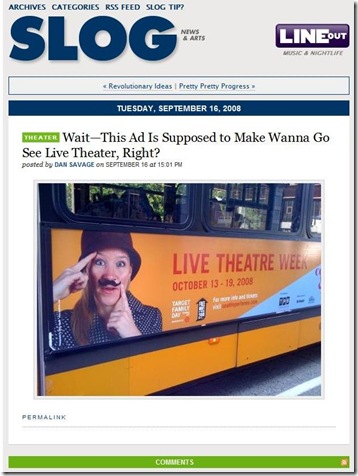
    Yes, we all cringed when we saw the Theatre Puget Sound (TPS) ads for Theatre Week in years past.   Apparently some PR firm had been hired in Sioux Falls, South Dakota and given the very specific instructions to create a campaign that would confirm every uninitiated civilian’s suspicion about just how lame and goofy live theatre can be.  Bowler hats, canes and dorky “del arte” facial expressions were de rigueur.  Some one who did not know better could easily have gotten the impression that every show in Seattle was some variation of a Godspell Hell.

    The comments to Dan Savage’s Slog post here about this flip phone pic  below sum up the general response hilariously.  Comment number 5 buttons them all together, thusly: “Perhaps it is a typo… perhaps it is supposed to read “Live Theatre Weak”

    Screen shot from Slog

    If you are tempted to riposte in the comments with that hoary Seattle arts chestnut of an excuse: “They were doing the best they could”, please spare us, because anyone looking to encapsulate the thrill of theatre photographically need look no further for examples than any of the images pushed out over the last few years by WET. (Sorry, I just can’t bring myself to cave and call them “Washington Ensemble Theatre” just because some litigious trust-funded ensemble in NYC got jealous of WET’s success.  See here .)
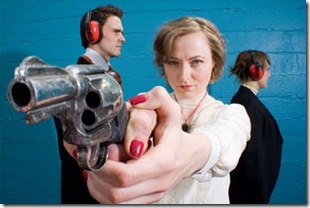
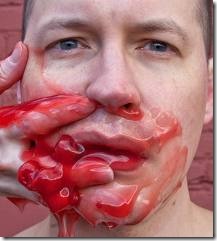
    Promotional photo from WET's Hedda Gabbler redux: blahblahblahBANG Promotional photo for WET's Titus Androncius

    Promotional photo for WET's RoboPop

    (Just how and why is it that WET can make headphones so sexy?)

    As much as Seattle’s theatre professionals longed for a fresh and empowering marketing campaign from TPS to hook people into big and small local theaters around town, the last kind of change most of us would have wished for is what rolled out this Spring.

    Announcing Arts Crush,
    The Month-Long Arts Festival

    on April 19, 2010, at 5:30 pm | Category: Arts Crush

    As you may already know, Theatre Puget Sound is planning an expansion of our highly successful Live Theatre Week festival.  In an effort to build upon the momentum of that program and address the expressed needs of the larger arts community, we decided to expand our scope and build a more diverse and inclusive month-long festival modeled after Live Theatre Week.

    This October, Theatre Puget Sound will present Arts Crush, a month-long festival that connects artists and audiences with invigorating new experiences at hundreds of events across the region.  More than 200 arts organizations and innumerable artists from all over the Puget Sound will come together as a united arts community to share arts experiences with people of all kinds….

    So Theatre Week becomes Arts Crush, and somehow, the theatre artists (mostly actors, actually) that make up TPS’s membership, all of the sudden become, without being asked, patrons of all the arts, because, you know, we make so much money on the stage.  Where are the other major discipline-specific arts organizations that are joining TPS in this move towards expansiveness?  There are none.  TPS basically owns Arts Crush, in conjunction with broad based arts funders like Seattle Office of Arts & Cultural Affairs.  None of the non-theatre-but-still-discipline-specific organizations like Velocity Dance or Seattle Chamber Music come even close to matching TPS’s size or influence.

    Before I go on, let’s take a quick look at TPS’s mission, shall we?

    TPS is a member-driven organization whose main goals are the nurturing of a healthy and vibrant theatre community, developing strong ties among the region’s theatre professionals, raising the visibility of the region’s theatre scene on national and international levels, and finding ways to develop new and diverse audiences.

    Nowhere in the paragraph above is there any mention of cross-discipline arts promotion.

    So why is TPS diluting its mission?  My best guess is fear, with a touch of pointless power grab thrown in for flavor.  The move is part of a larger strategy to beat a tasteful and bloodless retreat from world class status.  The thinking goes like this, “Theatre is suffering.  And so are all the arts.  The core audience for theatre in the Northwest overlaps the core audiences for all of the other arts.  Let’s expand our scope, control that shrinking core and hope to hold the ground we have.  We can give up the castle to control the wider, albeit weakened, kingdom.”

    Of course this runs counter to what I and many of my colleagues believe is the best strategy to not only save theatre in Seattle but also elevate it to world class status at the same time.  We believe now is the time go on the offensive: to advance, not retreat; to push forward bold new and innovative plans for making a completely different and fresh sort of theatre.  We certainly do not think we should be spending our limited resources promoting “arts” in general.  That sort of “yay arts!”, “up with people!” advocacy ultimately helps no one.

    TPS’s desperation is showing.  Just this week an email went out from extending the deadline for applications to the Arts Crush festival.  A cynic has to wonder why.  Could the dilution of the TPS’s core mission have anything to do with it? <
    /p>

    Turning Theatre Week into Arts Crush is a mistake.  Theatre artists are rightfully reluctant to underwrite an effort that has expunged the word “theatre” from its name.  (If you played professional shortstop in Seattle, and the Mariners began a promotional campaign promoting all sports, but omitting the word “baseball” from its title, would you be worried, irritated or both?)  TPS should rethink this move.  Seattle needs a theatre advocacy organization that can keep its focus.  If TPS wants to be something other than it is, they should be honest about it and change their moniker to “APS” for Arts Puget Sound.  Of course, if they did that you would have to wonder what it would do to their membership rolls.

  • NewsWrights United begins “Crowd Sourcing” its Investigations

    NewsWrights United begins “Crowd Sourcing” its Investigations

    We posted the following note on the NewsWrights United Facebook page this morning, as we gear up our full-bore effort to cover the current crisis in journalism from a Pacific Northwest perspective. 

    Help NewsWrights “Crowd Source” its Investigation into How Northwest On-Line Newsies Monetize

    As Newswrights United continues its investigation into the current crisis of journalism for our upcoming second edition of A Living Newspaper: The New New News, it has become clear to us that monetization is possibly the most crucial issue facing the imperiled Fourth Estate. How will these nascent on-line information sources sustain themselves financially? Will the reporters gathering the news be able to make a living or will they, like, say theatre artists, be forced to cobble together their livelihoods through means both related and unrelated to their chosen vocation of truth telling? Will funders, advertisers, subscribers and other potential sources of revenue respect the traditional “fire-wall” between financial and editorial?

    Our Editing Producer Tom Paulson shrewdly notes that the “monetization question” is one most journalists are unwilling to ask, since they would rather not to have to answer it themselves. We at NewsWrights believe a significant public service could be performed simply by accurately reporting how Seattle’s online news providers fund their operations and how they plan to in the future. After all, since we are only playacting as journalists, we should have nothing to lose, right?

    So if you know anything, or know anyone that might know anything, about how the sites on the following list are monetizing, please let us know.

    CrossCut

    InvestigateWest

    MyBallard.com (along with its other neighborhood affiliates: MyQueenAnne, etc.)

    PI.com

    Publicola

    Seattle Times on line

    Seattlecrime.com

    Seattlepostglobe.org

    The Stranger on line (SLOG)

    Sunbreak.com

    Weekly online

    West Seattle Blog

    (Please feel free to suggest additions to this list.)

    You can go to the NewsWrights United Facebook page by clicking here.

    If you have not already done so, I strongly encourage you to “like” us on Facebook.  We will not be spamming you, but rather encouraging you to chime in as we build our theatrical coverage of The New New News, ultimately culminating in a production of a second edition of A Living Newspaper in Seattle early next year. 

  • Curtain Speech for FourPlay – June 11, 2010

    So often the direction of my words is page to stage that when I had this opportunity to go the other way, I could not pass it up. So without further introduction, here, transcribed, is the curtain speech I gave for last Friday night’s performance of FourPlay: original works penned by four of Seattle’s emerging playwrights.  (I am also including a link to the sound file at the end of this post, so that you listen to the actual speech if you care to.)

    Hi everybody.  My name is Paul Mullin and I’m a playwright here in Seattle.  And I asked permission to record my little speech to you here tonight.  I hope that’s okay with you guys.  (I’ll set that right there.  I hope I don’t walk on it. … I better pull out my notes.)

    First of all, if you have a cell phone please turn it off.  Especially in a place this small we can even hear like the little bleeps and bloops.  It’s just distracting to everybody involved.  So thanks for that.

    So Jesse Putnam—and I think he’s here—there he is—is the producer of this piece, and about, I don’t know how many months ago (he’s a former student of mine) he wrote me an email and said, “You know, Paul, I want to produce some theatre.  I got the itch.  I’m thinking about some Pinter plays, or I’m thinking about maybe producing just all new work by emerging playwrights.  What do you think I should do?”  And before I could even get back to him he wrote me and said, “I decided I’m going to go with doing the four new playwrights.”  Which was what I was going to tell him to do.  So good choice.

    And with that in mind, thank you for being here.  You are on the right side of what is right now a very important and pretty avidly fought struggle for the heart and soul of theatre here in Seattle.  Basically there [are] two camps.  One camp thinks that theatre is so precious that it needs to be preserved at any cost.  And then there’s another camp that thinks that theatre doesn’t need any preservation at all.  It just needs perpetration.  Because theatre will always survive.  It’ll even survive these humiliating, soul-sucking, debilitating attempts of the first camp to preserve it.  It’ll survive productions of Glengarry Glen Ross dressed up as a cogent response to the recent mortgage meltdown when the play’s not about that at all and the ironic fact is the recent mortgage meltdown that so drastically affected our country had its epicenter about a mile that way [pointing west] at the WaMu Tower in downtown Seattle.  It’ll survive productions of plays called Rock and Roll set in London and Czechoslovakia, when rock and roll was born in America and the most recent, most important wave of rock and roll had its epicenter in… Seattle.

    So theatre doesn’t need preservation.  Trying to preserve theatre is like yelling at a bunch of kids to “Have Fun!”  We just have to produce theatre, because theatre is produce.  And you can freeze it, and you can can it, and you can genetically modify it so that it has a really long shelf life and can survive distant trips from places like New York and London but we all know that produce is best when it’s fresh and it’s local and it’s organic, like the theatre you’re going to see tonight.

    So if you think what you’re about to see is precious, I would say you should probably just go home, because they just made it.  It’s straight out of the still.  It hasn’t aged in an oak cask.  Okay?  And if you’re here because you think what you’re about to see is important, I gotta ask you, how would you know that?  They just made it.  In fact … no one will know if what you see tonight is important for so long that by the time they know, it won’t  be important anymore.  So it’s a lot like life like that.  Was today important to you?  How do you know?  What you know is that you lived through it.  And it was important in that, right?  And you’re going to live through this… hopefully.

    And I hope you enjoy it.

    FourPlay Curtain Speech – June 11, 2010 by Paul Mullin

  • Notes from a Pure Success

    This past Monday night the Sandbox Artists Collective held its Spring Salon, An Ensemble Playground, with member actors reading short plays that member playwrights had written specifically for them, with an added twist that each playwright had to use seven of ten words assigned by another participating playwright.  I know that the trope “honor and pleasure” gets thrown around a lot, but in this case, my experience of being the member sponsor for this salon was unequivocally both, and you can add “thrill” and a “joy” to the mix, since the whole process reminded me a bit of childhood Christmases, when making presents ran a close second to the fun of opening them.

    I jotted some notes which I share with you here, mostly roughhewn:

    Preshow

    • People are wandering in, enjoying the food, wine and cookies.  Some Sandboxers, but other folks too, including– god help us all!– young people interested in fresh and locally grown plays.
    • 7:10, everyone is still eating, drinking, chatting, playing pinball machines and getting to know one another, which was the primary intent of this salon so I’m reluctant to get things started.

    Play One

    • Anita Montgomery’s  “The Ties that Bind”
    • Early it dawns that Leslie Law and Peter Dylan O’Connor are playing sister and brother, and it’s perfect.  Not only do they convincingly look the parts but their interaction is laced with that particular pain that only a brother and sister grown apart suffer.
    • Is this great acting, great writing, great casting?  Well, the writing essentially is the casting, so . . .
    • Fold in Dave Natale as the palpably estranged  step-brother, again pitch perfect, and the brilliance builds, blissfully untraceable to any single artist in the process, the way great theatre should be?

    Play Two

    • Ki Gottberg’s “Felt”
    • Leaps straightaway from the precipice of “qualia” one of Ki’s ten assigned words (by me: full disclosure).
    • Richard Ziman, gamely filling in for Shawn Belyea, plays a lovable pompous philandering pendant, bookended by his wife (Tracy Hyland) and his young lover (Renata Friedman).
    • Again the voices are pitch perfect.  Even the silences with which both Tracey and Renata charge the beginning of the piece seem written particularly for them. 
    • Ki writes four roles actually, gamely making full thematic use of the yet-to-be born Hyland baby Tracy so gracefully carries.
    • The arc of the piece, launching in absurdist comic verbosity gently lofts into a bitter-sweeter, clearer atmosphere and touches down so gently in shared humanity.  Maybe we can share our experiences, our “qualia”.
    • So exciting to see another playwright attack a subject I have longed to approach and do it so differently and successfully. 

    Play Three

    • “The Eulogy” by Elizabeth Heffron
    • Immediately we know that Mik Kuhlman, Lori Larsen and Seanjohn Walsh are siblings.  Siblings again! and also death, as they’re at a funeral: Anita’s characters were at a viewing.
    • Elizabeth clearly knows each of her actors so well that she can trust them with just enough dialogue to nail the moment without overdrawing it.   
    • The local references to a Ballard and a sex besotted Scandinavian parking lot king has the audience eating out of the palm of Elizabeth hands.  They can taste freshness, like eating a salmon they just watched being pulled out of the locks.

    Play Four

    • “Satsuma” by me, featuring Rik Deskin and Gin Hammond. 
    • Again the performers find their characters’ voices like virtuoso’s picking up their favorite fiddle
    • And  again, it’s siblings.  What’s with the synchronicity?  Is it that many of us in the Sandbox have known each other for so long that we see each other as brothers and sisters?  Or is it, like Lori Larsen suggests in the talkback, just some Jungian archetype that happens to  be floating for the moment in the collective ether.  Either way, it seems like a phenomenon uniquely connected to the immediacy of the work.

    Afterwards, we all agree we have to do something like this again.  The theatrical potentialities unleashed in the fusion of local playwrights with local actors with local audiences are just too powerful to ignore or leave untapped.   I know the Big Houses are busy staying alive, but they need to ask themselves why they are not more actively engaged in this uniquely fertile process.  There’s surviving and then there’s thriving, and Monday night felt like the latter to me. 

    And not just me.  Every person in that room felt it. That’s the singular beauty of theatre.  At its best, there’s nothing singular about it.

  • Congratulations, Jerry!

    Jerry has said often, publicly and privately, that if he landed the job of Artistic Director permanently–instead of on an interim basis, which is how he has held it the past two seasons–  he would fully engage bringing locally grown new plays to the fore at the Rep, and thus help move Seattle theatre towards world class. We happy Northwest playwrights expect he will be as good as his word.