Just Wrought

Recovering playwright, once won a STRANGER Genius Award for theater. Now writing a bloated novel about… G-d help me! Theatre.

Tag: Paul Mullin

  • Ballard House Duet’s Poster is Here!

    Ballard House Duet’s Poster is Here!

    There’s nothing quite like a show’s  poster going live to underscore the message: “This sh*t is happening!”

    You can get your tix here.  (Do the math. {Small house + short run} * {dynamite cast + crackerjack production team} = early sellout!)

    You can stay up-to-date  on additional Ballard House Duet information as it comes available by “liking” the Custom Made Plays Project Facebook page here.

    And as always, I’ll do my best to keep you up to date here at Just Wrought. More fun news is on the way, I promise!

  • Ballard House Duet: Just the Facts

    Ballard House Duet: Just the Facts

    Blogging is hard. You have to keep posts short to hold people’s attention, but then a project comes along like Ballard House Duet and all I want to do is tell everyone every little thing about it. I want to describe why it’s been so important to me creatively: how it’s been so fun, but also stretched me; why I think every playwright should try custom writing for individual actors; why I think the play tells a locally grown story Seattleites can uniquely identify with; and on and on.

    I am, however, going to show some restraint, by limiting myself in this post to delivering the simple facts.  Ballard House Duet grew out of local actor Rebecca Olson’s idea to commission plays crafted especially for individual actors in Seattle. Says Olson:

    The process begins with a blank page; the actors themselves are the basis for the play, and the actors stay attached to the script from conception through performance. The project includes development, workshops and full production of the finished scripts. This model allows the playwrights to draw on the individual and collective experiences of the artists they are working with. The resulting plays are more satisfying to produce and more resonant with local audiences.

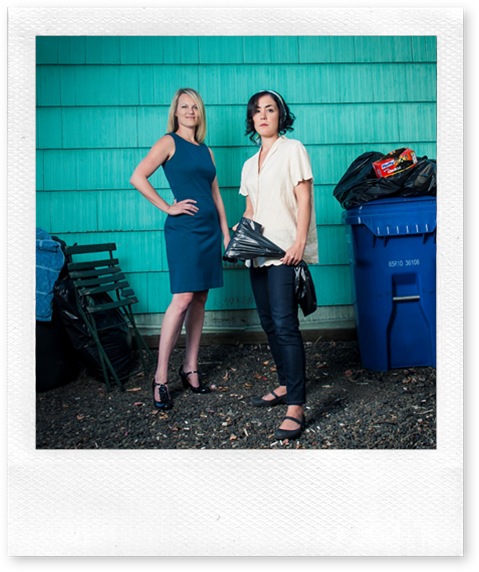
    Olson offered me the honor of being the premiere guinea pig playwright. Hana Lass is Rebecca’s castmate, and Erin Kraft leads the project as director and unofficial dramaturg (though Hana and Rebecca certainly had a hand in that as well. More on that later.)

    We kick this premiere off on December 7 (‘cuz nothing bad has ever happened on that date, right?) and run for two short weeks in a small house, so you’re gonna wanna get your tix quick, by clicking here.

    Here’s a synopsis . . .

    Heidi doesn’t say the word “adopted”.  Holly’s her full sister, even if she is half-Asian and Heidi’s all American.  Somehow Holly inherited Aunt Nana’s religion gene, while Heidi got Mom’s need to be the center of attention.  Now in their 30’s the two sisters have agreed to clear out their hopelessly hoarding great aunt’s house, but when Heidi shows up a week late, hoping to film the process for a reality show, the past and future explode, scattering the shrapnel of strong, deeply hidden betrayals and even stronger, more deeply hidden loyalties.  As they wade through a lifetime of accumulated possessions – and personal grudges – Holly and Heidi must decide: What has value and what are they better off just throwing away?

    And here are the production details . . .

    WHAT:  Ballard House DuetA Custom Made Play Project & World Premiere

    WHO:  Written by Paul Mullin  for actresses Hana Lass and Rebecca Olson; directed by Erin Kraft.

    WHEN:  December 7-17th, 2012, Thursdays through Mondays at 7:30pm; Sneak Peak Thursday Preview, December 6th @ 7:30pm

    WHERE:  608 19th Avenue East, at The Little Theatre in Capitol Hill

    TICKET INFORMATION:  Tickets are $15-$25 and are available at the door or in advance at www.washingtonensemble.org.

  • This Change is Playwright Approved

    This Change is Playwright Approved

    Theatre tradition runs rife with jokes, sayings and funny stories about actors and playwrights, and their divergent natures.

    Question: How many playwrights does it take to change a light bulb?

    Answer: The light bulb doesn’t need any changes.

    * * *

    Question: What’s the difference between a working Seattle actor and a large pepperoni pizza?

    Answer: A large pepperoni pizza can feed a family of four.

    * * *

    “The average actor craves approval; the above average playwright craves disapproval.”

    These clichés occasionally harbor a smidgeon of truth, but persist as mostly empty stereotypes. However, I do hold one difference between playwrights and other theatre artists to be true and fundamental: we tend to have a keener long-term view of the theatrical environment. This only makes sense. Our work cycle runs to years, whereas most other theatre artists live tactically, month to month; at most, season to season. Playwrights simply scan a farther horizon. (So no, I was not using my psychic powers when I predicted earlier than most the demise of the Intiman as we know it.)

    All this is to say my eagle eyes tell me that ACT just made an exquisite choice by appointing John Langs to the position of Associate Artistic Director, and thereby giving him and his family a reason to make Seattle their permanent home. (You can read a detailed run down of John’s new duties here.)  Unlike other hotshot directors who have been recruited from afar to fill similar roles at Seattle Big Houses, Langs is no elitist carpet bagger. His roots run deep here in Seattle, at Big Houses and small, with him directing work by writers running a gamut from Shakespeare to, well, me.

    Seattle actors love Langs, and he loves them. Seattle playwrights respect Langs, and he respects them. (A dual-facing fact I wish were true for more Seattle Big House administrators.) I won’t tell you John Langs can single-handedly drag Seattle theatre to excellence—he can’t; but he is the piece that perfectly fits a missing part of the puzzle here. Langs has shepherded more excellent new plays to world premiere than any other director I know. He gets why new work is so vital to Seattle’s health as a World Class theatre town. He also gets how nurturing it can help his own career in a way that staging the latest New Yorker-approved off-Broadway hit never could.   

    ACT’s choice is a win for everyone. Langs will grow his already formidable career here instead of elsewhere, and he will grow his fellow Seattle artists with him. For John, Seattle isn’t a stepping stone.  It’s the destination.

    Confidential to John:  carve an hour out of your swamped schedule and let me be one of the first of many to buy you a congratulatory cocktail so I can properly say:

    “Welcome, welcome, a thousand times, welcome. 

    Now… get to work!”

  • Happy Columbus Day from THE GOOD SHIP MANHATTAN

    Happy Columbus Day from THE GOOD SHIP MANHATTAN

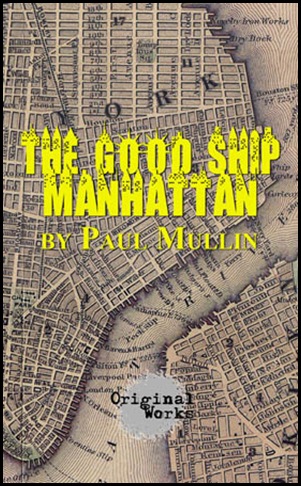
    In honor of this dubious-at-best holiday, I offer a relevant excerpt from my play The Good Ship Manhattan.  (Fair warning: for the most part this is a near exact transcription of a conversation that actually happened.  Politically correct, it was not.)


    . . . . GREG:  You gotta live in the real world.

    RICHARD:  Yeah.  And apparently you gotta shit in it too.

    GREG:  Please.  Cry me a river.

    RICHARD:  I’m just saying.

    (Pause, as Greg takes a healthy gulp from his single malt.)

    GREG:  So are all ex-social studies teachers big whiney liberals like you?

    RICHARD:  Actually, my 11th grade American History teacher was a flag-waving, ignoramus Nazi wacko such as yourself: Mr. Capezio.

    GREG:  Oh, he was a wop, too, hunh.

    RICHARD:  I don’t hold it against the wops.  Some of this country’s greatest Leftists were ginnys: Sacco and Vanzetti, LaGuardia, Columbo.

    GREG:  Columbus.

    RICHARD:  No, I said “Columbo”.  As in Peter Falk, as in a joke?

    GREG:  Yeah, and I’m saying “Columbus”.  As in Christopher.

    RICHARD:  Please.

    GREG:  Please what?

    RICHARD:  Do not talk to me about Columbus.

    GREG:  We’re talking about great Americans.  How do you do greater than actually finding the place?

    RICHARD:  Oh boy.

    GREG:  What?

    RICHARD:  Where do I start?

    GREG:  Oh don’t tell me.  You got a beef with Columbus.  You’re one of these idiots out here protesting the fucking parade.

    RICHARD:  Do you know anything about Columbus?

    GREG:  Uh… yeah, I know a little something about Columbus.

    RICHARD:  Like?

    GREG:  Like Fourteen Hundred and Ninety two.  Sailed the ocean blue.  To tell the liberal schoolteachers, “fuck you”.

    RICHARD:  Landed on Haiti.  Immediately enslaved the entire population.  Effectively wiped them out with disease, torture and execution.  Encouraged his men to hunt them for sport.

    GREG:  You wanna compare him to a Nazi now?  That’s you people’s favorite thing to do, isn’t it?

    RICHARD:  Well, let’s see… he rounds up an entire race of people, puts ‘em in camps and proceeds to annihilate ‘em in a holocaustic blood-fest, all in the name of Queen and Cross.  I wouldn’t say it’s an unfair comparison.

    GREG:  And who was it exactly that stopped the Nazis?  Hunh?… 

    GREG:  The Americans.    RICHARD (simultaneously):  The Russians.

    GREG:  Bullshit!

    RICHARD:  Ever heard of Stalingrad?  Got any idea what the casualty rate was for a Soviet infantryman?

    GREG:  All I know is, if it wasn’t for us, the Brit’s would be speaking German right now.

    RICHARD:  That’s the standard Hollywood fantasy.  Unfortunately utter bullshit.

    (The bartender, Ursula, steps closer to listen.)

    GREG:  Yeah, I know: nothing I learned in history class is true.

    RICHARD:  Well–

    GREG:  There’s no such thing as George Washington.  He never crossed the Delaware.  We never kicked ass on the Redcoats and won our independence.

    RICHARD:  I’m not saying that.  I’m saying there’s always more to the story.  Like if it hadn’t been for the French, we’d all be–

    URSULA:  What?  Speaking English right now?

    RICHARD:  What?  That makes no sense.

    GREG:  Makes sense to me.

    URSULA:  That fact is, the French only brought their full support to bear once they were convinced the Continental Army would ultimately beat the British.

    RICHARD:  Which they could only do because Britain was over-extended with her empire stretched across the globe.

    URSULA:  Agreed.  But you can’t deny that the symbolic victories Washington won at Trenton and Princeton after crossing the Delaware– as this gentleman mentioned– and the subsequent winter of drilling and reinforcement at Valley Forge, effectively transforming a motley crew of rag-tag citizens into an inspired fighting force, had nothing to do with the ultimate victory of the Continentals and the formation of the United States that you call home.

    (Ursula steps away to another part of the bar.)

    GREG:  Holy fuck!

    RICHARD:  Whatever.

    GREG:  You think she’s ever modeled?

    RICHARD:  Reductionist claptrap.

    (He drains his glass.)

    GREG:  How much would you pay to fuck her right now?

    RICHARD:  I wouldn’t pay your money to fuck her with your dick.

    GREG:  Yeah.  Okay, teach. . . .

  • My Friend Goes to LA, Becomes Famous Raccoon, Returns to Seattle to Kill Philosophical Zombies

    My Friend Goes to LA, Becomes Famous Raccoon, Returns to Seattle to Kill Philosophical Zombies

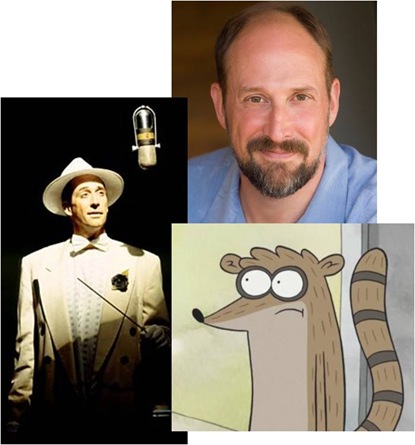
    William Salyers and I met during Seattle’s fervent 90’s: a now hazy golden age when you could beg an actor like Paul Giamatti to be in your play workshop, or witness a writer like Karl Gajdusek premiere his deeply surreal, nearly inaccessible Dr.s F.s in the Terminal Ward twenty years before he would premiere his eminently accessible action series, The Last Resort, on national network television. So Bill Salyers and I already sort of knew each other from the scene when were forced by the exigencies of corporate temping into the close proximity of the licensing department of Northern Life Insurance. The two of us would blunt the boredom when we could by improvising various scenarios. I would open with something like:

    PAUL (best British Colonial Officer voice): Do you remember that time in the Congo when the battalion lost its way and we were forced to eat grubs?

    BILL (way better British Colonial Officer voice): Oh, yes. Sergeant Major Grubbs. Terribly good man. Such a pity.

    No one can match Bill for voices and improv.

    When I began writing my play Tuesday— a piece which I now, in retrospect, recognize as my first post-journeyman work— I could only manage to finish it by assuring myself that Bill would play the main character, Audie McCall. That development process, and culminating first production at AHA! Theatre, began a collaboration that lasted over the following 17 years, with Bill premiering the title role of my Louis Slotin Sonata at Circle X Theatre in LA and then playing it off-Broadway, then playing Walt Whitman among several other rolls in An American Book of the Dead – The Game Show, and then inhabiting the skin of the now real-life head of NIH, Francis Collins, in my play about the race to decode the human genome, The Sequence. And it’s not just my plays that Bill has helped to mid-wife. Having run the math, I am now convinced that William Salyers has participated in the world premieres of more plays than any other person currently on the planet. I am still waiting for someone to prove me wrong.

    While the size of the houses my plays premiere in has stayed, well, let’s say “cozy”, Bill has happily gone on to much wider success as a stage actor. For instance, he’s currently premiering Dan O’Brien’s The Body of An American at Portland Center Stage. Beyond the boards, Bill has achieved exponentially greater fame —the kind only Hollywood can offer— for work he’s done as a voice actor. I finally managed to impress my nephews with my show business connections when I told them that the guy who voiced Rigby the Raccoon on The Regular Show was my good friend. (Congratulations to Bill and everyone on TRS for their freshly won Emmy!)

    All this history is just my a long winded wind-up to telling you that Bill will once again be helping me bring a new play to life by playing the role of Simon in a very raw reading of my latest stab, Philosophical Zombie Killers, along with Susanna Burney, John Q. Smith and Amy Love.

    Here’s a sort of synopsis of the play:

    The graduate level seminar is about human consciousness. Or at least that’s what you thought when you signed up for it. Now someone’s telling you that you’re 45 years old and you’re dying. You certainly didn’t sign up for that. Now this alcoholic professor is asking you to explain consciousness to him. And this depressed ex-cop from Missouri is telling you about the epidemic of decapitations in Seattle. And this weird lady from Omnisoft just wants you to admit that there’s no such thing as consciousness and no such thing as you for that matter. Could she possibly be right? Might make dying easier. Who said you were dying?

    And here are the details:

    Who:       Susanna Burney, Amy Love, William Salyers and John Q. Smith

    What:     Philosophical Zombie Killers by Paul Mullin

    Where:   The Bathhouse Theater in Green Lake

    When:    October 15, 2012, 7pm

    How:      Pay what-you-will, including nothing at all. You’re doing us a favor by giving it a listen.

    Reserve seats at Brown Paper Tickets: http://www.brownpapertickets.com/event/278468

    Zombie Bill

  • A Bountiful Fall Harvest for Seattle’s Locally Grown

    A Bountiful Fall Harvest for Seattle’s Locally Grown

    Seattle’s scene for locally grown plays has always been stronger than your average mid-sized city’s, but anything good is worth fighting to make better. That’s why I mouthed off over two and a half years ago with an essay titled “Theatre takes Place: Why Locally Grown Plays Matter”.  I listed some bullet points explaining why the development of new plays is so crucial to the health of any great theatre scene:

    • “Local actors evolve a better understanding of how their contribution … can be generative as well as interpretive.
    • “Local audiences evolve a better understanding of how plays get made and how they can participate in the process….
    • “Local funders evolve a better understanding of their roles as patrons of the arts…
    • “Local funders, artists, and administrators …[can see] the development of plays as actual investments, with the potential to pump profits back to Seattle in several ways.”
    • I even complained that the then recently introduced TPS  Gregory Awards had a category for “outstanding director” but none for playwright, a blunder since rectified.

    Mouthing off is fun, but theatre is a collaborative art form.  Unless others join the fray it isn’t much more than meaningless monologue.  Happily, the last few years have shown just how much a modest city can grow as a theatre town when a group of motivated professionals put their collective mind to it.  For instance, last year A Contemporary Theatre finally took another chance on a local playwright by producing Yussef El Guindi’s  Pilgrims Musa and Sheri in the New World.  The gamble paid off big-time: El Guindi won The Harold and Mimi Steinberg/ATCA New Play Award (plus the $25,000 that comes with it), and American Theatre Magazine just published the script in its current September 2012 issue.

    Keri Healey’s new play Torso, produced by Printer’s Devil Theater, mesmerized everyone I know who saw it.  I suspect it is no coincidence that Keri has been short-listed for a Stranger Genius Award this year.  Torso recently doubled down on local impact with its currently running second production on Orcas Island.

    These are just two stand-out success stories from many.  And this fall promises another bountiful harvest of locally grown new theatre.  Again, just to name and explain a few (with a promise to blog separately on some as they come closer):

    14/48 outdoors for the first time ever

    A few weeks ago I raved about the glorious gamble the 14/48 steering committee was then making by staging their first “Kamikaze” festival, but this weekend they are amping up their Summer of Risk by staging the instant theatre festival outdoors for the first time in their 15 year history.  Tickets are free (also a new twist) so it’s hard to see how you could afford to miss it. (More info here.)

    The Betty Plays

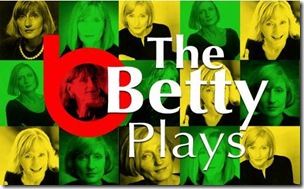
    Beloved local actor Betty Campbell doesn’t get around as easily as she used to, so five local playwrights, myself included, wrote four short plays tailored to her unique and extraordinary talents.  This special Theater Schmeater offering is the sort of one-of-a-kind live experience that only happens in Seattle.  (Click here for more information  and here for reservations.)

    NCTC’s Foreclosure by Vince Delaney

    One of Seattle’s hottest acting ensembles workshops one of Seattle’s hottest playwrights, as he tackles an issue facing Americans nationwide  There aren’t many performances scheduled for this pre-world premiere, so you better reserve early.

    Sandbox Radio Live!

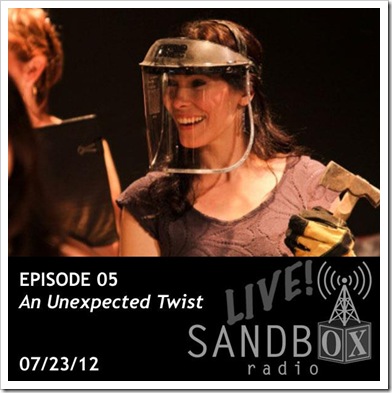
    1. The podcast from Episode 5: “An Unexpected Twist” recently dropped.  (A blog on that to come.)
    2. A “Best Of” show kicked ass at Bumbershoot!  (Check out this review.)
    3. And Episode 6: “Something Wicked This Way” is coming very soon: October 1 at West of Lenin.

    Why is Sandbox Radio Live! so important to Seattle’s locally grown theatre movement?  Because it happens every quarter and every quarter it gets better.  Because nearly every play, poem or commercial is written by top local playwrights and performed by top local actors.  Because it is fresh local “produce” at its best and most consistent.

    Custom Made Plays

    In my opinion this may just be the most exciting new wrinkle in Seattle’s locally grown scene, and not just because I have the good fortune of being the inaugural playwright.  Brainchild of local actress Rebecca Olson, the Custom Made Play Project  is dedicated to matching Pacific Northwest playwrights with local actors to develop and produce new plays of regional significance.  In my case, after interviewing my collaborating actors, Ms. Olson and Hana Lass, I tailor-made the soon-to-world- premiere Ballard House Duet to their unique talents and qualities.  Because of that, I am painting with colors I have never used before, and I’m loving it.  The resulting script simply would not exist were it not for these unique one-on-one collaborations. That fact excites me.

    Here’s another fact: Seattle is the best city in the country—maybe even the world— for locally grown theatre.  And we are only getting better and better at growing it.  As you can see from the small sampling above, it’s going to be an awesome autumn harvest.  It makes you wonder what next winter, spring and summer will bring.

  • Sandbox Radio Shoots Bumber

    Sandbox Radio Shoots Bumber

    I know, I know.  The biggest complaint about Sandbox Radio Live! is that the super fun recording sessions are always sold out, making it damned tough to watch the magic being made.  Of course, the final magic is always eventually available to you as a podcast.  In fact, Episode 5: “An Unexpected Twist” just recently dropped and is available here .

    Tracy Hyland

    But now Seattle’s beloved arts festival Bumbershoot is offering a one time solution to this conundrum.  This coming Labor Day (September 3) is your chance to see a “best of Sandbox Radio Live!” at the Center Theatre in the Armory, which has about thrice as many seats as our usual venue.  We will start at 7pm and pack an episode’s worth of fabulousness in just one hour. 

    Here’s what’s in store:

    “Notes from the Workplace” by Vincent Delaney

    “Why We Run” by Scot Augustson

    PSAs for Hanford Challenge and World Arts Access

    A blues tune from Charles Leggett and The Sandbox Radio Orchestra.

    Ads from “The Back of the 358” and a teaser for what’s coming in Markheim by Paul Mullin

    “T-Minus” by Elizabeth Heffron

    “Barcarolle” from Tales of Hoffman featuring special guest soprano Heather Curtis Mullin,  and more!

    You read that correctly.  My wife will be singing.  And I will be acting: reprising my role of Sam, Prince of the World, in my on-going noir angel detective series, Markheim.  That makes this Bumbershoot performance the very first time that Heather and I have shared a professional stage.  So come see Sandbox Radio Live! at Bumbershoot and watch some hot history being made.

    Paul & Heather Mullin

  • Exploring Alternative Narrative Structure

    Exploring Alternative Narrative Structure

    It doesn’t happen often, and when it does I always manage to kvetch about it, but I am teaching again, this time at Hugo House, and with a broader scope than just playwriting.  Here’s the pitch. . . .

    Exploring Alternative Narrative Structure

    Aristotle said a story should have a beginning, middle and end, in that order; but how often does life really feel like that? Sometimes to reflect reality we have to challenge old assumptions about how we experience and process narrative. We will explore alternatives to Aristotle’s cherished mountain of rising action, looking at classical music forms, technology, architecture, political systems and biology for potential models.  Indeed, no source of inspiration will be excluded. Famous examples of effective use of alternative narrative form will be examined, including Pinter’s Betrayal, Thorton Wilder’s “The Pullman Car Hiawatha,” Italo Calvino’s novels and Paul Mullin’s Louis Slotin Sonata.  Finally, we’ll examine our current writing projects and determine how they might benefit from some structural shake-ups.

    If you’re interested, your best bet is to register on line here.

  • 14/48 Raises the Stakes Again, then Again

    14/48 Raises the Stakes Again, then Again

    I was going to write another essay about 14/48 running up to this summer’s festival.  I’m an old hand at essays about 14/48. In fact, I once wrote an essay about how an essay I wrote about how 14/48 is partly responsible for all these essays I wright here at Just Wrought.  Talk about recursion.

    I was going to write an essay about how 14/48 serves as a sort of “stealth” semi-annual Seattle theatre convention, encouraging theatre artists of different disciplines, different experiences and varying amounts of “dues paid”, to get to know each other when otherwise they might not. I was going to point out that such a convention has to be “stealth”, and it has to contain as its main component the compressed camaraderie that only producing a show together creates. If someone offered to host a “Seattle Theatre Convention” where we all just gathered to chat, flirt, and share war stories, I am certain nearly no one would come. The younger theatre artists all have better things to do, mostly centered around boozing, bullshitting and getting laid. And the older theatre artists all have better things to do, mostly centered around dealing with the consequences of our earlier boozing, bullshitting and getting laid. It’s not that we old-timers don’t like you, Young Seattle Theatre Artists— far from it.  You are, as the kids like to say, hella fine. But we are never gonna come to your pick-up kickball games or your Facebook arranged Karaoke nights starting after 9:30. Shit ain’t happening. The only thing I start after 9:30 at night is a bath. 14/48 forces us together, young and old, in the only way that matters: putting on a show. Just by participating I have come to know upwards of a hundred amazing artists that elsewise I might only know as names in a program.

    Okay. So that’s what I would have said about 14/48.  And it would’ve been enough.  But the 14/48 powers-that-be have sprung some surprises for this summer’s festival, yet again upping the ante of their game. The first week of the world’s quickest theatre festival will take the form of the oft threatened but heretofore never actually implemented “kamikaze” version.  Normally seven playwrights are selected to write 10 minute plays on a randomly selected theme. The plays, written between 10 pm the night of the selection and 8 am the next day, are then randomly assigned a director who randomly casts from a pre-selected pool of actors. Over the next 10 or so hours the plays are rehearsed. At 8pm, less than 24 hours from when they were conceived, the plays a performed before a rather demanding live audience.  At 10:30 pm they are performed again, before a whole new audience. And then all of it happens again the next day. If you’re thinking, “Wow, that sounds like an ass-kicker,”  you are thinking rightly.

    So what is Kamikaze? Nothing short of more randomness, more risk. 45 veterans have been invited to participate without knowing ahead of time which of the disciplines they will working in: acting, directing, writing, band or design. 14/48 co-founder Jodi-Paul Wooster explains the rationale behind adding the Kamikaze twist: “Over the years, we’ve had a number of talented artists say ‘thanks for inviting me to [blank] but I’ve always wanted to [other blank]’ To those brave folks I say: ‘Careful what you wish for.’”

    As if these Kamikaze rules weren’t wrinkle enough, a few weeks later 14/48 will twist the festival in a different direction, staging it outdoors for the first time at Seattle in the gardens on the eastern side of the Seattle Repertory Theatre. “We can never rest on our laurels,” says Jodi-Paul. “Our audience and artists expect not only new plays but new ways of creating these plays.”

    I must confess a bit of shameful glee at the terror with which many of my fellow invitees are facing the Kamikaze weekend. If you break down the numbers of any given 14/48, you’ll find that actors comprise by far the largest plurality of participants.This mirrors the world of normal theatre. On the other hand, of the 45 total participants only seven are playwrights, or 15.5%. This proportion exceeds that of modern American theatre by an abnormally high value. Normally writers are much smaller minority: maybe two percent, maybe less. For many Seattle actors, 14/48 is the only chance they ever have to collaborate with a living breathing playwright to produce a brand new work.  So the thought of having to wright a new work in 10 hours can be petrifying. One good friend, an actor, reached out to me for advice: “Yo, … can you give me 3 things to help me thru my fear. Maybe 3 tips to help me tell a good if not moderately acceptable story.” I’ll share my reply, lest my buddy acquire any unfair advantage from my advice, which seems damned unlikely.

    Hey!

    It’s all gonna turn out good, you know, and by my math you only have a 15% chance of being drawn as a writer. But still, I’m happy to offer a few tricks of the trade, to be taken with a grain of salt, because if you find something doesn’t work for you, toss it right away.

    1) Beginning, Middle, End. That’s the best trick. You have a situation. It’s static, in balance, but only just barely. Something’s wrong with it. It cannot sustain. That’s your beginning. Something happens to change that situation, throw it out of balance, either from inside or outside, either someone MAKES the change happen or it happens to them. Doesn’t matter. But change happens. That’s your middle. Things happen in the struggle for a new balance to be struck. …. It could be bad (MACBETH), good (MIDSUMMER) or indifferent (WAITING FOR GODOT), but the lights fall on a new order. This is your end. In 14/48 your best bet is to give 1-2 pages to the beginning. 3-5 pages to the middle, and probably not more than 1 page to the end. Your mileage may vary, but do remember, when you hit the end of typewritten page six, you are done.

    2) Start jotting down ideas, characters, snippets of dialogue that strike you. Keep a little notebook. If you find yourself stuck on the night of writing, open this up and draw from it, at random if you have to. Some may say this is cheating, but there’s an old saying in baseball, if you ain’t cheating a little bit, you ain’t trying hard enough.

    3) Trust. You’ll be working with 45 of Seattle’s very best theatre artists, all 14/48 veterans. We’re experts at making this shit fly. You don’t need to do it all by yourself as a writer. (The dirtiest secretest secret about playwrights is that we’re at our best when we are at our laziest.) Trust that some brilliant folks will come in and fill the gaps. And notice that I didn’t say you’d be working with 44 of Seattle’s best. I said 45 ‘cuz I’m counting you. Trust you. You’re fucking awesome.

    Hope that helps. Feel free to bug me some more if you get worried. It’s gonna kick ass though, so don’t worry too much.

    pm

    My last 14/48 essay was called “Holy Fear” and in it I argued that  healthy fear is essential to making good theatre. 

    It is what keys us into the audience’s experience of the immediacy of the moment. If you’re not feeling it, then chances are the audience won’t be feeling much of anything.  And, alas, they’re used to that. If they want “perfection”, they stay home and watch the boob. Our fear as theatre artists fuels the whole machina ex deus that is theatre.

    Oddly, less than two weeks out, I am mostly fear-free. I suppose, like a childish Luke Skywalker, I don’t really know enough to be afraid. And now, having written that, chill bumps rise on my arm, and I hear Yoda saying, “You will be.”

    The confirmed Artist Roster for 14/48 Kamikaze is: Jose Amador; Ahren Buhmann; Susanna Burney; Dave Clapper; Trick Danneker; Nik Doner; John Farrage; Brandon Felker; Bret Fetzer; Mark Fullerton; Julia Griffin; Basil Harris; Alyssa Keene; Erin Kraft; Mik Kuhlman; JD Lloyd; Hana Lass; Teri Lazzara; David- Anthony Lewis; John Lutyens; Corey McDaniel; Ben McFadden; Pamala Mijatov; Pattie Miles Van Beauzekom; Scotto Moore; Paul Mullin; Peter Dylan O’Connor; Opal Peachey; Nik Perleros; Celene Ramadan; Shane Regan; Jaime Roberts; Carl Sander; Charles Smith; Roy Stanton; Allison Strickland; Erik Van Beauzekom; Jonah Van Spreecken; Doug Willott and Anthony Winkler.

    Tickets for 14/48 Kamikaze can purchased in advance at Brown Paper Tickets, by clicking here. I highly suggest you do.  They will sell out.

  • An Unexpected Twist

    An Unexpected Twist

    I’m a MarkheimA sort of angel.  But not the sort with wings and a harp and a halo.

    Markheims are the black ops.  We do things other angels can’t… or won’t.  Upstairs pulled me outta retirement for a mission down in this soggy town.  But when it was done I didn’t go back. I had questions.  And the answers weren’t up above. 

    Now I’m walking neutral, half-fallen, in what we angels call the Show.  But I gotta watch my back.  ‘Cuz things can always get uglier.

    Make your reservations here.

    Can you believe Sandbox Radio Live! has been broadcasting for a year now?

    Neither can we. That’s why we’re calling our upcoming fifth(!) episode “An Unexpected Rebecca Olson playing with chainsTwist”. The Sandbox Artists Collective will be recording our latest offering before a live audience on Monday, July 23 at 7:30 at Fremont’s newest theatre, West of Lenin.

    Entirely new, fresh and locally grown, Sandbox Radio Live! is written, produced and performed by some of Seattle’s hottest stage talent. This latest episode, An Unexpected Twist will include new short plays by Scot Augustson, Emily Conbere, and Elizabeth Heffron, plus Episode 5 of Paul Mullin‘s noir-angel serial Markheim, plus an original poem by Reggie Jackson, and special musical guests John Engerman and Heather Curtis Mullin.

    Members of the Sandbox Artist Collective currently scheduled to appear include: Megan Sandbox BarAhiers, Eric Ray Anderson, Gin Hammond, Tracy Hyland,  Kelly Kitchens, Charles Leggett, Peter O’Connor, Larry Paulsen, Annette Toutonghi, Kathryn Van Meter, Cynthia Whalen and guest Jim Gall.

    Original music will be provided by Jose Gonzales and The Sandbox Radio Orchestra: Charles Leggett, Dave Pascal, Dan Tierney and Rob Witmer.

    You won’t want to miss this, and you won’t want to wait until the podcast gets posted.

    Plus! Before the show and during intermission enjoy our newly added bonus feature from last episode, The Sandbox Bar! Featuring beer, wine, mixed drinks and other refreshments.

    Come see it LIVE! on Monday, July 23.

    Sandbox Radio Live - Episode 5 Poster

    Who:      The Sandbox Artists Collective

    What:     SANDBOX RADIO LIVE!: An Unexpected Twist

    Where:   West of Lenin (Located at 203 N. 36th Street, a few blocks west of the Statue of Lenin in the center of the universe,Seattle’s Fremont neighborhood.)

    When:     Monday, July 23, Sandbox Bar opens at 7:00, house opens at 7:30 with a live music set, show starts at 8:00pm

    How much: Donations gratefully accepted at the door. ­Reservations recommended and Available through brownpapertickets.com by clicking here starting Monday, July 2.

    Sandbox Radio is conceived, produced and directed by Leslie Law.

    Subscribe to the podcast of Sandbox Radio and listen to past episodes at the iTunes store: http://itunes.apple.com/us/podcast/sandbox-radio-live/id452830642