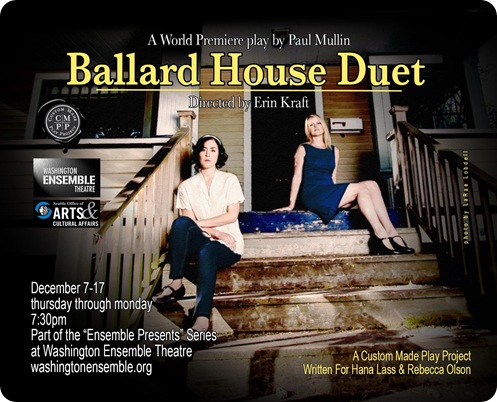
I made a promise to myself a while back that if I was going to use the word “experiment” in association with my work as a theatre artist, I had to do so more like a scientist and less like some avant garde poser. As I said in my earlier post “Putting the Fail back in “Experimental”:
Any actual scientist understands that true experiments have rules and consequences. Experiments are tests of hypotheses hoping to become theories; and theories, in order to prove useful, must be falsifiable. In other words, true experiments by definition contain the possibility of failure.
I would add that good scientists publish their results whether or not they find them gratifying. And that’s exactly what I intend to do here and now regarding the experiment of publishing my play Ballard House Duet simultaneously with its recent world premiere. (I enthusiastically explained my reasons for initiating this experiment here.)
So as of this posting, here is how my sales break down by channel:
Not a data/chart nerd like me? Okay, here are my plain English conclusions:
-
I have too much unsold inventory. If I had listened to my publisher and ordered the number of books he recommended I’d be sitting on a mere 3% overhang now, which would have been right in the estimator’s sweet spot.
-
“Show sales” was my strongest channel, which is gratifying, since offering the script simultaneously with performances was the main point of this effort. If I did this again I would lean even more heavily into this channel: maybe invest in a more visually pleasing display than the cardboard box with the words “Scripts for Sale – $10” scrawled on the front of it in ballpoint pen.
The bottom line is I turned a profit about three eBay sales ago. I am now $19.59 richer for this experience; but based solely on the data, I would have to give myself a C +, since I moved only 78 % of my product.
Of course, it is much harder to quantify all the things I have learned from the experience, not to mention all the nerdy fun I have had. Here’s a quick list:
-
People will buy scripts at a show, but they have to be reminded, in the pre-show speech and then again at intermission and after the show. The display of scripts has to be prominent. You have to make buying them easy and fun.
-
eBay is not the best means of selling a script on line. It wound up costing me $2.31 out of every $10 script I sold on-line. Given the cost of printing, that left me with very little margin to take any profit. If it hadn’t been for show sales, with their much wider margin, I would still be bleeding red ink at this point.
The best outcome of this experiment was, of course, the chance to talk about the experiment itself: to revisit the question of whether it makes sense to publish play scripts simultaneously with world premiere productions, and more specifically, whether it makes sense for a playwright to put up his own capital to do so. I would say the short answers to these questions are, “Yes, with some improvements in the process.” And “No, a playwright already banks enough when he or she antes up their play for staging.”
Fellow playwright Joshua Conkel chimed in on Facebook to point out, “…In the U.K. it’s common to get the script at the show. It costs a few pounds and it also serves as the program…. Oberon Books does it. And then of course the script goes out to bookstores and all that. It’s great!” Perhaps as Seattle grows as one of the nation’s hothouses for locally grown new theatre, it might behoove us as to explore a script sales model like the UK’s, though it should also be noted that the simultaneous publishing experiment has been run quite extensively here in decades past. Bret Fetzer explained in comments posted on my earlier blog:
The experience of Rain City Projects — which published plays in conjunction with productions for over ten years… was that when the theater promoted selling the script, it succeeded, and when they didn’t, it didn’t. The single most significant factor, by an order of magnitude, was having someone hold up the script in a preshow speech and say “This is for sale in the lobby; if you enjoyed the show, we encourage you to buy the script.” Other approaches — such as plugging the script for sale in a program ad — had a fraction of the impact of a live preshow plug.
Over time, theaters became less invested in promoting scripts. There was a trend away from preshow speeches, and even the theaters that still did them just wanted the speaker to say the essentials and get off the stage. Most of the theaters producing new plays were small, volunteer-run organizations, so there was no one to consistently make a plug for the script, and trying to educate a rotating crew of house managers about this was too much to accomplish on top of all the other stuff that had to get done. Everyone supported the idea of selling the scripts in the abstract, but in practice it fell by the wayside.
But the main reason Rain City Projects stopped publishing individual scripts was that, as these were brand new plays getting their first production, a majority of playwrights learned a lot of new things and did significant rewrites after the production. Immediately the scripts were obsolete and the playwrights didn’t want them sold or distributed….
My experience working with Original Works Publishing, eBay and Amazon Direct Publishing leads me to believe that new technologies and processes might allow theatres and playwrights to keep their inventory small and flexible enough to offer scripts, either in hard copy or electronically, such that some of the challenges Rain City Projects faced might now be mitigated.
One conclusion seems certain: folks who bought my script seem very pleased indeed to be able to own a permanent document of an otherwise inherently ephemeral experience. Theatre is fleeting, but perhaps we theatre artists could work a bit harder to bottle some of our volatile moonshine for future times.