Just Wrought

Recovering playwright, once won a STRANGER Genius Award for theater. Now writing a bloated novel about… G-d help me! Theatre.

  • Messing with Form for Maximum Effect

    Messing with Form for Maximum Effect

    ‘Tis true: I have messed about a bit with narrative over my career as a playwright.  My best known play follows the sonata allegro form.  I have written fugues, concertos and duets as well.  Beyond musical inspirations, I have made plays in the shape of a clock, a single day passing, and a palindrome.  And even when I’m wrighting the “well made” play— putting all my plot peaks and valleys at the proper places on the x-axis of time, like with my farce Gossamer Grudges— I still lean heavily on the lessons I’ve learned playing faster and looser with the Aristotelian rules of story-telling. That’s why I so enjoy the rare opportunities I get to teach my Hugo House class, Exploring Alternative Narrative Structure

    From Hugo House’s class description:

    Aristotle said a story should have a beginning, middle and end, in that order; but how often does life really feel like that? Sometimes to reflect reality we have to challenge old assumptions about how we experience and process narrative. We will explore alternative structures to Aristotle’s cherished mountain of rising action, looking at classical music forms, technology, architecture, political systems and biology for potential models.  Indeed, no source of inspiration will be excluded. Famous examples of effective use of alternative narrative form will be examined, including Pinter’s Betrayal, Thorton Wilder’s “The Pullman Car Hiawatha,” Italo Calvino’s novels and Paul Mullin’s Louis Slotin Sonata. Finally, we’ll examine our current writing projects and determine how they might benefit from some structural shake-ups.

    Whether you craft short stories, novels, graphic novels, plays or screenplays, if your writing involves narrative, in can help to push the envelope of alternatives. 

    Come join the fun!  I have spaces left in the class, so click on this link for more info on the class and how to register: https://hugohouse.org/class/exploring-alternative-narrative-structure

  • Custom Made Love for the Loveliest Lady

    Custom Made Love for the Loveliest Lady

    I make a lot of outrageous claims about Seattle as a theatre town, and a lot of outrageous demands, too. I stand by all of them. But the claim I am most eager to defend at the moment is that Seattle is the best city in the world for locally grown plays: that is, new work written for Seattleites, by Seattleites, with Seattle audiences  in mind.  We do it quarter after quarter over at Sandbox Radio, Annex Theatre has been doing it for decades, and Printer’s Devil for only slightly less than that. Recently, local actor Rebecca Olson founded the Custom Made Plays Project dedicated solely to matching Pacific Northwest playwrights with local actors to develop and produce new plays of regional significance. (More on that exciting new wrinkle in a later blog.) Even the big lumbering mastodons are starting to get into the act, with A Contemporary Theatre recently world premiering Yussef El Guindi’s  Pilgrims Musa and Sheri in the New World to great success, and the Seattle Rep fostering a ongoing workshop of local playwrights, though, in fairness to companies fully fighting the good fight, the Rep has yet to really put its producing money where its workshopping mouth is.

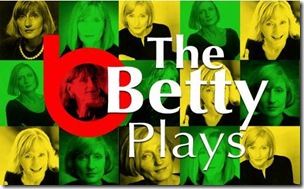
    In this spirit of making theatre which is a custom fit to performers and audiences alike, allow me to introduce to you The Betty Plays, world premiering this Sunday at Theater Schmeater. These are four new short plays written for actor Betty Campbell by Scot Augustson, Pamela Hobart Carter, Paul Klein, Jim Lapan and myself, plus a short film, “Lethal Cotillion”, which was featured at the Cannes Film Festival. Says the Schmee in their press release:

    The playwrights embarked on this project because of their love for the acting talents of the brilliant Betty Campbell and their desire to see her on the stage again.  Stylistically distinct, the four plays demonstrate the prowess of Seattle’s reigning thespian septuagenarian.

    And here’s what contributing playwright, Scot Augustson said recently on Facebook:

    I’ve got a show coming up that won’t get a review, is playing just 3 Sunday afternoons. I’m guessing less than 150 people will see it. It will never be nominated for anything. The taste makers won’t declare it The Hot Ticket In Town! And yet, it gets to the core of why I stay in Seattle and make theater. . . . Betty Campbell is an incredibly talented woman who has given immeasurably to this town and this community. But, she’s been facing some physical limitations lately that make doing a whole show difficult. Pamela Hobart Carter realized that to not have Betty up in front of an audience was ridiculous. So she got a hold of a few of Betty’s fans who were also writers to create an evening of shows . . . .  It’s gonna be great, check it out. (Hmm, if we can’t get Hot Ticket, maybe we can be Best Kept Secret. )

    As for me, I first saw Betty Campbell  six years ago when were both making our “virgin” appearances in the 14/48 instant theatre festival: her as an actor, me as a writer. I watched wide-eyed as Betty stalked around the arena stage, opposite another actress, as they both shouted competing boasts to the audience about the depraved pornographic acts they were about to perform. Now, you don’t need to know Betty well to know she’s a consummate lady with a deeply sweet and genteel heart. She was playing fiercely against type.  But more importantly, she was playing fiercely. She was not cowed by material. She rose to it. And then she rose above it. She is the kind of performer that makes a playwright’s fingers itch for his keyboard.

    Here are the details for the Theater Schmeater run of The Betty Plays, should you choose to avail yourself of Scot’s delightful “secret”:

    (more…)

  • “An Unexpected Twist” Exceeds as Expected

    “An Unexpected Twist” Exceeds as Expected

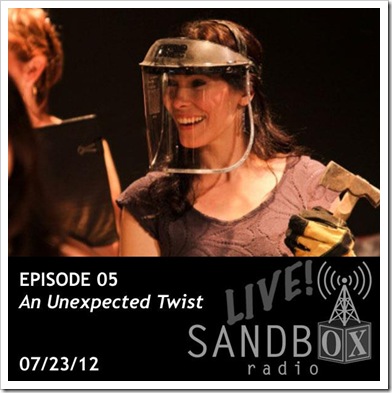
    Sandbox Radio Live!: Episode 5, “An Unexpected Twist”

    recorded at West of Lenin on July 23, 2012

    Download here. 

    @2:35      “Markehim: Episode 5″ by Paul Mullin
    @16:58     “A Work of Art” adapted from the story by Anton Chekhov
    @ 26:00    PSA – Little Bit Theraputic Riding Center by Elizabeth Heffron
    @ 28:25    “Sound Thieves” by Emily Conbere
    @ 42:09    “Au Fond Du Temple Saint” by Georges Bizet
    @ 47:08     PSA – World Arts Access by Scot Augustson
    @ 50:56     “Rally” a poem by Reginald André Jackson
    @ 58:21     “Lactar” by Elizabeth Heffron
    @ 1:12:12  “A Sousa Salsa” arranged by John Engerman
    @ 1:15:38  “The Bleak End of the Woods” by Scot Augustson
    @ 1:30:36   Finale/Credits

    Tracy Hyland in An Unexpected Twist: This is how I feel when I listen to Sandbox Radio on line, only I don’t feel this beautiful.

    Every time the podcast of a Sandbox Radio Live! episode drops, I write a little blog about it.  And every time I do, I say something like, “This episode is the best one yet.”  And every time I say it, I believe it.  But I fear that you’ll stop believing me if I keep saying so.  So…  what’s the solution?

    Unsure, I press ahead.

    Well, here’s one pretty objective way we get better.  Each episode we try to fold a new writer or two into the mix.  This time, with our episode “An Unexpected Twist” we presented a new play by relative newcomer-to-Seattle, Emily Conbere, and a poem by long-time local actor Reginald André Jackson. Speaking as someone who has written for Sandbox Radio since its inception, it’s a little unnerving when a newbie like Emily so masterfully makes her debut.  Her “Sound Thieves” leverages all the peculiarities, good and bad, of crafting stories for the fecund darkness of the mind.  (I know, because our July show was completely sold-out.  So without a single spare seat for a freeloading playwright, I sat under the risers, my view of the stage totally blocked by audience legs.  I swear this is the very best way to experience radio theatre: live but blind.)  My favorite moment: Annette Toutonghi as Gloria, a mom trying to convince a shopkeeper who illicitly fences stolen sounds, to sell her some zoo noise to cheer up her son.

    SHOPKEEPER:  Individual zoo animals are twenty-five.  A cacophony is fifty.

    GLORIA:  I only got twenty dollars.

    SHOPKEEPER:  Prices are prices.

    GLORIA:  And I’ve… I’ve got my dignity.

    SHOPKEEPER:  I don’t know what that means.

    GLORIA:  I’ll give you my … (much huskier voice) dignity.

    SHOPKEEPER:  Ah!  You don’t say!

    Other favorite moments include Leslie Law and Heather Curtis Mullin singing “Au Fond Du Temple Saint” by Georges Bizet, Jim Gall as the title role in Elizabeth Heffron’sLactar”, and of course, Scot Auguston, gift-wrapping the evening with the final offering, “The Bleak End of the Woods”, a stark noir detective story for forest animals.  (See if you can spot my wife’s radio acting debut cameo as Charday the Squirrel’s mom.)  As always, I listened with unbridled envy as Scot tossed off comic brilliance as easily as peeling bananas.

    CHARDAY THE SQUIRREL:  So, who’s missing?

    JOE THE POSSOM:  Clementine.

    CHARDAY:  Clementine?  Let that old windbag stay missing.

    JOE:  Charday!

    CHARDAY:  She’ll turn up like the bad penny she is.

    JOE:  I went to look for her and she wasn’t home.

    CHARDAY:  Wasn’t home?

    JOE:  Was not home.

    CHARDAY: That doesn’t make sense.  She’s a turtle.  She’s always home.

    So how do I convince you that while each episode is great in its own right, each one is better than the ones that precede it?

    Aha!  I know the solution! Go listen to the podcasts and decide for yourself.

    PS: Advance reservations for our next episode, “Something Wicked this Way” become available tomorrow, September 14, at Brown Paper Tickets.  Click here.

    PPS: Per my tradition, I’m posting the transcript of Markheim: Episode 5 below the fold.

    (more…)

  • A Bountiful Fall Harvest for Seattle’s Locally Grown

    A Bountiful Fall Harvest for Seattle’s Locally Grown

    Seattle’s scene for locally grown plays has always been stronger than your average mid-sized city’s, but anything good is worth fighting to make better. That’s why I mouthed off over two and a half years ago with an essay titled “Theatre takes Place: Why Locally Grown Plays Matter”.  I listed some bullet points explaining why the development of new plays is so crucial to the health of any great theatre scene:

    • “Local actors evolve a better understanding of how their contribution … can be generative as well as interpretive.
    • “Local audiences evolve a better understanding of how plays get made and how they can participate in the process….
    • “Local funders evolve a better understanding of their roles as patrons of the arts…
    • “Local funders, artists, and administrators …[can see] the development of plays as actual investments, with the potential to pump profits back to Seattle in several ways.”
    • I even complained that the then recently introduced TPS  Gregory Awards had a category for “outstanding director” but none for playwright, a blunder since rectified.

    Mouthing off is fun, but theatre is a collaborative art form.  Unless others join the fray it isn’t much more than meaningless monologue.  Happily, the last few years have shown just how much a modest city can grow as a theatre town when a group of motivated professionals put their collective mind to it.  For instance, last year A Contemporary Theatre finally took another chance on a local playwright by producing Yussef El Guindi’s  Pilgrims Musa and Sheri in the New World.  The gamble paid off big-time: El Guindi won The Harold and Mimi Steinberg/ATCA New Play Award (plus the $25,000 that comes with it), and American Theatre Magazine just published the script in its current September 2012 issue.

    Keri Healey’s new play Torso, produced by Printer’s Devil Theater, mesmerized everyone I know who saw it.  I suspect it is no coincidence that Keri has been short-listed for a Stranger Genius Award this year.  Torso recently doubled down on local impact with its currently running second production on Orcas Island.

    These are just two stand-out success stories from many.  And this fall promises another bountiful harvest of locally grown new theatre.  Again, just to name and explain a few (with a promise to blog separately on some as they come closer):

    14/48 outdoors for the first time ever

    A few weeks ago I raved about the glorious gamble the 14/48 steering committee was then making by staging their first “Kamikaze” festival, but this weekend they are amping up their Summer of Risk by staging the instant theatre festival outdoors for the first time in their 15 year history.  Tickets are free (also a new twist) so it’s hard to see how you could afford to miss it. (More info here.)

    The Betty Plays

    Beloved local actor Betty Campbell doesn’t get around as easily as she used to, so five local playwrights, myself included, wrote four short plays tailored to her unique and extraordinary talents.  This special Theater Schmeater offering is the sort of one-of-a-kind live experience that only happens in Seattle.  (Click here for more information  and here for reservations.)

    NCTC’s Foreclosure by Vince Delaney

    One of Seattle’s hottest acting ensembles workshops one of Seattle’s hottest playwrights, as he tackles an issue facing Americans nationwide  There aren’t many performances scheduled for this pre-world premiere, so you better reserve early.

    Sandbox Radio Live!

    1. The podcast from Episode 5: “An Unexpected Twist” recently dropped.  (A blog on that to come.)
    2. A “Best Of” show kicked ass at Bumbershoot!  (Check out this review.)
    3. And Episode 6: “Something Wicked This Way” is coming very soon: October 1 at West of Lenin.

    Why is Sandbox Radio Live! so important to Seattle’s locally grown theatre movement?  Because it happens every quarter and every quarter it gets better.  Because nearly every play, poem or commercial is written by top local playwrights and performed by top local actors.  Because it is fresh local “produce” at its best and most consistent.

    Custom Made Plays

    In my opinion this may just be the most exciting new wrinkle in Seattle’s locally grown scene, and not just because I have the good fortune of being the inaugural playwright.  Brainchild of local actress Rebecca Olson, the Custom Made Play Project  is dedicated to matching Pacific Northwest playwrights with local actors to develop and produce new plays of regional significance.  In my case, after interviewing my collaborating actors, Ms. Olson and Hana Lass, I tailor-made the soon-to-world- premiere Ballard House Duet to their unique talents and qualities.  Because of that, I am painting with colors I have never used before, and I’m loving it.  The resulting script simply would not exist were it not for these unique one-on-one collaborations. That fact excites me.

    Here’s another fact: Seattle is the best city in the country—maybe even the world— for locally grown theatre.  And we are only getting better and better at growing it.  As you can see from the small sampling above, it’s going to be an awesome autumn harvest.  It makes you wonder what next winter, spring and summer will bring.

  • Sandbox Radio Shoots Bumber

    Sandbox Radio Shoots Bumber

    I know, I know.  The biggest complaint about Sandbox Radio Live! is that the super fun recording sessions are always sold out, making it damned tough to watch the magic being made.  Of course, the final magic is always eventually available to you as a podcast.  In fact, Episode 5: “An Unexpected Twist” just recently dropped and is available here .

    Tracy Hyland

    But now Seattle’s beloved arts festival Bumbershoot is offering a one time solution to this conundrum.  This coming Labor Day (September 3) is your chance to see a “best of Sandbox Radio Live!” at the Center Theatre in the Armory, which has about thrice as many seats as our usual venue.  We will start at 7pm and pack an episode’s worth of fabulousness in just one hour. 

    Here’s what’s in store:

    “Notes from the Workplace” by Vincent Delaney

    “Why We Run” by Scot Augustson

    PSAs for Hanford Challenge and World Arts Access

    A blues tune from Charles Leggett and The Sandbox Radio Orchestra.

    Ads from “The Back of the 358” and a teaser for what’s coming in Markheim by Paul Mullin

    “T-Minus” by Elizabeth Heffron

    “Barcarolle” from Tales of Hoffman featuring special guest soprano Heather Curtis Mullin,  and more!

    You read that correctly.  My wife will be singing.  And I will be acting: reprising my role of Sam, Prince of the World, in my on-going noir angel detective series, Markheim.  That makes this Bumbershoot performance the very first time that Heather and I have shared a professional stage.  So come see Sandbox Radio Live! at Bumbershoot and watch some hot history being made.

    Paul & Heather Mullin

  • Exploring Alternative Narrative Structure

    Exploring Alternative Narrative Structure

    It doesn’t happen often, and when it does I always manage to kvetch about it, but I am teaching again, this time at Hugo House, and with a broader scope than just playwriting.  Here’s the pitch. . . .

    Exploring Alternative Narrative Structure

    Aristotle said a story should have a beginning, middle and end, in that order; but how often does life really feel like that? Sometimes to reflect reality we have to challenge old assumptions about how we experience and process narrative. We will explore alternatives to Aristotle’s cherished mountain of rising action, looking at classical music forms, technology, architecture, political systems and biology for potential models.  Indeed, no source of inspiration will be excluded. Famous examples of effective use of alternative narrative form will be examined, including Pinter’s Betrayal, Thorton Wilder’s “The Pullman Car Hiawatha,” Italo Calvino’s novels and Paul Mullin’s Louis Slotin Sonata.  Finally, we’ll examine our current writing projects and determine how they might benefit from some structural shake-ups.

    If you’re interested, your best bet is to register on line here.

  • Uplift of Fear

    I just ran across these impressions I jotted to myself after surviving my stint as a “virgin” actor in the last 14/48. It seems appropriate to post them, with the Kamikaze artists draw less than 10 hours away.

    The terror hit me like a fever about a half hour before the first show’s curtain. The day went by in a punishing blur: a vivid dream in which one is never really sure how much time is going by until suddenly someone is saying “We tech in 20 minutes.” And then someone else is saying, “Let’s break for dinner.” And then someone else is saying, “Places for Show One, people, places.”

    “Thank you, places.”

    I was in the second of seven ten-minute plays. I stood in the house-right vom looking up and out onto the stage, half-watching and listening to the first play, a funny piece about swinger birds by Doug Willott called “Duck/Penguin”. I couldn’t really concentrate on the piece, since I was undergoing a vast existential amazement: confounded and astounded that somehow the individual circumstances of my life had brought me here to this deeply horrifyingly moment. Why was I here? Who does this to themselves? It’s one thing to be an asshole, but only a stupid asshole plots his own very public humiliation. 

    It was an oddly uplifted dismay.  Nothing depressed or depressive about it. 

    And then the lights were changing and the band was playing and I was going on. As I noted in my earlier essay, as an actor, once you’re on you’re on. The terror doesn’t disappear, but it is forced by the demands of actual performance to sit in the back seat and shut the fuck up. There’s nothing you can do when you’re sliding down the mountain except make your goddamned best effort to steer and maybe hope to outrun the avalanche. 

    And then I was marching offstage. And then I was done.  For a couple hours at least. I still had the second show, which now, miraculously, I wasn’t dreading at all.

    By the first show of the second day the process had actually become fun, though terror was still sitting there in the back seat, sitting on her hands.

    (more…)

  • The rewards of theatrical risk-taking should accrue, first and foremost, to the audience.

  • What is the best way you have ever seen sex staged?

  • 14/48 Raises the Stakes Again, then Again

    14/48 Raises the Stakes Again, then Again

    I was going to write another essay about 14/48 running up to this summer’s festival.  I’m an old hand at essays about 14/48. In fact, I once wrote an essay about how an essay I wrote about how 14/48 is partly responsible for all these essays I wright here at Just Wrought.  Talk about recursion.

    I was going to write an essay about how 14/48 serves as a sort of “stealth” semi-annual Seattle theatre convention, encouraging theatre artists of different disciplines, different experiences and varying amounts of “dues paid”, to get to know each other when otherwise they might not. I was going to point out that such a convention has to be “stealth”, and it has to contain as its main component the compressed camaraderie that only producing a show together creates. If someone offered to host a “Seattle Theatre Convention” where we all just gathered to chat, flirt, and share war stories, I am certain nearly no one would come. The younger theatre artists all have better things to do, mostly centered around boozing, bullshitting and getting laid. And the older theatre artists all have better things to do, mostly centered around dealing with the consequences of our earlier boozing, bullshitting and getting laid. It’s not that we old-timers don’t like you, Young Seattle Theatre Artists— far from it.  You are, as the kids like to say, hella fine. But we are never gonna come to your pick-up kickball games or your Facebook arranged Karaoke nights starting after 9:30. Shit ain’t happening. The only thing I start after 9:30 at night is a bath. 14/48 forces us together, young and old, in the only way that matters: putting on a show. Just by participating I have come to know upwards of a hundred amazing artists that elsewise I might only know as names in a program.

    Okay. So that’s what I would have said about 14/48.  And it would’ve been enough.  But the 14/48 powers-that-be have sprung some surprises for this summer’s festival, yet again upping the ante of their game. The first week of the world’s quickest theatre festival will take the form of the oft threatened but heretofore never actually implemented “kamikaze” version.  Normally seven playwrights are selected to write 10 minute plays on a randomly selected theme. The plays, written between 10 pm the night of the selection and 8 am the next day, are then randomly assigned a director who randomly casts from a pre-selected pool of actors. Over the next 10 or so hours the plays are rehearsed. At 8pm, less than 24 hours from when they were conceived, the plays a performed before a rather demanding live audience.  At 10:30 pm they are performed again, before a whole new audience. And then all of it happens again the next day. If you’re thinking, “Wow, that sounds like an ass-kicker,”  you are thinking rightly.

    So what is Kamikaze? Nothing short of more randomness, more risk. 45 veterans have been invited to participate without knowing ahead of time which of the disciplines they will working in: acting, directing, writing, band or design. 14/48 co-founder Jodi-Paul Wooster explains the rationale behind adding the Kamikaze twist: “Over the years, we’ve had a number of talented artists say ‘thanks for inviting me to [blank] but I’ve always wanted to [other blank]’ To those brave folks I say: ‘Careful what you wish for.’”

    As if these Kamikaze rules weren’t wrinkle enough, a few weeks later 14/48 will twist the festival in a different direction, staging it outdoors for the first time at Seattle in the gardens on the eastern side of the Seattle Repertory Theatre. “We can never rest on our laurels,” says Jodi-Paul. “Our audience and artists expect not only new plays but new ways of creating these plays.”

    I must confess a bit of shameful glee at the terror with which many of my fellow invitees are facing the Kamikaze weekend. If you break down the numbers of any given 14/48, you’ll find that actors comprise by far the largest plurality of participants.This mirrors the world of normal theatre. On the other hand, of the 45 total participants only seven are playwrights, or 15.5%. This proportion exceeds that of modern American theatre by an abnormally high value. Normally writers are much smaller minority: maybe two percent, maybe less. For many Seattle actors, 14/48 is the only chance they ever have to collaborate with a living breathing playwright to produce a brand new work.  So the thought of having to wright a new work in 10 hours can be petrifying. One good friend, an actor, reached out to me for advice: “Yo, … can you give me 3 things to help me thru my fear. Maybe 3 tips to help me tell a good if not moderately acceptable story.” I’ll share my reply, lest my buddy acquire any unfair advantage from my advice, which seems damned unlikely.

    Hey!

    It’s all gonna turn out good, you know, and by my math you only have a 15% chance of being drawn as a writer. But still, I’m happy to offer a few tricks of the trade, to be taken with a grain of salt, because if you find something doesn’t work for you, toss it right away.

    1) Beginning, Middle, End. That’s the best trick. You have a situation. It’s static, in balance, but only just barely. Something’s wrong with it. It cannot sustain. That’s your beginning. Something happens to change that situation, throw it out of balance, either from inside or outside, either someone MAKES the change happen or it happens to them. Doesn’t matter. But change happens. That’s your middle. Things happen in the struggle for a new balance to be struck. …. It could be bad (MACBETH), good (MIDSUMMER) or indifferent (WAITING FOR GODOT), but the lights fall on a new order. This is your end. In 14/48 your best bet is to give 1-2 pages to the beginning. 3-5 pages to the middle, and probably not more than 1 page to the end. Your mileage may vary, but do remember, when you hit the end of typewritten page six, you are done.

    2) Start jotting down ideas, characters, snippets of dialogue that strike you. Keep a little notebook. If you find yourself stuck on the night of writing, open this up and draw from it, at random if you have to. Some may say this is cheating, but there’s an old saying in baseball, if you ain’t cheating a little bit, you ain’t trying hard enough.

    3) Trust. You’ll be working with 45 of Seattle’s very best theatre artists, all 14/48 veterans. We’re experts at making this shit fly. You don’t need to do it all by yourself as a writer. (The dirtiest secretest secret about playwrights is that we’re at our best when we are at our laziest.) Trust that some brilliant folks will come in and fill the gaps. And notice that I didn’t say you’d be working with 44 of Seattle’s best. I said 45 ‘cuz I’m counting you. Trust you. You’re fucking awesome.

    Hope that helps. Feel free to bug me some more if you get worried. It’s gonna kick ass though, so don’t worry too much.

    pm

    My last 14/48 essay was called “Holy Fear” and in it I argued that  healthy fear is essential to making good theatre. 

    It is what keys us into the audience’s experience of the immediacy of the moment. If you’re not feeling it, then chances are the audience won’t be feeling much of anything.  And, alas, they’re used to that. If they want “perfection”, they stay home and watch the boob. Our fear as theatre artists fuels the whole machina ex deus that is theatre.

    Oddly, less than two weeks out, I am mostly fear-free. I suppose, like a childish Luke Skywalker, I don’t really know enough to be afraid. And now, having written that, chill bumps rise on my arm, and I hear Yoda saying, “You will be.”

    The confirmed Artist Roster for 14/48 Kamikaze is: Jose Amador; Ahren Buhmann; Susanna Burney; Dave Clapper; Trick Danneker; Nik Doner; John Farrage; Brandon Felker; Bret Fetzer; Mark Fullerton; Julia Griffin; Basil Harris; Alyssa Keene; Erin Kraft; Mik Kuhlman; JD Lloyd; Hana Lass; Teri Lazzara; David- Anthony Lewis; John Lutyens; Corey McDaniel; Ben McFadden; Pamala Mijatov; Pattie Miles Van Beauzekom; Scotto Moore; Paul Mullin; Peter Dylan O’Connor; Opal Peachey; Nik Perleros; Celene Ramadan; Shane Regan; Jaime Roberts; Carl Sander; Charles Smith; Roy Stanton; Allison Strickland; Erik Van Beauzekom; Jonah Van Spreecken; Doug Willott and Anthony Winkler.

    Tickets for 14/48 Kamikaze can purchased in advance at Brown Paper Tickets, by clicking here. I highly suggest you do.  They will sell out.