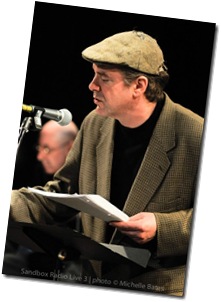
Just Wrought

Recovering playwright, once won a STRANGER Genius Award for theater. Now writing a bloated novel about… G-d help me! Theatre.

  • Two Names of Perfect Proof

    I have six words for the Seattle Big House Artistic Director that stood up two years ago at the Outrageous Fortune discussion and said about local playwrights, “We are looking for excellence and just not finding it.”

    Keri Healey and Yussef El Guindi

    (Of course, I have many many more words than that, but those are all I need for my perfect proof.)

    Congratulations Keri and Yussef!  You inspire us.  And congratulations Seattle, for having undeniably World Class playwrights in your midst.

  • Sandbox Radio Live! Seats Now Available

    Sandbox Radio Live! Seats Now Available

    Advance reservations are available today for the Fourth Episode of Sandbox Radio Live! “The Chase.”  Click here to assure your seat at Brown Paper Tickets.

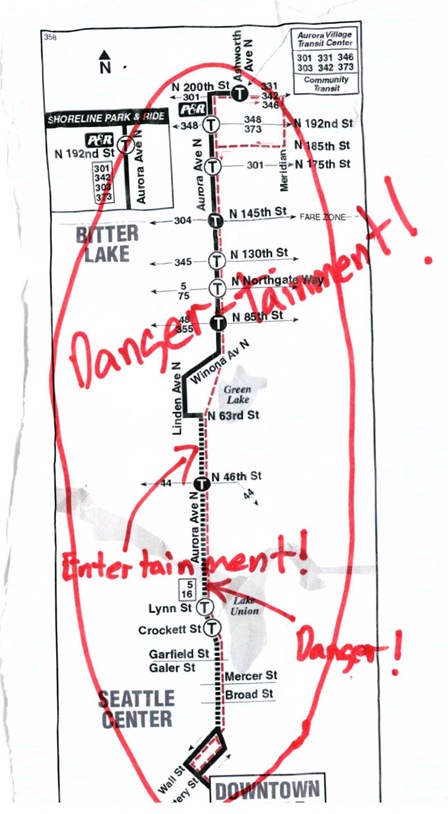
    Back in Episode 2, we had some fun with commercials for the King County Metro Line #358 Express to Aurora Village, or as I like to call it, “My Danger-tainment” bus.  Listen here to the very first one we did.  (“Read-along” script below the fold.)

    Here’s a quick review of the info on the upcoming show.

    Who:     The Sandbox Artists Collective

    What:    SANDBOX RADIO LIVE! Episode 4 “THE CHASE”

    Where:  West of Lenin (203 N. 36th Street, Seattle WA) www.westoflenin.com

    When:  Monday, April 16th, house opens at 7:30 with live music, show at 8:00pm

    How Much:   $10 suggested donation at the door, Reservations recommended! Available April 2nd: http://www.brownpapertickets.com/event/236740
     
    Sandbox Radio is conceived, produced and directed by Leslie Law.
     
    contact:  sandboxradio@thesandboxac.org
     
    Podcast available in iTunes and here:  http://www.thesandboxac.org/podcast.html

    (more…)

  • Hakuin and the Baby

    Hakuin and the Baby

    One very powerful way to court luck is to consider with some specificity just how lucky you already are. As I continue to do just that, here’s another early essay, from my days as a stay-at-home dad when our first son was still just a baby and this country was gearing up for our ill-fated invasion of Iraq.

    * * *

    The Zen Master Hakuin was praised by his neighbors as one living a pure life.

    A beautiful Japanese girl whose parents owned a food store, lived near him. Suddenly without any warning, her parents discovered she was with child.

    This made her parents angry. She would not confess who the man was, but after much harassment at last named Hakuin.

    In great anger the parents went to the master, “Is that so?” was all he would say.

    After the child was born it was brought to Hakuin. By this time he had lost his reputation, which did not trouble him, but he took very good care of the child. He obtained milk from his neighbors and everything else the little one needed.

    A year later the girl-mother could stand it no longer. She told her parents the truth—that the real father of the child was a young man who worked in the fishmarket.

    The mother and the father of the girl at once went to Hakuin to ask his forgiveness, to apologize at length, and to get the child back again.

    Hakuin was willing. In yielding the child, all he said was: “Is that so?”

    — from Zen Flesh, Zen Bones

    It is the koan-like nature of even the simplest—especially the simplest—zen stories to keep haunting you until you crack them or, perhaps more accurately, until they crack you.

    I was a teenager when I first came across this story, quoted in my sister’s college textbook Religions of the World (a book that so fascinated me that I’ve kept it to this day.)  What struck me most back then is this bizarrely unflappable “Zen Master” and how he simply takes a baby into his care based on accusations he knows to be false. One can only imagine he is completely unprepared for parenthood (something any teenage boy can sympathize with); and the fact that he greets the challenge without seeming to blink an eye was truly astounding to me then, and now. It definitely fanned the flames of my interest in Zen. These guys, it seemed, could face anything, at a moment’s notice.

    Now, 15 years later, having practiced Zen for twelve years and having been a dad for one, and a stay-at-home Dad for half of that time, what strikes me as most astounding isn’t the first part of the story, Hakuin taking the baby into his care, but the second: Hakuin willingly giving up the child when these frighteningly fickle grandparents came round to retrieve the kid. To me, this utterly unfathomable. No way could I do it: not with my own baby boy, not with any child with whom I had spent the first year of life. You become so invested, so attached—indeed, so in love—with a baby that it is hard to be away from them for more than a couple of days.

    But here’s Hakuin, a year later, doing what must be the right thing, again merely on the word of some not-so-likeable people. What’s the lesson here? I’m not completely sure. I’m still learning it. I think it has to do with the profound choices we’re inevitably faced with, often spur of the moment, and how it is incumbent on us to stay as even-keeled as we can when facing them.

    By all commonly accepted standards, Hakuin has every right to react with moral outrage, both at the initial accusation, and again when the family came round later to collect the baby like so much forgotten baggage. So why doesn’t he? Well, the easy answer is: he’s a Zen Master. Such fellows don’t truck much with moral outrage. But I think the question is worth a little more digging than that.

    In the West, not really knowing any better, we tend to equate “Zen Master” with “wizard” or “ascended being”, or perhaps more pejoratively, “empty shell”, or even worse, as a fundamentalist family member of mine once called anyone claiming to be Buddhist: “amoral idol worshipper”. But what if, when you’ve stripped away the ritualistic trimmings specific to Zen practice, all “Zen Master” really means is “complete human being”? Then Hakuin’s actions make a perfect sort of sense. He saw the truth in front of him—a child that needed care—and he cared for the child. Then later, when he saw a family who recognized their error and wanted to become whole again, he gave the kid up. I cannot think that, just because Hakuin was a Zen Master, he felt no pain at parting with the child. I infer that his practice allowed him the equanimity to face the pain with courage and without adding more suffering to the world through outrage.

    The world is suffering right now, arguably more so than usual. Many of us on the Left are perhaps rightfully outraged at the ignorance, self-righteousness and high-handed hypocritical moralism that has brought us to this pass. Maybe we should ask ourselves, though, how far our outrage will get us in solving the problem. I seek counseling from a man who is the abbot of a Zen temple, and may some day achieve the official rank of “Roshi” or “Master” in the Rinzai Dharma lineage. (Hakuin is an extremely important reformist link in this patriarchy.) When I expressed to him my anger and frustration over the current political situation, he told me the best thing I could do for the political future is bring my son up well. Talk about long-term solutions to short-term problems! 

    So those are some of my thoughts on Hakuin and his baby. I feel like there’s more to say, but… I have to go take care of my boy. He’s turning one in a week. And you can call me a hypocrite, but I thank the lord I ain’t no Zen Master, and ain’t nobody taking him away from me.

    * * *

    My son turns 10! at the end of May. Being his dad is easily one of the top three things I have ever done in my life. That will never change nor can  anyone ever take that away from me. In that, I have it over on even Hakuin. 

    I understand that my current hunt for luck has a facetiousness about it, like a billionaire arguing that he’s not as rich as everyone thinks he is. I’m the Mitt Romney of being blessed.  I have so much I don’t even know how much I have. Like Hakuin, I’ll take it, knowing that in a year, or at any moment, it can be taken back. True luck doesn’t rest in the having, but the being. And being cannot be done anywhere but here or any when but now.

  • The Chase

    The Chase

    Markheim’s just a half-fallen angel trying to keep his head down and walk neutral in The Show, but a street kid stole his dog and now some Cherub has dropped down from the Fix for heaven only knows what reason.

    Seattle ain’t big enough for two expatriate angels. Sam ain’t gonna like it.  And when Sam’s unhappy, nobody’s happy.  

    Does tax season have you on the emotional lam?  Then join “The Chase”: The Sandbox Artists Collective’s fourth episode of its wildly successful SANDBOX RADIO LIVE! to be recorded before a live audience on Monday, April 16 at 8:00pm at Fremont’s newest theatre, West of Lenin.

    Entirely new, fresh and locally grown, Sandbox Radio is written, produced and performed by some of Seattle’s hottest stage talent. This latest episode, “The Chase” will include new original poems by playwrights Elizabeth Heffron and Scot Augustson, new short plays by Vincent Delaney, Ki Gottberg, Elizabeth Heffron and Juliet Waller Pruzan, plus Episode 4 of Paul Mullin’s noir-angel serial “Markheim”, original blues from Charles Leggett, and special guest chanteuse Joanne Klein.  Before the show and during intermission enjoy a beverage from our newly added bonus feature, The Sandbox Bar!   Halloween Sandbox Fun

    Members of the Sandbox Artist Collective currently scheduled to appear include: Megan Ahiers, Eric Ray Anderson, Shawn Belyea, Ki Gottberg, Mik Kuhlman, Amy Love, Charles Leggett, Todd Jefferson Moore, Peter Dylan O’Connor, Rebecca Olson, Kathryn Van Meter and Richard Ziman. Original music will be provided by Jose Gonzales and The Sandbox Radio Orchestra: including Dave Pascal, Dan Tierney and Rob Witmer.  You won’t want to miss this, and you won’t want to wait until the podcast of this episode is available online.

    Come see it LIVE! on Monday, April 16th…
     

     Sandbox Radio 4 postcard

    Who:     The Sandbox Artists Collective

    What:    SANDBOX RADIO LIVE! Episode 4 “THE CHASE”

    Where:  West of Lenin (203 N. 36th Street, Seattle WA) www.westoflenin.com

    When:  Monday, April 16th, house opens at 7:30 with live music, show at 8:00pm

    How Much:   $10 suggested donation at the door, Reservations recommended! Available at Brown Paper Tickets after April 2nd by clicking here

    Sandbox Radio is conceived, produced and directed by Leslie Law.  Contact:  sandboxradio@thesandboxac.org

    Podcast available in iTunes and by clicking  here

  • Make Me One with Everything

    Make Me One with Everything

    Luck is a sympathetic magic, to be coaxed with metaphor and token.  So I have decided to troll for a streak of it by posting a run of early essays that I wrote for Everything2, a quasi-prophetic mash-up of Face Book and Wikipedia, if the former only allowed text and the latter had a sense of humor. 

    The following essay was written in 2003 during the build up to invasion of Iraq.

    * * *

    It’s got to be the oldest Zen joke in the West . . .

    There’s a barbecue at the Zen Buddhist Temple, and the Zen Master’s working the grill. A young monk reverently approaches. The Roshi looks up, smiles and says, “Wanna hotdog?”

    The monk replies: “Please, Master, make me one with everything.”

    Besides being pretty darned cute, this joke, I’ve always suspected, has something deeper to say about Western attitudes, toward Zen in specific, Eastern thought more broadly, and most generally of all, our poorly perceived relationship to each other and the universe at large.

    I’ve been a practicing Buddhist for twelve years now (ironically enough, ever since around the time of the last war brought to you by the Bush family.) For most of that time, I’ve kept my mouth shut about my practice, for a couple of simple reasons. First and foremost, it’s just considered bad Zen form to prattle on about it. “Him who’ll tell ya, don’t know. Him who knows, won’t tell ya” (my hillbilly stab at Lao Tzu’s Tao Te Ching). Secondly, upon hearing that I’m a Buddhist, most people tend to react to the novelty of it, rather than the substance. “That’s wild!”. . . “That’s crazy!”. . . “Only you, Paul!”. . . “We’ll see how long that lasts!” Since Buddhism is decidedly not a religion of conversion, I see little up side in telling people I follow it. But in these darkening days of terror and hatred and waste, I’ve begun to feel that it’s incumbent on me to pipe up about a practice that has helped me face these things; and while it may not be everyone’s cup of tea, it may just offer some unique and rarely considered perspectives on our world and our place in it.

    So what’s the problem with “make me one with everything?” In a nutshell: you can’t make someone, even yourself “one”, any more than you can make yourself obey the law of gravity. You are one with everything, whether you like it or not, and that oneness necessitates inevitabilities and responsibilities that all of us as human beings ignore at our peril and the greater suffering of everyone.

    For instance, some examples of the inevitabilities: you will die, I will die, everyone who will ever read this will die. Death is inevitable. Pretty simple stuff so far, right?

    Here’s another inevitability, directly related to the first: you will suffer, I will suffer, everyone who reads this will suffer (though hopefully not because they read this).

    And another: what you do, and don’t do, reverberates throughout existence. You can’t avoid this through hiding. You can’t wall off your section of existence and hope that all the awful and inevitable things happening on the other side won’t creep across. They will. Why? Because any wall you build is an illusion. Why? Because you are one with everything, whether you asked for it or not, whether you like it or not.

    So that brings us to our responsibilities. And these are not Buddhist responsibilities, per se. Remember, one doesn’t become one with everything because one is a Buddhist; you just are, and because you just are, and because as part of the unique blessing/curse of being a sentient human being, you know you are, you have to acknowledge that your responsibility is to everyone and everything.

    Americans love being heroes. We’re shocked when we hear that most of the world doesn’t see us that way. “Don’t these ungrateful bastards realize we saved their asses in WWII?” (I’ve said these very words myself on many beer-sodden occasions.) But from the one with everything perspective, storming Normandy and all the rest of it was less heroic than the Hollywood media machine would have us fool ourselves into believing. We saved ourselves by storming those beaches, just as much as anyone. And while there’s nothing ignoble about self-preservation, it’s not necessary to lord it over a bunch of people who happen to live in Europe, and who lost a lot more lives than we did.

    Americans are very comfortable being powerful, because we are so convinced that we are right. And much of the time we are. Alas, the universe responds with an profound “So what?” For just as you can’t make someone “one with everything”, you cannot coerce someone to be free, and you cannot force someone to give up force. You can only force them to force you to use more force. The Buddha recognized such recursively misguided action as a trap. He compared it to trying to still the ripples of a pond by patting them down with your hand. (In the case of our recent actions in Iraq, I’d compare it to smacking an oar down on the water. These violent ripples we’re currently creating won’t go away in our lifetime.)

    Regarding these actions, many Americans throw up their hands and say, “Better them than us.” But the point is: there is no “them”, only us. Some of our glibber war advocates say “You can’t make an omelet without breaking eggs.” I just wonder if enough thought and pause was given to the question, “Do we really need the omelet? Aren’t our geopolitical love handles big enough?”

    From the Buddhist perspective, every bullet fired, is fired at your own head, or, if you find it more terrifying, your own child’s head. The upside of this is that every kind act—every bow, every smile—is an action done for—a bow made to—a smile smiled for—everyone. In our actions in the world, it is our responsibility to ask ourselves, very simply: are we adding to its suffering, or healing it? Every day we must ask the question, and every day, change the answer based on what the day gives us and what we give in return (though of course, we are the day, and it us.)

    This is the Buddhist practice in a nutshell.

    Call me crazy.

  • The Cathedral of Saint John the Divine

    I decided at the beginning of this year to focus a little bit more than usual on luck: to court it a bit, if that makes sense. Luck is one of those wonderful inventions that cannot really exist— not in any empirical way— but that nevertheless human beings can still learn a lot by considering. For instance, I spent a lot of last week constructing an essay I felt compelled to write defending my chosen art form from prevarications that would weaken it. Contrary to what some assumed, it brought me no joy to make my arguments. It felt like duty. But then, as luck would have it, someone I did not know read that essay and reached out with an email to thank me for it.  We became Facebook friends and I noticed that this person had a professional relationship with one of my favorite places on earth, the Cathedral of St. John the Divine. I flashed on a long forgotten essay I wrote nearly nine years ago for an on-line gathering site for weirdoes and writers and weirdo writers called Everything2.

    I repost it here as a burnt offering to luck.

    I don’t believe in God.

    I pretty much don’t believe in God.

    Okay… here’s the deal:

    I believe in God. . .

    . . . but only in one place: the Cathedral of St. John the Divine in New York City. Apparently, the universe is constructed in such a manner that the omnipotent, omniscient—though obviously not omni-present— deity known for the most part in these parts as “God”, only exists– as far as I can tell– when I exist within the walls of this largest Gothic cathedral in the world.

    I can vouch for this phenomenon going back to late 1999 when I first stepped inside the church, its cool echoing darkness enveloping me immediately. I was living up on the edge of Harlem at the time, and began going often. I’d walk in past the periodic light shafting down from the stained glass, sit on one of the chairs (the nave has no permanent pews) and strike up an ongoing conversation on hold since my earnest Catholic childhood.

    Hello Old Man. It’s me.

    These were not supplications, but rather heartfelt chats between one very good old friend and another. I didn’t have to genuflect or cross myself to gain access to this communication. It’s certainly telling that I don’t feel this presence at all at, say, St. Patrick’s Cathedral down on 50th and Madison, shouldered up against Rockefeller Center and all those other much taller skyscrapers. If God lives there, he’s the God of Pinstripes and Napoleon Complexes and Rudy Giuliani.

    We moved to Queens in the late fall of ’99 and my visits to St. John’s became rarer but no less ardent– in fact, maybe more so, since a two-train, 45-minute pilgrimage was involved.

    And then, less than two years later, the world changed for New Yorkers and for everyone. I found myself in Our meeting place almost every other day, two trains or not. The conversations grew ever more urgent, but also so private that I couldn’t even bring myself to write about them in my personal journal:

    9/25/01

    St. John’s again.
    Talking with God.
    Private stuff.
    Wondering: Is faith a means or an end?
    Or is the question nonsense? 

    Sometimes I’d cry. Sometimes I’d feel God feeling me cry and letting me know that it was understood.

    On December 7, 2001, while I watched TV in the living room, my wife took a home pregnancy test. From the bathroom I heard a calm but distinct, “Uh-oh.” Back then I didn’t know just how damned accurate those things have gotten, but still I had a gut inkling that this time it was for real. I had a whole new thing to talk to God about, a whole new way to be scared. 

    Old Man, help me be a good old man.

     On December 18, 2001, I turned on the TV just to be dosed with a whole new horror. 

    12/18/01

    8:12
    St. John’s is burning; a five alarm fire.
    God damn.
    What a lousy, lousy year.
      

    In my head I drove a pathetic devil’s bargain worthy of Winston Smith in room 101. “Take the goddamned Twin Towers”, I practically prayed to Satan, “Just leave me my St. John’s.”

    The firefighters, already crowned in glory, waded into the burning church which was home to, among so many other things, the largest memorial to fallen FDNY prior to 9/11. Commanders on the scene rapidly made the decision to use high-tech lasers to find their way through the smoke instead of following the common sense course of action: smashing through priceless, irreplaceable stained glass to vent it (adding a James Bond-esque/art connoisseur quality to their already enormous reputation for heroism). Within hours the fire was extinguished. But who knew how long the church would be closed to visitors?

    In March of 2002 I got a short-term temp gig up at Columbia University. I walked by St. Johns on my lunch break, saw where soot still blackened the stones of the northern transept. My heart heavy and anxious, I climbed the front stairs and went in. It still smelled of burnt wood inside, and the gift shop, where the fire started, was still boarded up, but I knew instantly that the conflagration had done nothing to fumigate my Old Friend from the place. I sat down to chat.
    In the end, you can only ask Him for a sample of his Grace, a slightly wider perspective than the one you’re sitting in. It seems like a small thing writing about it now, but such an epiphany is really the only miracle there is. Art can offer it sometimes. Perhaps that’s why I decided to become an artist.

    And becoming one I am still.

    Now I live in Seattle and have no place to talk to God. 

    Cathedral of St John the Divine

  • Please Let the Daisey Debacle Mean More Theatre/Journalism, not Less.

    Please Let the Daisey Debacle Mean More Theatre/Journalism, not Less.

    A lot has already been said about the revelation that Mike Daisey fabricated many portions of his one-man show, The Agony and The Ecstasy of Steve Jobs: a piece he previously passed off as entirely truthful reportage, most egregiously on This American Life, a nationally broadcast public radio program. I leave it to wiser minds to sort through all but one of the many questions Mike’s transgressions raise, reserving for scrutiny only that which I feel I am particularly qualified to examine: what impact will Mike’s dishonesty have on the intersection of theatre and journalism?

    A huge number of people are familiar with Daisey’s work creating and performing topical monologues at some of the most prestigious venues in America, from the Seattle Rep to New York’s Public Theatre to the Woolley Mammoth in Washington, D.C. A much smaller number of people know of the work produced by NewsWrights United, a theatre company I co-founded and serve as Executive Director. We dramatize news using a form invented in the early 20th century called the living newspaper, and all of our stories are researched and written by local Seattle playwrights. (Memorable examples include Scot Augustson staging the farcical misadventures of a reporter/photographer duo sent to Detroit a week early to cover the Seahawks only Superbowl appearance; and on the serious side, Pamela Hobart Carter’s lyric poem/play about the psychic damage done by the Green River Killer.) On first appearances, NewsWrights United and Mike Daisey seem to occupy similar territory in the art/news nexus, but in actuality I believe we do something fundamentally different, and if I can tease apart for you these differences, I earnestly hope to convince you that coverage of news in the theatre is something worth saving even if Mike Daisey’s methods are not.

    I predict two reactions to this crisis from artistic administrators at U. S. regional theatres. The first is already in evidence. Institutions that have already booked Mike will mostly stick with him, echoing his essential tack: “Yeah, lying to the public radio program TAL was wrong, but lying in the theatre is obviously eminently forgivable. After all—heck!—isn’t all theatre lying?” Artistic administrators are not widely known for the courage of their convictions, however, so I further predict that over the next year or two, while the controversy dies down, they will quietly divest themselves of as much Daisey stock as possible, so long as it doesn’t cost them too much to dump it. What’s worse, I also predict they will take the dreadfully wrong-headed step of underscoring this divestment with an abandonment of all new work that explores the intersection of theatre and journalism. (The exception to this new silent ban will be, perversely, Mike’s inevitable one-man apologia, which regional houses will be falling over each other to stage.)

    But forsaking the theatre/journalism intersection does not have to be our future. With hard work, honest self-examination and courage we can take this opportunity not to withdraw but advance the genre. As a once and, with luck, future practitioner of news theatre, I venture to offer some practical advice on how we might achieve this.

    Expand the Pool

    Beyond his extraordinary talent as a storyteller, Mike’s shows appeal to regional theaters across the country because they are cheap and easy to mount. Most important, they are portable. If you are looking to plug a little topicality into your otherwise staid season, you cannot do it more easily than by giving Mike a call.

    Living newspapers are much more difficult. To create effective alternatives to the Daisey Debacle, you have to give up some of the conveniences of the one-man show; most crucially, you have to give up the idea of “one-man.” Actual plays are vast collaborative efforts, featuring dialogue among and between more than one player on stage. The play development process contains a built-in organic vetting process that zeroes in on “truth” even when the story, like Agony/Ecstasy, is more accurately classified as fiction.

    For instance, I am working with Rebecca Olson’s project Custom Made Plays to develop a script for her and another actor. Every week I sit in a room with them and the director, carefully combing through the script with questions. The process is gentle but relentless, and when a false note gets rooted up, we pounce to replace it with something more “honest.” Many of the moments in Agony/Ecstasy that Daisey promised us were real were not. In retrospect, they reek of bad fiction now that we know that is exactly what they are.

    I reach into my satchel, and I take out my iPad. And when he sees it, his eyes widen, because one of the ultimate ironies of globalism, at this point there are no iPads in China. …. He’s never actually seen one on, this thing that took his hand. I turn it on, unlock the screen, and pass it to him. He takes it. The icons flare into view, and he strokes the screen with his ruined hand, and the icons slide back and forth. And he says something to Cathy, and Cathy says, “He says it’s a kind of magic.”

    Daisey’s a fine writer and I have no doubts he could have avoided this tripe, offering instead something genuinely brilliant, if he had only admitted it was fiction in the first place and then collaborated with performers and a director to sharpen it.

    Living newspapers expand the pool in more than one dimension. Beyond just other actors in the room, you must also let in other writers. How much would anyone trust a newspaper with only one reporter who also served as the sole editor? NewsWrights United engaged several local playwrights for its living newspaper about the demise of the actual newspaper, The Seattle Post-Intelligencer. By spreading the attack, we were able to cover a number of different beats—sports, politics and arts coverage at the P-I—in a wonderfully varied spectrum of styles, some of which implicitly “watermarked” their stories as fictionalization (but more on “watermarking” later.) Using more artists allows you to cover more kinds of stories, leading to another way to better provide theatrical news…

    Up Your Local Content

    It certainly was exciting to watch “David” Mike take on “Goliath” Apple from the stage of my local regional theatre; and certainly my local regional theatre enjoys, along with regional theatres across the country, the imprimatur of international relevance when such a story as Agony/Ecstasy gets told.  However, we lose a huge opportunity when our big houses keep mounting the very same one-man show, instead of staging local news that actually has as much, if not more, to do with the lives of local audiences as does Applegate. Let’s dare to flip the model and have each theatre produce its own living newspapers, telling stories about their own communities, and sure, plugging in national stories such as those Mike tells when appropriate.

    I promise you: locally grown journalistic theatre is not only doable, it’s been done. In NewsWrights United’s last effort, The New New News: A Living Newspaper, we locally sourced nearly all of our stories about the crisis in journalism brought on by the digital age. Our play It’s Not in The P-I: A Living Newspaper about a Dying Newspaper gave voice to locally beloved P-I reporters so that a community eager to hear their tales finally had the opportunity that no other medium would give.  We also broke important exclusives into the buy-out process that the Heart Corporation used to cherry-pick and union bust their newsroom as they shuttered the print version of The Seattle P-I and moved to an all on-line edition.  It didn’t hurt that one of our founding producers, Tom Paulson, is a professional journalist, formerly the P-I’s science reporter, and currently writing for NPR’s Global Health site, Humanosphere.

    Use “Watermarks”

    Not everything that takes place in a theater is theatre. If this is news to you, you might not be to blame. The theater = theatre fallacy is happily perpetrated by artistic administrators to fill their seasons with the easiest fare to produce. (Click here to see my essay on this.) True theatre is rife with “watermarks” built into both the text and context of a play to remind you, sometimes explicitly but mostly implicitly, that what you are seeing is to some degree false.

    “Watermarks?” You say. “How come I’ve never heard of these watermarks before?” Well, for two reasons: One, I just started using the term in a theatrical context about a week ago when I was trying to explain why Mike should not be allowed to take refuge in our art form. Two, watermarks are so endemic to theatre that we tend to look right through them, like reading glasses. The Greeks used masks as watermarks. Shakespeare and his contemporaries stitched their plays out of the watermarking fabric of Iambic pentameter. Not a single tradition within our grand form lacks them, but an exhaustive list is superfluous to this argument, because the definition of theatre is the ultimate watermark: two or more people staging a live dialogue (before you ask, no, it doesn’t have to be with words) within the physical perception of other people. Think about it. Someone tells you a story on the street. She could be lying. She could be telling the truth. But two or more people obviously acting out a story in front of you? Without question there’s some tomfoolery going on here.

    Of course there is an important stipulation implicit to the tradition of tomfoolery and even blatent dishonesty in the theatre: we demand ardent honesty about our dishonesty. We tell you were going to lie, before we do it, while we do it, and after we do it.

    If we shadows have offended,
    think but this; and all is mended
    that you have but slumbered here
    while these visions did appear 

    When you reach the certainty that we paltry players are lying, you can begin to understand that we are actually telling the truth. Daisey could have easily entered this tradition. He could have done all the good works he claims to have hoped to have done within it. Instead he took the risk that selling fiction as non-fiction would get him further. It did. But he got caught. And now he’s run back into our house claiming sanctuary. Brother Daisey has forgotten that theatre’s unwritten canon is as unyielding as the ecclesiastic: the crimes of the church can be punished within the church. If he wants sanctuary here, he will have to work hard and long at his penance.

    Here’s a simple rule of thumb about watermarks: a theater (i.e. the venue) cannot serve as a watermark; theatre (i.e. the work of art) must contain the watermarks that prove it false, and thus prove it true theatre. Otherwise you’re just some guy telling me a story and if you tell me explicitly that what you’re saying is true, I am likely to take you at your word.

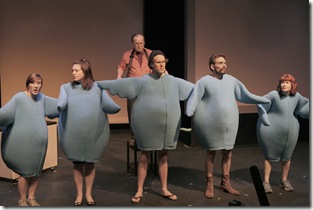
    A living newspaper has an even greater obligation than conventional theatre to watermark early, often and obviously. For example, when we staged the Twitter stream of the Maurice Clemmons manhunt (He killed four Puget Sound cops in cold blood), we did not alter a single word of the tweets, though obviously, since there were over five thousand, we had to whittle them down considerably. We knew we could not give an accurate portrayal of what it was like to witness this stream in real time. No one could. Not only was it a moment passed, but in a way it was a meta-moment. No one person witnessed it in its entirety. So we posited the next best thing. We staged the stream as a symphony of actorsNEW NEW NEWS Twitter Chorus, Photo by Chris Bennion dressed in blue bird suits, evoking the Twitter logo. We weren’t just trying to be funny (though god I hope we were). We were saying, “Obviously we can’t give you the literal truth. Pay no attention to the blue bird suits if you don’t want to, but every (often idiotic) word these actors declaim was actually tweeted over that 3-day ordeal.” (Here‘s a segment on this section by Seattle’s NPR affiliate KUOW did .)
    Not only did Mike refuse to use watermarks, he actively defumigated the theatre of all its delicious anti-sanctity.

    “… Mike told at least me time and time again [that the story] was true. He insisted that “This is a work of non-fiction” be printed in playbills.” 

    Alli Houseworth,
    former marketing/communications director
    at Woolly Mammoth Theatre Company. 
    (You can read her excellent essay by clicking here.)

    Mike didn’t want a watermark within a mile of any house he played. He wanted us to believe every word he charmed us with. And now he encourages his defenders to ridicule and condescend to the very people who took him at his word. “We are all liars and hypocrites,” says Mike. There is something particularly vicious about the man who would punish others simply for being the victims of his sins.

    Act Like it Matters

    The worst thing I heard in response to Daisey’s dishonesty was this from a friend of a friend on Facebook:

    “I never believe you theater folk – you’re a rascally bunch.”

    Yeah, we’re rascally. But sometimes we are able to illuminate stories that journalists themselves are not willing to touch, like when NewsWrights covered the closing of the P-I. And sometimes we are able, like Daisey, to tell a story like Agony/Ecstasy, in such a moving way that we inspire people, perhaps otherwise impossible to inspire, to action. However, in order to poach a bit on journalism’s turf we have to be trusted.  Do we really want to give up this wonderfully fertile ground just because Mike Daisey lied and then excused his lies as so much “theatre”? Do we really want to let him claim sanctuary in our church where we have established traditions stretching across millennia of being scrupulously honest about our dishonesty?

    In answer to this question, the silence from big house artistic administrators so far has been pristine. Clearly theatre has a leadership vacuum in addition to its identity and relevance crises. No one seriously denies that we are simply not producing enough new, fresh, locally sourced material to keep our audiences engaged like Shakespeare’s were, or even Shaw’s. Projects like Daisey’s and NewsWrights United’s help mitigate the problem, but only if we take the issue of truthfulness seriously. We have to act like it matters. We have to show our audiences that we give the issue of truth consideration and respect, or they will walk away from us forever.
  • A Delicious Sampler of Sandbox Radio Live

    Sandbox Radio Live from Sandbox Radio on Vimeo.

  • New Zen Digs

    New Zen Digs

    Him what knows, won’t tell ye.
    Him who’ll tell ye, don’t rightly know.
    The Hillbilly’s Tao

    When I tell people I’m a Zen Buddhist the conversation usually goes something like this:

    Wait.  What?

    I’m a Zen Buddhist.

    You? You’re a Zen Buddhist?

    Yes.

    You are? Mr. Angry Pants? Mr. Be-Careful-of-Daddy’s-Martini? Mr. Picks-a-Fight-with-You-‘Cuz-He-Likes-You?… You’re a Zen Buddhist?

    Yes.

    Really?

    Yes. Really. I mean, ask yourself, who needs it more? Do you really want to imagine what I’d be like if I hadn’t been meditating on a daily basis for the last 21 years?

    Thankfully, these conversations do not happen very often. The first rule of Zen Club is you do not talk about Zen Club. Plus, seriously, I find it awkward and somewhat humiliating to discuss Zen in a culture that uses the word to promote everything from skin moisturizer to coffee blends to sex lube. Barnes and Noble contains a whole section devoted to Zen in every one of its superstores, but I can count on one hand clapping the people I know, outside of my temple, who have ever seriously practiced. I suppose it’s easier to sit and read a book than it is to just sit.  Wait.  I don’t suppose; I know.  But hard or not, just sitting’s how the magic happens.

    I usually practice zazen, or “seated meditation” by myself, at home or on my special bench overlooking Elliott Bay near my work or down by Green Lake on the weekends.  However the community of practice, or “sangha”, is one of the three wheels that make the Buddhist tricycle go.  So I understand it is my responsibility as well as my inordinate blessing to practice with a temple as often as I can.  That’s where Dai Bai Zan – Cho Bo Zen Ji comes in.

    I first starting going to Dai Bai Zan – Cho Bo Zen Ji (translated as “The Listening to the Dharma Zen Temple on Great Plum Mountain”) back in 1991.  (You can check out the temple’s website here.) My good friend and collaborator in the Seattle theatre scene, John Sylvain, turned me on to the place. Back then the temple was a tiny living room in the International District behind the Wonder Bread Factory.  The rest of the house was where the abbot Genki Takabayashi lived. I remember being so intimidated the first couple times I went to beginner’s night that I had to steel myself to open the front door of the small house that had nothing but a wooden sign painted with the words “Clear Quiet Clean” to identify it as a zendo.  Could I really sit still for twenty-five minutes without moving or making a noise, then get up, stretch for half a minute, then do it again for almost half-an-hour?

    A wizened little Japanese man, like some embarrassingly trite Hollywood stereotype of a Zen master, the abbot Genki Roshi,  would sit next to the huge bell, stiller than stone.  Most weeks, Genjo Marinello, the American-born vice-abbot would sit next to him and lead the question-and-answer period afterwards; but one night it was just me and Genki.  It was like sitting with a ghost.  I struggled with, and eventually let go of, my irrational fears that the old man would forget I was there and fall asleep or just decide to go all hardcore Zen on me and sit for three hours without a break.  As I breathed, I calmed down.  The two meditation periods passed like fleeting dreams. Genki Osho served tea. Bowed. And then left me there alone. In that moment I began to understand what all the hype over Zen was about… nothing. Absolutely nothing. Absolutely gorgeous, clear and life-affirming.

    Genki Roshi had little English and never spoke at “Introduction to Zen” nights, though he often served the tea. (If you’ve never been served tea by a genuine Zen master, well, all I can say is, you’re missing nothing– the huge, beautiful, inner-eye-opening nothing that I mention above.) However, at longer half-day and week-long retreats the Roshi would give a commentary on some selection from the Buddhist canon. Genki would sit like a monument for an interminable moment before speaking, then squinch up his face and growl softly:

    Booodhaaah?… Booodhaaah?… No Boodhah… No BOODHAH!YOU da Booddhah!… No Shinking. [No thinking]. Shtraytuh cuhhting. [Straight cutting].

    YOU da Booddhah!… You da BOODHAH!

    Genjo sitting beside him, would then translate. “Genki Roshi asks you to consider Mumon’s commentary on the 33rd Case, Baso’s ‘No Mind, No Buddha’….” It wasn’t uncommon for Genjo to take ten minutes “translating” something  Genki said in 30 seconds.

    After a year or two the temple lost the lease on the little house in the I. D., and was forced to take up residence in the back room of an Aikido dojo on Aurora Avenue up around 76th Street North of Greenlake. This was a strange and difficult transitionary period in my life as well. I was going through a divorce, living hand-to mouth on temp jobs in a comfortable enough but tiny studio on Capitol Hill: alone, no phone, no TV, no social life, no car. About all I could count on was, if zazen was scheduled for an evening, and if I made the hour-long two-transfer bus trek to the temple, someone—maybe just one someone– Genjo or Genki or some other ranking member of the temple—would be there to just sit with me.

    I usually keep my mouth shut during Q & A sessions, but one night, when it was just me and Genjo, and I had endured both sits with a big sore heart and tears rolling down my face, I asked if he had any advice on how to get through really, really hard times. His answer was simple. Maintain the practice, and remember to have compassion: compassion for others of course, but first and foremost, compassion for myself. He told me to sit, and listen to my pain; witness it; notice that with each breath, somehow, I was getting through it.

    Five years later Genjo Osho officiated at my wedding to the most inside-and-out beautiful woman I have ever met. Shortly thereafter, Heather and I moved to New York City, but I never sought out a temple there. I guess I was too afraid of the Yuppie Zen factor that plagues big rich cities like New York and San Francisco. When our first baby boy came into the world, we decided to move back to Seattle, where I resumed attending Dai Bai Zan – Cho Bo Zen Ji, back in its own house again on Capitol Hill.

    This past Fall, the temple relocated to a larger building on Beacon Hill at 1733 S. Horton St., just five blocks of the Beacon Hill Light Rail station.  In January, I finally had the honor and pleasure of sitting zazen in these new digs.  Then in February I attended a “mini-sesshin”. (A mini-sesshin is a half-day meditation retreat.  A full sesshin can last a week or more.)

    Contrary to what Amazon would have you believe, the best introduction to Zen practice is not downloading the latest book to your Kindle, but rather practicing zazen itself. Dai Bai Zan – Cho Bo Zen Ji offers an excellent and extremely accessible introduction to seated meditation at the Tuesday night “Introduction to Zen” which begins promptly at 7:30 pm. (Allow yourself at least ten minutes extra: the last thing you want to do is barge in late on a zazen session.)

    If you are as intimated as I was 21 years ago, then contact me and I’ll go with you.  That’s what sangha’s all about.

  • The Blessings of Getting Better: Sandbox Radio Live!

    The Blessings of Getting Better: Sandbox Radio Live!

    Like any good theatre town, Seattle tends to lavish plenty of hype on the inaugural production of a new company when that company is made up of talented veterans who have proven themselves on other stages around town. Pressure mounts on the new ensemble to make their kick-off show one of the best audiences have ever seen, thus assuring crucial momentum for the future. Of course, the inherent danger lies in forgetting that no matter how earth-shatteringly brilliant your first play is, the primary law of show business remains as immutable as gravity: you are only as good as your last gig.  A company that can never live up to the promise of its premiere production is a company destined to be loved like a first crush: fondly, but weakly, and with an ardor that fades even as the intervening years serve to burnish or blur the memory of love-at-first-sight’s luster.

    Happily, through luck, hard work and great leadership, the Sandbox Artists Collective has managed to escape that fate with its quarterly audio offering, Sandbox Radio Live. Don’t get me wrong. We had a great initial outing, back in July of last year with our first show.  And lots of delicious hype to go with it. But I don’t know anyone who would argue we couldn’t do better.  And better we did, with the second iteration, a horror-themed show turned out just in time for Halloween.

    With this third episode, however, every member of the team— writers, actors, musicians and production crew — stretched out into strong new strides: going beyond what we had done before with a confidence that surely grew out of our prior successes and failures.  Everyone seems to agree that Episode Three, “To Hell With Love” was our best show yet.  And best of all, now that the podcast is ready, you can listen and decide for yourself by clicking here.

    For me, the evening did not contain a single clunker.  I loved every segment, from Anita Montgomery’s hilarious plumbing of the particular hell that is on-line dating in “F- You, Cupid!” to Elizabeth Heffron and Leslie Law’s stirring tribute to the great radio drama talent, Norman Corwin, in the show’s finale, “Corwin on Corwin.”  And I will never forget when Elizabeth Heffron’s delightful sex romp in space “T-Minus” gloriously Lesliel Law and Heather Curtis Mullin singing their gorgeous duetdissolved into an Offenbach duet sung by Law and the shimmering soprano Heather Curtis Mullin.  As Heather herself will tell, you it’s no great accomplishment that this brought me to tears.  I’ll cry at a cell phone commercial.  But that doesn’t diminish the welling of awe I felt witnessing that unrecoverable moment of live theatre.

    Wait!  What did I just say?  “Unrecoverable?”  Bullcrap!  Due to the greater glory of Sandbox Radio you can go and recover it right now, here!   (Act I, 52:50).

    And here’s a list of all the evening’s pieces:

    Episode 3, “To Hell With Love”
    recorded at West of Lenin on January 23, 2012

    Act 1

    @1:55 “F-You, Cupid!” by Anita Montgomery
    @13:28 PSA-Coal Free Washington by Vincent Delaney
    @16:45 “Lost Love Blues” by Charles Leggett
    @22:53 “Markheim: Episode 3” by Paul Mullin
    @37:30 “T-Minus” by Elizabeth Heffron

    Act 2

    @0:00 “Angry” by Charles Leggett
    @2:48 “Charlotte Doesn’t Clean Here Anymore” by Scot Augustson
    @17:55 PSA-Communities in Schools of Seattle by Vincent Delaney
    @21:08 “Corwin by Corwin” by Elizabeth Heffron
    @40:03 Finale/Credits

    Charles Leggett IS MarkheimTrue to the night’s pattern, my own piece, the third installment of the noir angel series, Markheim, was the best one yet.  If I can modestly say so, I am really starting to find the action of the story.  And the actors, foley artists and musicians have modulated the series’ unique and tricky tone to pitch perfection.  As always, I’m providing the script for Episode Three below the fold.

    (more…)