Just Wrought

Recovering playwright, once won a STRANGER Genius Award for theater. Now writing a bloated novel about… G-d help me! Theatre.

  • The Inalienable Happy Pursuit of the Living Wage

    The Inalienable Happy Pursuit of the Living Wage

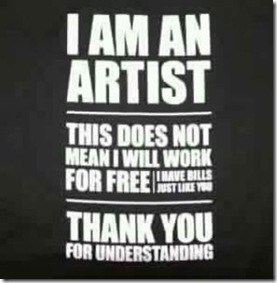
    This image has been floating around Face Book lately, accumulating plenty of “likes” on its way. 

    Well, I don’t like it.  I actually kind of hate it.  I believe that once an artist ties his or her work in a one-to-one, all-or-nothing relationship with making a buck off it, the game is done, and the moneyed powers-that-be have won it all over again.  Nothing new or good or game-changing can come out of saying you’re only going to do your art if someone pays you a living wage for it. Instead, what you are really saying is that your creativity is simply one more commodity to be bought and sold in a market-driven society owned by folks who know a lot more about money, and a lot less about creativity, than you do.

    One the other hand, I also hate the idea artists should shun the marketplace altogether. We should get paid,  as much as we possibly can in any given market. (So long as we are aware and comfortable with knowing that some markets will only offer us compensation that is utterly untranslatable into coin.)

    Up until now I have not written about the “living wage” crisis in Seattle Theatre because I did not have a good new idea on how to frame it. Then I attended the October Seattle Theatre: What’s Next? Forum, and listened with growing excitement as actor/producer Peggy Gannon kicked off a heated round-robin discussion of the issue that was finally and brilliantly summed up by Annex Theatre’s Meaghan DarlingJim Jewell’s notes from the night describe it best:

    Making a living and making art should not be mutually exclusive.

    This last point came out of our earlier discussion, but was most eloquently encapsulated by Meaghan Darling, fairly paraphrased as, “Nobody owes me a living, but I want them to not prevent me from making a living.” Big House rehearsal schedules were particularly discussed here, as the now-standard 10-6 rehearsal day precludes keeping a day job, while the economics of theatre (and of course there is much debate here) can’t offer a sustainable salary for that work (and we lamented how many amazing actors have had to leave town or the profession). We all rallied around this idea, because it is very much in the spirit of Seattle Theatre: What’s Next as a whole – it is a statement that holds within it hope and offers compromise, which seem to me essential components of productive dialogue.

    “Life, Liberty and the pursuit of Happiness.”  Despite the Tea-Bagging idiots who have co-opted their ideas and headgear, our Founding Fathers were no fools. No one can or should guarantee anyone happiness or a living wage. But when your systems—and this goes for unions and Big House administrations alike—stand in the way of the pursuit of making a decent buck from doing theatre, well, then the truth becomes self-evident, and independence must be declared.  If this be treason, let’s make the most of it!

  • José Amador Calls Out Bardolatry

    Check out José Amador’s insightful and fun essay  over at the Seattlest examining our obsequious and unweened relationship with the works of William Shakespeare.  To his excellent points I would add an apologia for my own insolence in presuming to wright plays when, according to so many theatre canonophiles, all the great works have already been written.  However, I feel compelled to note sheepishly that that a few things have happened in human history since Shakespeare died.  And since he wasn’t able to address them, it is up to foolish mortals such as myself to give ‘em a whack.

    My own paltry stabs have included so far:

    I’m so sorry that Shakespeare couldn’t live forever to put these important issues in their proper blank verse perspective; but since all Golden Ages are, by definition, over, you’re stuck with the unlikely likes of me and others who pathetically soldier on at the art of dramatic writing, so clearly dead since 1616.

    ‘Tis true, ’tis pity,
    And pity ’tis ’tis true.

  • IBM and Microsoft, Sittin’ in a Tree

    IBM and Microsoft, Sittin’ in a Tree
    Available Now
    imageBuy Now

    While I have stated publically I hate being prescient, there are times when I don’t mind too much.  With the massive Occupy movements afoot I thought I should note that I was talking about the absurdities of Corporate Personhood long before it was popular.

    Check out this section of An American Book of the Dead*- The Game Show†.

    (more…)

  • Hawking Whole Theatre at “What’s Next?”

    Hawking Whole Theatre at “What’s Next?”

    Last night I joined a small but extremely energized group of theatre professionals at the second iteration of “Seattle Theatre: What’s Next?” hosted by Jim Jewell and Peggy Gannon.  I want to talk more about what was discussed and what action items came out of that discussion, but I think I will wait until Jim publishes the official minutes.  Until then, here’s a transcript of the three minute spiel that I was asked to give on what’s currently exciting me about Seattle Theatre:

    Whole Theatre

    Be careful what you wish for, sure.  But when it comes to Seattle Theater, it’s also wise to be specific what you wish for.  For a good while now Seattle’s Big House theatres have been gradually increasing the percentage of local actors they hire.  And rightfully they have then touted this change as a noble step in the direction of locally grown theatre. But let’s be honest.  We all know one of two things happened.  Either the artistic administrators of Seattle’s Big Houses all got together in a room and decided, “Hey, we should do the right thing and hire more local actors.”  Or… they all independently realized that in the current depression it was becoming cost prohibitive to fly in every actor from New York or LA.  I’ll leave it to you to decide which scenario seems more plausible.  But look, when a good thing happens it’s churlish to over-analyze the reasons for it.

    The problem is that using local actors isn’t enough.  And so when we advocate for locally grown theatre, we need to be more specific…  Whole Theatre.  Theatre that is soup to nuts local: written by local talent in collaboration with local talent.  Zero degrees of separation among everyone from the playwright to the director to the designers to the actors to the audiences. 

    Zero degrees of separation. 

    If what I am proposing sounds radical or overly ambitious, consider this: we do it all the time.  In fact, if I can brag a little, as a playwright and an actor, I have done very little in the last five years that hasn’t been Whole Theatre.  Going back to 2006, there was the Empty Space production of Louis Slotin Sonata.  When the floor needed final painting, Allison Narver was there in jeans, helping designer Gary Smoot to finish it.  I’m trying to picture one of Seattle’s Big House artistic directors doing that.  To be fair, I’m sure there are union rules against it.

    Then there was The Ten Thousand Things, which Washington Ensemble Theatre produced.  I sat in a room with the director and the designer Etta Lilienthal talking through her sketches. Later, I sat in the theatre while audience members rewrote my play one word each performance.

    And most recently there was Newswrights United producing two living newspapers, researched, written and produced by Seattleites, about Seattleites, for Seattleites.

    And of course it’s not just stuff I’m working on.  There’s the incomparable 14/48, perhaps the most consistently exciting weekend of theatre in town.  All local actors, directors, designers and crew mixing it up on plays written by local playwrights in the space of maybe ten hours, tops.

    There’s Printer’s Devil, opening yet another Scot Augustson world premiere, Shadow Odyssey in their unique committed relationship with him.

    There’s Sandbox Radio which just staged its second all original slate of short pieces, combining some of Seattle’s best actors with the best playwrights and musicians.

    And right on the horizon is Rebecca Olson’s new project Custom Made Plays, commissioning local playwrights to write for specific local actors.  I’m happy to be the playwright on the pilot play, writing for Rebecca herself and Hana Lass.

    Whole Theatre.  Theatre that hasn’t had the yummy good-for-you stuff processed out of it.  Non-corporate theatre that ain’t stale from being packaged three years ago in a theatre scene 2,700 miles away by MFA’s who have never stepped foot in your town.  Whole Theatre. Seattle’s crawling with it.  And surely it gives us the most solid shot at World Class.

    (I want to do a version of the poster that says Enjoy Whole Theatre!  Or as Shakespeare, Molière and Chekhov called it, “Theatre.”)

  • The Causes of Monsters

    The Causes of Monsters

    The first is the glory of God.

    The second, His wrath.

    The third, too great a quantity of semen.

    The fourth, too small a quantity.

    The fifth, imagination.

    The sixth, the narrowness or smallness of the womb.

    The seventh, the unbecoming sitting position of the mother, who, while pregnant, remains seated too long with her thighs crossed or pressed against her stomach.

    The eighth, by a fall or blows struck against the stomach of the mother during pregnancy.

    The ninth, by hereditary or accidental illnesses.

    The tenth, by the rotting or corruption of the semen.

    The eleventh, by the mingling or mixture of seed.

    The twelfth, by the artifice of wandering beggars.

    The thirteenth, by Demons or Devils.

    Ambroise Paré, Monstres et Prodiges (1573) 

    I was in Dick Rhodes’ living room leafing through a scrap book he had handed me when I came across this excerpt pasted to a page surrounded by various pictures of grotesques. I’ve had these moments before: something reaches out from a different dimension and gently tugs me towards it, letting me know that a relationship has just begun, and will quite probably last for the rest of my life. This is how I discovered John Gardner, not in some creative writing class as most of the folks I know who know of him did, but at the Cockeysville Branch of the Baltimore County Public Library when I was scanning the shelves and came across the tangle of antlers that is the dustcover of Freddy’s Book. How different would my writing– my life!– be had I not discovered Gardner to mentor me from beyond the grave?

    This list of causes struck me with its simple boldness and poetry. Of course, Paré is a physician from that era when science and art were siblings that still shared the same room. Even though they bickered and weren’t crazy about the arrangement, they occasionally enjoyed each other’s company and shared a common set of interests and language for talking about them. (I flatter myself and you, gentle reader, that we can, perhaps bring the kids back together again.)

    The wonderful matter-of-factness of the list is due to the very fact that, as far as Paré ‘s concerned, he is dealing in matters of fact. Birth defects had causes, and those causes ranged from the blatant and incomprehensible intercession of God, such as the blind man in the Gospel of John, born that way for no reason other than that Jesus might one day give him sight and thus prove “. . . the works of God might be magnified in him . . . “; to the more mundane fakery of traveling beggars:

    I have a recollection being in Angers, in 1525, that a wicked scoundrel and beggar had cut off a hanged man’s arm– already stinking and infected– which he had tied to his vest, letting it lean on a small fork against his side. . . . One Good Friday, the people, seeing his rotted arm, gave him alms, thinking it was real. The beggar having wiggled this arm around for a long time, finally it came loose and fell to the ground. . . thereupon he was led off as a prisoner, then condemned to get the whip, by order of the magistrate, with the rotted arm hung around his neck.*

    I think most of us boys can relate to the third and fourth causes of monsters, and nearly everyone to the fifth.

    This list, this wonderful found object, has inspired me to think in a different way about a challenge I’ve been mulling for over a year now: the problem of horror in theatre. Instead of a full-length, single subject play, I’m thinking now of attacking it one short experiment at a time; for if Paré proves anything here, it’s that horror has a variety of sources.

    I’m further inspired to generate my own, modern list of the causes of monsters. Here’s what I have so far (and I welcome your suggestions):

    rumsfeld poking his eyes out

    The Modern Causes of Monsters

    The first is the glory of scientific ascendance.

    The second is the ignorance of its limits.

    The third, too small a quantity of faith.

    The fourth, too great a quantity.

    The fifth, imagination.

    The narrowness of an individual mind or smallness of one’s heart.

    The seventh, the incessant, uninvited malfeasant fiddling of extra-terrestrial entities who, while floating above us like condescending hydrocephalic, wing-plucked fruit bats, or occasionally swooping down to probe us into ignominy, never seem to take the time to realize that we have feelings and sometimes feelings get hurt.

    The eighth, by a fall or blow struck against a nation once too many times impregnated with pride.

    The ninth, unnozzled anger.

    The tenth, by rotting or corruption of the soul, if it exists.

    The eleventh, by the mingling or mixture of misunderstood Easternisms, if it does not.

    The twelfth, by the artifice of hungry-to-be-sentient corporate entities.

    The thirteenth, is the glory of God.

    The thirteenth, is His wrath.

    *From Janis L. Pallister’s translation, On Monsters and Marvels, The University of Chicago Press, 1982.

    (This essay was written in 2004 and originally posted  to the wild and woolly text-only writers’ site, Everything2.com.  I repost  it here essentially as it appeared, including the annoying formatting.)

  • American Theatre Hearts Scot Augustson

    American Theatre Hearts Scot Augustson

    Slip this clipping into the “Seattle’s-Big-Houses-May-Not-Care-Much-about-Seattle’s-Locally-Grown-Plays-But-the-International-Media-Sure-Does” file.  You know, it’s that one that’s getting a little over-stuffed by now with pieces like NPR’s On the Media’s story about the first edition of NewsWrights United’s Living Newpaper (you can listen here), and the UK’s Guardian covering both Seattle’s hosting of the Outrageous Fortune discussion as well as Just Wrought’s vibrant comment stream regarding the Intiman debacle.

    This time it’s the vaunted magazine American Theatre giving Scot Augustson a little much deserved love for the opening of his latest Sgt. Rigsby joint, Shadow Odyssey, produced by Printers Devil Theatre at Theatre Off Jackson.  Apparently this side-bar shout out doesn’t appear on line, but only in the print version.  So I asked Scot to send me a scan.  Scot apologized to me for his “Flintstone scanning technology”.  (I’m picturing a bird with a pen in its beak, furiously copying the page and then flying with it to my house in Green Lake.  Once I take the image, he turns to the camera, shrugs and squawks, “It’s a living!”)

    I’m going to see Shadow Odyssey tonight, opening night, ‘cuz I’m cool that way.  But whatever you do, you better get your tix soon, before all the folks flying in from all over America buy up all the seats.

  • Louis Slotin Sonata is #1!

    Funny story: I mentioned on Google+ this morning that sales of the Kindle version of my play Louis Slotin Sonata seemed to have gone through the roof (though in the interest of perfect honestly, I must now instruct you to picture a roof approximately six inches off the ground.)  Shortly thereafter, my friend and colleague Wes Andrews chimed in to point out that the play is the bestselling e-book in the playwriting category.  (See the rankings here. ) 

    Shocking!

    At this point I began mentally listing reasons this might be so:

    1. In November, Louis Slotin Sonata will be receiving a production on the retired ocean liner, The Queen Mary, produced by California Repertory Company, or Cal Rep for short, the resident theatre company at California State University – Long Beach.  Now, a staging of the play does not necessarily translate into a significant boost in Kindle sales.  I only saw a small uptick when A Red Orchid produced Slotin in Chicago last year; but I wonder if, since the play is being done under the auspices of a university, perhaps certain professors are assigning the text as course reading.  If so, that would be sweet.  I’d like nothing better than to start feeding at the trough of mandatory academic assignment, especially in light of how often and eagerly I rail against the dangers of academia infecting American Theatre with the debilitating disease of elitist inaccessibility.
    2. It ain’t exactly hard to top a list of books about playwriting.  It’s a bit like being the best ice-hockey player in Chad: an achievement, undeniably, but one that needs to be placed in context.  Adding to the irony is the fact that that Louis Slotin Sonata isn’t about playwriting, it is playwriting.  When I first published the script “playwriting” was the closest category Kindle offered.  (A further irony is implied here: Amazon recognized that books about playwriting were more likely to sell than plays themselves.)  All that said, I flatter myself to think that reading Louis Slotin Sonata might teach you things that you won’t learn from Playwriting for Dummies (number two on the list).
    3. You can only get Louis Slotin Sonata on Amazon.  While Slotin is probably my best known play, it is not necessarily the most successful by all standards.  Tuesday has had more productions and The Sequence has netted me more money.  A while ago I decided that I would hold Slotin back from hard-copy publication, if only to see how well it might do if solely offered electronically.  It was an experiment. I like to think Louie would approve.

    Regardless of how I might try to explain it, the situation remains absurd.  And thus, it is my sworn duty as a theatre artist to do everything possible to perpetuate it.  You can help.  You can order the play for your Kindle of course, but if that does not work for you either because…

    • you do not have a Kindle (I sure don’t)
    • or you already have a copy of the play
    • or don’t have the $7.99 to spend

    … you can still help by going to Amazon and supplying a review of the play.  Reviews and good ratings help raise the profile of an electronic title. 

    So think back.  Did you see Slotin in Los Angeles, New York, Seattle or Chicago?  What did you think?  Type those thoughts out and post them to Amazon.  Maybe give the play some stars.  Then sit back with me and see how long we can keep this absurdity going.

  • Horror, Terror, Dread

    Horror, Terror, Dread

    “Horror”, “terror” and “dread” are terms often used interchangeably, but it is important to remember there are no true and total synonyms in any language, let alone the enormous and endlessly supple English lexicon.  As we dig deeper into the problem of horror in theatre, it behooves us to tease out the differences among these concepts so that we can better understand what we as theatre artists can reasonably hope to engender through a live stage experience.

    Despite what you might think of Orson Scott Card’s social politics—and they are pretty reprehensible—he is at times capable of important insights, especially when it comes to story-telling.  In his introduction to his collection of short fiction, Maps in a Mirror, Card illuminates his perspective on the differences and interdependencies among horror, terror and dread. Technically, according to the vaunted sci-fi scribe, I should list “dread” first, since this is the anticipatory emotion, the harbinger of fleeting “terror”.  Thirdly comes “horror”, terror’s lingering residue. Says Card:

    Dread is the first and the strongest of the three kinds of fear. It is that tension, that waiting that comes when you know there is something to fear but you have not yet identified what it is. The fear that comes when you first realize that your spouse should have been home an hour ago; when you hear a strange sound in the baby’s bedroom; when you realize that a window you are sure you closed is now open, the curtains billowing, and you’re alone in the house.

    According to Card, terror is what happens when the dreadful unknown becomes known: when the vampire finally bursts out of its coffin, when the airplane finally plows into the building, when the proctor says pencils down, and you realize you haven’t written anything. Terror is powerful, but transient. It only lasts as long as it takes to fight, flee or die. As Card points out, “. . . At least you know the face of the thing your fear. You know its borders, its dimensions. You know what to expect.”

    Horror happens after the fact, and thus, says Card:

    . . . is the weakest of all. After the fearful thing has happened, you see its remainder, its relics. . . . with repetition horror loses its ability to move you and, to some degree, dehumanizes the victim and therefore dehumanizes you. As the sonderkommandos in the death camps learned, after you move enough naked murdered corpses, it stops making you want to weep or puke. You just do it. They’ve stopped being people to you.

    So Card’s schema of fear in a nutshell:

    Dread / pre-cursor / powerful in cumulative doses / ductile

    Terror / cursor / extremely powerful / transient

    Horror / post-cursor / weak / easily degrades to apathy

    I quibble a bit with Card’s definition of horror. I think he is jamming it into a semantic slot for the sake of neatly rounding out his schema. Horror to me is a larger thing, not just following upon, but also encompassing, terror and dread. After all, it’s significant somehow that we don’t call them “dread stories.”* Nonetheless, Card’s theory is undeniably powerful in breaking down what does and does not work in some of the most famous examples of the genre.

    Shirley Jackson‘s The Haunting of Hill House offers a quintessential serving of well-constructed dread which ultimately lacks the particular punch of terror at the climax that would make it an unquestionable classic. Jackson builds the menace of the house nicely throughout the bulk of the book, and gently allows readers to discover for ourselves Eleanor’s psychic deterioration, with deviously gentle hints, such as having the poor girl remember prior fancies as fact, etc; but Jackson’s handling of the terror piece of the puzzle right near the end does not rise to meet dread’s hand-off, and the nearly non-existent denouement offers no meaningful lingering touch back to the cancerous anxiety that had us, as connoisseurs of the form, so horribly hopeful during the buildup.   H. P. Lovecraft  is another vaunted master of the form for whom evoking dread is easy money, but spicing it with actual terror when the right time comes proves elusive.

    For a pitch perfect example of Card’s theory in practice, I submit for consideration Stephen King’s early novel,Salem’s Lot. Here King instinctually employs all the right tricks to pull these three important pieces together in a literary symphony of fear.  First, instead of ending with horror, King begins with it, placing the reader in Mexico, at the end of the action, where the protagonist Ben Mears and his boy sidekick Mark have fled as far they practically can from the evil Maine town that gives the book its title. Clearly both are shattered by whatever happened to them, though the boy seems a bit more resilient.

    Upon returning to the narrative proper, King’s next trick, or more accurately, running series of tricks, is to dribble in small chunks of terror as he simmers the stock of dread. This makes sense from several points of craft. First, it serves to amp the dread as he builds it, leaving readers ratcheted up another quantum notch of anxiety from which we cannot return until the book is done. Second, it places less structural weight on the final climax, so King does not have to resort to breathless rushing like Jackson, or vague insinuations like Lovecraft to meet his mark. When our reluctant vampire hunter Mears has to climb down into that infested basement armed only with wooden stakes, you feel along with him his dogged determination as well as his near-certainty of doom. Pockets of terror catch us off guard, and leave us reeling. Terrible things happen when we least expect them, perpetrated by the most unusual suspects. It’s a fascinating testimony to King’s canny genius that the most terrifying moment (using Card’s definition) in a book about a town literally crawling with bloodthirsty vampires is when a perfectly normal woman punches a perfect normal infant in the face. (Though, agreed: I’m using the term “perfectly normal” in the loosest of senses.)

    Card’s tripartite schema, slightly strained as it is, proves an excellent guide to those of us who are trying to figure out new ways of frightening the fuck out of people. But he digs even deeper as he concludes his introduction to Maps in a Mirror:

    [This] is the artistry of fear. To make the audience so empathize with a character that we fear what he fears, for his reasons. We don’t stand outside, looking at gory slime cover him or staring at his gaping wounds. We stand inside him, anticipating the terrible things that might or will happen. Anybody can hack a fictional corpse. Only a storyteller can make you hope the character will live.

    So as with all great story-telling, and indeed, great art, the trick lies in cracking the nutshell of the other– to climb inside and drive them around for a ride. This happens so rarely that billions of human beings have never experienced it, or if they have, barely realize they have. But it is incumbent upon us artists to keep hammering on that shell. This is a trick which is both more difficult and easier in the theatre.  Easier, because “climbing inside and taking someone else for a ride” is the very definition of acting; but in a modern American theatre stuck revving representational realism, an audience can very quickly lose connection so completely that there remains no chance of instilling genuine terror, horror, or even dread, beyond the dread of sitting in a cramped seat and wondering how long and how bad the show you are about to see might be.

    *It’s also telling that we don’t call terrorists “dreadists.”  Human beings can, and often do, tolerate long comfortable lives lived within an ambient state of dread.

  • KING 5 Hearts Sandbox Radio

    KING 5 Hearts Sandbox Radio


    Taking a break from talking about the problem of horror in theatre to let you know that Nancy Guppy gave us crazy good love today on KING 5’s New Day Northwest’s “Weekend Zone”, kicking off the segment with a huge plug for Sandbox Radio, calling us Seattle’s Prairie Home Companion, only Leslie Law is “a lot better looking than Garrison Keillor”.  Well, duh, Nancy!  (Oh, and funny story, Margaret Larson has volunteered to be our foley artist.  Gee, thanks Margaret, but uh… we’ll call you, okay?)

    I am pretty sure we are all sold out on Brown Paper Tickets, but if you really want to come see the live recording, message me and I will see what strings I have left to pull.

    And of course, if you haven’t already done so, check out the podcast of Episode One.

  • The Problem of Horror in Theatre

    It’s a simple question, in two parts:

    1.     Is it possible to engender genuine horror in an audience through a live stage experience?
    2.     If so, how?

    I have been kicking this around for at least the last two years, maybe longer. Finally I decided to toss some of the issues out to some of the smartest people I know, i.e. youse guys.

    First. . .

    Some not so simple questions

    What’s the point?

    What do we get out of it, this horror experience so prevalent and so profitable in movies and books? Is it the adrenaline kick? Studies have shown that regular doses of adrenaline can have both positive and negative health effects. (m_turner* points out that one of the roles adrenaline plays is to enhance memory. This might provide a welcome side-benefit to the artistic experience, but I think it hardly accounts for the pervasiveness of the genre.) Certainly in the modern world– occasional terrorist attacks and earthquakes notwithstanding– we have fewer opportunities to cop our adrenaline fix than our forebears did swinging from branches or crouching in caves. Maybe we like being scared because it makes us feel more human – or rather, more animal. Then again, maybe we enjoy occasionally giving form to the inchoate fears commensurate with our modern existence. Maybe, in a nobler vein, the value of experiencing fear lies in conferring us some sympathy for those poor souls who, for whatever reasons, live their lives afraid. Or maybe there’s a sort of psychic purge at work. And finally, maybe it’s a combination of some or all of these factors, and perhaps many more.

    It’s nearly impossible to dispute that there is indeed something about the horror experience that that keeps us coming back for more; and thus, as a playwright, I feel like it’s incumbent upon me to explore it further, to see if it is possible for me to mine this vein so artistically and, what’s more, financially lucrative.

    What drives horror?

    This is a larger question than just, “what scares us?” I want to go one stratum deeper and ask: What is it that is inherent to our natures that makes us capable of getting scared in the first place? Is it death? Or the apprehension of it? Or is it the broader apprehension of universal loss– the fact that everything changes, and mostly for the worse? Does isolation drive horror? Or does its more evil twin, alienation, more urgently push the pedal?

    A little over a year ago, Cletus the Foetus* and I got into an on-going discussion about this very subject, and I believe he got at something very interesting indeed when he said:

    Horror involves things beyond human comprehension, breaking down cherished notions about self-identity, memory, spatial relation, history and chronology, body, reference or representation, influence, reason – all the metaphysical categories according to which we situate our knowledge in the first place.

    I am tempted to dub what CTF is talking about here something like “psychic distortion”, but I balk just a bit. Is it quite the right term? In any case, I’d like to show how theatre is uniquely suited to get at some of these notions he talks about breaking down.

    Why theatre?

    After all, if other media like film and fiction do it so well, maybe theatre is out-gunned. The challenge of frightening audience members in a live environment is certainly more arduous and complex. Ask yourself: have you ever been truly frightened by something you have seen on stage? For that matter, have you ever even been to the theatre? (A question for another node, perhaps, but still somewhat relevant, in that it points at theatre’s dwindling scope as a medium for the masses.)

    Obviously fiction can wrap a reader so tightly up in a world of mostly their own imagining that well-written horror can easily work its suffocating magic; but of course, there’s always the option of putting the book down as well. The great horror writers create in their readers that wonderful tearing tension between not wanting to turn the next page and not being able to stop themselves. It is worth noting, however, that fiction is a lonely art, written by one to be read by one. Theatre, conversely, is created collaboratively and consumed that way as well.

    Film creates palpable realities, woven with special effects, compelling cinematography, and some of the best acting, directing and screenwriting talent gazillions of dollars can buy. Theatre just cannot compete, at least not on film’s turf. But mind you, it is a common mistake to think that the stage is nothing more than cinema’s poorer, older, four-dimensional cousin. That extra dimension makes a true world of difference; if only theatre artists can allow themselves to trust in its power.

    “Psycho-social regression”

    I am cocky enough to propose that theatre is capable of exploring types of horror that other art forms can’t really touch. Carl Jung hints at this in Concerning Rebirth circa, 1940:

        …You go to the theatre: glance meets glance, everybody observes everybody else, so that all those who are present are caught up in an invisible web of mutual unconscious relationship….

    Mankind has always formed groups which made collective experiences of transformation—often of an ecstatic nature— possible. The regressive identification with lower and more primitive states of consciousness is invariably accompanied by a heightened sense of life.…The inevitable psychosocial regression within the group is partially counteracted by ritual, that is to say through a cult ceremony which makes the solemn performance of sacred events the centre of group activity and prevents the crowd from relapsing into unconscious instinctuality… The ritual makes it possible for him to have a comparatively individual experience even within the group and so remain more or less conscious. But if there is no relation to a centre which expresses the unconscious through its symbolism, the mass psyche inevitably becomes the hypnotic focus of fascination, drawing everyone under its spell. That is why masses are always breeding-grounds of psychic epidemics, the events in Germany being a classic example of this.

    Of course, this leads to certain safety concerns unique to theatre that I will touch upon in another node.

    I suspect, in the final analysis, we’ll find that theatre is not outgunned by its cousin art forms, given that it possesses weapons in its arsenal and cards up its sleeve that only deeply experienced show people can begin to suspect; but I also believe only careful experimental evidence can truly prove otherwise. That is why I so very much want to create an evening of horror, ideally a collection of small pieces at first, to see what does and does not achieve the goal of terrifying a goodly portion of the audience. Horror, like laughter, is a verifiable, repeatable experimental result in the theatre.

    Now . . .

    How do we do it?

    Suspension of Disbelief

    A lot of lip service is given to the idea of the willing suspension of disbelief both in regards to horror and drama. Indeed, Cletus told me once that he wondered if it was possible to engender horror on stage without suspension of disbelief. I beg to differ. Frankly, I’ve always thought SOD had far less importance in the theatre than most believe, and judging from the works of my favorite playwrights: Shakespeare, Brecht, Wilder, I’d say they’ would probably agree. Far from suspending disbelief, good theatre is about expanding belief, enriching and perhaps even exploding it.

    On a pragmatic level, I would say SOD is hardly even an achievable, or for that matter legitimate, goal vis-à-vis modern audiences. Today’s theatre-goer is far too sophisticated and hiply inured to every possible shock to blithely and willingly suspend their disbelief. Still, I would like to experiment with finding smaller points and/or zones of disbelief suspension. I propose it is possible to use the technique almost surgically, like a painter adding a small field of pointilism in an otherwise expressionistic canvas. I’d call this Tactical Suspension of Disbelief. (It is important to note, however, that within this area of exploration, it is utterly incumbent upon theatre artists to have a frank discussion of safety and liability issues that arise when a theatre starts messing with people’s idea of what is really happening.  There is a fine and all too often broken line between disbelief suspension and hoax; and, while hoax may or may not be an effective form of expression, I remain unconvinced that this is the best method for true theatrical madness. Hoax locks people up more often than it frees them.)

    Proximity

    An alternative to SOD is something I call theatrical proximity. This is the notion that something which happens on stage, especially on a smaller fringe-scale stage, is inherently more effecting than the same event projected on a screen, regardless of whether the audience suspends their disbelief, for the very reason that theatre adds entirely new dimensions, not only spatially but psychologically. I remember a particular production of Julius Caesar I saw at the Public Theatre oh so many years ago. The cast boasted Al Pacino as Marc Antony and Martin Sheen as Brutus, and it sucked. But, boy, I tell ya: when those knives came out in Act III  my heart pounded in my chest all the same. The knowledge that violence– even fake violence in a badly acted play– is about to happen feet from your face is something that makes an end-run right around your cerebral cortex and leaps right into your reptile brain instead.

    Bottom Line

    I think theatre holds unique opportunities for engendering horror in an audience, but this cannot be achieved by trying to do what film and fiction do better. The trick will lie in finding what theatre does best: right now I am looking at psychosocial regression, tactical– rather than strategic– suspension of disbelief, heightened proximity and psychic distortion as my key targets of investigation; then using these techniques masterfully to achieve the wonderfully simple and experimentally verifiable goal of frightening the fuck out of people.

    * * *

    *This essay was written in 2004 and originally posted to the wild and woolly text-only writers’ site, Everything2.com.  I repost  it here essentially as it appeared, including the annoying formatting and the oh so overwrought style, which I like to think I’ve since modulated to just wrought. I intend to expand on my thoughts above with new essays and I am hoping some of you will kick in your perspectives so that I can include those too.