My original plan was to dedicate two essays in this ongoing series, Towards a World Class Theatre, to the crucial role that design plays– or should play– in the development of new work for the stage. The thesis of the first was to be pretty safe and straightforward: designers and playwrights should begin collaborating as early in the process as possible, something which is, if not actively discouraged by the monolithic regional theatre/MFA mediocracy, well then certainly almost universally ignored. I pre-ranted a bit about this in “Theatre Takes Place: Why Locally Grown Plays Matter”:
This sort of intimate relationship between playwright and set-wright is generally frowned upon in today’s play development superstructure. The alternative model forcefully defended at your favorite regional theater goes something like this: you go to your MFA program, I go to mine. If, based on the recommendation of the well-known playwright who runs my MFA program, said regional theater decides to develop my play, said theater will assign me the MFA grad designer recommended to them by the top-tier MFA design school, most assuredly not the same school as the playwriting program. It is all very polite and respectable, like an arranged marriage without the hot stranger sex. In the very respectable League of Regional Theatres (LORT), playwrights have no business consorting with designers, let alone taunting them into being brilliant.
The second essay, which I hoped to call “Good Friend for Jesus Sake Forbeare and Never Build another Proscenium Stage” would proffer an equally straightforward, though perhaps more superficially controversial argument: prosceniums suck. “How sad it is,” I would have said, “That this vestige of a relatively narrow historical window still needlessly constrains the presentation of plays, imposing a fatuous ‘fourth wall’ where none had previously existed.” One excellent actor, provoked by just this provisional title, wrote me privately to lodge his indignant pre-protest: “Particularly interested in some of these future essays. Personally I like proscenium stages– very much.” This simple statement hints at the multifarious underlying pathologies of modern American theatre that the proscenium either perpetrates or participates in. My imaginary reply to my eminent colleague would be:
-
Of course you like prosceniums. You were trained to perform on them because prosceniums so egregiously outnumber any other stage plan, especially in League of Resident Theatres (LORT) houses across the country, but even more especially on Broadway. Acting conservatories and the cannon itself are unnaturally and unhealthily skewed toward enabling this awkward and fundamentally disabling 19th century model.
-
Of course you like prosceniums. They allow you a distance from your audience which is most comfortable for you, given your training and preference for self-centric acting techniques.
-
Who cares if you like prosceniums? Can we please move away from doing theatre that we as artists prefer at the expense of what the audience needs? I know you like chewing through Mamet dialogue and Shakespeare soliloquies, but can’t even you see that audiences have had it with our self-indulgence? Rather than watching you feel it, they want to feel it themselves. What a concept!
In this now never-to-be-written essay, my basic point would have been, let movies languish, locked in flat proscenium shadow boxes, conning their market targets with ersatz “3D”, while we blow audiences away actually dancing through all four dimensions.
However, as I began reaching out for quotes to sprinkle into these two essays I made some rather startling discoveries. First, designers actually know a lot more about design than I do, and what’s more they can talk about it a lot more eloquently. (Writers hate it when putative non-writers out-write them.) Another uncomfortable realization was that certain collaborators of mine, whom I assumed aligned perfectly with my views on the subject, actually diametrically disagree. (See below Gary Smoot’s cogent defense of the proscenium.) In the end I thought it wiser to let them speak for themselves.
So without further invective ado, here they are, answering the same questions I asked each of them, along with some interspersed introduction to their work.
MULLIN: How crucial do YOU feel an early, robust relationship be-tween playwright and designer(s) to be? I.e. am I full of shit and if so, why?
MATTHEW SMUCKER: An early relationship seems like a swell idea. But in my experience, it isn’t the typical model of how plays get made. My primary interaction is usually with the director, who serves as a conduit of playwright’s vision but often also as a buffer. They are the chief interpreter, whether they fancy themselves auteur or consensus builder or cat herder or usually somewhere in-between. The times when I truly have felt the “early, robust relationship” with a playwright, it has been with a playwright directing the play they have written/are writing. And this has been great—I see my responses to early drafts (or to source material, if it is an adaptation) mutate and become fully integrated into the final creation. The play on stage is better because the collaboration is deeper. If the hypothetical playwright and director are separate individuals, it seems like the real robust relationship that should be proposed is not just playwright/designer, but rather playwright/company. In this case “company” constitutes all of the interpretive artists—director, actors, designers. The playwright isn’t just writing for an abstract actor/director/designer, but with them.
The one playwright’s work I always see early is my wife’s. And if you asked her, she would certainly second your opinion that a robust playwright/designer relationship is a fruitful thing. (And that isn’t meant just as a childbearing pun.) One big reason for that is that designers are by nature kick-ass dramaturges. We (and in my “we” I include all set, lighting, costume, sound, and projection designers, plus the occasional puppeteer) are already keyed into how a play flows and its emotional beats. We pick apart character arcs and create imagined back-stories. We do deep research into period and culture and geography. We think big picture. We ask hard questions. We distill research data to its essence. Our job is to understand the bones of a script and bring it to life visually. So of COURSE we are good dramaturges—and for that matter we are dramaturges who actually have to make something real happen on stage, perhaps making us better at dramaturgy than “real” dramaturges.
GARY SMOOT: I’m not sure if I would use the word crucial. I think it really depends on the team. A lot of times the playwright is dead, so you can’t really have a relationship with them. Then it becomes the director or artistic director subbing in for the playwright. That’s probably why people like Shakespeare, because they don’t have to fuck around with the dumb playwright. It so depends on who the two people are. And it depends on the rules that are set up for that relationship. With some writers too much involvement can water things down, turn everything beige; and, new work excluded, a lot of the time writers aren’t available. Part of good design is solving problems and sometimes it involves more creativity than others. A good designer should be able to take everything from the page, and from his or her own research. Too much planning can sometimes kill a project. There is a lot to be said for the connections we form from external forces. I think the entire process can grow from resolving problems along the way. The trick is that I don’t want to be a writer ( who would?… oh … sorry…) and I don’t want the writer (or director for that matter, but that’s a whole new conversation) to design.
You and I have that fun relationship sometimes where you’ll push me, give me something that you know can’t be done and then see what kind of interesting solution I come up with to the problem: we work on problems that create other problems or new directions to go in; but most people just want to know that it can be done.
ETTA LILIENTHAL: I spent a summer working at the O’Neill Playwriting Conference where the original idea was for designers to interact with playwrights early in their writing process. It was a transformative experience for both parties! In many cases the playwright thought they were communicating one thing regarding the space of the environment, and the designers read something totally different. I also recently had the pleasure of being instrumental in the process of creating a new play based on transcribed interviews. The influence of the designers toward the body of the writing was palpable in the final script. I felt hugely rewarded by the process and the design work that resulted.
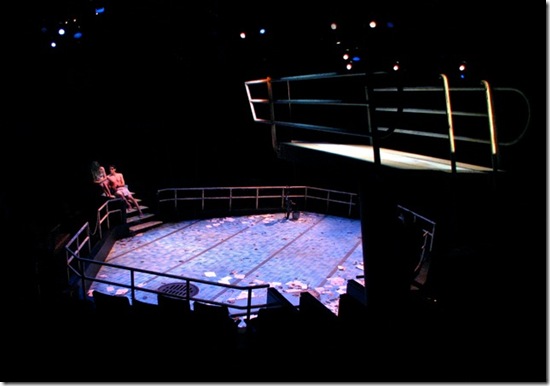
Matthew Smucker’s designs are enjoyed throughout Seattle, in all three of the Big Houses, plus that bigger than big ‘un, The 5th Avenue, where he recently designed the set for Candide). However, his work is not limited to those venerable institutions. New Century Theatre’s production of Orange Flower Water and Book-It Rep’s Night Flight benefited from his designs. I particularly enjoyed his design for ACT’s production of Sarah Ruhl’s Eurydice, even though I do not care for the play itself, a prime example of American theatre’s current scourge: plays for, by and about Upper Westsiders. Smucker’s diving board, however, so grittily realistic, soared to the mythological as it simultaneously evoked aspiration and menace. It almost single-handedly salvaged the evening for me. Such is the power of powerful design. For his consistently outstanding work, Smucker has won a Seattle Times Footlight Award and has been named one of “Seattle’s Best” by The Seattle Weekly.
MULLIN: How do you feel about the proscenium stage? Do you enjoy designing for it? Why? If not, why not? Are there other plans you enjoy more?
SMUCKER: First off, let me say that I do very much enjoy designing for a proscenium. It’s great for big epic stage pictures, deep pictorial space and your classic bits theatrical trickery. That said, I would be very disappointed if that was the only type of venue I got to work in. (Fortunately, it’s not.) If I had to pick my favorite venue configuration, I’d have to say I’m kinda a sucker for theatre in the round. The Seattle venue where I think I’ve had my greatest personal artistic success is ACT’s arena space. I love the intimacy. I love the paradox of “real” sculptural staging in the patently “unreal” environment of visible viewers. (Of course this unreality is a part of all theatre by definition… suspension of disbelief blah blah, but arena staging tackles this tension head-on by being more real and more fake simultaneously.) I love that any play conceived by a playwright for a proscenium instantly becomes similar to staging a new play because precedents are thrown out the window. One has to re-conceptualize all the rote proscenium-based stage directions (as it seems like 95% of scripts get wrought with the proscenium in mind) and re-invent them for a very different way of making stage pictures.
The proscenium is the classic form of 18th and 19th century theatre. The specific relationship between audience and performer in a proscenium has long since been co-opted and improved on by cinema, by television, by videogame. You look through the magic rectangle and see a simulated reality on the other side. One is distanced and divided from that performance by the proscenium’s formality.
There can be a real sameness to proscenium houses, and therefore a default type of problem solving. This leads to a sameness in the designer’s responses to it, as well as the director’s and actor’s choices in it. This sameness works in the favor of the big ol’ national tour and the special event that doesn’t rely on a response to location, but it eliminates the quirkiness of unique local environments. The quirkier the theatre-space, the more responsive the design needs to be, and the more innovative and “local” the results will become.
SMOOT: I prefer the proscenium. It is really an iconic model. It sets up the “I’m about to see a play” feeling in an audience member. I also feel that sometimes in theater people are always looking for novelty. And that alone doesn’t make a play better. I think sometimes being clever can steal the focus. If some things stay traditional, it is easier to pick moments to really make a production sing. It is easier to break the rules if they are known to most of the audience. It is also a little more controlled. That is really my own preference. I have seen great and terrible shows in all forms of staging.
LILIENTHAL: The proscenium stage is a double edged sword. It is one of the most classically formal theatrical spaces, and is both limiting and freeing in its organization. I tend not to prefer designing on this type of stage as I am more interested as a designer in including the audience in the environment I am creating rather than creating a window for them to view something in. However it is very easy to create illusion in this kind of space. My preference is a open black box theater with movable seating. This kind of arrangement allows me to create multiple relationships with the space to the audience members and allows for a completely inclusive environment. It is also the least theatrical arrangement of space which I find is helpful in allowing people to relax their predisposed inhibitions and expectations to the theater experience.
I was first introduced to Etta Lilienthal’s work when she agreed to join an already underway production team for the world premiere of The Ten Thousand Things at Washington Ensemble Theatre. It turned out that her style, both personally and artistically, was so categorically different from mine that she was able to create a world—more accurately, a “multi-verse”— for the play that went light-years beyond anything I could possibly envision. For me this is the crucial essence of playwright/designer collaboration. Good designers are inspired by playwrights. Great designers turn that equation around, and inspire good plays toward greatness.
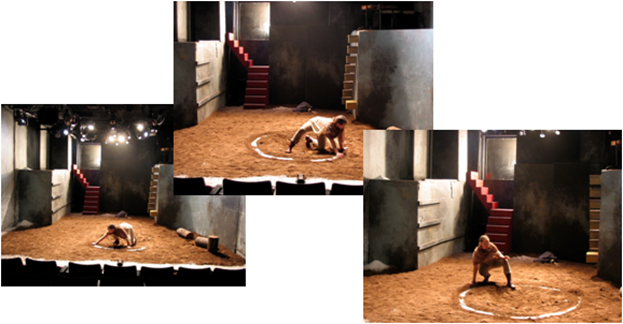
What I loved best about Etta’s set was its permeability into the audience’s world, not just in the obvious example, pictured above, wherein Yew (as played by Elise Hunt) draws a circle of enchantment in the actual peat, (the reach aroma of which pervaded the entire theatre) but also more nuanced effects, like the changing natural light in the back window, which opened out onto the sky above the alley behind the Little Theatre, creating a subtle effect during the beginning of the show as the midsummer twilight faded, but also another mind-blowing surprise at the end, when Yew finally finds what she’s looking for.
For more on Etta’s work and bio, you can check out her site here.
MULLIN: If someone told you big money was being raised for a medium sized space in Seattle, what would you suggest we build and why?
SMUCKER: Build a large scale flexible blackbox space with easily reconfigurable seating. Remake a found space that oozes character, keeping that character intact. Don’t flatten out the quirkiness when turning it into a performance venue. Give it a fully trapped floor with deep traproom. Give it a decent flyspace and hanging points above the lighting grid. Make the relationship between audience and performer a required choice, not a default.
SMOOT: I think flexibility is a good thing and serves the most interests. Simple things like: no columns in the middle of the stage, cross around opportunities, high ceilings for at least two levels and lighting, bathrooms that aren’t onstage. Good acoustics, big enough doors to actually load a set in… That sort of thing. Also the size is important. I know budgets need to be met, but a crowded house is always better than a vast empty one. Location is really important. It’s nice to have a theatre where there’s a pedestrian environment already. It might be cool to have it in an airplane hanger somewhere, but it’s nice to have it where there’s a restaurant, all those things that aren’t necessary but do make it easier for people to get there and want to be.
LILIENTHAL: Going further with my response above, my suggestion for a new space would be a multi-space black box theater, similar to the REDCAT Theater that was recently built in LA for CalArts theatre students to design in the city proper. I believe this kind of architecture and the creative use of space it elicits is the new future of theater. For a design team and a director to be able to choose where and how the audience is viewing the work is the last layer of the theatrical experience that is hardly ever utilized. Therefore movable seating, a flexible lighting grid & high ceiling, a trapped floor, and a balcony surround are the elements key in the new theater space I would design for Seattle.
Gary Smoot and I began our designer/playwright relationship after having been friends already for at least half a decade. I consider it a horror of history that I cannot show you the design idea that I think most epitomizes his work. It was for my play An American book of the dead – The Game Show. We needed three iso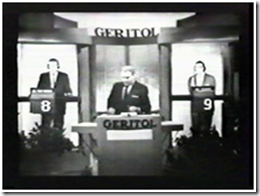 lation booths for the afterlife contestants. I wanted something straightforward and on the nose, similar to the glass boxes they used in the 1950’s t.v. gameshow Twenty-One. Naturally, Gary zagged off my zig. After storming through a lot of tentative ideas, including bubble packs for life-sized action heroes, file cabinets and morgue drawers, he finally landed on simple genius; and of course had the skill and the luck to bring it together: three identical, perfectly white refrigerators, with plastic magnet letters to spell out each enclosed contestant’s name. When the intense gelled Fresnels were focused on them, the white surface utterly transformed into whatever deeply saturated color the lighting designer chose to call up. The actor “contestants” blithely climbed in and out, emerging unexpectedly from one after entering another, like so many peas in a karmic shell game. For the audience the layers of meaning dawned almost imperceptibly but no less forcefully for that: the three fridges were consumption, comfort, death and banality all rolled together in a uniquely American triptych icon; but even as they were evoking these ideas, it was also bluntly obvious that they were nothing more nor less than refrigerators, or isolation booths, or maybe some vast gentle joke played on everyone from patron to playwright. When Gary’s designing, the sense of play never leaves the play, even if the play involves death at its very core.
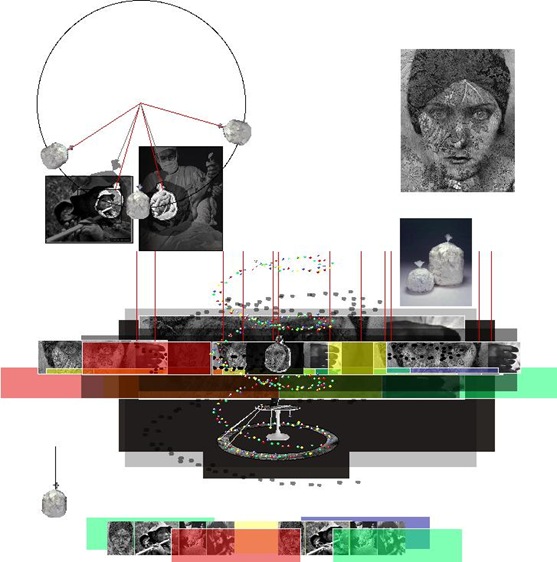
Apparently all design photos from the world premiere of An American Book of the Dead – The Game Show are lost, proving that even the most brilliant designer can prove himself a piss-poor archivist. Since I cannot give you those fridges, I will give you something completely Smootly different. Not a design by Gary, but a fever dream. During the ramp up to the premiere of The Sequence at the Theatre @ Boston Court, Gary would send me these collages like scraps tossed to starving dog, teasers to give me some idea of how he was lining up to attack. Call it an extended enlightened short hand he developed for allaying my anxieties. By showing me images like this, he not so much indicated what the set will look like— Gary’s sets do not customarily look like anything so much as they behave—but rather what it would feel like to watch the show.
I came to playwriting as an actor, and so sometimes I too easily shrug off the actor’s gift. Partly that is due to a deep-rooted belief that we show people praise ourselves at our peril, but I know I should try to be more respectful. Only actors outrank playwrights in the seniority of the theatrical tradition. Directors did not come into existence until the 19th Century. Artistic directors not until the 20th. When it comes to designers, however, I doubt I will ever overcome my awe for the artists who can translate from their vision what I literally cannot even begin to imagine. People often ask me, “What did you picture in your head when you wrote this scene?” thus forcing me again and again to sheepishly admit, “I don’t picture anything. I just hear it. I leave the picturing to my betters.” I am blessed– we are all blessed– to have these three working in our world and doing the heavy lifting of our dreaming.