Just Wrought

Recovering playwright, once won a STRANGER Genius Award for theater. Now writing a bloated novel about… G-d help me! Theatre.

  • Notes from a Pure Success

    This past Monday night the Sandbox Artists Collective held its Spring Salon, An Ensemble Playground, with member actors reading short plays that member playwrights had written specifically for them, with an added twist that each playwright had to use seven of ten words assigned by another participating playwright.  I know that the trope “honor and pleasure” gets thrown around a lot, but in this case, my experience of being the member sponsor for this salon was unequivocally both, and you can add “thrill” and a “joy” to the mix, since the whole process reminded me a bit of childhood Christmases, when making presents ran a close second to the fun of opening them.

    I jotted some notes which I share with you here, mostly roughhewn:

    Preshow

    • People are wandering in, enjoying the food, wine and cookies.  Some Sandboxers, but other folks too, including– god help us all!– young people interested in fresh and locally grown plays.
    • 7:10, everyone is still eating, drinking, chatting, playing pinball machines and getting to know one another, which was the primary intent of this salon so I’m reluctant to get things started.

    Play One

    • Anita Montgomery’s  “The Ties that Bind”
    • Early it dawns that Leslie Law and Peter Dylan O’Connor are playing sister and brother, and it’s perfect.  Not only do they convincingly look the parts but their interaction is laced with that particular pain that only a brother and sister grown apart suffer.
    • Is this great acting, great writing, great casting?  Well, the writing essentially is the casting, so . . .
    • Fold in Dave Natale as the palpably estranged  step-brother, again pitch perfect, and the brilliance builds, blissfully untraceable to any single artist in the process, the way great theatre should be?

    Play Two

    • Ki Gottberg’s “Felt”
    • Leaps straightaway from the precipice of “qualia” one of Ki’s ten assigned words (by me: full disclosure).
    • Richard Ziman, gamely filling in for Shawn Belyea, plays a lovable pompous philandering pendant, bookended by his wife (Tracy Hyland) and his young lover (Renata Friedman).
    • Again the voices are pitch perfect.  Even the silences with which both Tracey and Renata charge the beginning of the piece seem written particularly for them. 
    • Ki writes four roles actually, gamely making full thematic use of the yet-to-be born Hyland baby Tracy so gracefully carries.
    • The arc of the piece, launching in absurdist comic verbosity gently lofts into a bitter-sweeter, clearer atmosphere and touches down so gently in shared humanity.  Maybe we can share our experiences, our “qualia”.
    • So exciting to see another playwright attack a subject I have longed to approach and do it so differently and successfully. 

    Play Three

    • “The Eulogy” by Elizabeth Heffron
    • Immediately we know that Mik Kuhlman, Lori Larsen and Seanjohn Walsh are siblings.  Siblings again! and also death, as they’re at a funeral: Anita’s characters were at a viewing.
    • Elizabeth clearly knows each of her actors so well that she can trust them with just enough dialogue to nail the moment without overdrawing it.   
    • The local references to a Ballard and a sex besotted Scandinavian parking lot king has the audience eating out of the palm of Elizabeth hands.  They can taste freshness, like eating a salmon they just watched being pulled out of the locks.

    Play Four

    • “Satsuma” by me, featuring Rik Deskin and Gin Hammond. 
    • Again the performers find their characters’ voices like virtuoso’s picking up their favorite fiddle
    • And  again, it’s siblings.  What’s with the synchronicity?  Is it that many of us in the Sandbox have known each other for so long that we see each other as brothers and sisters?  Or is it, like Lori Larsen suggests in the talkback, just some Jungian archetype that happens to  be floating for the moment in the collective ether.  Either way, it seems like a phenomenon uniquely connected to the immediacy of the work.

    Afterwards, we all agree we have to do something like this again.  The theatrical potentialities unleashed in the fusion of local playwrights with local actors with local audiences are just too powerful to ignore or leave untapped.   I know the Big Houses are busy staying alive, but they need to ask themselves why they are not more actively engaged in this uniquely fertile process.  There’s surviving and then there’s thriving, and Monday night felt like the latter to me. 

    And not just me.  Every person in that room felt it. That’s the singular beauty of theatre.  At its best, there’s nothing singular about it.

  • Congratulations, Jerry!

    Jerry has said often, publicly and privately, that if he landed the job of Artistic Director permanently–instead of on an interim basis, which is how he has held it the past two seasons–  he would fully engage bringing locally grown new plays to the fore at the Rep, and thus help move Seattle theatre towards world class. We happy Northwest playwrights expect he will be as good as his word.
  • The Colbert Nation Meets The 10,000 Things

    The Colbert Nation Meets The 10,000 Things

          Stewart Brand was on The Colbert Report last night, mostly talking about his conversion to the notion that nuclear energy is a viable option for getting human beings out of the current environmental/energy crisis; but at ~4:30 in the time code Colbert asks him about the Clock of the Long Now.

    The Colbert Report Mon – Thurs 11:30pm / 10:30c
    Stewart Brand
    www.colbertnation.com
    Colbert Report Full Episodes Political Humor Fox News

          I first met Stewart Brand at the Exploratorium in San Francisco, after a staged reading of my play The Sequence produced by the Magic Theatre.  To my later shame I had no idea that this was the founding publisher of The Whole Earth Catalogue and the originator of one of the first and most famous electronic bulletin boards, the WELL.  My friend and mentor Richard Rhodes introduced us, we chatted briefly about my play , then Stewart handed me his card and informed me he was building a clock in the desert that will keep time for ten thousand years. 

    People say a lot of strange things to me after readings, but this rated easily in the top ten.  I went home to Seattle, ordered his book The Clock Of The Long Now: Time And Responsibility from the library and proceeded to learn more about this project.  By the time I had finished reading I was hooked.
          The brainchild of Brand, composer Brian Eno, and supercomputer inventor, Daniel Hillis, The Clock of the Long Now is intended to provide a counterpoint to today’s “faster/cheaper” mind set, promoting instead “slower/better” thinking by keeping accurate time for 10,000 years: ticking once a year, booming once a century and “cuckooing” every thousand years.  The very act of contemplating how to design, build and maintain such a device forces everyone involved to re-think their relationships to time, technology, community, culture and the planet.  How should the clock operate given its unprecedented life-span for a machine?  What should its power source be?  Should it be located far enough from the mainstream of civilization to avoid any possible concomitant destruction, or close enough to allow its significance to be absorbed by normal people?  Should the clock require “winding”, or should it be able to hum along through the millennia with no need for human interaction at all?  These questions and many others are only just beginning to be wrestled with, as the full-sized clock’s construction has not yet begun.
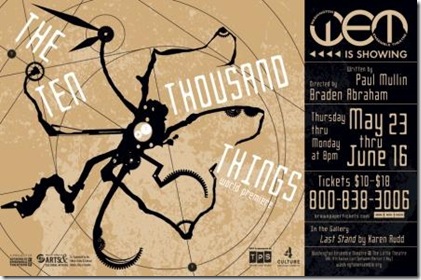
          Soon after reading his book I contacted Brand and offered my services as a playwright, explaining that theatre, while ostensibly foundering in today’s high-tech culture, is nevertheless one of humanity’s most robust and enduring art forms: perfect for accompanying a clock through the millennia– introducing and illuminating “deep time” ideas to audiences, while also evolving itself through the epochal duration.  Brand and his fellow Long Now board members decided my proposal had merit, and charged me with assembling the wherewithal and funds to conceive, draft and produce such a play.  In other words, they loved the idea, but were not about to draw precious resources away from the Clock’s construction.  Eventually I landed a grant from the City of Seattle and Washington Ensemble Theatre offered to produce the play based on some early pages.  In May of 02008 the first 19 ticks of The Ten Thousand Things were performed. (You can learn more about The Ten Thousand Things, and even purchase a digital copy of Tick 19 here.)

    TTKpost WEB size80KB
          To follow is a short excerpt.  I will buy a drink for the first person to spot one of the “ticks”.  There’s at least one in there.  Maybe more.  (WET production members are ineligible, though heck, I’d happily buy any of youz guys a drink, too.)

    * * *
    PLAYWRIGHT:  People have been predicting the imminent end of the world since the beginning of the world.

    PRODUCER:  I’m not just people.  I’ve made a few fortunes predicting stuff.   Trust me: we’re toast. a few decades tops.

    PLAYWRIGHT:  I can imagine even you being wrong now and then.

    PRODUCER:  You’re right.   Assume I’m wrong.  Tell me about your play.

    PLAYWRIGHT:  Forget it.

    PRODUCER:  No, really.

    PLAYWRIGHT:  No, really, forget it.

    PRODUCER:  Stop.  I wanna know.  I really am asking nicely.

    PLAYWRIGHT:  Are you?
          It’ll be a clock.

    PRODUCER:  What?  The play?

    PLAYWRIGHT:  Yes.

    PRODUCER:  The play will be a clock.

    PLAYWRIGHT:  Yes.  From the beginning I’ve known that the play has to change though the ages like the clock.  It can’t just stay still, frozen in time while the clock ticks on; but how does the play change?  At first I thought it changed with time.

    PRODUCER:  Isn’t that how all things change?

    PLAYWRIGHT:  Well, yes, but hear me out.  At first I thought it changed in ordinary time, time like a clock keeps, ticking like a clock ticks..

    PRODUCER:  Okay.

    PLAYWRIGHT:  But after a lot of false starts and blind alleys I’ve come to realize that the play has to keep time like only a play would or could.

    PRODUCER:  And how is that?

    PLAYWRIGHT:  It has to keep theatric time.

    PRODUCER:  And what is that?

    PLAYWRIGHT:  Well, in the theatre, time only passes in front of the audience.  No audience, no time.  So I decided a very simple solution.  The play ticks once a performance.

    PRODUCER:  It ticks.

    PLAYWRIGHT:  Yes.

    PRODUCER:  Explain that please.

    PLAYWRIGHT:  It ticks a word.

    PRODUCER:  It ticks… a word. 

    PLAYWRIGHT:  Right, and if, say, the play were exactly ten thousand words–

    PRODUCER:  Sounds long.

    PLAYWRIGHT:  Actually it’s only like a third of Hamlet.

    PRODUCER:  Okay–

    PLAYWRIGHT:  And a single word changes every time it’s done, then the theatric clock ticks ten thousand times, just like the actual clock chimes once a year.

    PRODUCER:  Okay.  And who changes the word?

    PLAYWRIGHT:  Anyone.

    PRODUCER:  Anyone?

    PLAYWRIGHT:  Except me.

    PRODUCER:  Anyone except you?

    PLAYWRIGHT:  That’s right.  An actor, the middle, an audience member, the light board operator– I don’t care– anyone.

    PRODUCER:  Except you.

    PLAYWRIGHT:  Except me.

    PRODUCER:  Why except you?  You wrote it.

    PLAYWRIGHT:  That’s the beauty.

    PRODUCER:  I’ve seen prettier.

    PLAYWRIGHT:  What?  It’s perfect.  Something will happen.  Then something different.  For a little while I’ll even get to watch, maybe.  Who could ask for more?

    PRODUCER:  You’re willing to just hand over a huge amount of your work to someone, everyone, else to change. 

    PLAYWRIGHT:  That’s basically what playwrights do anyway.

    PRODUCER:  More’s the pity.  They’ll obliterate you.

    PLAYWRIGHT:  It’s only one word at time.

    PRODUCER:  Yeah, like Chinese water torture, they’ll take you apart.

    PLAYWRIGHT:  I’m hoping they won’t.

    PRODUCER:  But they will.  That’s what actors, bananas, audience members, board ops, other people do.  Trust me. 

    PLAYWRIGHT:  Stop saying “trust me.”  It’s a bully’s trope. 

    PRODUCER:  Okay, let me ask you this: what happens if some one comes along and purposefully tries to ruin your play?

    PLAYWRIGHT:  You know? I think I might want them to purposefully try and ruin my play.

    PRODUCER:  All right.  What if– worse– they make mundane, meaningless changes, simply for the sake of honoring your demand that they change it?

    PLAYWRIGHT:  I think I want them to do that too.

    PRODUCER:  What if they wind up not caring at all?

    PLAYWRIGHT:  And that would be so different from now how?

  • The Sandbox Artists Collective’s First Ever Ensemble Playground Salon!

    THE PROBLEM

    Of all the excellent points and counterpoints made in recent discussions about how new work is suffering in the American theatre, perhaps the one that hits hardest home for me is that playwrights have generally drifted away from writing for a specific ensemble.  I know I have been guilty of this sin; knowing even as I committed it that the scripts which I have written for specific actors have been some of my most artistically satisfying as well as popular among audiences.  Local work means local actors, and playwrights need to form better connections with the talent that surrounds them in the city they call home.

    ONE SOLUTION

    The Sandbox Artists Collective has dedicated its Spring Salon to an experiment wherein member playwrights write material with specific member actors in mind.

    WHAT?  HOW?

    On April 10 at the Elysian brew pub, five Sandbox playwrights (or their proxies) drew names from an envelope containing 15 Sandbox actors.  Over the course of a month, the playwrights personally and individually met with each of actors we drew.  We then wrote 10 – 25 pages of brand new material specifically for our selected actors. These pages will be read publicly at the Sandbox’s Spring Salon.

    THE TWIST

    Each of the playwrights gave another writer a list of ten words, seven of which they were obliged to include in their script.  (For instance, Anita Montgomery gave me “magic”, “earthquake”, “bat-shit”, “circumcision”, “pilates”, “semi-sweet”, “funk”, “solipsistic”, “satsuma”, and “largesse”.  Hell, those constitute a play in themselves!)

    WHO

    The Sandbox playwrights involved are Ki Gottberg, Elizabeth Heffron, Anita Montgomery, Paul Mullin and John Paulsen.  The Sandbox actors involved are Shawn Belyea, Rik Deskin, Renata Friedman, Gin Hammond, Tracy Hyland, Mik Kuhlman, Leslie Law, Lori Larsen, Todd Jefferson Moore, Paul Mullin Dave Natale, Peter Dylan O’Conner and Seanjohn Walsh.

    WHERE

    The Sandbox Salon 2010 Spring Salon will take place at the THE STUDIO @ 15 MCGRAW, 15 McGraw Street, Seattle WA 98109, on the top of Queen Anne Hill.

    WHEN

    Monday, May 10 at 7PM. 

    HOW MUCH

    Admission is free, though we may beg you for a $5 suggested donation to help bring you innovative Sandbox Projects like this in the future.

  • Recent bit on KUOW about art & the day job: http://tinyurl.com/29qhcxu Clever editing again making me sound smarter than I deserve to.

  • I think this means I’m going to be on KUOW tomorrow between 12-2 pm.

    But more when I know more.

    And I didn’t even pay for it!  How old fashioned is that?

  • As Predicted, the Spin Begins . . .

    . . . and I could’ve predicted the source of this first spin too, had I really cared to.

    http://slog.thestranger.com/slog/archives/2010/04/29/pay-for-play-the-response

  • The Seattle Rep and the Fifth Avenue Take a Walk on the Sleazy Side

    I will be honest: although I always hope for the best, I never really expected the Big Houses here in Seattle to have some sort of Road-to-Damascus conversion and start doing the right thing. I always assumed they would continue to offer safe and staid programming and promote it with safe and staid marketing techniques.  So when I read in this week’s Stranger that the Fifth Avenue was paying for coverage on KING 5 TV’S New Day Northwest without making it plain that the coverage was sponsored, I was actually genuinely shocked.  And I have to confess, it gave me a bit of pleasure, because I honestly did not think that, given their tepid programming, the Big Houses could ever possibly shock me again.

    Folks, this story will get spun by the culpable spinners.  Those of us who are appalled by this supremely less than ethical behavior will be branded as naïve and bitter; but this is exactly the sort of thing the Bush Administration tried to pull. 

    …the White House, … spent taxpayer money to produce local TV-news segments advocating policies of the Bush administration. The Government Accountability Office condemned these paid-for “news” segments as “covert propaganda,” but the White House instructed agencies to ignore the GAO findings.

    “As a former journalist, I’m horrified to be compared with the Bush administration,” Larson said. “This isn’t a news program—it’s an entertainment program.”

    If the Rep and the Fifth cannot see what they did was wrong, then they have no business offering us art that purports to be honest, edgy, and untainted by corporate equivocation.

    ***

    PS:  Brendan Kiley suggests here that all the Big Houses, plus the little ones like WET, too,  owe him back pay for covering them, but I would further suggest that NewsWrights United covered the Seattle theatre press in last fall’s It’s Not in the P-I: A Living Newspaper about a Dying Newspaper, so perhaps they in turn owe us a little som’n-som’n.  Granted, I wrote about Misha Berson and Joe Adcock. (You can watch the video here. ) and left out  Kiley, because, let’s face it, he’s just too boring.  But Brendan?  If you’re willing to make me an offer I’ll happily write a play about how you wrote an article about how the Fifth bought buzz and convinced the Rep to join their ethically dubious enterprise, for what I can only imagine was what they saw as the high-ground cover the Rep could offer them if the shit hit (which it did).  Forget cover, Big Houses.  Your cover is blown.  Get started living right, or get started dying.  There are no longer any in-betweens.

    PPS:  A year and a half a go The Stranger gave me a hunk of change for being a “Genius”.  Obviously, this is a bogus award, the sole purpose of which was to get me to push traffic over to their website.  So go, damn you, go!  I don’t want them asking for their money back!

    PPPS:  I hate loving The Stranger, but given the connect-the-dots drawing of Mohammad they ran on the front of this issue, how can I help my damned self.

  • Jose Amador and a Damned Good Argument for the Solo Show

    Jose Amador and a Damned Good Argument for the Solo Show

    It’s a strange and wonderful world.  The very day I post my screed on solo shows and how Seattle’s Big Houses are leaning too heavily on them, my good friend and colleague publishes a completely different point of view on why the solo show serves a vital purpose in his creative life, and in the larger creative life of our theatre community.

    http://thesunbreak.com/2010/04/27/jos-amador-on-solo-performance-and-being-an-ethnic-theatre-artist-in-seattle

    Go see this show.  Lord knows, for all my bitching, I’ll sure as hell be there.  I’m thinking of going next Wednesday.  If you go that night and can prove you paid full price to get in, I’ll buy you a drink.

    Jose Amador, people!  One more reason Seattle is already World Class!

  • The Solo Show: A Risk Averse Artistic Administrator’s Best Friend

    The Solo Show: A Risk Averse Artistic Administrator’s Best Friend

    The fourth in a series of essays entitled: 
    Towards a World Class Theatre

    Some fifteen years ago Dawson Nichols and I were having lunch at a long gone Japanese noodle house on Broadway when he asked me an awkward question that I will now try to do a better job of answering.  Back then we were not the close friends and collaborators we are now—more like respectful but wary competitors for the title of AHA! Theatre’s Golden Boy.  Dawson had a much better line of attack on the prize, because while we both wrote strong multi-actor plays, Dawson also amazed us all with his impressively diverse catalogue of one-man shows, including Stop/Start, Virtual Solitaire, I Might be Edgar Allen Poe and Three Descents of Darwin.  I have always been captivated by Dawson’s one-person work. 

    I have also always had my theoretical reservations about the genre, as Dawson must have suspected that day over yakisoba when he challenged me squarely, “You don’t think my solo work is theatre, do you?”  I must have made a weak apologetic smile. I must have hemmed and hawed. I think I finally answered, “Strictly speaking, no, but—“ and then went on to make some half-lame explication, but the look on Dawson’s face showed it all: hurt and disbelief at my dismissive arrogance, even as I tried to explain how much I respected him as a generative and performing artist.

    So perhaps now, with my friendship with Dawson a little more secure (I hope), it is time to make that earlier explication sharper, and then explore that explication’s implications within our regional theatre administrator’s collective half-conscious effort to re-forge by fudging a new definition of the art form and thus raise the number of one-person shows they can get away with and still claim that they are practicing theatre.

    Before writing this I decided to do a little research by reaching out to my compadres over at 14/48 via Facebook:

    Paul Mullin

    April 9 at 3:32pm

    Hello lovers!

    Any and/or all of you can answer. And yes, I’m going to quote you in my blog. I’m working on an essay about one-person shows. And my question is this: “Why don’t you ever have the option of drawing just one actor in the actor draw? Are there any other reasons beyond the fact that that poor schlump would have to memorize too much?”

    Let me know.

    Love,

    Paulie

    clip_image001[4]

    Shawn Belyea

    April 10, 2010 at 3:56pm

    Re: Question for the 14/48 Crew

    Cuz one-person shows are dumb. Mostly it’s memorization and it’s supposed to be a collaborative effort so we want actors to have some company.

    clip_image001[6]

    Jodi-Paul Sanford Brown-Wooster

    April 11 at 1:06am

    I hate one person shows. And yes, I’m looking at you Lauren. There is no intrinsic dramatic tension with one person, it’s fakey.

    clip_image001[8]

    Peter Dylan O’Connor

    April 11 at 3:52p

    One person shows are fucking glorified camp fire stories…

    clip_image001[10]

    Matthew Richter

    April 11 at 8:33pm

    i love one-person shows. and i think they’re an interesting challenge for 14.48.

    but i’m retired.

    xom

    If you seek consensus, you would be wise not to consult the prophets of 14/48.  Once again, I am left to my own opinions and devices.  I proceed with that caution for you, my gentle reader.

    Basically, solo shows boil down into two kinds: the actor’s tour de force and the enlarged lecture.  Dawson Nichols shares the first tradition with Anna Deavere Smith, Chazz Palminteri and countless other talented writer/actors, who generate shows that then require them to become all of the characters on stage, even at times performing both sides of multi-sided dialogue.  Over the last few decades, it has become an increasingly effective way of growing an actor’s career.  Palminteri literally leveraged himself into playing the principal role, Sonny, in Robert DeNiro’s directorial debut film A Bronx Tale, which began as Palminteri’s one-man show of the same name.  As Rik Deskin, Aristic Director of The Eclectic Theatre points out, “When you’re self-producing/self-promoting, a solo show is one way to get yourself out there.”

    My friend and comrade-at-arms, Mike Daisey, presents from the lecturer tradition, most recently reinvigorated by Spalding Gray, but one which runs the gamut, in just this country alone, from Jonathan Edwards to Mark Twain and right on up to David Sedaris and Sarah Vowell.  This kind of show employs more direct address, less actorly technique.  Instead of primarily inhabiting other characters, the lecturer’s own personality ties the evening together.  In the hands of a Daisy or Sedaris it can be hugely fun, funny and compelling, but no one plying the trade 130 years ago would have thought of calling themselves a theatre artist, even if a particular night’s performance happened to take place in a theater—unlikely in that age, since theaters were rarely dark and there was a plentitude of active churches, as well as all sorts of lecture halls specifically built for this purpose.  As different as these two kinds of solo show are, and as much as it seems the Nichols / Deveare Smith variety is much closer to theatre as we know it, they both represent variations of the much older, and completely honorable tradition of story telling.

    Theatre, however, is something really quite different.  It happens in the preternaturally galvanized space between two or more people on stage and the other people in the audience.  It sprang forth from its older sibling, storytelling, in that radical moment when the teller pointed at someone in the campfire circle and said:  “You be me.  I’ll be the wolf.  We’ll show them how it happens.”  Thus a whole new art form was born.

    As a solo lecturer, Mike Daisey has a point of view.  And a damned good one too.  He makes no bones about telling you what to think.  And if you want my opinion, you should listen to him.  I have a different role as a playwright and a different box of tools.  I can show you things happening, but it is up to you what to make of them.  Theatre is dialogue.  Not as part of the narrative, like in a novel, but as all of the show.  Even if no words are spoken, dramatic action takes place in a framework of implicit dialogue: people doing things to other people. This is why our collective audience hackles go up whenever a narrator starts telling us the story instead of enacting it.  Good playwrights understand this and know how to leverage the discordance of direct address narration (see Shakespeare’s Chorus in Henry V or Wilder’s Stage Manager in Our Town).  Lesser playwrights never seem to learn: you can’t tell an audience anything.  They can only be shown.  They can only ever come to their own conclusion about what is happening.

    Dialogue breeds risk like flowers bloom scent, and risk is the fabric of theatre.  Because two or more people on stage can never know with certainty what an other is about to do, no matter how many times they have done it before, the audience attends the action with a sense of the innate exposure.  “Anything could happen, and we are in the same damned room with these agitated people.”   Risk is not a by-product of drama.  It is the main ingredient.  

    Nothing wrong with masturbation, but everyone knows you cannot tickle yourself.   Likewise, I cannot, as a performer, ever surprise myself to the degree another performer can—arguments about unexpected inspiration notwithstanding.  When there is another actor on stage with me, I have to watch, I have to listen, I have to be wary.  Other actors can push you around, and you can push back.  No one can manufacture this kind of risk in a solo performance, no matter how earnestly the performer tries to convince his corpus callosum  not to tell his left brain what his right plans on doing.   Sure, an actor can mimic dialogue, playing both sides of a conversation, but even at its very best this trick still contains an unconscious but unavoidable note of condescension, like Donald Rumsfeld asking himself ostensibly difficult questions about the Iraq War in a press conference and then answering them with ostensibly matter-of-fact brilliance.  True dialogue adds a crucial dimension which defines theatre, just as surely as the third dimension of physical depth defines sculpture. 

    Theatre also trades on what we show folk loftily refer to as “the willing suspension of disbelief.”  Wikipedia defines this notion as “the willingness of the audience to overlook the limitations of a medium, so that these do not interfere with the acceptance of those premises. According to the theory, suspension of disbelief is a quid pro quo: the audience tacitly agrees to provisionally suspend their judgment in exchange for the promise of entertainment.”  (I should fully disclose here how I hate this term, mostly for its gratuitous gracelessness.  I mean, is the double negative really necessary to nail the point?  What would be wrong with, say, “fabrication of belief?”)  In a solo show disbelief can never be truly suspended.  At best, it can be sent to detention, where it still manages to sulk and grimace and call attention to itself.

    Let me be clear.  By pointing out that one-person shows are not, strictly speaking, theatre, I am in no way trying to denigrate them or argue for their banishment.  It has been a long standing tradition for regional theatres to opt for filling one slot in their season with an easily produced, low-overhead solo show, but indications are rising that Big Houses in this town intend to lean on this option more heavily in the future.  The Seattle Rep recently announced its 2010-2011 season in which they will be offering not one, but two solo shows,  The K of D in the smaller Leo K venue and Mike Daisey’s new piece on their Bagley Wright mainstage (a relatively unheard-of placement of a solo show for them.)  If Daisey does well (and as his friend and colleague, I cannot help but hope he does) you can bet you will be seeing more mainstage solo offerings from the Rep.  It is just too cheap for them not to.  And as long as no one’s complaining that they are not actually doing theatre in their theater, well…

    Meanwhile, next door at the Intiman, they have answered with unblushing cynicism the call for more locally grown new plays by staging The Thin Place which they laud on their website as “the second world premiere by a local writer in Intiman’s history.”  Note the pride with which they admit a fact of which they should rightly be ashamed.  Using a solo show to rectify their abysmal record reveals how little they wish to risk on the attempt.   How quickly will Intiman abandon and distance itself from The Thin Place if it does not do well with critics or audiences?  How likely are they to offer up the now tired Big House refrain when a locally grown piece does not catch fire right away?  “See?  We tried ‘locally grown’.  It just doesn’t work.  Can we please go back to retreading Pinter, Mamet and off-Broadway’s last season?”  Always behind such excuses are obfuscated variables of production and promotion that contribute to a given show’s putative failure but that go unnoticed and unconsidered in public.   In this case,  the crucial factor that will not be mentioned is that The Thin Place is a one-man show, and not, strictly speaking, theatre at all.

    Regional Big Houses defend their solo performance offerings like a richly-endowed sculpture gallery might defend an exhibition of paintings.  “We love sculpture.  And of course we are a sculpture gallery, but sculpture itself is expensive and difficult to maintain.  Instead, why not enjoy some lovely paintings of sculptures?”  Paintings of sculptures can indeed be lovely, but not even an idiot would call them sculptures, any more than Mark Twain would have referred to himself as a theatre artist 130 years ago.  Solo performance billed as theatre is a pig in a poke.  The unpredictability of human beings interacting lies at the heart of what we are selling in the theatre.  We trade it out and bank our future on its diminishment at the very risk of our art form’s soul.

    Next up: “Good Friend for Jesus’ Sake Forbear and Never Build another Proscenium Stage”